



Důl Vojtěch Other
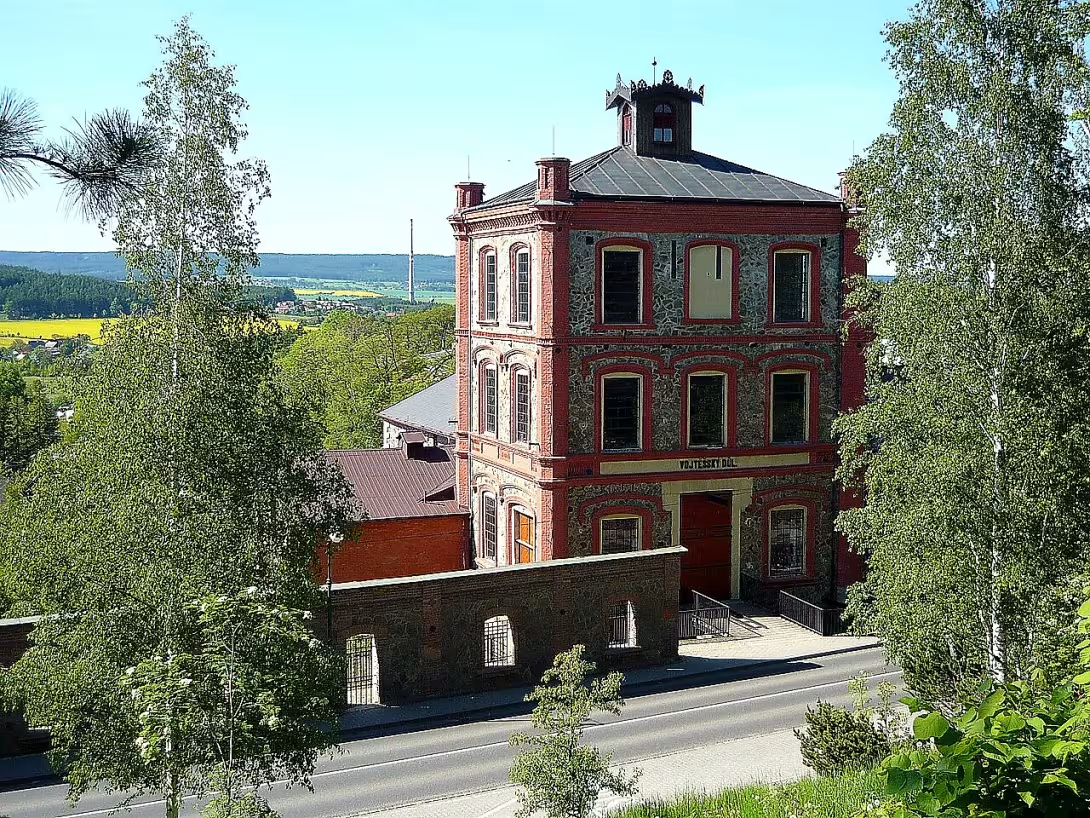
Důl Vojtěch is an unused mining work on the March Mountains in Příbrami. It was one of the most important mines in the March region where silver and lead ore were extracted. Its foundation dates back to 1779 when it was opened by Jan Antonín Alis, which came to Příbrami from Kutná Hora seven years earlier, namely in 1772. When constructing the Vojtěch Alis mine, he used progressive technological solutions - a new system of bearing openings and drainage, just as Anna applied them to existing mines.
Mining in the mine The soldiers were opened in 1779 at the site of the old sinkhole between the mine of Anen and Mariánský. From the beginning the operation was accompanied by technical difficulties. The water wheel for drainage stopped already in 1780 due to water shortages and the mine flooded to the seventh floor. The situation was to be solved by a waterproof machine put into operation in 1782, which however crashed - a hemp rope providing drainage broke after several months. The mine flooded again, this time up to the fourth floor, and ten miners died in this crash.
Although the beginnings of the operation were problematic, the mine achieved remarkable results in the coming decades. In 1875, Důl Vojtěch reached the depth of one kilometre - exactly 1 269.9 meters - and became the first mine in the world to cross this historic border. The mine had 35 floors at the time and the profile of the pit 6 × 3 meters. This world record was later overcome by other tadpoles: a Prokop mine with a depth of 1 579.62 metres and an Anen mine of 1 449.29 metres.
In 1981, Důl Vojtěch was closed and disposed of by filling the stopper at a depth of 40.4 metres. The depth was subsequently covered by concrete panels. Today the mine is managed by the Mining Museum in Příbrami and forms part of its tour area. Visitors can explore underground mines and familiarise themselves with the steam engine of Breitfeld & Danek from 1873 to 1889. In the upper part of the building there is a permanent exhibition of paintings with mining theme of painter Karl Hojden and sculptor Václav Šára. An integral part of the tour is also a renewed 18-century mining forge, which provides live proof of what technological processes and crafts were behind mining in the mining works of the frigate region.
Then and now
Drag the slider to compare how the landmark may have looked when it was built with the view today.
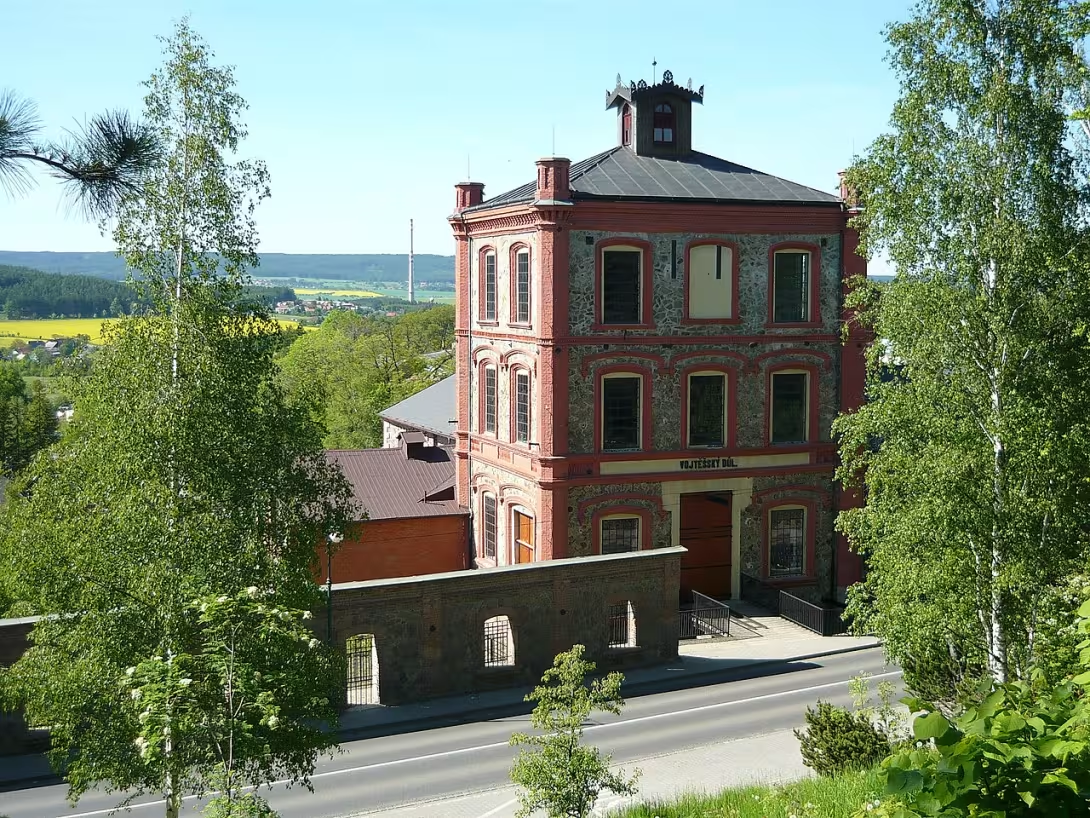

The historical appearance on the left is an AI-generated visualisation and serves as inspiration only.
Historical milestones
- 1875
- The mine reached the depth of one kilometer and became the first mine in the world with this boundary.
Architectural development
The mine was founded in 1779, where Jan Antonín Alis applied a new system for opening the bearing and pumping water. Over the years, the mine was modernised after the mid-19th century, which included buildings such as a shaft building, mining hall, old and new machinery room.
Historical events
- 1779
- The establishment of a mining site by Jan Antonín Alis.
- 1875
- The mine reached the depth of one kilometer and became the first mine in the world with this boundary.
Owners
The ownership of the mine has changed over the years. It was originally founded by Jan Antonín Alis, who was probably behind his development and significance. Further information on ownership changes is not available, but it can be assumed that the mine was managed by various mining companies or organisations.
Points of interest
- Důl Vojtěch was founded in 1779 by Jan Antonín Alis.
- When building the Vojtěch Alis mine, he used progressive technological solutions - a new system of bearing opening and drainage.
- Důl Vojtěch reached the depth of one kilometre (1,269,9 meters) in 1875 and became the first mine in the world to cross this historic border.
- Visitors can explore underground mines and familiarise themselves with the steam engine of Breitfeld & Daněk from 1873 to 1889.
- At the top of the building there is a permanent exhibition of paintings with mining theme of painter Karl Hojden and sculptor Václav Šára.
Guide
This guide is narrated by a synthetic voice generated by artificial intelligence.
Show guide text
This text was created by artificial intelligence and has not been editorially reviewed. It may contain inaccuracies.
The Vojtěch Mine at Březové Hory in Příbram was one of the most important mines in the Březové Hory mining district. Silver and lead ore were extracted here. It went down in the history of mining in 1875, when it became the very first mine in the world to reach a depth of one kilometer.
It was founded by Jan Antonín Alis, who came to Příbram from Kutná Hory in 1772. When building the mine, he used a new system for opening the ore deposit and for pumping water, similar to what had been done earlier at the Anna Mine. The shaft was dug in an old sinkhole between the Anenský and Mariánský mines, and mining began in 1779.
The beginnings were difficult. Dewatering was handled by a water wheel, but in 1780 it stopped due to lack of water, and the mine flooded with water up to the seventh level. In 1782, a water-lifting machine began operating. After a few months, however, the hemp rope on which the shaft dewatering depended snapped. The mine flooded again, this time up to the fourth level, and ten miners died in the accident.
The mine gradually reached a total depth of 1,269.9 meters and had 35 levels. The shaft had a profile of 6 by 3 meters. Later, it was surpassed in depth by two neighboring mines: the Anenský Mine with 1,449.29 meters and 39 levels, and the Prokopský Mine with 1,579.62 meters and 41 levels.
Operations ended in 1981. The shaft was then filled with clay at a depth of 40.4 meters, and the mine head, the upper opening of the shaft, was covered with concrete panels.
Today the mine is managed by the Mining Museum Příbram and is part of its grounds. In the upper part of the building is a permanent exhibition of paintings with mining themes by painter Karel Hojden and sculptor Václav Šáry. The mine also includes its underground chambers and a steam winding engine by the Breitfeld and Daněk company from 1873 to 1889. An interesting feature is a restored mining blacksmith's workshop from the 18th century.
Tips for visitors
The best time to visit the Vojtěch Mine is in spring or autumn, when the weather is pleasant and mild. This time of year offers ideal conditions for exploring historical mining works without extreme sunlight or cold.
We recommend checking the current connections with a traffic search engine for the most economical travel method.
To visit, take with you suitable clothes to protect from possible rain and cold. Traffic boots are recommended for a more comfortable walk through historic mining works.
Photography in the Mine The soldiers will offer interesting options, especially in the early morning or late afternoon when the light is softer. The best places for photos are access to old mining and panoramic places overlooking the surrounding landscape.
In the vicinity of the Vojtěch Mine you can visit the Břežové Hora, where there are several interesting historical sites. For families with children is a walk in the park and the possibility of learning about the history of mining on local information tables.
Frequently asked questions
Can the monument be visited?
We have not verified whether this monument is accessible. Please ask the owner or operator, or the local municipal office.
Where is the monument?
Location: Husova, Příbram VI-Březové Hory, Příbram, Středočeský kraj. The map on this page shows the exact spot.
Why is the monument protected?
It is listed in the Central List of Cultural Monuments of the Czech Republic as a national cultural monument (register no. 35432/2-2844). It is protected as part of a larger listed ensemble.
Businesses nearby
Do you run a restaurant, accommodation, shop, museum, rental, wellness or other visitor service near this monument? Show yourself directly to the people heading to it — this is how they will see you in the app and on the web:
Events nearby

Zdroj akcí: otevřená data měst a obcí ČR (Národní katalog otevřených dat) a kalendář akcí Národního památkového ústavu.
Nearby
Around the mine Vojtěch is located a number of other interesting places and monuments. The church of St. Jacob the Elder, which is an important Baroque building, can be visited directly in Břežové Hora. It is also possible to discover the remains of other mines and shafts that resemble the rich mining history of this area.
Accommodation nearby
Themed route
Route: Důl Vojtěch and surroundings
1. Důl Vojtěch (main objective) - mine, monument to mine tradition, interesting technical monument. 2. March Mountains - a former mining settlement, today a recreational area, the possibility of walking and views. 3. St. John under Skala - hermit, instead of pilgrimage tradition and peace. 4. Church of St. John the Baptist - parish church, important sacral building. 5. Mining Museum Příbram - Museum which represents the history of mining and mining in the region.
Seasonal recommendations
Spring:
In the spring season Důl Vojtěch is surrounded by green and flowers, creating a pleasant atmosphere. It's a good time to walk and take pictures. We recommend visiting the mine in good physical condition because it is necessary to go through vertical stairs and corridors.
Summer:
In summer season Důl Vojtěch is very popular, therefore it is good to come early to avoid large crowds. We recommend visiting the mine in warm clothes because it is warm and the air is full of dust. The best time to visit is in the morning or late afternoon when there are fewer people.
Autumn:
In autumn the Důl Vojtěch is surrounded by beautiful leaf color and it is a good time to walk. We recommend visiting the mine in comfortable clothes because it is cold here.
Winter:
In winter Důl Vojtěch is closed and it is warm. We recommend to visit the mine in warm clothes and shoes with good grip because there are wet and slippery surfaces.
Visualizations and artistic views


The visualisations are generated by artificial intelligence and serve as inspiration.
Photos from the area
Real photos taken near the monument


Zdroj a licence jsou uvedeny u každého snímku.
View from the area
This animation was generated by artificial intelligence from a real photograph of the surroundings. The motion and details are not real footage of the location.
Atmosphere of the place
This atmospheric visualisation of the place and period was generated by artificial intelligence. It is not real footage of the location.
Tips from visitors
No tips yet. Be the first!
Log in and add your tip.
Sources and literature
Photos: Ivo Bešťák / CC BY-SA 3.0 — Wikimedia Commons. The author and licence also appear when you hover over the image.
Faktickým podkladem tohoto textu byl článek na Wikipedii, jehož autory jsou přispěvatelé Wikipedie. Článek je dostupný pod licencí CC BY-SA 4.0.
Location on the map
More monuments – Příbram VI-Březové Hory
Show all in the municipality




Příběhy a pověsti
Legendy, pověsti a příběhy spjaté s touto památkou

Fotografie návštěvníků
Zatím žádné fotografie. Buďte první, kdo přidá fotografii z návštěvy!
Log in a přidejte svou fotografii nebo hodnoťte.
Za ověřenou návštěvu v aplikaci získáte víc bodů — poznáme podle GPS, že jste na místě.
Reviews and comments