



Sbor Mistra Jakoubka ze Stříbra Church
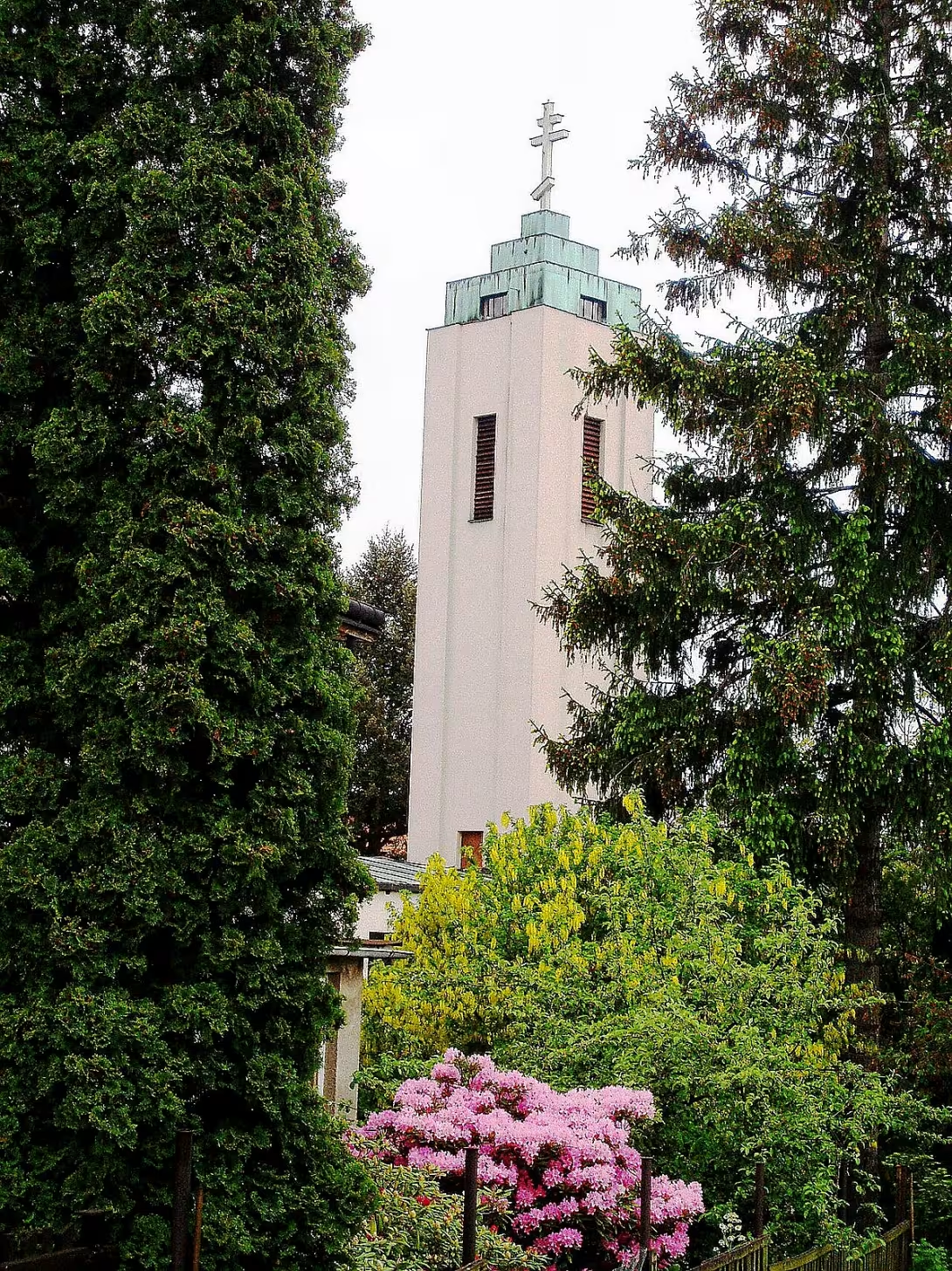
Sbor Mistra Jakoubka ze Stříbra stands in the quiet part of the March Hor in Příbrami VI. It is one of the choirs of the Czechoslovak Hussite Church, built in a characteristic functionalist style. The building was dedicated to the memory of Master Jakoubek of Silver, an important associate of Master Jan Hus and a supporter of the reception of believers in both ways. Professor František Kalous was also the principal spiritual founder of the title.
The building is the work of architect Stanislav Vachata. The construction began with a festive excavation on 11 May 1936. The foundation stones were laid on May 24th, and on July 26th there were three bells from Herold - named Hus, Masaryk and Farsky in honor of the fallen from the First World War. The congregation was consecrated on October 25, 1936 in the presence of the Patriarch of the Church of Czechoslovak Hussite Dr. Gustav Adolf Procházka.
The dominant feature of the building is a white 30-metre tower with a two-arm cross and a view gallery. The inside of the choir is designed as an extended room designed to create a cozy atmosphere. There is a ceremonial space in the facade with a priesthood and a large light cross, which is symbolically based on the cornerstones of Tábor, Silver and the Platoon Vojtěš mine. On the service table there is a candlestick in the form of clenched hands over the mountain of Ríp with the inscription "Prayer for the Fatherland.".
The choir is decorated with rich sculptures by Václav Šára and Václav Antoš. Reliefs show significant moments of Czech history and religion - from Receiving with the cup of Master Jakoubek to Cry of Exulants to White Mountain with Jan Amos Komenský to Joy of Liberation on 28 October 1918 with President Masaryk. In the corners of the choir are three sculptures symbolizing values - Work (miner and legionnaire), Love (student and student from the work of Alois Jiráska) and Freedom (presidents Masaryk and Beneš).
During World War II, two bells (Hus and Masaryk) were seized and destroyed; Only Farsky's bell remains. All sculptures survived without damage. Today, the choir serves not only services, but is also the centre of the cultural and social life of the community. The Chamber Choir of Jakoubci has a repertoire of religious songs. All year round, the church is exposed to a mining nativity and part of the complex is a Colombarium for believers regardless of their original religious beliefs.
Then and now
Drag the slider to compare how the landmark may have looked when it was built with the view today.
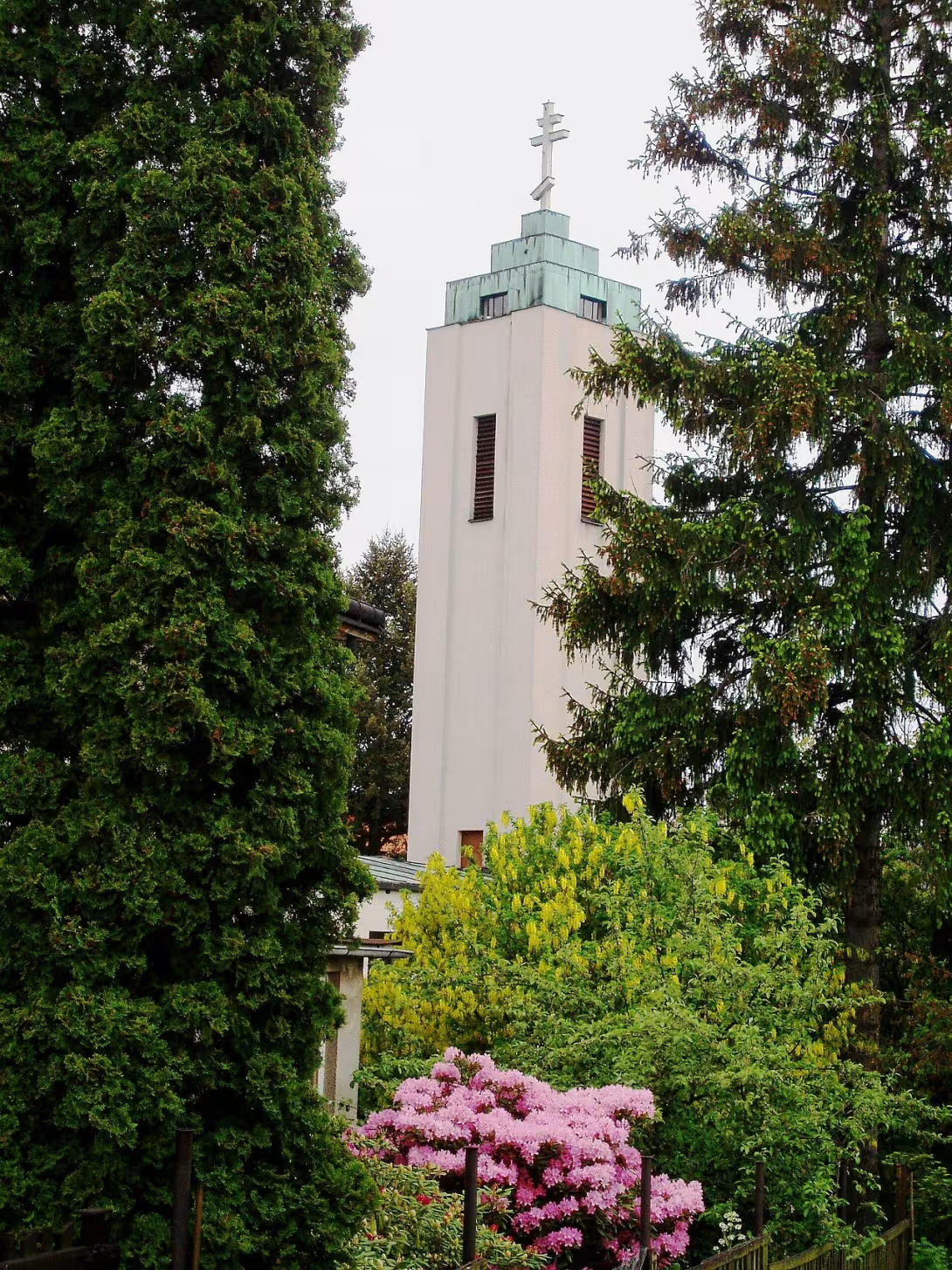

The historical appearance on the left is an AI-generated visualisation and serves as inspiration only.
Historical milestones
- 11 May 1936
- Festive kickoff of the foundation of the congregation
- 24 May 1936
- Festive laying of base stones
- 26 July 1936
- Three bells hanging (Hus, Masaryk, Farsky)
- 25 October 1936
- Opening ceremony in the presence of the Patriarch Dr. Gustav Adolf Walk
Architectural development
The construction was designed in a functionalist and constructive style by architect Stanislav Vachata. The dominant is a white tower with a cross and a gallery with a view. The interior is equipped with symbolic elements such as reliefs and sculptures by Václav Šára and Václav Antoš. The building is built of concrete and stone, with tastefully decorated surroundings.
Historical events
- 1936
- Festive laying of base stones on May 24th and opening of the choir October 25th
- 1936
- Completion of the tower and hanging of three bells (Hus, Masaryk, Farsky)
- 1938
- Confiscation of two Nazi bells during World War II
Owners
Sbor Mistra Jakoubka ze Stříbra
Points of interest
- The choir was built in a functionalist style and dedicated to the memory of Master Jakoubek of Silver, an important Hussite collaborator.
- The construction started on 11 May 1936 and in July of the same year there were already three bells named Hus, Masaryk and Farsky.
- In the facade there is a large light cross symbolically situated on the base stones of Tábor, Silver and the Plábras Vojtěšský mine.
- Sculpture elements from Václav Šár and Václav Antoš depict key moments of Czech history such as Reception with the cup of Master Jakoubek or Joy of Liberation on 28 October 1918.
- During World War II, two bells (Hus and Masaryk) were confiscated and destroyed while the sculptures' elements remained intact.
Guide
This guide is narrated by a synthetic voice generated by artificial intelligence.
Show guide text
This text was created by artificial intelligence and has not been editorially reviewed. It may contain inaccuracies.
The Mistra Jakoubka ze Stříbra Chapel belongs to the Czechoslovak Hussite Church. The functionalist and constructivist building was designed by architect Stanislav Vachata. It stands in the quiet part of Březové Hory, surrounded by tall trees.
The name commemorates a collaborator and successor of Master Jan Hus, who promoted receiving communion in both kinds, that is, with bread and wine. The naming was suggested by Professor František Kalous, the first clergyman of this chapel, who greatly contributed to the construction of the church as well.
The building was constructed quickly. The foundations began being dug on May 11th, 1936, and the foundation stones were laid on May 24th. Already on July 26th, three bells from the Herold company rang for the first time, named Hus, Masaryk, and Farský. They were dedicated to those who fell in the First World War. The dominant feature is a white thirty-meter tower with a double-armed cross and a viewing gallery, completed in September. The chapel was solemnly opened on October 25th, 1936 in the presence of Patriarch Gustav Adolf Procházka. During the Second World War, the Nazis confiscated the Hus and Masaryk bells for the weapons industry and destroyed them. Only the Farský bell has served until today.
In the chancel is a large luminous cross. It rests on stones from the Hussite Tábor, from the upper town of Stříbra, and from the Vojtěšský mine in Příbram, where the stone was extracted from a depth of 1000 meters. On the altar stands a candelabra in the form of clasped hands above Říp mountain with the inscription Prayer for our homeland.
On the sides of the chancel are reliefs by sculptor Václav Šáry. One depicts Master Jakoubka receiving communion with the chalice, the other the Last Supper with likenesses of František Kalous and his loved ones. Below them are two reliefs by Václav Antoš, The Crying of Exiles after White Mountain with Jan Amos Comenius, and The Joy of Liberation on October 28th, 1918 with Tomáš Garrigue Masaryk. This is followed by Comenius's prophecy about the return of power to the Czech people. In the corners stand sculptures representing Work, Love, and Freedom. They depict a miner with a legionnaire, a student couple from the work of Alois Jirásek, and presidents Masaryk and Beneš. All the decoration is original and has survived both the occupation and the communist regime.
According to the church's founders, the chapel should be a cozy room for a family, without excessive ornament. Karel Farský summed this up in saying that a priest is a brother to all present.
Besides services, exhibitions and cultural and educational events take place here. The Chamber Choir of Mistra Jakoubka ze Stříbra performs here, also called the Jakoubci. Throughout the year, a mining nativity scene is on display here. The building includes a columbarium with the ashes of the deceased regardless of their faith.
Tips for visitors
The best time to visit Master Jakoubek's Choir from Silver is in the summer months when the outdoor environment is pleasant and sunlight creates ideal conditions for photography. It is convenient to visit a memory early in the morning or in the evening when it is quiet and you can enjoy the atmosphere without crowds. The functionalist architecture of the building is best visible on a clear day when clean lines and simple shapes of the building are manifested.
This time you will avoid crowds and you can see detailed elements of the building without interference.
You can reach the memory by car or public transport. The choir is located in a quiet part of the Brno Mountains, so it is advisable to inform you in advance about the nearest stops.
When visiting, wear comfortable shoes and suitable clothing because it is an outdoor tour. In the summer months it is advisable to take sunglasses and sunscreen because the monument is located in the open space. You can also bring a map or navigation to make it easier to navigate around and visit other places of interest.
Preparation will provide you with a comfortable and pleasant stay on site.
Photography is allowed at this point, but the best results are achieved in bright daylight. It is best photographed from the outside where clean lines of functionalist architecture are visible. The inner space is also interesting, but the light here may be limited. It is recommended to photograph in the morning or afternoon light when the shadows are softer and the colours are more vivid.
Good lighting and perspective will highlight the uniqueness of this sacral structure.
The town of Příbram is located around the monument, which is only five kilometres away. You can see its historical centre, where you can find other cultural monuments and interesting places. Příbram also offers possibilities for culinary trips and tours of other historical objects. If you have time, go to Prokopská Street, where you can find a quiet part of Břežové Hor, surrounded by greenery, ideal for a short walk.
Příbram and Prokopská street are suitable for extending your visit to other interesting places.
For families with children, a visit to the Jakoubek Corps is interesting thanks to its simple and clean architecture, which can attract young visitors. You can talk to the children about the history and importance of this place, or take a short walk around. In the vicinity it is also possible to find places to relax and play in clean air. It is recommended to bring some activity that will entertain children during the tour, such as a small laptop or toys.
This monument offers an opportunity for education and entertainment for the whole family.
Frequently asked questions
Can the monument be visited?
Religious buildings are usually open mainly during services; at other times a visit is normally arranged with the parish or the operator. We have not verified specific times.
Where is the monument?
Location: Příbram VI-Březové Hory, Středočeský kraj. The map on this page shows the exact spot.
For kids
Imagine coming back 90 years... Until Příbrami was a small town at the foot of the March Mountains. The Church of the Choir of Master Jakoubek of Silver did not exist at the time, but life in this city was full of life and energy.
There were people here who lived for a living through agriculture, trade or craft. There was a market in the city where fruit, vegetables and domestic products were sold. The kids played in the streets and in the woods while the parents went to work.
Businesses nearby
Do you run a restaurant, accommodation, shop, museum, rental, wellness or other visitor service near this monument? Show yourself directly to the people heading to it — this is how they will see you in the app and on the web:
Events nearby
Zdroj akcí: otevřená data měst a obcí ČR (Národní katalog otevřených dat) a kalendář akcí Národního památkového ústavu.
Nearby
- Near is the city Příbram with historical centre and other cultural monuments.
- The choir is located in a quiet part of Břežové Hor, surrounded by greenery and trees.
Accommodation nearby
Themed route
Thematic cruise route: Sbor Mistra Jakoubka ze Stříbra and the surroundings of the Brno Mountains
1.Sbor Mistra Jakoubka ze Stříbra * Type: * Gothic Church * Why visit? * Unique sacral structure from the 14th century connected with the important Czech sculptor. The interior with original Gothic elements and later modifications offers a view into medieval sacral architecture.
2. Prokopská street * Type: * Local street * Why visit? * Quiet, green circular path where the choir is located. Ideal for a short walk between houses with a rural atmosphere, which complements the historical nature of the monument.
3. Příbram - historical center * Type: * Urban monuments * Why visit? * It lies only 5 km from Břežové Hor and offers other attractions such as the Baroque Church of the Assumption of the Virgin Mary or the Renaissance Town Hall. Suitable for a short trip around the city after visiting the church.
Seasonal recommendations
Spring: In the spring period Sbor Mistra Jakoubka ze Stříbra is revived by flowers that create a wonderful contrast with the historical architecture of the church. The sun rays illuminate the stone facades and increase the color of the landscape. This is the perfect time for photography because natural light is the brightest. Visitors should be prepared for sudden weather and wear suitable clothes - light coat or plaid, which is easily postponed in warmer hours. Visit the church early or late in the evening to avoid midday crowds.
Summer: During the summer season the memory of life gains thanks to long days and warm sun. The atmosphere is full of energy, which attracts many visitors from all over. It is advisable to visit the church early in the morning or later in the evening to avoid particularly hot and busy times. Don't forget the protective sunglasses and plenty of drinking water. In times of strong sunshine, an open garden around the church can be an ideal place to relax.
Autumn: In autumn Sbor Mistra Jakoubka ze Stříbra is surrounded by coloured leaves that add a romantic touch to the atmosphere. The sunlight in this period joins the church in a special way, making autumn ideal for poetry and peaceful moments. Visitors should be prepared for sudden climate change - from sunny days to wet evenings, so it is advisable to have a plaid or umbrella in your hand. Visit the memorial on Sunday or free time to enjoy a quiet atmosphere.
Winter: Winter season offers Sbor Mistra Jakoubka ze Stříbra a completely different view. The church is lit by the light of the west, which is reflected in snow or clouds, which creates a magical atmosphere. Visitors should be prepared for cooler temperatures and shorter opening times of the sights. Hot clothing, including hat and gloves, is essential for the comfort of visiting. The best time to visit is in the morning when there are fewer people and the atmosphere is quieter.
Visualizations and artistic views


The visualisations are generated by artificial intelligence and serve as inspiration.
Photos from the area
Real photos taken near the monument


Zdroj a licence jsou uvedeny u každého snímku.
Tips from visitors
No tips yet. Be the first!
Log in and add your tip.
Sources and literature
Photos: Wakowlk / CC BY-SA 3.0 — Wikimedia Commons. The author and licence also appear when you hover over the image.
Faktickým podkladem tohoto textu byl článek na Wikipedii, jehož autory jsou přispěvatelé Wikipedie. Článek je dostupný pod licencí CC BY-SA 4.0.
Location on the map
More monuments – Příbram VI-Březové Hory
Show all in the municipality




Příběhy a pověsti
Legendy, pověsti a příběhy spjaté s touto památkou
Fotografie návštěvníků
Zatím žádné fotografie. Buďte první, kdo přidá fotografii z návštěvy!
Log in a přidejte svou fotografii nebo hodnoťte.
Za ověřenou návštěvu v aplikaci získáte víc bodů — poznáme podle GPS, že jste na místě.
Reviews and comments