






Dům čp. 161 (Štramberk) House
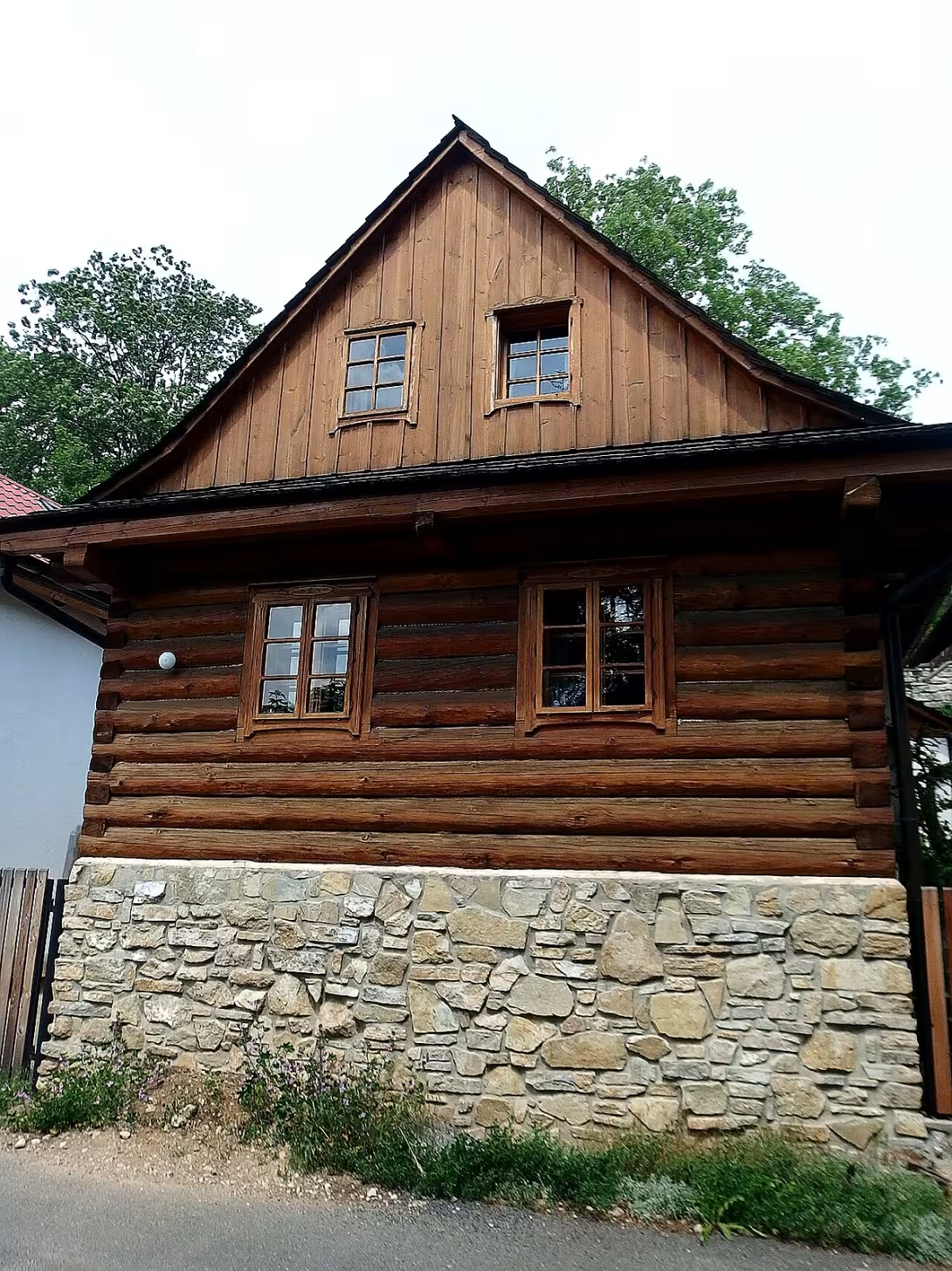
House No. 161 in Štramberk, a village in Nová Jicin district, is a historical monument from the first half of the 19th century, located on the street Hranice. It is an example of folk architecture and belongs to the town conservation. It was included in the Central List of Cultural Monuments of the Czech Republic before 1988, which highlights its importance for regional cultural heritage.
The history of Štramberk dates back to the 16th century, when the square originally built 22 houses with wooden archways. In 1614 the number of farms increased to 28 and the city had a rectory, church and school. For the reign of Jesuits in 1656 there were already 53 houses in the city. The first brick house No. 10 was built on the square in 1799. In 1855 the fire hit Štramberk, where 40 houses and two barns burned down. The original gagged house No. 161 was built in the first half of the 19th century.
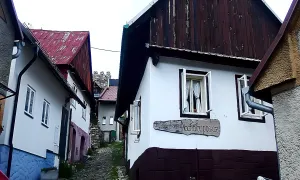
The architecture of House No. 161 is a ground floor, partially grafted building of a rectangular plan. It is oriented by the shield side to the road and perpendicular to the slope. The house has a three-paralleled chamber-sty type. It stands on a high stone suspicion that equalises the slope inequality and has in front of the cellar areas of former stables with entrance from the left gutter side. The cut-out part of the house is built of balls, the back part is walled. The shield facade has two-axis cashmere windows with decorative formwork frames and the shield is vertically boarded with two small windows, with a break at the heel. The roof is covered with pinched shingles. The left two-axis gutter side has a brick extension (porch) with entrance to the house. In the 1990s, a copy of the grafted part was built on it, showing an attempt to preserve the original architectural appearance.
House No. 161 is an example of folk architecture which was located in the suburb of Štramberk. It is built on a high stone suspect with basement areas of former stables and reflects typical building techniques of the first half of the 19th century. He's part of the city's heritage reserve.
Today house No. 161 in Štramberk is accessible for visit and is worth visiting because of its historical importance and architectural rendition. It is an example of popular architecture that reflects the cultural heritage of the region. By visiting this house, the visitor can better understand the history and development of Štramberk.
House no. 161 is not only a monument but also a witness of changes that took place in the region during the first half of the 19th century. It is important to realise the value of this cultural heritage and to promote its preservation for future generations. By visiting this house, everyone can gain a better understanding of the history and culture of Štramberka.
Historical milestones
- around 1614
- The number of holdings in Štramberk has increased to 28.
- 1656
- Under the Jesuits, the number of houses has increased to 53.
- 1799
- Built first walled house No. 10 in the square.
- 1855
- The fire destroyed 40 houses and two barns in Štramberk.
- first half of the 19th century
- Built the original gagged house No. 161.
Architectural development
The original grafted house was built in the first half of the 19th century. In the 1990s, a copy of the grafted part was built on it, showing an attempt to preserve the original architectural appearance.
Historical events
- 1855
- A fire in Štramberk that burned down 40 houses and two barns.
Points of interest
- House No. 161 is a historical monument from the first half of the 19th century. - It represents an example of folk architecture and belongs to the town conservation. - It was entered in the Central List of Cultural Monuments of the Czech Republic before 1988, which highlights its importance for the regional cultural heritage.
Guide
Show guide text
This text was created by artificial intelligence and has not been editorially reviewed. It may contain inaccuracies.
Welcome to the beautiful Štramberk, where history meets the present in every corner. Right now, you're standing in front of the house with the number hundred and sixty-one, which stands in the street of the Boundary. Stop for a moment, take a breath and feel the atmosphere of this place. You see before you one of those silent witnesses of the past telling us the story of how people in this area lived, built and dreamed almost two years ago. This house is not just an ordinary building of stone and wood, it is a living fragment of folk architecture that has endured trials of time and changes of epoch.
In order to understand why this house is so important, we need to go deep into the history of Štramberka. Imagine this place centuries ago. Already in the year six hundred and fourteen seventeenth century, the number of farms was small, only twenty-eight, but the city had already begun its journey to bloom. A little later, in the year six hundred fifty-six of the seventeenth century, the situation changed. Under the rule of Jesuits, the number of houses has increased to 53. The city grew, it changed, and with it changed the ways that people built their homes. For a long time the wood was dominated, which was available and easy to process in the surroundings. The break came in the year seven hundred ninety-nine of the eighteenth century, when the very first brick house with the number ten was built on the square. This was the beginning of a new era, when a stone and a brick began to assert themselves in folk architecture, which brought more resilience and stability.
It is in this context that the house that you are now facing has been built. It was built in the first half of the nineteenth century. At that time, there was no problem combining traditional techniques with more recent knowledge. If you look closely at the walls of the house now, notice its specific structure. This house is grafted, but it also contains parts of the wall. That's the key detail I'd like to draw your attention to. The grafting, the construction of wooden beams, was the basis of rural housing. The walls were then used to strengthen the structure or to protect against moisture and fire. This combination of materials perfectly reflects building techniques at the time when craftsmen tried to use the best of both worlds. Look at the facade and see how the wood combines with the stone. It is a simple but very functional architecture that aims not to amaze its size, but rather its integrity and its declared materiality.
When we look at this house, we have to realize how much danger there was in the nineteenth century for similar buildings. Imagine the year one thousand eight hundred fifty-five. The Štramberk hit a devastating fire. The flames were relentless and destroyed 40 houses and two barns. At that time, fire was the greatest enemy of wooden dwellings. The fact that house number hundred and sixty-one still stands and retains its form is almost a miracle. It is a reminder of the fragility of human work, but also of the evidence of resistance. Although we don't know the names of the particular architects who designed this house or the names of the people who lived there in the first half of the nineteenth century, their trail is still present. Each beam and every stone tells of their work, their anxiety from the fire and their desire for a safe home.
Now pay attention to the wider framework in which this house is located. You are standing within the city conservation area. This means that this entire space is protected as a censoring unit. House number hundred and sixty-one is not just an accessory in this reservation, but an important building block. Its importance was officially recognised a year ago by a thousand eight hundred eighty eight, when it was registered in the Central List of Cultural Monuments of the Czech Republic. That's a very important fact, because this kind of inscription guarantees that the house doesn't get in the hands of people who might have the wrong idea of rebuilding it. This allows us to see today the true character of a 19th-century people's house without being overwhelmed by modern materials or inappropriate modifications.
You may be interested in what lies the greatest mystery or interest of this place. It's paradoxically in his stealth. At a time when we are attracted to great cathedrals or luxury palaces, this modest, timid house reminds us that real history is made in the everyday life of ordinary people. The fate of those who spent their days, nights, celebrating their birthdays or taking care of their economies remains a mystery. Who was the first to lay the foundation stone? Who picked the right wooden beams? It is this ignorance that gives the house some mysticism. It's like an open book in which the character names are missing, but the plot is still clearly readable from the shapes and materials of the building.
Now if you look again at the house as a whole, try to imagine what the street of the Boundary looked like a century ago. Do you hear the sound of carriages on the way? Can you smell the smell of wood and stone smoke? This house is like a time machine that brings us back to a time when the rhythm of the day was determined by the sun and seasonal work. It is an example of regionalism, an architecture that is based on local conditions and needs. That is why this house is so valuable to regional cultural heritage. They teach us how to adapt to the environment and how to build things that will last generations.
Let's slowly say good-bye to house number hundred sixty-one. I hope you've found a moment to appreciate the beauty of simplicity and honest craft. This house is just one of the many jewels Štramberk has to offer. It is a reminder that even in small things there is a great history. Now we invite you to further explore this magnificent monument reservation. Go through the surrounding alleys, see the ceilings and walls of other houses and look for similar traces of the past. Every next step will bring you closer to understanding the spirit of this city.
Thank you for spending these moments with us at house number hundred and sixty-one. We wish you a pleasant continuation of the Štramberk journey and hope that the history of this place will continue to fascinate you. Enjoy your stay and let yourself be inspired by the calm and beauty of the folk architecture that surrounds us. See you next time.
Tips for visitors
Best time to visit House No. 161 in Štramberk is the autumn or spring season when the forests and horizons are the most holy. The sunny days offer ideal light for a photograph of architecture in peace without overfilling.
Parking is possible to find near the center of Štramberka, where are free parking. The city is also well accessible by public transport; use the local tourist information desk for the current connection.
When visiting take with you suitable clothes according to the weather, shoes for comfortable walking and breakfast or drinking on the outside. The house is in the historic center of the city, so you can take advantage of the opportunity to relax in one of the local cafés.
Photography of house No. 161 is the best from the side of Hranka street, where the overall picture of architecture and surrounding environment is captured. The most beautiful light for photography is at noon or at the end of the day when the sun illuminates the building from an angle.
In the vicinity of the house you can visit the local museum or see the historical monuments Štramberka. For families with children it is advisable to visit the park where various activities can be organised and children can play in the open.
Businesses nearby
Do you run a restaurant, accommodation, shop, museum, rental, wellness or other visitor service near this monument? Show yourself directly to the people heading to it — this is how they will see you in the app and on the web:
Nearby
🏰 Historic sites (198)
- Oldřich Bijok 0.0 km
- Památce padlým 0.3 km
- Památce padlým ve světové válce 0.3 km
- Karel Maska 0.5 km
- Tábor poddaných 0.5 km
- Bohumír Jaroněk 0.5 km
- Leoš Janáček 0.5 km
- Sv. Václav 0.5 km
- Čeněk Pikulík 0.6 km web
- Bedřich Smetana 0.6 km
- Jan Žižka 0.6 km
- Bratru Janu Čapkovi 0.6 km
- T.G. Masaryk 0.7 km
- Alois Jirásek 0.7 km
- František Palacký 0.7 km
- Hrstkova cesta 0.7 km
- Muzeum Šipka 0.7 km
- Muzeum Zdeňka Buriana 0.8 km web
- Muzeum loutek 0.8 km
- Štramberk 0.9 km
🍽️ Restaurants and dining (367)
- Bar Ucho 0.4 km
- U Mámy 0.4 km
- Palárna 0.4 km Nádražní 167
- Maestro 0.5 km Nádražní 820 +420603830262 web
- Pizzerie Piccollo 0.7 km
- Obecní hospůdka 0.8 km
- Městský pivovar 0.8 km web
- Bistro Bašta 20 0.8 km
- Občerstvení pod Trúbou 0.8 km
- Hrstka kafé 0.9 km
- Chata doktora Hrstky 0.9 km
- U Matesa 0.9 km
- Restaurace Na hřišti Bařiny 1.0 km
- Hans 1.1 km
- Restaurace Pod Kaštany 1.2 km
- PizzaKopr 1.3 km +420 737 056 950 web
- U Můstku 1.4 km
- Kebab house 1.6 km
- Bonver 1.6 km
- U Tomáše 1.7 km
🏨 Accommodation (113)
- GONG 0.4 km
- Josef Petráš 0.7 km Zauličí 242
- Chaloupka pod náměstím 0.7 km Dolní Bašta 254
- Ubytování U Tížků 0.7 km Horní Bašta 309
- Hotel Štramberk 0.8 km Náměstí 8
- Stará škola 0.8 km
- Šipka 0.8 km
- Ubytování V Podhradí 0.9 km Dolní Bašta 366
- ubytovna U Matesa 0.9 km
- Hotel Roubenka 1.0 km Dolní 327
- Hotel Stadion 1.6 km
- Penzion pod Bílou horou 1.7 km web
- Hotel Olympia 1.8 km
- Tatra Hotel 1.8 km
- Interhotel Tatra 1.9 km +420 556 872 111 web
- Rekreační středisko U Kateřiny 2.4 km
- Villa 603 4.0 km
- Dolní Dvůr 5.6 km web
- U Nádraží 5.7 km
- Autocamp RICCO 5.8 km +420777100007 web
🚲 Rentals and sport (78)
- Šitavanc 1.8 km
- Krytý bazén 1.9 km
- Sportovní hala SOU 2.0 km
- Cykloart 2.0 km
- Koupaliště Libotín 2.2 km
- Sportisimo 2.3 km
- Tesco Kopřivnice 2.6 km web
- FC Vlčovice-Mniší 4.5 km
- Sportovní hala 4.9 km
- Tělocvična Veřovice 5.3 km
- Fit centrum 5.5 km
- Koupak v Příboře 5.8 km +420 737 594 590 web
- dětský bazén 5.9 km
- Městská sportovní hala 5.9 km
- TopOutdoor 6.0 km +420 556 723 138 web
- OutdoorKWAK 6.0 km +420 605 172 557 web
- Elkol 6.1 km +420 603 804 846 web
- Školní Basketbalová hala 6.1 km
- Tělocvična TJ Sokol Příbor 6.2 km
- Herna stolního tenisu 6.2 km
🥾 Hiking and nature (306)
- Kamenný labyrint 0.1 km
- Jeskyně pouťová 0.1 km
- Botanická zahrada a arboretum 0.1 km
- 475 0.2 km
- Šipka 0.5 km
- Váňův kámen 0.5 km
- Studánka U Váňova Kamene 0.5 km
- Kamenný ovál s 12 křesly 0.7 km
- Vyhlídkové místo na Štramberk 0.8 km
- Bílá hora 0.8 km
- Rozhledna Bílá hora 0.8 km
- Studánka Míru 0.8 km
- Kotouč 1.0 km
- Kocvínek 1.1 km
- Studánka Na Lisinské 1.2 km
- Šutyrova studánka 1.3 km
- Markétin pramen 1.4 km
- Studánka U Vodojemu 1.5 km
- Výstavní pavilon 1.9 km
- Červený kámen 2.0 km web
Accommodation nearby
Themed route
Thematic cruise route from Štramberka
1.Dům čp. 161 (Štramberk) - Type: historical house - Why is it worth visiting: This house is an example of local architecture and offers a view of life from when Štramberk prospered as a mineral centre. It is the starting point for the history and traditions of the village.
2. Church of St. Gilji - Type: religious building - Why is worth a visit: The church is one of the oldest sacral objects in Štramberk and its Gothic interior attracts historically interesting people. It is located near the important centre of the village, which makes it easier to visit after exploring Dom no. 161.
3. Mineral Memorial - Type: historical monument - Why it is worth a visit: This monument is dedicated to the history of mining and industry, which were key to Štramberk. It offers an interesting view of the history of the village and its economic history.
4. Monastic Garden - Type: garden area - Why it is worth a visit: The monastery garden is a place of peace and beauty where you can enjoy natural flowers and historical surroundings. It's an ideal place to relax after exploring other monuments.
5. Municipal House - Type: administration building - Why is it worth a visit: The Municipal House is a centre of local administration and often hosts various cultural events and exhibitions. It offers insight into the current life of the village and its activities.
This route offers a comprehensive view of the history, culture and nature of Štramberka, allowing visitors to explore the key rooms of the village.
Seasonal recommendations
Spring: In the spring period, Štramberk is transformed into a shining flower paradise where various kinds of shrubs and trees bloom. The sun rays illuminate the house No. 161 finer than in the summer months, creating a magical atmosphere for visiting historical monuments. At this time it is recommended to visit the morning or evening when the crowds are still mild and can enjoy the peace. Clothing should be adapted to changing weather - combined layers are suitable to allow easy adaptation to warmer or colder climate.
Summer: In summer Štramberk offers itself as an ideal place to visit when nature is in full power and house No. 161 lit by long sunlight. The atmosphere is alive and full of energy, which makes this time ideal for exploring historical monuments. Visitors should come early in the morning or late in the evening to avoid special crowds on a sunny summer day. Clothes should be light and light, with sun protection - the hat or hat must not be missing.
Autumn: In the autumn months Štramberk becomes melancholic beauty when leaves colour trees in living colors. House No. 161 is illuminated by sunny rays that pass through a foggy atmosphere, which adds a historical monument to a romantic touch. This time is ideal for quiet tours without a special crowd. Clothes should be warm and suitable for colder weather, while not forgetting quality jacket and rain protection.
Winter: Winter Štramberk offers a unique view with snow covered in landscape, which turns house No. 161 into a magical place full of peace and quiet. Sunbeams illuminating roofs and windows bring a touching contrast to darker climate. Visit the historical monument at noon to enjoy maximum sunlight. Clothes must be warm and protective - remember the quality jacket, gloves and scarf for protection against cold air. Remember, opening hours can be shorter in winter.
Visualizations and artistic views


The visualisations are generated by artificial intelligence and serve as inspiration.
Photos from the area
Real photos taken near the monument

Zdroj a licence jsou uvedeny u každého snímku.
Tips from visitors
No tips yet. Be the first!
Log in and add your tip.
Sources and literature
Photos: Palickap / CC BY-SA 4.0 — Wikimedia Commons. The author and licence also appear when you hover over the image.
Faktickým podkladem tohoto textu byl článek na Wikipedii, jehož autory jsou přispěvatelé Wikipedie. Článek je dostupný pod licencí CC BY-SA 4.0.
Location on the map
More monuments – Štramberk
Show all in the municipality
Příběhy a pověsti
Legendy, pověsti a příběhy spjaté s touto památkou
Fotografie návštěvníků
Zatím žádné fotografie. Buďte první, kdo přidá fotografii z návštěvy!
Log in a přidejte svou fotografii nebo hodnoťte.
Za ověřenou návštěvu v aplikaci získáte víc bodů — poznáme podle GPS, že jste na místě.
Reviews and comments