






Dům čp. 23 House
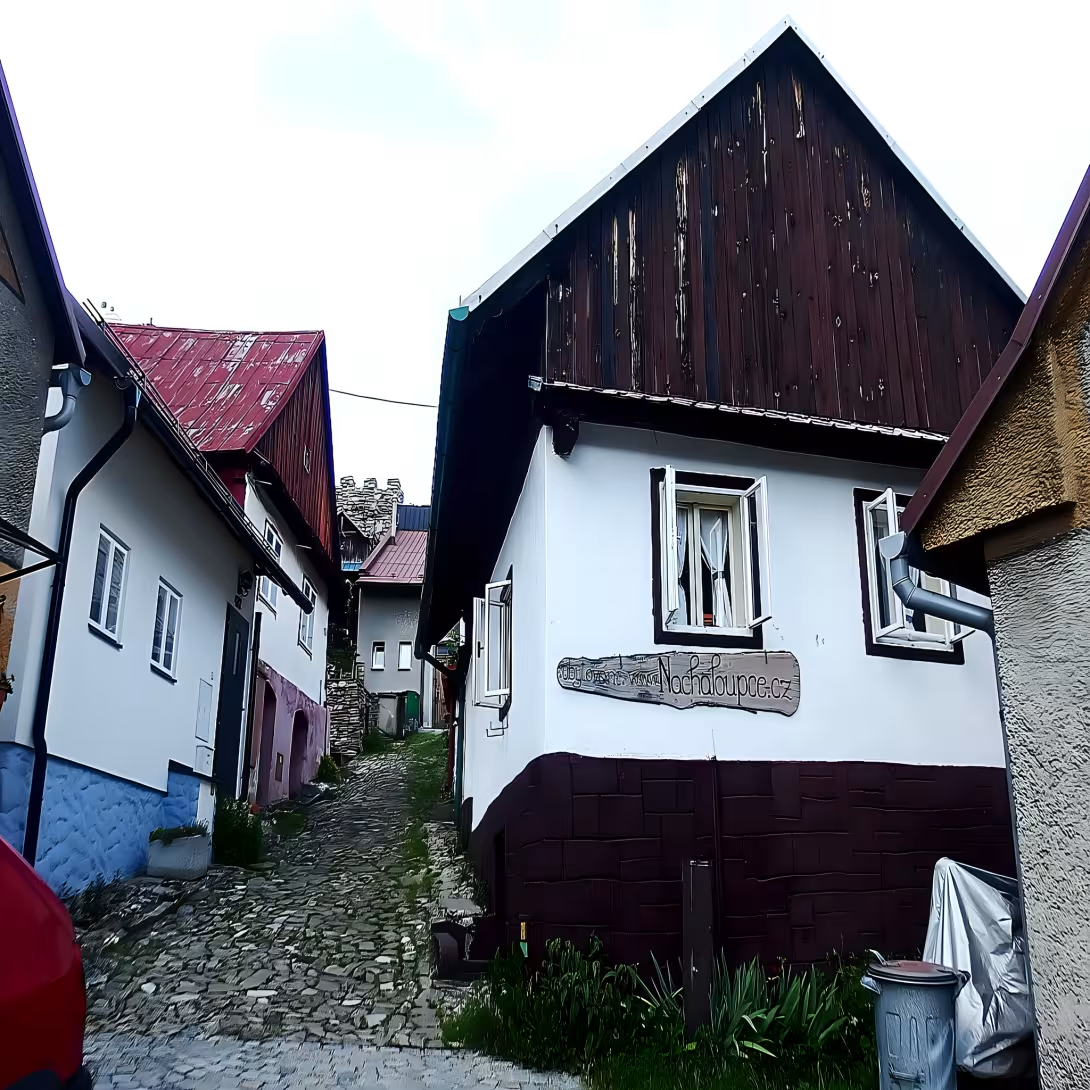
Dům čp. 23, located on Náměstí in Štramberk, Nový Jičín district, is a timber-framed residential building dating from the second half of the 18th century. It is a registered cultural monument and part of the municipal monument reservation.
Built during the same period, the building has served as both a residence and business for centuries. Its exact construction date is unclear, but it has been in continuous use since then.
The structure features a ground-floor timber frame with a rectangular floor plan and saddle roof. A high stone plinth compensates for the terrain's steep slope, containing spaces that previously housed stables. The ground floor is plastered, while the eaves side runs parallel to the road. A vaulted cellar is accessible through an entrance beneath a window on the eaves side.
The interior boasts a beam ceiling and features a kitchen with a beam trapdoor ceiling added at a later date. The two-axis triangular gable is vertically boarded; it originally had a half-hip and half-gable, but modifications altered its slope and eaves roof.
Historical records show several owners of the property. Martin David, a tavern keeper, owned the building in the 18th century's second half. Ferdinand Pavelka took ownership in the 19th century's first half. The Hanzlík family held the property until the mid-1870s, and Michaela Luňáčková is the current owner.
The building's notable feature is its high stone plinth, which levels the site. It was officially recorded on the Central List of Cultural Monuments of the Czech Republic before 1988.
Dům čp. 23 remains a preserved part of Štramberk's municipal monument reservation, serving as an example of 18th-century timber construction and urban adaptation to challenging terrain. This site adds value to the town's historical character and is worth visiting for those interested in traditional architecture.
Historical milestones
- 1750
- The building is constructed during the second half of the 18th century.
- 1800
- Martin David, a tavern keeper, owns the property.
- 1850
- Ferdinand Pavelka takes ownership in the first half of the 19th century.
- 1875
- The Hanzlík family holds the property until the mid-1870s
- 1988
- The building is officially recorded on the Central List of Cultural Monuments of the Czech Republic
Architectural development
The building is a partially masonry, ground-floor timber-framed structure with a saddle roof. It features a two-axis triangular gable that was originally supplemented with a half-hip and a half-gable, though it was later modified with an eaves roof. The house is constructed on a high stone plinth containing former stable spaces, and the ground floor is plastered.
Historical events
The house was recorded in the Central List of Cultural Monuments of the Czech Republic before 1988.
Owners
Martin David (tavern keeper in the second half of the 18th century), Ferdinand Pavelka (first half of the 19th century), Josef Bár, the Hanzlík family (until the mid-1870s), and currently Michaela Luňáčková.
Points of interest
– The building is a timber-framed residential structure dating back to the second half of the 18th century.
– It has served as both a residence and business for centuries, with its exact construction date unclear but in continuous use since then.
– The high stone plinth compensates for the terrain's steep slope, containing spaces that previously housed stables.
– The building features a beam ceiling and a vaulted cellar accessible through an entrance beneath a window on the eaves side.
Guide
Show guide text
This text was created by artificial intelligence and has not been editorially reviewed. It may contain inaccuracies.
Welcome, dear visitor. You are standing before Dům čp. 23, a modest yet remarkable timber‑framed house that watches over the historic heart of Štramberk. From where you stand, the building’s simple rectangular silhouette rises gently against the slope, its saddle roof capping the structure in a quiet, unassuming way. The high stone plinth on which it rests catches the light, hinting at the clever engineering that allowed this house to cling to the steep terrain of the Kut area. Take a moment to let the scene settle: the weathered timber beams, the subtle contrast between wood and stone, the rhythm of the roof’s gentle peaks. This is the first impression of a place that has quietly witnessed more than two centuries of local life.
Let us travel back to the second half of the eighteenth century, a time when Štramberk was expanding beyond its medieval core and new families were seeking both shelter and opportunity on the hillside. It was during this period, around the year 1750, that Dům čp. 23 was erected. While the exact year of its construction remains uncertain, the building’s timber‑frame technique and the style of its saddle roof firmly place it within the latter decades of the eighteenth century. In those days, the region’s economy was a blend of agriculture, small‑scale craft, and the beginnings of modest trade. A house such as this would have served not only as a family dwelling but also as a foothold for a small business, a dual purpose that was common in the bustling, yet still rural, environment of the time.
Now, as you look up, notice the high stone plinth that lifts the timber structure above the ground. This stone base is more than a decorative element; it was a practical response to the steep slope on which the house sits. By raising the wooden frame, the builders protected the timber from dampness and ground moisture, ensuring greater longevity. The plinth also creates a subtle visual separation between the earth and the living space, a reminder of the careful adaptation to the landscape that characterized many of Štramberk’s historic buildings. The rectangular floor plan you can discern from the façade reflects a straightforward, functional layout typical of residential architecture of the era. Inside, rooms would have been arranged along a simple linear axis, each serving the everyday needs of the household.
The timber framing itself is a testament to the craftsmanship of the period. Look closely at the exposed beams that form the skeleton of the house. In the eighteenth century, local carpenters would have selected sturdy oak or pine, shaping each member by hand and joining them with traditional mortise‑and‑tenon joints, secured with wooden pegs. This method not only provided structural strength but also created a visual rhythm of lines and angles that you can still appreciate today. The saddle roof, with its two sloping sides meeting at a modest ridge, was a practical choice for shedding rain and snow, a crucial consideration in the climate of the Moravian highlands. Though the roof’s covering material is not specified, the shape alone tells us that the builders prioritized durability and simplicity.
As we move through the building’s timeline, the story of its owners adds a human dimension to the timber and stone. Around the turn of the nineteenth century, the property was owned by Martin David, a tavern keeper. Imagine, if you will, the lively chatter of travelers and locals spilling out from a modest tavern that might have occupied part of this very house. Martin David would have welcomed guests, served ale, and perhaps provided a warm hearth for weary wayfarers navigating the winding roads of Štramberk. His presence links the house to the social fabric of the town, where inns and taverns were essential nodes of community life.
A few decades later, in the first half of the nineteenth century, ownership passed to Ferdinand Pavelka. While the records do not elaborate on his profession, the continuity of private residence suggests that the house remained a family home, perhaps adapting to the modest economic shifts of the era. By the mid‑nineteenth century, the Hanzlík family took up residence, holding the property until the mid‑1870s. Their long tenure indicates a stable household, likely passing the house from one generation to the next, each adding their own layer of memory to the walls. The Hanzlíks would have witnessed the gradual modernization of Štramberk, as railways and new trade routes began to reshape the region.
Among the names associated with Dům čp. 23, a few stand out for their connection to the broader cultural landscape. Josef Bár, whose name appears in the historical record, may have been a local craftsman or merchant, contributing to the town’s economic vitality. In more recent times, Michaela Luňáčková has been linked to the house, perhaps as a caretaker or researcher, ensuring that the story of this modest building continues to be told. Each of these individuals, though only briefly mentioned in the archives, represents a thread in the tapestry of lives that have intersected within the timber walls.
Now, let us pause for an intriguing fact that underscores the house’s enduring relevance. Dům čp. 23 is not merely an old structure; it is a protected element of the municipal monument reservation of Štramberk. In 1988, the building was officially entered into the Central List of Cultural Monuments of the Czech Republic. This designation acknowledges the house’s value as a tangible link to the town’s architectural heritage and as a witness to centuries of everyday life. The fact that a modest timber‑framed house, rather than a grand palace or church, received such protection highlights the growing appreciation for vernacular architecture—those ordinary buildings that, together, define the character of a place.
You might wonder why a house that appears so simple could hold such significance. The answer lies in its continuity. While many structures have been lost to fire, war, or redevelopment, Dům čp. 23 has survived, largely because of its solid construction and the care of its successive owners. Its timber frame, stone plinth, and saddle roof have withstood the test of time, offering us a rare, authentic glimpse into the building practices of the eighteenth century. Moreover, the house’s dual role as residence and business reflects a way of life that is increasingly rare in our modern, compartmentalized world. In a single building, you can sense the rhythm of daily chores, the warmth of family gatherings, and the bustle of commerce—all intertwined under one roof.
As you stand here, imagine the subtle sounds that would have filled this space over the years: the creak of wooden floorboards as children ran, the clatter of mugs in Martin David’s tavern, the quiet murmur of evening prayers, the occasional hammer of a carpenter repairing a beam. Though the interior is not open to the public, the exterior invites you to contemplate these layers of history. Feel the stone beneath your feet, the same stone that lifted the house above the slope, and consider how each generation has added its own story to the fabric of this place.
Before we conclude, take a final look at the building’s façade. Notice how the timber framing creates a pattern of light and shadow, especially as the sun moves across the sky. The high plinth, the modest roofline, the rectangular shape—all these elements combine to form a harmonious whole that speaks of practicality, resilience, and quiet dignity. In a world where architecture often strives for the spectacular, Dům čp. 23 reminds us that beauty can also be found in modesty and in the honest use of local materials.
I invite you now to continue your exploration of Štramberk’s historic quarter. Follow the winding streets that lead from this house to the town’s medieval tower, the charming market square, and the surrounding vineyards that have nourished the community for centuries. Each step will reveal more about the lives that have shaped this region, and each building, like Dům čp. 23, will add a new chapter to your own story of discovery.
Thank you for listening, and may the echoes of the past accompany you as you wander through the timeless streets of Štramberk. Enjoy the rest of your visit.
Tips for visitors
The best time to visit Dům čp. 23 is during the spring and autumn seasons, when the weather is mild and sunny. This allows you to fully appreciate the historic charm of the building.
Parking is available on the main square (Náměstí) near the house. You can also use public transportation, with Štramberk being easily accessible by bus or car.
When visiting Dům čp. 23, be sure to bring comfortable walking shoes and a camera to capture the beautiful architecture and surroundings.
The best spots for photography are around the main square (Náměstí) and near the house itself. The golden hour in the morning or late afternoon provides excellent lighting conditions.
If you're looking to explore nearby attractions, consider visiting the Štramberk municipal monument reservation within a 30-minute walk from Dům čp. 23.
Businesses nearby
Do you run a restaurant, accommodation, shop, museum, rental, wellness or other visitor service near this monument? Show yourself directly to the people heading to it — this is how they will see you in the app and on the web:
Nearby
The house is located on the main square (Náměstí) within the Štramberk municipal monument reservation.
Accommodation nearby
Themed route
Štramberk Heritage Trail
The main goal of this trail is to explore the charming town of Štramberk and its surrounding attractions. Here are three stops that make up the trail:
Stop 1: Náměstí (Main Square) Type: Historic Town Center Why visit: This picturesque square is the heart of Štramberk, surrounded by beautiful Baroque and Renaissance buildings. Take a stroll around the square to admire the architecture and soak up the town's atmosphere.
Stop 2: Dům čp. 23 (House No. 23) Type: Historic Building Why visit: This historic house is located on the main square and is part of Štramberk's municipal monument reservation. Its unique architecture and rich history make it a must-see attraction.
Stop 3: Náměstí (Main Square) - Evening Stroll Type: Evening Entertainment Why visit: Return to the main square in the evening for a romantic stroll under the stars. The square is beautifully lit, making it an ideal spot to relax and enjoy the town's tranquility.
This trail offers a unique glimpse into Štramberk's rich history and culture, with its historic buildings, charming atmosphere, and picturesque surroundings.
Seasonal recommendations
Spring
As you visit the historic landmark, House no. 23 (others), Štramberk, during the spring season, you'll be greeted by blooming flowers and lush greenery. The atmosphere is fresh and revitalized after a cold winter. Take advantage of the pleasant weather to explore the area without the crowds that come later in the summer.
Practical tips: Consider visiting early in the morning or late in the afternoon to avoid peak tourist hours. Wear comfortable shoes for walking, and don't forget your camera to capture the beautiful scenery.
Summer
The warm summer days bring a lively atmosphere to House no. 23 (others), Štramberk. The sun shines bright, casting long shadows across the historic buildings. Take a stroll through the charming streets of Štramberk, enjoying the sounds of children playing and laughter filling the air.
Practical tips: Be prepared for larger crowds during peak tourist season. Arrive early to beat the heat and avoid the midday rush. Wear light, breathable clothing and don't forget your sunscreen.
Autumn
As the seasons change, House no. 23 (others), Štramberk, takes on a cozy autumnal charm. The leaves turn golden, casting a warm glow over the historic buildings. Take a moment to appreciate the simple beauty of nature's transition from summer to winter.
Practical tips: Visit during the shoulder season for fewer tourists and more relaxed atmosphere. Wear layers as the temperature can drop significantly in the evenings. Bring your camera to capture the stunning fall foliage.
Winter
The cold winter days bring a serene silence to House no. 23 (others), Štramberk. The snow-covered buildings take on a magical quality, inviting you to slow down and appreciate the beauty of the season.
Practical tips: Visit during the week for shorter lines and more peaceful atmosphere. Dress warmly and consider bringing hot beverages to keep you cozy. Take your time exploring the historic landmark, savoring the quiet winter charm.
Visualizations and artistic views

The visualisations are generated by artificial intelligence and serve as inspiration.
Photos from the area
Real photos taken near the monument

Zdroj a licence jsou uvedeny u každého snímku.
Tips from visitors
No tips yet. Be the first!
Log in and add your tip.
Sources and literature
Fotografie: Palickap / CC BY-SA 4.0, rozlišení zvýšeno umělou inteligencí — Wikimedia Commons. The author and licence also appear when you hover over the image.
Faktickým podkladem tohoto textu byl článek na Wikipedii, jehož autory jsou přispěvatelé Wikipedie. Článek je dostupný pod licencí CC BY-SA 4.0.
Location on the map
More monuments – Štramberk
Show all in the municipality
Příběhy a pověsti
Legendy, pověsti a příběhy spjaté s touto památkou
Fotografie návštěvníků
Zatím žádné fotografie. Buďte první, kdo přidá fotografii z návštěvy!
Přihlaste se a přidejte svou fotografii nebo hodnoťte.
Za ověřenou návštěvu v aplikaci získáte víc bodů — poznáme podle GPS, že jste na místě.
Reviews and comments