






Dům čp. 5, Bubeneč Villa
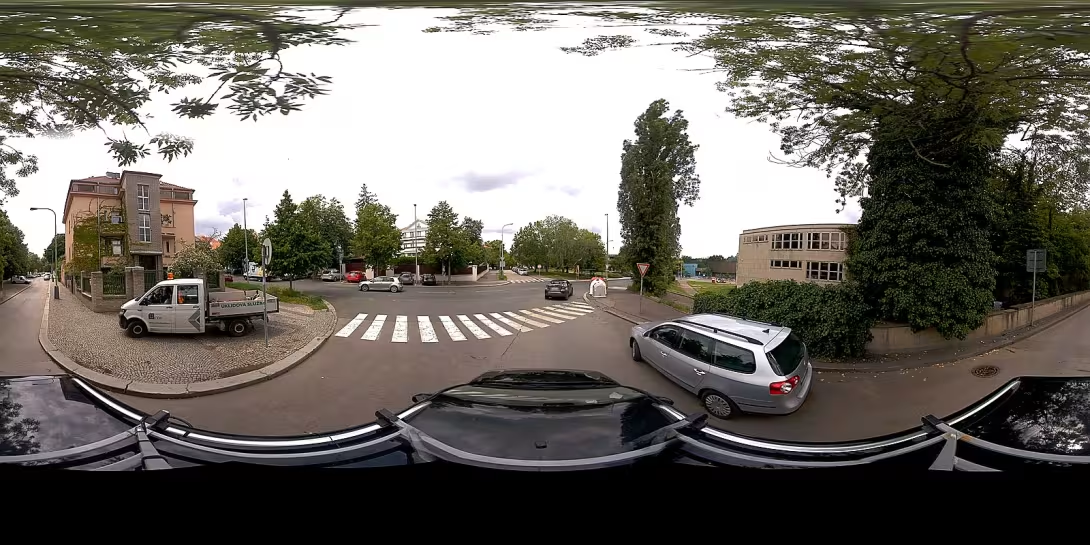
House No. 5, known as the Obornicke Court, was a historic economic courtyard and summer residence in the Prague Bubenč. He used to stand west of St. Gotthard's Church. The building was founded in the 15th century and has undergone Baroque and Classicist modifications over the centuries. He was definitely demolished in 1975.
Historical sources suggest that the court was created probably in the 15th century as a background for the professors, the administrator of the adjacent Royal disciplines. In 1668 the Archbishop of Prague Matouš Ferdinand Sobek z Bílenberka bought it and had the farm rebuilt to its summer residence. In 1715, the yard, along with the land in the Earth's records, was designated Central Ovenec.
Architecturally it was a two-wing one-story building on the ground plan of the letter L. The front part, rebuilt around 1825, exhibited classicist features. On the other hand, the rear wing has preserved baroque arches with sections drawn into nails. The central tract of the building was divided by pilasters with volutes in their heads. The equipment included a walled underarched roof on the floor, accessible by an external staircase with a railing decorated with oval openings. There was also a gloriet from 1796, which stood in the garden near the wall. This building had a prismatic ground floor, a polygonal floor with broken windows and a high needle roof covered with shingles.
The owners of the estate were gradually professionals, Prague Archbishops, nobles and bankers. After 1800 there was a theatre, a Chinese pavilion and a decorative well on the grounds. The area was protected as a real-estate cultural monument of the Czech Republic between 1958 and 1973. The last repairs of the building took place in 1956, but subsequently the area was dilapidated.
In 1975, the Obornicke Court was torn down. A school for the Soviet Embassy was subsequently built in its place and on the property of the neighbouring economic court No 4.
Today there is nothing left of this historical whole that resembles its former importance for the administration of the Royal Division or its baroque form. Although the construction has ceased to exist, its history remains a testament to the transformation of the Bubenech building from the Middle Ages to the 20th century. For those interested in the history of Prague suburbs, the fate of this yard is a memento of the demise of historical economic sites in the urban landscape.
Historical milestones
- 1668
- The purchase of the court by Archbishop of Prague, Matthew Ferdinand Sobk of Belenberg.
- 1715
- The yard and the grounds marked in the Earth's records as Central Ovenec.
- 1956
- Last repair of the compound before his demise.
- 1975
- The destruction of the building and the subsequent construction of a school for the Soviet Embassy.
Architectural development
The court was founded in the 15th century and gradually underwent baroque modifications. The front building was significantly rebuilt around 1825 and gained a classical appearance. The site was also a gloriet from 1796 with a needle roof.
Historical events
1668: Purchase of the Court by the Archbishop and conversion to the summer residence. 1958-1973: Monument protection period. 1975: Demolition of the premises.
Owners
Royal branch (administrators of the professors), Prague Archbishop Matouš Ferdinand Sobek z Bílenberka (since 1668), nobles and bankers.
Points of interest
- House No. 5, known as the Obornicke Court, was created in the 15th century as a facility for the administrators of the Royal Division. - In 1668 the Prague Archbishop Matouš Ferdinand Sobek z Bílenberka purchased the building and had it rebuilt to his summer residence. - Part of the complex was a gloriet from 1796, which had a prismatic ground floor, a polygonal floor with broken windows and a roof covered with shingles. - After 1800 there was a theatre, a Chinese pavilion and a decorative well on the grounds of the estate. - In 1975, the yard was finally demolished and a school was built for the Soviet Embassy.
Guide
Show guide text
This text was created by artificial intelligence and has not been editorially reviewed. It may contain inaccuracies.
Welcome to Bubeneči. You are standing in a place that no longer offers its original form, but its history is still deeply imprinted in this Prague district. Even though you now have another architecture and another life spreading around you, try to imagine for a moment what was here before. Imagine a place where the calm of vast forests mixed with the noble life of nobles and religious dignitaries. You are in a place where house number five once stood, known as the Obornicke Court. It's a place that carries centuries, from when this region was part of the vast royal monasteries to the dramatic changes of the modern era.
Let's go back deep into the past together to understand why this court was so important. The entire history of this place begins in the 15th century. At that time there was no luxury residence, but rather a practical background. The Court served as a base for the steward of the Royal Division. Imagine the era when nature was much wilder around Prague and the industry was an important place for the royal hunt. Managers had to be in place all the time, taking care of forests and animals, and this house was their home and workplace. It was a functional, economic space that was firmly linked to the rhythm of nature and the needs of the royal court.
Now, however, pay attention to the crucial turning point that has completely changed the character of this place. Let's move on to 1668. This year there was an event which made the simple economic court a place of high social importance. Dvořák was bought by Prague Archbishop, Matthew Ferdinand Sobk of Bílenberk. This personality was extremely influential in the then society and its arrival meant that this corner of Bubeneče would become part of a wider circle of religious and aristocratic settlements. The Archbishop was not only looking for practical accommodation here, but he created his summer residence here.
By doing so, the house stopped seeing itself as a part of the forest economy and began to gain an touch of elegance and calm. In 1715, as can be read from the Earth's records at the time, this area and its land were officially designated Central Ovenec. This name gives the place some historical weight and reminds us that every building has its own unique name that defines it in the history of the city.
If we now try to reconstruct what the house looked like, we should focus on its architecture. Even if you don't see the building today, we know from historical records that its resemblance has evolved over time towards a classical form. Classicism is a style that bets on harmony, balance and purity of lines. Imagine buildings that don't seem chaotic, but have a certain order and dignity that matched the status of the Archbishop's mansion. The area was not only a set of buildings, but it formed a whole, which included beautiful garden buildings.
Notice how important the integration of architecture with the surrounding landscape was. One of the greatest treasures of this place was the gloriet, which dates back to the late eighteenth century, namely from 1796. This type of building, a small pavilion used to relax and look around, was a typical element of the gardens at the time. Even though you can no longer see his prism creases with your own eyes, you can imagine how guests have made it into the beauty of scattered gardens and surrounding nature. It was a symbol of the bloom and aesthetic feeling that ruled this part of Bubeneče at the time.
But the story of the Obornicke Court is also a story of fleeting. Even the most beautiful architecture and the most important mansions are subject to time. During the twentieth century, the fate of this object began to change. Instead of blossoming, there was a gradual decline and decay. Even though he tried to make the last repairs in 1956 to preserve the site, it was not enough against the inevitable changes of the time.
The year 1975 followed, which meant a final end to this place. The whole building was destroyed. It is a sad chapter in the history of our urban memory, where historical sites give way to the new needs of the state and the political situation. A school for the needs of the Soviet Embassy was built in a place where the Archbishop's summer court once stood and where the royal administrators moved in the gardens. This radical change in the perception of space - from a noble residence to a functional educational object built for foreign diplomatic prosecutors - is a clear proof of how much political upheaval can rewrite the city's face.
Here, however, there is also an interesting, perhaps even mysterious aspect of history. Think about how many layers of stories are under your footsteps. Each square foot of this place witnessed a different era. You've seen the Archbishop's procession here, you've heard the rustling of the leaves in the gloriet gardens, and you've felt the seriousness of the royal forests. Today this place is different, but its spirit still persists in local memory and in documents that allow us to perform this reconstruction in the mind. It's fascinating how a place that doesn't exist physically can still be such a living topic for our thinking.
Now, I beg you, continue to drift through the atmosphere of this neighborhood. Bubeneč is full of other hidden treasures that await their discoverers. Even though you've just seen the end of one chapter that took place at house number five, this whole area is still ready to tell you more stories about history, architecture and the people who lived here. So keep walking, look around you and try to find clues of the past in every building and street. Thank you for joining us on this short journey through time. We wish you a pleasant continuation in exploring this beautiful city.
Tips for visitors
Since the historical house number descriptive 5, known as the Obornicke Court, has been torn down in the past, the visit to this place is rather a walk in the footsteps of the extinct history of the old Drummer. The best times for arrival are pleasant spring or autumn days, when there is peace and favourable conditions for walking. The location is easily accessible by public transport and by car; Check the exact route and current connection in the traffic search engine. If you arrive by car, you can expect that parking in Prague streets is regulated by city zones.
Take comfortable walking shoes and a water bottle for this easy walk. Families with children will be pleased that the location is on flat terrain and is easy to ride with a baby carriage. Although the economic station itself can no longer be seen, children can be told about how the management of the government sector used to be here, and the overall calm character of the neighborhood.
A late afternoon or late evening with golden soft light is best suited for photography lovers, which nicely depicts the atmosphere of the old building. Although the original court no longer exists, it is possible to capture impressive shots of quiet bubenecks and historic genius locus of the whole area.
Visiting the location of the defunct yard is best connected with monuments in the immediate surroundings, which are accessible within a few minutes walk. Right in the neighborhood is the Church of St. Gotthard, a significant baroque dominance of this neighborhood. Only a few steps from here is the Royal Area (Stromovka), with which the yard has been functionally connected for centuries and which today offers an ideal environment for further rest and walks in the green.
Businesses nearby
Events nearby

Zdroj akcí: otevřená data měst a obcí ČR (Národní katalog otevřených dat) a kalendář akcí Národního památkového ústavu.
Nearby
Church of St. Gotthard, Royal Area (Stromovka).
Accommodation nearby
Trips and activities nearby
Guided tours, tickets and activities nearby from GetYourGuide
Affiliate link: if you buy from the partner, we may receive a commission. The price for you does not change.
Search tours and activities →Themed route
1.Dům čp. 5, Bubeneč Type: Architectural object Why: This monument presents an interesting detail within the local development.
2. Church of St. Gotthard Type: Sacral monument Why: The historical building offers a quiet environment and cultural importance for the whole area.
3. Royal branch (Stromovka) Type: Natural site Why: The extensive green area is an ideal place for relaxation and walks.
Seasonal recommendations
Spring: During the spring period, the former Domen district no. 5 in Bubeneči turns into a living and beautiful green when oak and linden bloom. Sun rays illuminate newly opened leaves, creating an ideal atmosphere for walking in the countryside. Visitors should plan their visit mainly on Sunday or Wednesday, when there are probably fewer people. Short gloves and light coat are suitable for weather changes that often occur during spring.
Summer: Summer in Bubeneči brings long sunny days with warm and light evenings. Nature is in full bloom, which increases the attractiveness of surrounding parks and green areas. More visitors may appear in the main summer season, which is why we recommend arriving in memory of the early afternoon or Wednesday week. Don't forget to wear sunscreen and a wide-screen cap to protect yourself from intense sun.
Autumn: In autumn, Bubeneč turns into a colourful landscape with coloured leaves and mild heat. The sunny days still provide a pleasant atmosphere, while the evenings are getting colder. Visiting on Sundays can be more burdened with crowd, so we recommend visiting on Tuesday or Wednesday. Dress in layers and prepare a warm shirt for cooler evenings.
Winter: Winter Bubeneč offers a calm and quiet atmosphere where the green garden is covered with snow. Sunshine days can be a beautiful opportunity for photography or relaxation in a mild noon heat. On Advent days the attendance increases, so it is more appropriate to visit the memorial on Wednesday week. Hot clothes, including fur shirts and solid shoes, are essential for a comfortable visit during winter.
Visualizations and artistic views

The visualisations are generated by artificial intelligence and serve as inspiration.
Photos from the area
Real photos taken near the monument

Zdroj a licence jsou uvedeny u každého snímku.
Tips from visitors
No tips yet. Be the first!
Log in and add your tip.
Sources and literature
Faktickým podkladem tohoto textu byl článek na Wikipedii, jehož autory jsou přispěvatelé Wikipedie. Článek je dostupný pod licencí CC BY-SA 4.0.
Location on the map


Příběhy a pověsti
Legendy, pověsti a příběhy spjaté s touto památkou

Fotografie návštěvníků
Zatím žádné fotografie. Buďte první, kdo přidá fotografii z návštěvy!
Přihlaste se a přidejte svou fotografii nebo hodnoťte.
Za ověřenou návštěvu v aplikaci získáte víc bodů — poznáme podle GPS, že jste na místě.
Reviews and comments