






Dům čp. 58 House
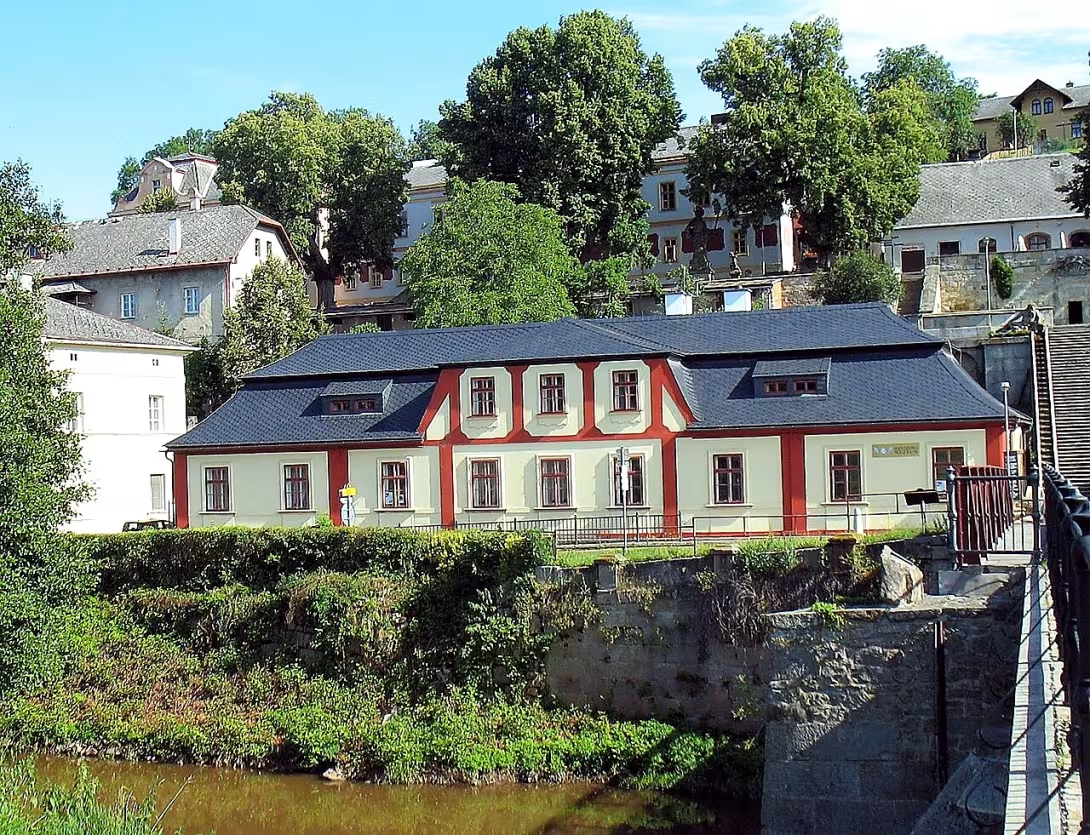
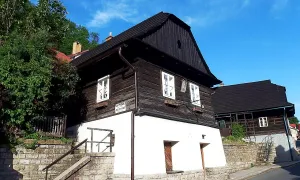
Dům čp. 58 on the street Kopec in Štramberk (district of Nové Jicin) is a historical monument planted in the city monument reservation. This grafted building from the first half of the 19th century represents the original suburban building of the city. Its architecture with dual layout and grafted valley-oriented shield is characteristic of this period.
The history of Štramberka dates back to the 16th century, when the square originally stood at 22 houses with wooden arches, which had a shellfish law. In 1614 the number of farms increased to 28; there was a rectory, church and school in the city. The reign of Jesuits has developed further, as demonstrated by 53 houses listed in 1656. The first walled house No. 10 was built on the square in 1799, which indicates a gradual transition from wooden to walled buildings.
Architecturally, it is a ground-floor grafted building from carved tribes, which stands on a plaster stone suspect. This was used to compensate for significant terrain inequality on the slope. The back of the house is walled from a quarry stone, which looks solid and permanent. The saddle roof is a typical element of the era.
In 1855, Štramberk hit a fire that destroyed approximately 40 houses and two barns. This event influenced the architecture and urban structure of the city, as greater emphasis was placed on security measures and more resilient materials.
Today the house No. 58 is part of the town conservation Štramberka, which makes it an important cultural monument. His history and architectural features attract not only historians, but also tourists interested in the region's rich past. Visiting this building offers a view of life in the first half of the 19th century and allows you to understand the development of the city.
Dům čp. 58 reminds of historical events and architectural development of Štramberka. Thanks to its preservation and inclusion in the monument reserve, future generations can appreciate its importance. For visitors, not only is it an opportunity to think about the historical heritage of our country.
Historical milestones
- 1614
- Increasing the number of farms in the city to 28
- 1656
- Urban development and housing increase for the rule of Jesuits
- 1799
- Construction of the first brick house in the square
- 1800-1850
- The creation of the grafted object No. 58
- 1855
- Destructive fire affecting part of urban buildings
Architectural development
The building is grafted from carved tribes and has a saddle roof. A stone plastered suspect was used to balance the slope. The rear part of the building is removed from the wall of the quarry stone.
Historical events
1855: Fire in Štramberk, which burned down approximately 40 houses and two barns.
Points of interest
- It is a grafted building from the first half of the 19th century, which represents the original suburban building of the city. - The architecture of the house has a double-sided and grafted shield oriented into the valley. - The construction stands on a plaster stone suspect, which was used to compensate for the inequality of the terrain on the slope. - The back of the house is walled from a quarry stone. The object has a saddle roof, which is a typical element of the era.
Guide
Show guide text
This text was created by artificial intelligence and has not been editorially reviewed. It may contain inaccuracies.
Welcome to Štramberk, a city that carries the incredible power of tradition and history. You're standing right where time stops, and before your eyes, there's an object that's one of the last true guardians of the original character of this city. In front of you is house number 58. At first glance, you may find it a simple, modest structure that has quietly bowed into the landscape, but believe me, it is in this simplicity and in this silence that the greatest value lies. Feel the atmosphere radiating from this place. It's not just wood and stone; It is a living witness of ancient times, when the city's borders were still expanding and when life was closely linked to what the surrounding nature offered. This house represents a rare example of the original suburban development, which you can find very difficult to find in today's rapidly changing world.
To really understand why this house is standing right here and why it looks like you see it, we need to go back to the past with you and explore the roots of this city. Štramberk as a city grew and changed for centuries. Already in the year one thousand six hundred fourteen, the number of farms in the city began to change, which meant the need for new dwellings and new living spaces. Later, in the middle of the seventeenth century, for the reign of Jesuits, the city experienced another boom that brought new faces and new needs. Gradually, the city's net was thawing and the house was changing the face of the entire valley. Around the year a thousand seven hundred ninety-nine began to appear the first brick buildings right on the square, which was the beginning of a new era in architecture. However, this area where you are now remains loyal to the old ways of construction. Just in the first half of the nineteenth century, between the years of a thousand and eight hundred and fifty, this grafted object was created. It was built at a time when people still relied on what the forest and rock provided. But you have to realize the risk of life at that time. In the year of a thousand eight hundred fifty pięť, the city met with a devastating fire that hit part of the city building. But this house has endured, making it an even more precious monument to resilience and stability.
Now pay attention to the architecture itself and what you see right in front of you. Look at the material the house is made of. It's not just ordinary wood. Notice the massive, carved tribes that make up walls. This technique was absolutely crucial at the time to ensure the strength and longevity of the construction. Each cut in the wood is proof of manual labor and deep understanding of the material. Notice also how the house is oriented towards the outside world. Its grafted shield goes directly to the valley, which gives the construction a specific character and allows it to harmonically fit into the sloping landscape. The whole layout of the house is two-piece, which was a practical solution for separating various parts of everyday life at the time. Now try to look below, to the foundations that hold this whole structure. See that stone, plastered suspect? It's not just for decoration or as an aesthetic element. It is a brilliant and practical solution that was to offset the terrain inequality on this slope. Without this solid stone foundation, the house in this challenging place could not stand steady. And if you could look at the back of the object, you would see an interesting contrast that points to the complexity of the construction at the time. While the front part is wooden and friendly to the view, the back part is built from a masonry made of quarry stone. This combined way of building shows how people could use different materials to create a solid and functional household that can withstand all the effects of weather.
Even if we were unable to keep the names of specific builders or families that lived in this house in historical records, we must imagine them. Imagine the hands that worked hard to carve these tribes, those people who were in this house looking for shelter from rain and cold, and those families who lived their joys and hard moments here. Every trace on this wood, every inequality of stone in the suspected, is a trace of human efforts and efforts to create a home. Even if we don't know their names, we perceive their presence through this structure, which was the safety and foundation of their existence. There are hidden, invisible people who have filled this space with life.
The interesting thing that can think of you is the infirmity of this place. At a time when the world around Štramberk began to change rapidly and when wooden buildings became a risk due to frequent fires, this house was preserved. It is a fascinating mystery how we managed to maintain such a traditional, grafted structure in an environment that was gradually changing towards a more modern, walled architecture. It's like this house wants to stay faithful to its origins and refuse to submit to the trends of its time. It is a symbol of continuity that teaches us that even what is built of natural materials can be extremely permanent if it is created with balance and respect for the outside world.
I hope this short stop at house number 58 brought you closer to the history of this beautiful city and helped you see its depth. But now you have another road to go. Continue along the streets of Štramberka, perceive every detailed structure of the surrounding buildings, look at the slope of the streets and let yourself drift through the atmosphere of this place. Every stone, every wooden structure, and every plaster wall here have their own unique story that just waits for someone to discover it. Thank you for spending this moment with us, and we will wait you out on your next tour of this beautiful city. Goodbye.
Tips for visitors
The best time to visit is late afternoon, when the sun lights up a grafted shield heading into the valley, creating ideal lighting conditions for shooting historical buildings. Spring and autumn season are suitable for quieter observation of the object without large crowds.
You can reach Štramberka by car and public transport. Check the current traffic connections and parking facilities near the city's heritage reservation in internet search engines or official transport portals.
For comfortable movement in the historical part, we recommend to bring comfortable shoes suitable for uneven surfaces. For families with children, a walk within the city conservation Štramberk offers an interesting opportunity to explore ancient wooden buildings.
When visiting, focus on detailed views of the grafted construction of the house No. 58. The entire area of the city conservation Štramberk offers a rich environment for every lover of history and traditional architecture.
Businesses nearby
Do you run a restaurant, accommodation, shop, museum, rental, wellness or other visitor service near this monument? Show yourself directly to the people heading to it — this is how they will see you in the app and on the web:
Nearby
City Heritage Reservation Štramberk.
Accommodation nearby
Themed route
Dům čp. 58 is the key point of this short walk, which represents a demonstration of traditional folk architecture in the heart of the city. This property, classified as other monuments, captures the authentic atmosphere of a strutberish building and offers a view of the historical nature of the village. The visitor can admire the details of the facade and imagine living in the past centuries, when the daily events of the locals took place in such houses.
The tour continues to a wider context, which consists of the City Monument Reservation Štramberk. This protected zone covers the entire historical part of the city and ensures that its unique urban plan is maintained. Walk down the streets of the reservation allows you to connect individual architectural elements to the whole and understand how the city evolved over centuries. Reservation serves as a framework for the main destination of the route and gives it historical depth.
Within this reservation the visitor can move around historical core Štramberku, where old houses are interconnected with narrow corridors and squares. This area is ideal for a slow walk where you can observe the roofs, windows and entrances that are typical of this part of Moravia. The atmosphere here is calm and reminiscent of another era, which creates contrast with modern surroundings.
It is recommended to finish the route by returning to Dom no. 58 from a different point of view to highlight its position in connection with the overall installation. In this way, a comprehensive picture of how individual monuments connect to a functional and aesthetic whole is created. This strategy makes it possible to fully exploit the potential of the site without leaving its borders.
The entire route is designed to be clear and understandable for every visitor. Focus on the specific house and its immediate surroundings within the booking ensures deeper knowledge instead of superficial gathering information. The trip thus designed respects the limitations given by the materials and offers an authentic experience of Štramberk history.
Seasonal recommendations
The spring visit brings with it freshness and awakening nature in the surrounding hills. The light is delicate in this period and ideal for shooting details of historical architecture without sharp shadows. We recommend wearing layered clothes because the morning cold can still smell. The road to the monument is more peaceful at this time, which allows you to perceive the city's atmosphere without a great rush.
Summer season is characterized by intense sunshine and lively atmosphere of the town. Due to the increased number of visitors in the main summer season, it is best to arrive early in the morning to see the memory in peace. Clothes should be light and breathable, don't forget the sun protection and plenty of fluids. It can be hot in the narrow streets in the high noon, therefore it is more pleasant to walk in the morning.
Autumn in Štramberk offers a fascinating view thanks to colorful leaves and morning fog, which deliver the historical environment mysterious. The golden light of the autumn sun beautifully highlights the texture of the old facades. Quality, waterproof shoes and a warmer layer of clothing are essential for comfortable movement around the town. The ideal time for a visit is afternoon hours, when the colors most excel.
The winter visit is connected with calm and perhaps also a snow blanket, which turns the town into a fabulous setting. In advent time the atmosphere is very cozy, although the days are short and the light quickly disappears. It is necessary to prepare for strong frosts and choose very warm clothes including gloves and caps. Watch out for slippery paving cubes and count on the fact that during this period the availability of objects may be limited due to shorter daily time.
Visualizations and artistic views

The visualisations are generated by artificial intelligence and serve as inspiration.
Photos from the area
Real photos taken near the monument


Zdroj a licence jsou uvedeny u každého snímku.
Tips from visitors
No tips yet. Be the first!
Log in and add your tip.
Sources and literature
Faktickým podkladem tohoto textu byl článek na Wikipedii, jehož autory jsou přispěvatelé Wikipedie. Článek je dostupný pod licencí CC BY-SA 4.0.
Location on the map
More monuments – Štramberk
Show all in the municipality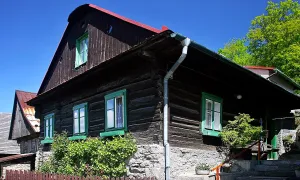
Příběhy a pověsti
Legendy, pověsti a příběhy spjaté s touto památkou
Fotografie návštěvníků
Zatím žádné fotografie. Buďte první, kdo přidá fotografii z návštěvy!
Přihlaste se a přidejte svou fotografii nebo hodnoťte.
Za ověřenou návštěvu v aplikaci získáte víc bodů — poznáme podle GPS, že jste na místě.
Reviews and comments