



Dům U černého orla v Litoměřicích House
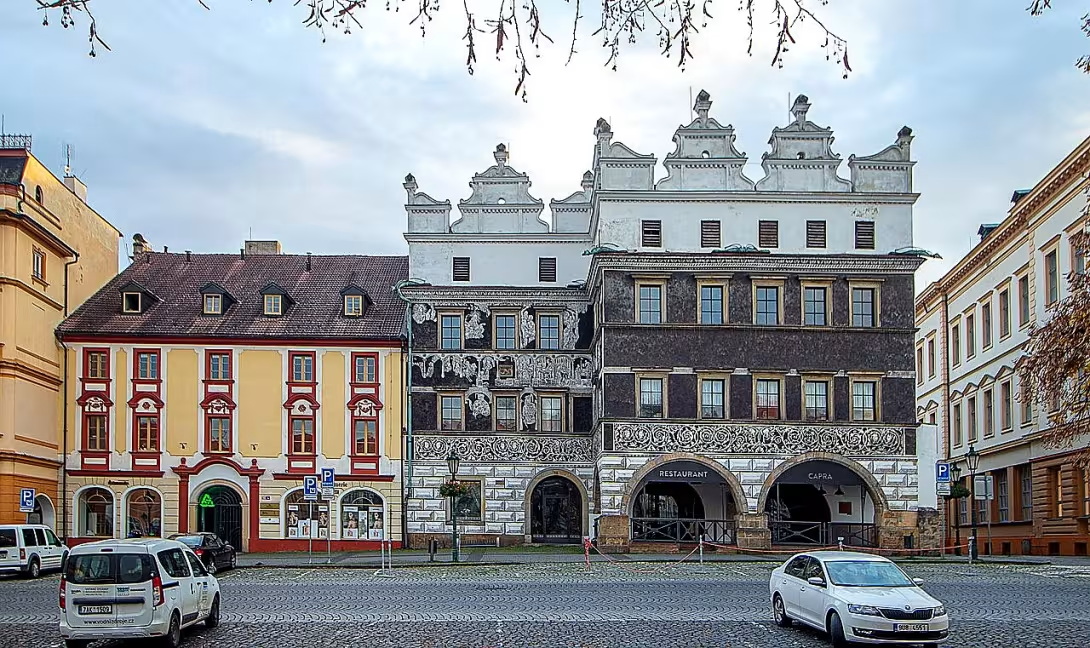
The House of the Black Eagle in Litoměřice represents one of the key real estate cultural monuments that illustrates the urban early Renaissance architecture. Located in the village Litoměřice-Město and is considered one of the first hotel facilities in Central Europe. Its history dates back to the 14th century, when it was founded as a Gothic building for the Dionysia House family. In the 16th century a renaissance reconstruction was carried out by Italian architect Ambroggio Balli, also known as Vlach.
The history of the house begins in the 14th century, when the Gothic building was founded for the family of Dionysia House. Over the years, the building witnessed several ownership changes and architectural reconstructions. Between 1560 and 1564, the house was remodeled for the Divišovský family, which meant its transformation into an Italian style under the direction of Ambroggio Balli. This reconstruction laid the foundations for the future importance of the house had as one of the first hotel facilities in Central Europe.
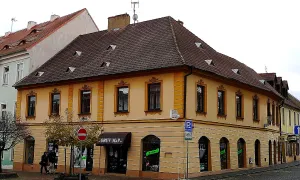
Architecturally, the Black Eagle House is a two-storey corner building with a folded front. The originally late Gothic building was rebuilt in the 1960s in Italian Renaissance style, which included sgraffiti decoration. In 1834 there were interior modifications and repairs of the arches, which was important for maintaining the historical character of the house. The general reconstruction of the building took place in the years 1952-1961, where the original sgraffiti was uncovered.
Owning and managing the house went through different stages. The Divishovsky family bought it from the Royal Speedster Šimon Petr Oulík z Třebenic, who in 1628 Emperor Ferdinand II. liberated the house from taxes and entered it into the Earth records. In 1650, Emperor Ferdinand III. granted him the privilege of a knighthood named Salvo Guardo, which was intended to protect the house from military plundering. In 1726, the Oulík family sold it to the city of Litoměřice, which was subsequently set up here by the barracks and later by the city office.
The Black Eagle House witnessed key events. In 1628 liberated from taxes by Emperor Ferdinandom II, which meant a significant change in his status. In 1650, the house was designated as Salvo Guardo's knighthood, which provided protection against war raids. After World War II, the city set up a clothing factory and a shop.
Today the House of the Black Eagle is not only a cultural monument, but it also works as a Salva Guarda hotel. Its historical significance and architectural beauty make it an attractive destination for tourists and locals. The house has its own courtyard, where the Charles Hynek Mácha City Theatre is located with a poem statue. The Baroque Church of All Saints and Town Hall in the vicinity of the house is in the style of the early Saxon Renaissance, which gives the place another historical significance.
The House of the Black Eagle is not only a monument to architecture, but also a witness to the rich history of Litomeric. Its presence on the town square shows a significant period of cultural recovery and spread of Italian Renaissance inspiration in Central Europe. For those who want to explore the history and architecture of Bohemia, a visit to this house is necessary.
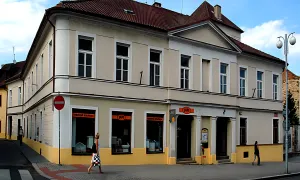
Then and now
Drag the slider to compare how the landmark may have looked when it was built with the view today.
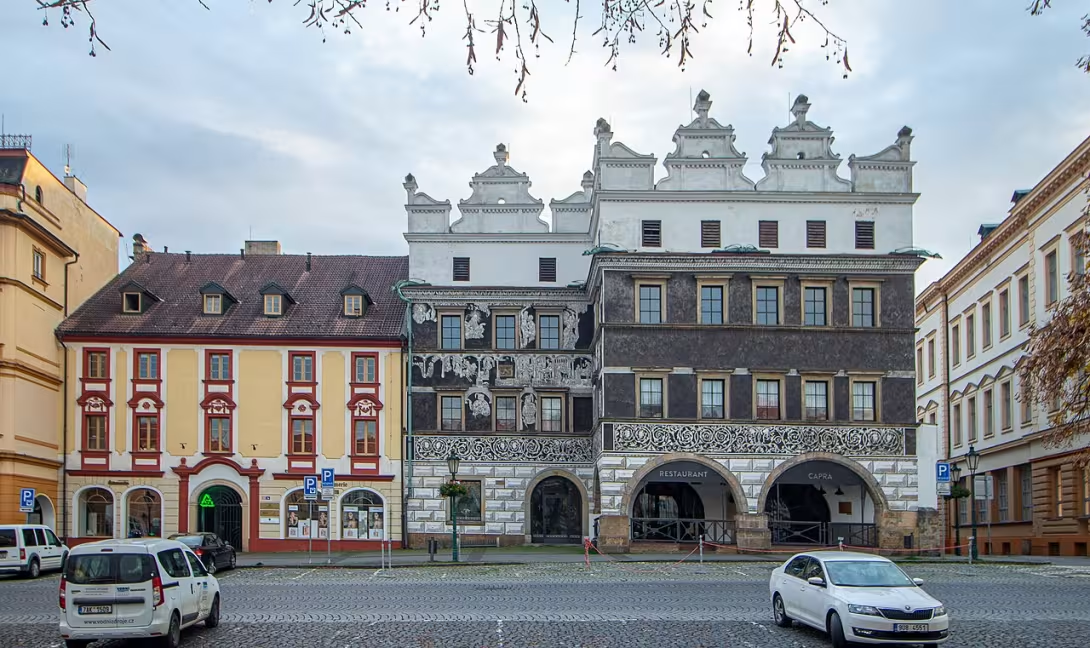

The historical appearance on the left is an AI-generated visualisation and serves as inspiration only.
Historical milestones
- 1560
- Renaissance reconstruction carried out by Ambroggie Balli.
- 1650
- The house was given the prerogative of Salvo Guardo's knighthood.
Architectural development
The house was originally a Gothic building that was rebuilt in the 1960s into an Italian Renaissance style by the architect Ambroggio Balli. In 1834, interior modifications and repairs were carried out, while the general reconstruction of the house took place between 1952- 1961.
Historical events
- 1628
- Emperor Ferdinand II. liberated the house from taxes.
- 1650
- Ferdinand III. granted the privilege of a knighthood named Salvo Guardo.
Points of interest
- The House of the Black Eagle is one of the key real estate cultural monuments that illustrates the urban early Renaissance architecture. - His history dates back to the 14th century when the Gothic building was founded for the Dionysia House family. - Over the years, the building has witnessed several ownership changes and architectural reconstructions, including the Renaissance reconstruction carried out by Ambroggio Balli (Vlach) for the Divišovský family. - The Divishovsky family bought it from the Royal Speedster Šimon Petr Oulík z Třebenic, who in 1628 Emperor Ferdinand II. liberated the house from taxes and had it entered into the Earth's records. - In 1650, Emperor Ferdinand III. granted him the privilege of a knighthood named Salvo Guardo, which was intended to protect the house from military plundering.
Guide
Show guide text
This text was created by artificial intelligence and has not been editorially reviewed. It may contain inaccuracies.
Welcome to the beautiful town of Litomerice. Right now, standing right in front of this building, you have the opportunity to enter a world where history touches the present in every detail. In front of your eyes is the house of the Black Eagle. Feel the atmosphere of a place that is not just an ordinary house, but a living witness of the many centuries that have taken place here. Look at his facade and try to imagine how many people have sought shelter, rest or business opportunity under him in the past. This construction carries the weight of time and is one of the most important examples of how urban architecture in our countries has evolved and changed.
But in order to really understand what you're seeing right now, we need to go back deep into the past together until the 14th century. At that time, this building did not stand here in the form you know now. There is a Gothic history at the heart of this place. At that time, the construction was much more crude and her face was completely different. This Gothic era was closely linked to the family of Dionysus Houska, who had its seat here. Imagine the city back then, its narrow alleys and the sense of certainty the House family was building in this place. It is these old, Gothic roots that form the basis on which the whole future glory of this house later was built.
Now, however, pay attention to the great turning point that has completely changed the direction of this place. If we look into the chronicles, we'll find that in the 16th century, there was one of the most important events in the history of this house. In a thousand and five hundred and sixty, a major reconstruction took place. A man named Ambroggio Balli came to town, a master who brought with him new visions and new ways of seeing beauty. Balli was a man from the southern lands, which means he brought the spirit of the Italian Renaissance to Litoměřice. Thanks to his work, this house turned from its original Gothic building into a wonderful example of early Renaissance architecture. Feel the transformation as the old shapes turned into new, harmonious and balanced shapes that are so typical of this style. It is thanks to this reconstruction that the house is now considered one of the most important examples of township housing at the time.
Now, if you look again at the overall design of the building, try to realize that this house was not just an ordinary house for one family. His history teaches us that he was very progressive. Do you know that this object was seen as one of the first places in the entire central part of our country to offer accommodation for passengers? Imagine the first people here to look for a safe place to stay, the first guests here to experience hospitality at a time when the roads haven't been as well as they are today. This house was therefore a pioneer in the area of accommodation and services for people on the road, which gave it very special importance throughout the region.
The history of this place is also inseparable from the names of the great personalities that probably hosted or related to this place. There were people in this area whose names are among the greatest in the history of our countries. We can mention Simon Peter Oulik from Třebenice, who was part of this historical context, for example. And perhaps most fascinating, this house witnessed the presence of even the highest power. We can think here that there were also monarchs like Ferdinand II. or Ferdinand III.. Imagine the weight of history when there were people in these spaces who made decisions about the fate of nations. Each of these people left an invisible clue in the atmosphere of this house.
And now I want to tell you one very interesting thing that gives this place an even higher status. In a thousand and six hundred and fifty something extraordinary happened. The house has acquired a special privilege called Salva Guardo. This privilege brought him the knighthood status. It's not just ordinary law, it's an honorable sign that the house has set aside from a number of ordinary townspeople 'houses. This privilege has given him some nobility and dignity that you can perceive even today when you look at his face. This is proof of how much this house was perceived as a significant and respectable place in the social hierarchy.
So the Black Eagle House is more than just a building of stone and mortar. It's a layered book that tells us stories about the House family, about the Italian masters who brought new light to our cities, about the first passengers looking for rest and about the kings who sought refuge here. Every era, from goth to renaissance to fourteenth century and beyond, left its mark.
I hope that this short journey through time that we have just taken before this monument has caught your attention. Now that you know more about what happened here, I suggest you continue your tour of the city. Litomerics have many other hidden treasures waiting for you. Thank you for your time and I wish you a beautiful and inspiring walk in history.
Tips for visitors
The best time to visit Dom U Black Eagle is in the spring or autumn season when the light is pleasant and the temperature is comfortable. This time of year also offers a beautiful opportunity for photography with mild colours of trees or flowering flowers.
You can use both cars and public transport to reach the sights.
When visiting, remember air-conditioned clothes, especially in the winter months. It is advisable to photograph during the day in order to capture the details of architecture in sunlight.
The Baroque Church of All Saints, which is about 30 minutes' walk, is situated in the surroundings of the House U Black Eagle. This place offers another historical value and a beautiful opportunity for photography.
For families with children it may be interesting to explore the surrounding streets of Litoměřice, where you can find other historical buildings and parks suitable for short walks.
Frequently asked questions
Can the monument be visited?
This is a residential or farm building, not a museum with opening hours. Please view it from public space and respect the owners' privacy. We have no information about access to the interior.
Where is the monument?
Location: Litoměřice-Město. The map on this page shows the exact spot.
Why is the monument protected?
It is listed in the Central List of Cultural Monuments of the Czech Republic as a cultural monument (register no. 1000124673).
Businesses nearby
Do you run a restaurant, accommodation, shop, museum, rental, wellness or other visitor service near this monument? Show yourself directly to the people heading to it — this is how they will see you in the app and on the web:
Events nearby


Zdroj akcí: otevřená data měst a obcí ČR (Národní katalog otevřených dat) a kalendář akcí Národního památkového ústavu.
Nearby
Barokní kostel Všech svatých
Radnice ve stylu rané saské renesance
Accommodation nearby
Trips and activities nearby
Guided tours, tickets and activities nearby from GetYourGuide
Affiliate link: if you buy from the partner, we may receive a commission. The price for you does not change.
Search tours and activities →Themed route
1. Town Hall in the style of the early Saxon Renaissance Type: Historical building. Why to visit: This building shows the beauty of the early Saxon Renaissance.
2. Baroque Church of All Saints Type: Church. Why to visit: You can observe Baroque architecture here.
3. The Black Eagle House Type: Historical House. Why to visit: It is the main objective of your tour.
Seasonal recommendations
Spring: In the spring season the atmosphere around Dům U černého orla v Litoměřicích is full of newly blooming flowers and green nature, which awakens after a freezing winter sleep. The sun rays illuminate the building with fine shadows, which gives its historic facades life and beauty. It is advisable for visitors to choose clothes for the transition between cold wounds and warmer noon hours such as sweaters or light jackets. The best place to visit is in the early afternoons, where fewer people are on the streets and nature offers the most beautiful view.
Summer: Summer brings long sunny days and warm evenings, making the Black Eagle House an ideal place to relax in a quiet environment. The sun illuminates the building directly from the head, highlighting its architectural details and history. When visiting, it is advisable to choose light clothes that protect from sunlight such as ties or high collar hats. The best time for a tour is an early morning or evening when the temperature calms down and fewer people walk the streets.
Autumn: In autumn the area around Dům U černého orla v Litoměřicích becomes the colour of golden leaves that are stolen into the shadows of the building. The sun's dawn is shorter and the light falls on the facade in the angles, which adds a melancholy touch to the place. It is advisable for visitors to choose warmer clothes such as long-sleeved jackets or shirts, and perhaps even an umbrella for possible springs. Best to visit the memory in the early afternoon, when the temperature is still pleasant and fewer people wander around.
Winter: Winter atmosphere around the House The black eagle is characterized by cold winds, snow and light falling on the building from low clouds. Sun rays can be projected into the glass facade, which gives the place a magical touch. It is important for visitors to choose warm clothes such as fur or duvet jackets, and suitable shoes on cold surfaces. The best time for a tour is at noon, when the sun lights the building most beautifully and can warm up the cool winter.
Visualizations and artistic views


The visualisations are generated by artificial intelligence and serve as inspiration.
Photos from the area
Real photos taken near the monument


Zdroj a licence jsou uvedeny u každého snímku.
Tips from visitors
No tips yet. Be the first!
Log in and add your tip.
Sources and literature
Photos: VitVit / CC BY-SA 4.0 — Wikimedia Commons. The author and licence also appear when you hover over the image.
Faktickým podkladem tohoto textu byl článek na Wikipedii, jehož autory jsou přispěvatelé Wikipedie. Článek je dostupný pod licencí CC BY-SA 4.0.
Location on the map
More monuments – Litoměřice-Město
Show all in the municipality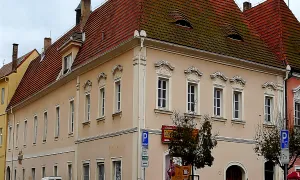


Příběhy a pověsti
Legendy, pověsti a příběhy spjaté s touto památkou

Fotografie návštěvníků
Zatím žádné fotografie. Buďte první, kdo přidá fotografii z návštěvy!
Log in a přidejte svou fotografii nebo hodnoťte.
Za ověřenou návštěvu v aplikaci získáte víc bodů — poznáme podle GPS, že jste na místě.
Reviews and comments