



dům U Červeného orla House
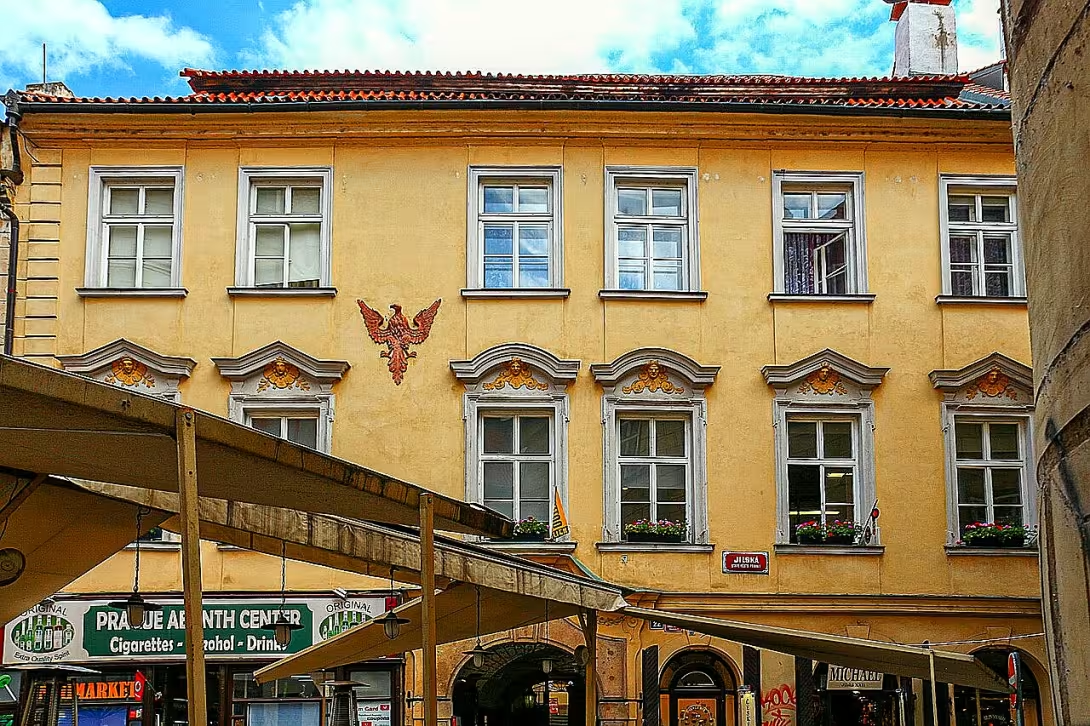
The House of the Red Eagle is a historical object no. 452, which stands on the Old Town of Prague between Jilska street and Hlavsová street. This cultural monument of the Czech Republic excels by layering architectural styles from Romanesque foundations to classical adaptations. The interior preserved authentic Gothic vaults and Renaissance elements.
There are few direct reports of the oldest history of construction. However, construction research confirms that there was a Romanesque object on the site. The first written mention dates back to 1404, when there was probably already a storey building oriented to the street. During this period, the Czech countries were in times of pre-Hussite unrest and growing criticism of the church, while the foundations of early humanism were formed in a broader European context.
The architectural development of the house is the result of many reconstructions. The original Romanesque foundation was gradually gothic and expanded. A significant extension of the building to the yard took place around 1490. At the beginning of the 17th century, a late Renaissance reconstruction followed, in the first decade of the 18th century, a top Baroque treatment, and after the mid-19th century the house acquired its classical form.
The object construction represents a valuable set of historical elements. Authentic Gothic vaults have been preserved in the basement. On the ground floor there is a room with a cross vault and on the first floor is preserved Renaissance space decorated with ceiling mirror. The building is situated in a landmark building between the Three Peasants' and the Whale's houses.
The House of the Red Eagle is an important document of the continuous development of Prague's urban residence. A walk through the historical centre near the church of St. Jilje or the Bethlehem Chapel offers an opportunity to explore the pedestal history of the Old Town building.
Then and now
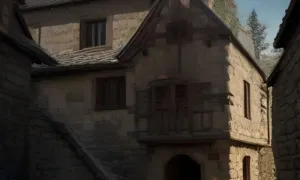
Drag the slider to compare how the landmark may have looked when it was built with the view today.
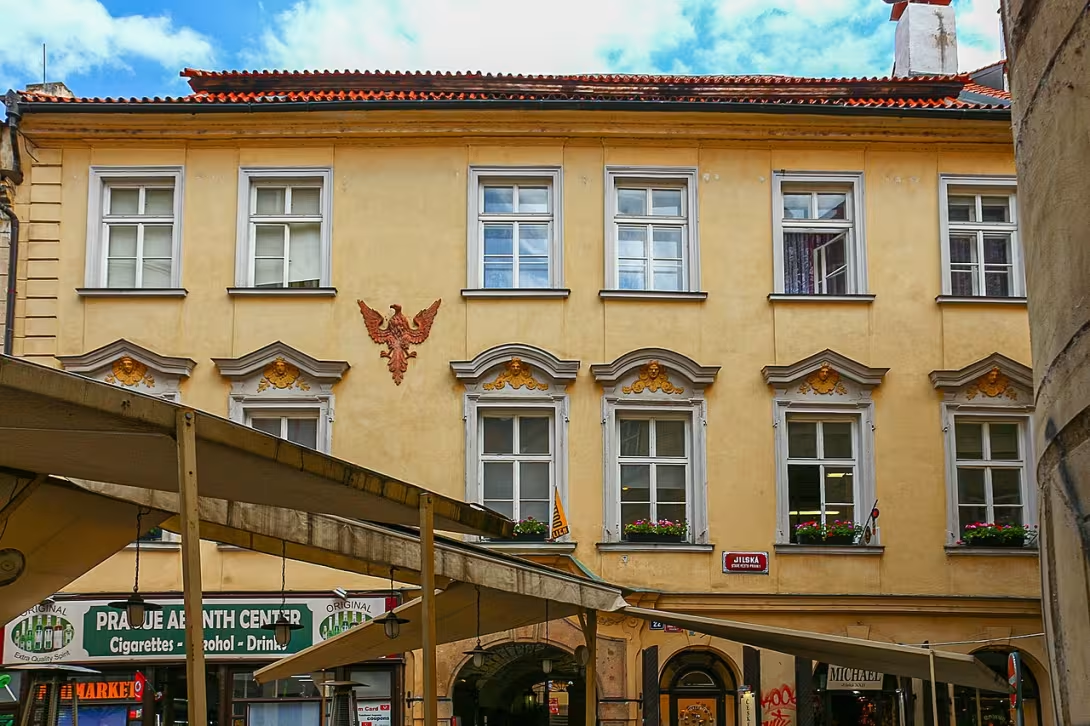
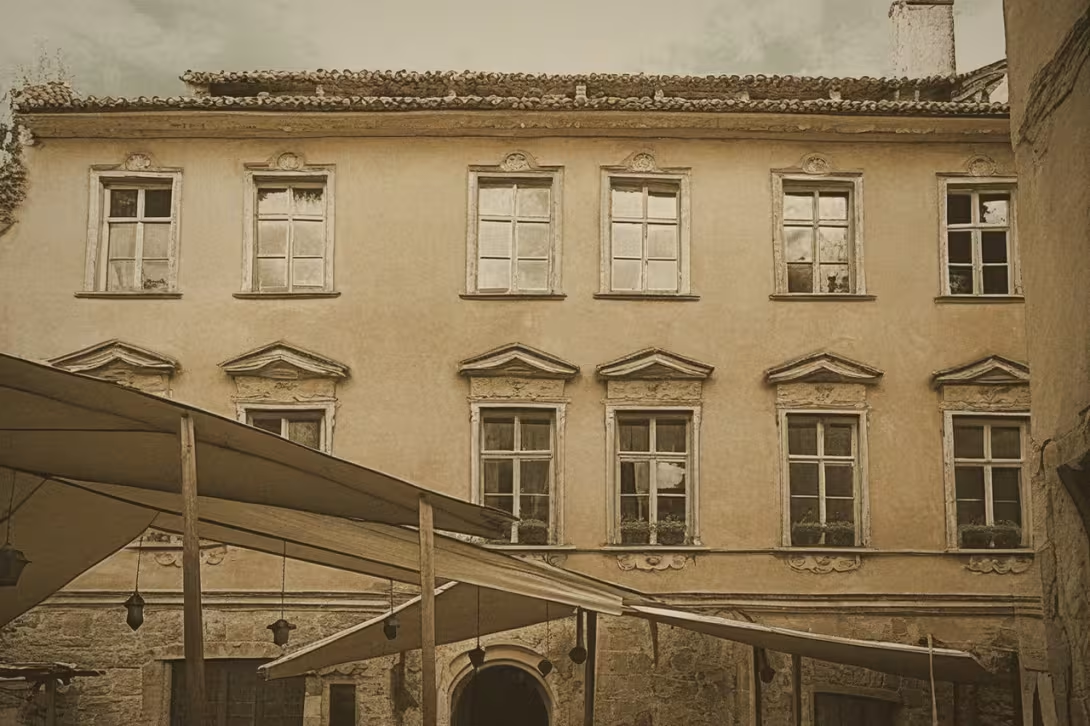
The historical appearance on the left is an AI-generated visualisation and serves as inspiration only.
Historical milestones
- around 1200
- The creation of Romanesque foundations of construction
- 1404
- First written mention of the existence of the building
- around 1490
- Significant extension of the building to the yard
- around 1600
- Late Renaissance reconstruction of the building
- around 1705
- Highly Baroque style house
- about 1850
- Classicism and acquisition of contemporary form
Architectural development
The original Romanesque foundation was gradually Gothic and expanded. At the beginning of the 17th century, a late Renaissance adjustment was carried out, followed by the highest Baroque reconstruction in the first decade of the 18th century. The last major transformation took place in a classical spirit after the mid-19th century.
Historical events
The first written mention of the house dates back to 1404. A significant extension of the building to the yard took place around 1490.
Points of interest
- The building has Romanesque foundations, on which additional architectural styles were gradually layered up to classical modifications. The first written mention of the building dates back to a thousand four hundred and four. A significant expansion of the house into the court occurred around the year one thousand four hundred and ninety. - The original Gothic vaults are preserved in the basement and on the first floor is a Renaissance space with a ceiling mirror. - The house is located between two other historical buildings called the Three Peasants and the Whale.
Guide
Show guide text
This text was created by artificial intelligence and has not been editorially reviewed. It may contain inaccuracies.
Welcome to the heart of old Prague. You're standing in one of those places where time seems to be denser and where every tile under your feet tells stories from centuries ago. You have the advantage of being in a place where history is constantly being rewritten, but it never completely erases what was here before. The dům U Červeného orla stands before you. It is located in a narrow and picturesque space between the street of Jilska and Hlavsova, in the very core of Prague's Old Town. If you look around now, you'll feel the strange atmosphere of the old metropolis where modern life tries to spin through narrow passages and historical facades. This house is not just an ordinary house, it's like a living organism that grew, changed its skin and adapted to every new time that came.
Let's go back deep into the past together to understand where this object comes from. Imagine the beginning of the third millennium after Christ, about a thousand and two hundred in particular. This is the time when the very first foundations were laid, the Romanesque foundations on which this house stands today. Back then Prague was a different city, much more common, but already at this point the foundation for future grandeur began to be laid. But the first real confirmation that this house exists and is part of the city is found only in the Middle Ages. In the year of a thousand and four hundred and four, his existence was first written in historical records. This means that the house already had its fixed position and its own name, although its appearance has changed many times since then.
Now pay attention to how this house has grown. Around the year a thousand four hundred and ninety took a very significant step. The building began to expand towards the inner court. It was a crucial moment when the house stopped looking only on the street and began to create its own closed world inside. This growth process continued for centuries, and every new generation of people who lived here wanted to have their own style and their own form. Around the year a thousand and six hundred were brought into the house by the spiritual and aesthetic power of the late Renaissance. People then sought harmony and new ways to express their dignity through architecture.
But there was another big turnaround. Around the year a thousand seven hundred and five the house witnessed the peak of the baroque era. Baroque brought movement, emotion and richness of shapes to Prague streets. Even though we don't see every single ornament today, the Baroque soul of the house is still felt in its overall structure. And to make the house look like you might see it in its present form, we have to look at the mid-nineteenth century. Around the year a thousand and eight hundred and fifty underwent modifications in the spirit of classicism. It brought to the construction order, peace and some simplification, which today allows us to perceive the house as a whole, which is united even though it is composed of many different layers.
If you look at the building now, try not to just look at its outer walls, but feel the incredible subtlety. You're standing in front of the architect's palimpseur, where one era rewrote the previous one, but the older footprints remained hidden beneath the surface. You see it in the rhythm of the windows, in the thickness of the walls, and in the way the house was wedged between the neighboring buildings. It is a fascinating process as the Romanesque foundations, Gothic elements, Renaissance shapes, Baroque richness and classical purity intertwined into one whole.
You may now ask who suggested all these changes. Who were the masters who held the instruments and determined the fate of these walls? Unfortunately, history has not given us the names of the particular architects who shaped this house. We don't know the names of the builders or the names of the great personalities who would live here in the past. And that is where the greatest mystery and beauty of this place lies. This house is not a monument to one particular person or one great artist. It is a monument to thousands of unknown people - craftsmen, workers, traders and residents who lived here every day, worked and made their own history. It's those anonymous creators whose hands created these walls and whose lives took place in these rooms.
If you're interested in the hidden side of this house, I must invite you to imagine what is under your feet. Although you are now out in the space between the streets, the house hides its most precious treasures deep in the earth. The original Gothic vaults were preserved in the basement. These stone arches are like the skeleton of an entire house, a silent witness of ancient times, when they were built with a different precision and a different force. These vaults are one of the few elements that allow us to almost directly touch medieval Prague, which was here long before the street of Jilská became what it is today.
Consider how incredible the continuity is. From a thousand to this day, 200. From Romanesque stones to today's protection as cultural monuments of the Czech Republic. This house has survived wars, fires, changes in political systems and completely new ways of life. He survived because he could adapt. He survived because every new era found its place in him. That's the biggest lesson this object can give us.
Now that you know about its deep roots and its changing face, I suggest you continue your walk around Old Town. Let yourself drift through the atmosphere of these narrow alleys. Any other house you meet may have a similar story of hidden layers and unknown creators. Perhaps you'll stop at the next monument and find the same connection between old and new. Thank you for spending this moment with us and paying attention to the Red Eagle House. I wish you a beautiful and inspiring journey further through the history of our city.
Tips for visitors
I recommend a visit in the morning during the working week when you avoid the greatest onslaught of tourists in the narrow streets of Old Town and enjoy a quieter atmosphere of the historic core.
The house is located in a pedestrian zone where the entrance of vehicles is restricted. Use public transport to travel and get off at the nearest stop within walking distance from where you can walk. Search the current connection in the transport application.
Take comfortable shoes suitable for walking on historic tiles. If you plan to photograph, the best light to capture the details of the facade of the house is during the sunny days when the sun lights up the facade of the Jilska Street.
In the immediate vicinity, you can visit the Old Town Square, see the architecture of the church of St. Gilje, visit the Bethlehem Chapel or walk through the historic Charles Street.
For families with children the location is ideal for walking history. The alleys are narrow, which is why I recommend keeping the children under constant supervision and choosing a stretcher rather than a stroller for the smallest.
Frequently asked questions
Can the monument be visited?
This is a residential or farm building, not a museum with opening hours. Please view it from public space and respect the owners' privacy. We have no information about access to the interior.
Where is the monument?
Location: Praha 1, Hlavní město Praha. The map on this page shows the exact spot.
Why is the monument protected?
It is listed in the Central List of Cultural Monuments of the Czech Republic as a cultural monument (register no. 1000150516).
Businesses nearby
Do you run a restaurant, accommodation, shop, museum, rental, wellness or other visitor service near this monument? Show yourself directly to the people heading to it — this is how they will see you in the app and on the web:
Events nearby

Zdroj akcí: otevřená data měst a obcí ČR (Národní katalog otevřených dat) a kalendář akcí Národního památkového ústavu.
Nearby
Staroměstské náměstí, kostel svatého Jiljí, Betlémská kaple, Karlova ulice.
Accommodation nearby
Trips and activities nearby
Guided tours, tickets and activities nearby from GetYourGuide
Affiliate link: if you buy from the partner, we may receive a commission. The price for you does not change.
Search tours and activities →Themed route
Red Eagle House Type: Historical building Why is it worth a visit: This monument represents the key point of your tour where you can enjoy the atmosphere of the old town and the details of the facade. It's an ideal place to start, to develop the context of surrounding historical buildings.
Old Town Square Type: Square Why is it worth a visit: A short walk from the house takes you to the heart of the historical center. Here you can get carried away by the ruckus and architectural wealth surrounding the main destination of your route.
St. Jilji's Church Type: Church Why is it worth a visit: Located in the immediate vicinity of the square and offers contrast to surrounding secular buildings. Its peaceful atmosphere and historical value complement the image of an old-town building.
Bethlehem Chapel Type: Chapel Why is it worth a visit: This small sacral structure is an important part of the local heritage. Its position allows a smooth connection with other destination routes without the need for long movements.
Charles Street Type: Street Why is it worth a visit: The final part of the route leads through this iconic street which connects various parts of the historical core. It offers great views and the possibility to end the walk in a quiet but still historically challenging environment.
Seasonal recommendations
Spring: During the spring season dům U Červeného orla is particularly lit by the sun rays that penetrate the streets of Old Town and decorate historical architecture with pink and yellow colors. Nature wakes up, lilies and tulips bloom in the courtyard, adding freshness and new hope to the atmosphere. Visitors should count on moderate crowds, because it is a popular time for first walks out. It is recommended to visit early morning or late evening when there are fewer people and the atmosphere is quieter. Clothes should be mild - warm coat for cooler mornings and evenings.
Summer: During the summer period, dům U Červeného orla becomes the center of attention when the sun lights up the streets of Old Town with long and warm days. The atmosphere is full of living with people sitting on outdoor platforms enjoying beautiful weather. The main summer season increases the flow of tourists, so we recommend visiting early morning or late evening to enjoy the memory without overloading the crowd. Due to the warm weather, it is advisable to wear light clothes and not miss sun protection.
Autumn: Autumn season offers dům U Červeného orla in a beautifully coloured light when tree leaves turn Old Town into a lively palette of gold and red shades. The atmosphere is calmer with mild weather, which allows you to enjoy the sights in peace. Shortly after the full moon, street lighting changes and brings the magic of autumn evenings. We recommend wearing warmer clothes because they start colder nights, and visiting a memory at noon when the sun is still in the sky.
Winter: The winter season brings dům U Červeného orla to the atmosphere fairy tales with the ice and snow streets of Old Town. Sun rays illuminating snowy architecture add landscape beauty, which can be used especially in advent time. Visitors should expect shorter opening times and warmer clothes due to cold autumn and winter days. It is recommended to visit the memory early in the morning when there are fewer people on the streets, and take advantage of the opportunity for a photo with the background of the Old Town.
Visualizations and artistic views


The visualisations are generated by artificial intelligence and serve as inspiration.
Photos from the area
Real photos taken near the monument

Zdroj a licence jsou uvedeny u každého snímku.
Tips from visitors
No tips yet. Be the first!
Log in and add your tip.
Sources and literature
Photos: VitVit / CC BY-SA 4.0 — Wikimedia Commons. The author and licence also appear when you hover over the image.
Faktickým podkladem tohoto textu byl článek na Wikipedii, jehož autory jsou přispěvatelé Wikipedie. Článek je dostupný pod licencí CC BY-SA 4.0.
Location on the map
More monuments – Praha 1
Show all in the municipality

Příběhy a pověsti
Legendy, pověsti a příběhy spjaté s touto památkou
Fotografie návštěvníků
Zatím žádné fotografie. Buďte první, kdo přidá fotografii z návštěvy!
Log in a přidejte svou fotografii nebo hodnoťte.
Za ověřenou návštěvu v aplikaci získáte víc bodů — poznáme podle GPS, že jste na místě.
Reviews and comments