






Dům U severní hvězdy House
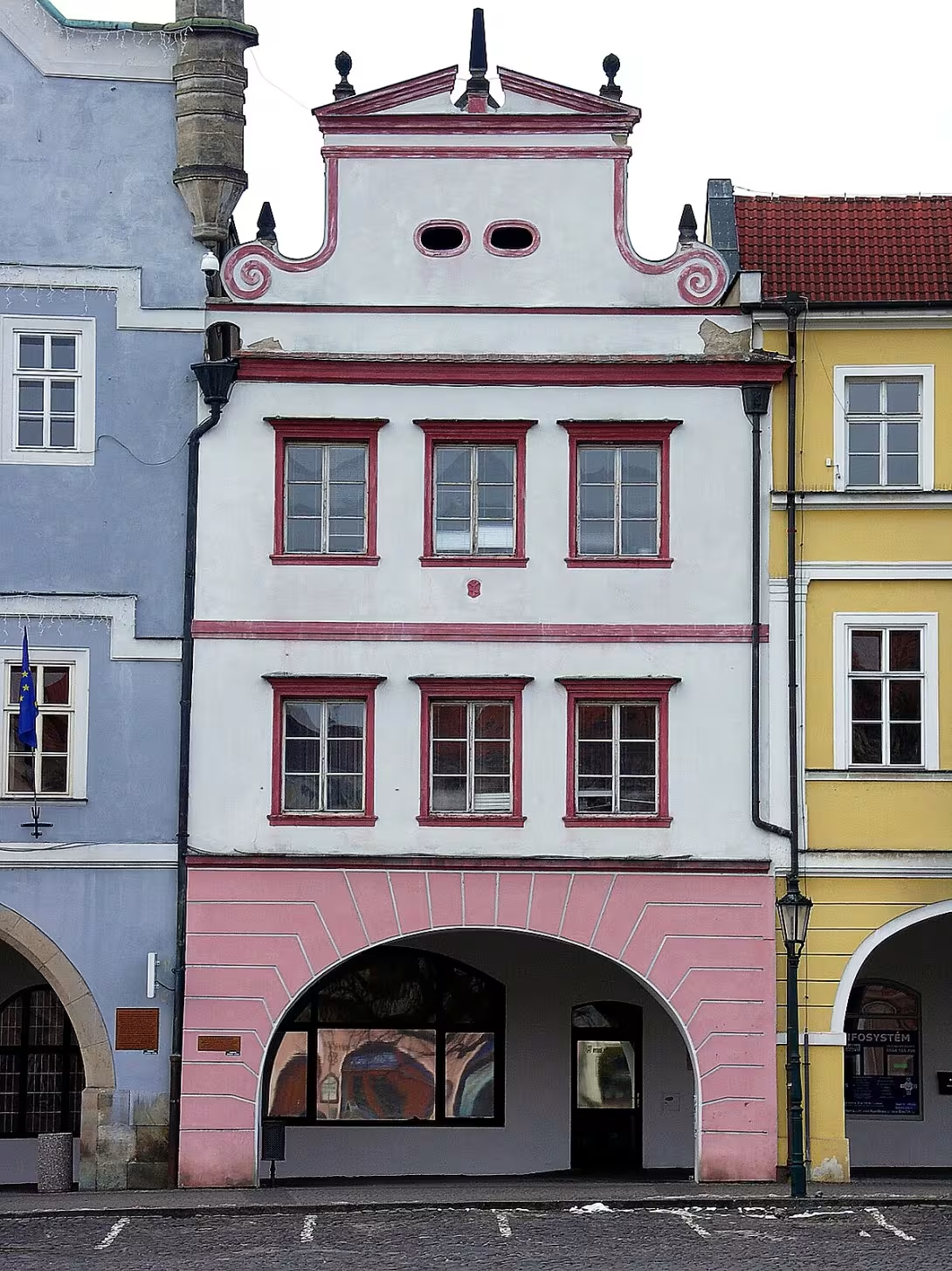
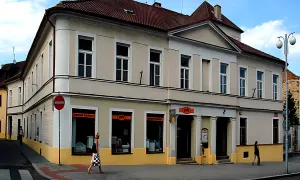
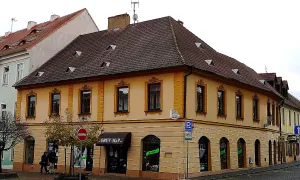
Dům U severní hvězdy is a Renaissance townhouse from the turn of the 15th and 16th centuries, located in the southern part of the Peace Square in the village Litoměřice-Město. The monument is significant by its architectural development from goth to renaissance and is registered as a real-estate cultural monument of the Czech Republic.
The building was built at the time of the transition from goth to renaissance, when urban construction was developed in Czech cities. This style reflected the effects of humanism and new aesthetics coming from southern Europe.
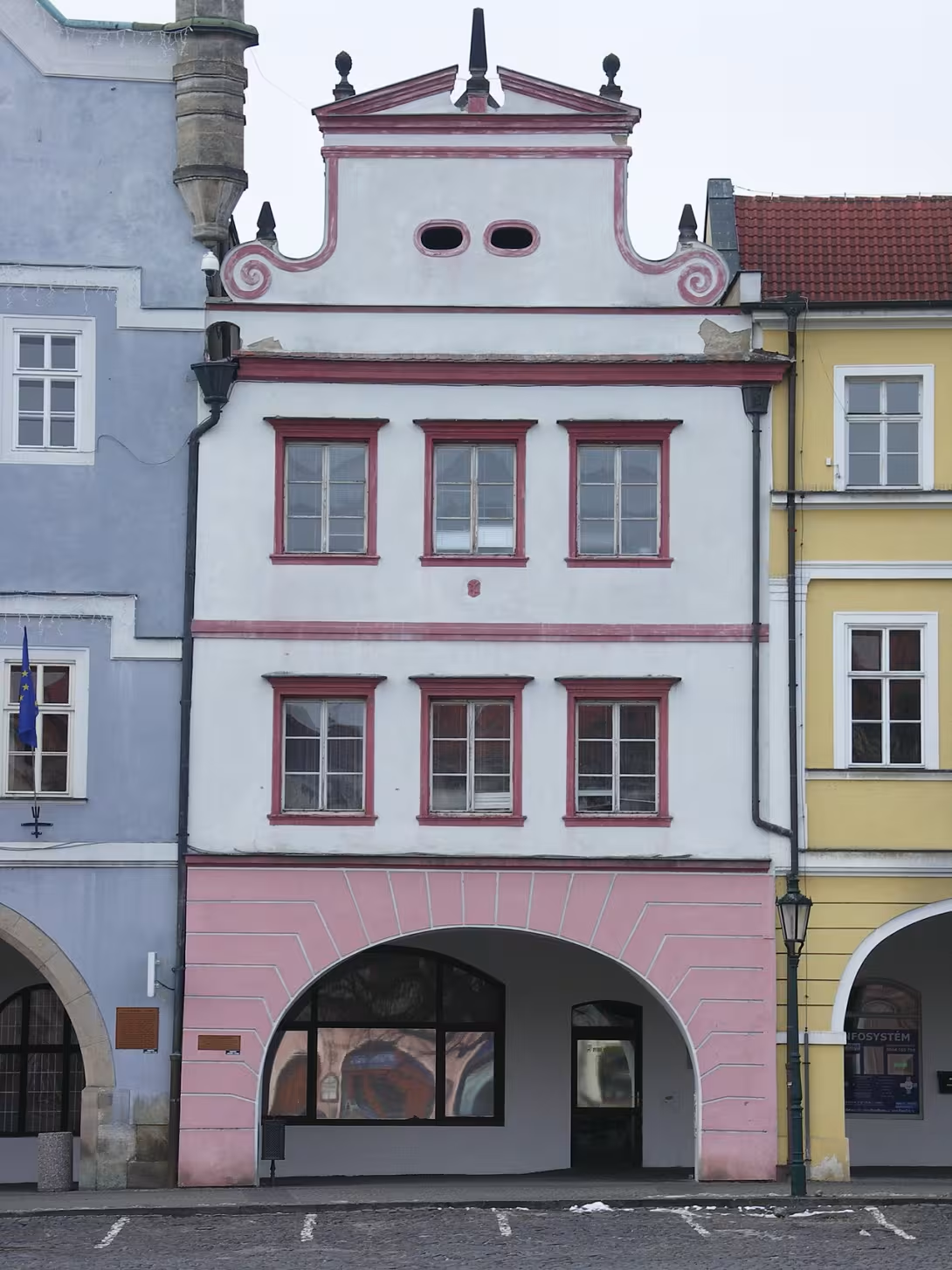
The building is a two-storey house that stores the original Gothic building in its foundations. This includes cellars and ground floor with a wide arch in the arch. During the Renaissance period the house was raised by one floor and ended with a characteristic shield with volute wings and two oval windows. The facade is closed by a triangular tympan with an obelisk at the top and balls on the sides. The windows were preserved by the original stone ledge and frames. Under the middle window of the second floor there is a small stone label with a family sign.
In the interior of the ground floor there are two boxes of cross vaults with nails in front of the stairwell with carved railing. The other rooms, including the rooms on the first and second floors, have flat ceilings, with preserved original Renaissance roofs. There is a rectangular chamber in the rear wing facing the yard. The interior of the house was partially rebuilt in the 19th century.
The house is connected with lithomeric underground cellars, which is among the largest in Bohemia. The monument is closely adjacent to the House of Kalich, originally called House under Báňí, which serves as the seat of the City Office.
At present Dům U severní hvězdy is recognised as a real-estate cultural monument of the Czech Republic. Due to the neighbourhood with the City Office, it is considered that some offices and the City Information Centre from the Kalich House will be transferred to this very building.
This construction represents a valuable example of urban architecture with layers of several centuries. Visitors are advised to see its facade and surroundings of the Peace Square.
Then and now
Drag the slider to compare how the landmark may have looked when it was built with the view today.
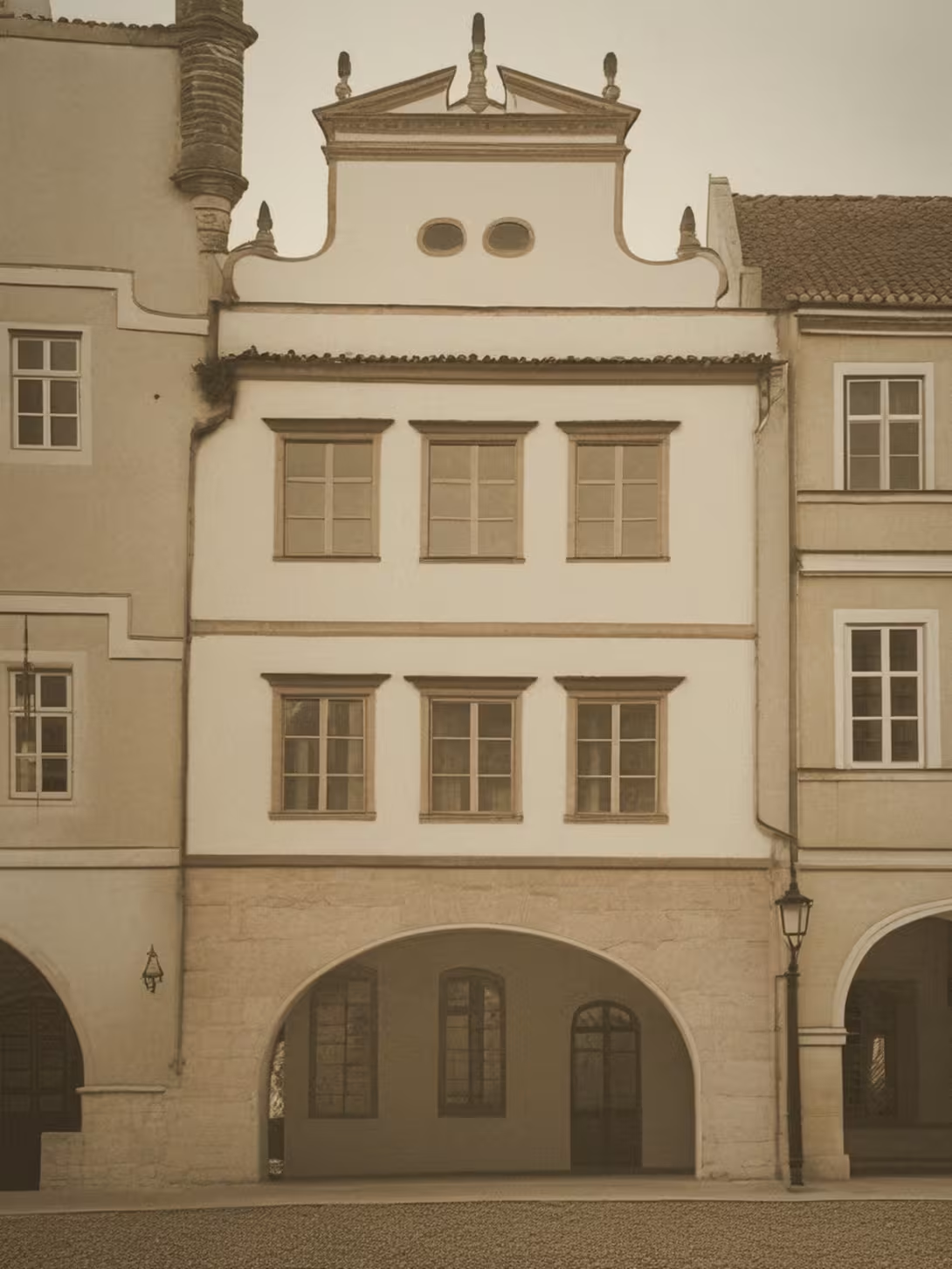
The historical appearance on the left is an AI-generated visualisation and serves as inspiration only.
Historical milestones
- around 1500
- The turn of the 15th and 16th centuries, the creation of a Gothic building in the foundations of the house.
- around 1550
- Renaissance rebuilding of the house, raising the floor and creating a shield.
- about 1850
- Nineteenth century, a partial reconstruction of the interior of the house.
- around 2000
- Registration of the house as a real cultural monument of the Czech Republic.
Architectural development
The original Gothic building included cellars and ground floor with wide arch in the arch. During the Renaissance the house was raised by one floor and ended with a shield with volute wings and a tympanone with obelisk. In the 19th century there was a partial reconstruction of the inner space.
Points of interest
- Dům U severní hvězdy is a Renaissance township house from the turn of the 15th and 16th centuries in the southern part of the Peace Square in Litomeric- Town. - The building in the foundations keeps the original Gothic structure, which includes cellars and ground floor with a wide arch in the arch. - During the Renaissance, the house was raised by one floor and ended with a shield with volute wings, two oval windows and a triangular tympanone. - The house is connected with lithomeric underground cellars, which are among the largest in Bohemia. - The monument is closely adjacent to the House of Kalich, which serves as the seat of the City Office.
Guide
Show guide text
This text was created by artificial intelligence and has not been editorially reviewed. It may contain inaccuracies.
Welcome to Litoměřice, the heart of the city that breathes its history from every stone. Please stop for a moment and feel the atmosphere of Peace Square. Right now, you're standing in front of one of his real pearls, in front of a house called The North Star. Look at him. It is a two-storey townhouse that stands in the southern part of the square and tells the story of how the city and its inhabitants changed over the centuries. The first impression the building is likely to give you is a sense of stability and elegance. It is a house that has seen the coming and going of generations, survived the storm and peaceful times and still stands here to remind us of the craftsmanship of our ancestors.
Let us now look together at how this house was created and in what historical context it was born. In order to understand its essence, we have to go back very far in our minds, until the turn of the 15th and 16th centuries. Imagine Litomeric at the time. The city was an important hub, a place to shop and meet. It was during this period, around the year of a thousand five hundred, where the original building was created. Back then, the house looked completely different, built in the spirit of goth. Although today you see mainly later modifications, the Gothic essence still lives in it. It's hidden but still present. If you could see through the ground under your feet, you would see the Gothic foundations and cellars that form the solid foundation of the whole house. Even the ground floor keeps track of this time. Gothic was a period of strength and veracity, and it is this fortress that is still felt in the foundations of the North Star House.
Now, look up and look at what the house defines today. Around the year a thousand five hundred fifty went through a major transformation. There came a time of renaissance, a time of rebirth, when people began to look more closely at beauty, harmony and light. The house was significantly rebuilt during this period. The owners decided to increase the building by one floor to gain more space for housing and storage of goods. It was at this time that the beautiful form that you admire was created. Pay attention now to the top of the house, its facade. Notice the signature shield. It's called a volute shield. The word voluta denotes these elegant, spirally curved ornaments that decorate the shield. These curves are typical of Renaissance architecture and give the house some lightness that contrasts with massive Gothic foundations. Also look at the stone details of the facade. They are small but important elements that show a high level of stonework. Every detail has been carefully chopped up so that the house does not only act as a dwelling, but as a symbol of the status and wealth of its owner.
Now if you look down below, notice the space below where the house connects to the square area. You are in the arch, which is a typical element of many old urban houses. I would particularly like to draw your attention to the broad arc in this arch. It's an element that combines practicality with aesthetics. The archipelago served as a protection against the rain and the sun, a place where people met, where shops were negotiated and the life of the city was pulsed. This arch is a silent witness to the thousands of conversations that have taken place here over the last few hundred years.
Even if we're standing outside now, let me take you for a brief picture to the interior of the house. There are treasures hidden behind these walls that can't be seen from the street. In the interior there are cross vaults with nails. Imagine these stone structures that cross in the ceiling and form rhythmic patterns. They are structures that carry the weight of the house and at the same time give it inner nobility. And if we went all the way up under the roof, we'd find the original Renaissance roofs. These are massive wooden beams that form the roof skeleton. These elements are incredibly valuable because they show us how it was built five years ago, what kind of wood was used and what precision the carpenters were working on.
You may be wondering who lived in this house or who visited it. Although history did not retain the particular names of architects or lists of all the personalities that lived here, we can imagine the life of ordinary but successful Litomeric townspeople. Dům U severní hvězdy was not just a construction, it was the center of family life and probably the place of business. Imagine the morning rush in the arch, the smell of goods brought from the surrounding area and the sound of steps on stone tiles. This house was part of a city organism that was constantly evolving. Even in the nineteenth century, about a thousand eight hundred fifty, the house was not standing, but adjusting. There was a partial reconstruction of the interior space at the time to meet the new needs of the time, which shows that the house was still used and valued.
Here we come to one interesting thing that may be fascinating to you. Dům U severní hvězdy is basically an architectural layer of time. It's like a book where each layer represents a different epoch. In the foundations we have strict and strong goth, above it there is a playful and elegant Renaissance and in detail we perceive modifications from later centuries. This combination makes the house unique. It's fascinating to think that one building can keep its tracks so faithfully for centuries at a time. This value led to the fact that around the year two thousand the house was officially registered as a real-estate cultural monument of the Czech Republic. With this recognition, the state has confirmed that the North Star House is not just an old house, but an important piece of our common history that we must protect for future generations.
Now that you've seen the facade, perceived the volute shield and imagined the Gothic vaults in the depth of the house, I suggest you stay with the building for a while. Try looking at it from different angles. Notice how light is reflected from stone details and how the house fits into the overall rhythm of Peace Square. It's where history becomes tangible.
Thank you for accompanying me to this brief interpretation of the North Star House. I hope you've found a way to please this house and appreciate its quiet beauty. Now invited to further explore Litomeric. The city still has many secrets waiting to be revealed. We wish you a pleasant continuation of your journey and enjoy every moment you spend in this historic city. Goodbye.
Tips for visitors
The best time to visit the historic centre of the city is early in the morning, when the streets are quiet and you can enjoy the outdoor architecture of the two-storey townhouse. Traffic to the centre is possible by car or public transport, with the current connection and parking possibilities in the area of the square we recommend to check in advance in the local search engine. Bring comfortable shoes on historic tiles, camera and raincoat in case of weather change. To photograph the exterior facade of the house, which stands in the southern part of the Peace Square and whose foundations extend back to the turn of the fifteenth and sixteenth centuries, the best light in the morning is when the sun illuminates the facade. In the immediate vicinity, within 30 minutes walk visit the House of Kalich, which is directly adjacent to this monument and today serves as a seat of the City Office in the heart of Litoměřice. For families with children, walking through the city centre is easy, the historic square offers sufficient space to discover details on ancient houses and Gothic elements in the foundations of buildings.
Businesses nearby
Do you run a restaurant, accommodation, shop, museum, rental, wellness or other visitor service near this monument? Show yourself directly to the people heading to it — this is how they will see you in the app and on the web:
Events nearby

Zdroj akcí: otevřená data měst a obcí ČR (Národní katalog otevřených dat) a kalendář akcí Národního památkového ústavu.
Nearby
Dům sousedí s Domem Kalich, který slouží jako sídlo Městského úřadu, v centru města Litoměřice.
Accommodation nearby
Trips and activities nearby
Guided tours, tickets and activities nearby from GetYourGuide
Affiliate link: if you buy from the partner, we may receive a commission. The price for you does not change.
Search tours and activities →Themed route
I propose a thematic cruise route in the historic heart of the city.
1.Dům U severní hvězdy Type: historic house in the city centre Why it is worth a visit: It is the main destination of our trip, located in a beautiful environment of historical development. The building occupies its location in close proximity to important neighboring objects.
2. House of Chalice Type: historical house and seat of office Why is it worth a visit: This monument is immediately adjacent to our main destination in the centre of Litoměřice. Currently it serves as the official seat of the Municipal Office and forms a natural dominant position.
3. City Office Type: official and historical building Why is worth a visit: It is located in the adjacent house and represents an important point in the heart of Litoměřic- Cities. You can admire the connection of historical architecture with modern use for running the city.
Seasonal recommendations
Spring: During the spring season, Dům U severní hvězdy lights up with young leaves and flowers, creating a lively atmosphere full of hope. The sun is warm, but still present cold winters can be felt. When visiting, it is recommended to wear clothes in different layers in order to easily respond to temperature changes. The best time to visit is in the afternoon when the sun illuminates historical facades and gives an opportunity for a beautiful photo.
Summer: Summer brings long days full of light and warmth. Dům U severní hvězdy gets a life during this period, when many people gather to walk the historic streets of Litoměřice. When planning a visit it is advisable to come early in the morning or later in the afternoon to avoid heat and crowds. Hot clothes for the sun recommend protection against UV radiation and drinking plenty of water.
Autumn: In autumn, the atmosphere around Dom U North Star is filled with coloured leaves, providing a beautiful opportunity for photography. The sun becomes less intense and the temperature falls, so it is advisable to wear clothes in different layers. The best time to visit is usually early afternoon when the atmosphere is calm and fewer people meet for walks.
Winter: Winter brings cold temperatures and short days. Dům U severní hvězdy has a quiet, quiet character at this time with the possibility to observe light from lamps or lights when visiting the evening. The warm clothes are necessary and the right time for visiting is in the afternoon when the streets and historic buildings are starting to illuminate. In addition, this time can be ideal for a quiet walk without large crowds.
Visualizations and artistic views


The visualisations are generated by artificial intelligence and serve as inspiration.
Photos from the area
Real photos taken near the monument


Zdroj a licence jsou uvedeny u každého snímku.
Tips from visitors
No tips yet. Be the first!
Log in and add your tip.
Sources and literature
Photos: H2k4 / CC BY-SA 3.0 — Wikimedia Commons. The author and licence also appear when you hover over the image.
Faktickým podkladem tohoto textu byl článek na Wikipedii, jehož autory jsou přispěvatelé Wikipedie. Článek je dostupný pod licencí CC BY-SA 4.0.
Location on the map
More monuments – Litoměřice-Město
Show all in the municipality


Příběhy a pověsti
Legendy, pověsti a příběhy spjaté s touto památkou
Fotografie návštěvníků
Zatím žádné fotografie. Buďte první, kdo přidá fotografii z návštěvy!
Log in a přidejte svou fotografii nebo hodnoťte.
Za ověřenou návštěvu v aplikaci získáte víc bodů — poznáme podle GPS, že jste na místě.
Reviews and comments