






Dům U Švagerků Museum building
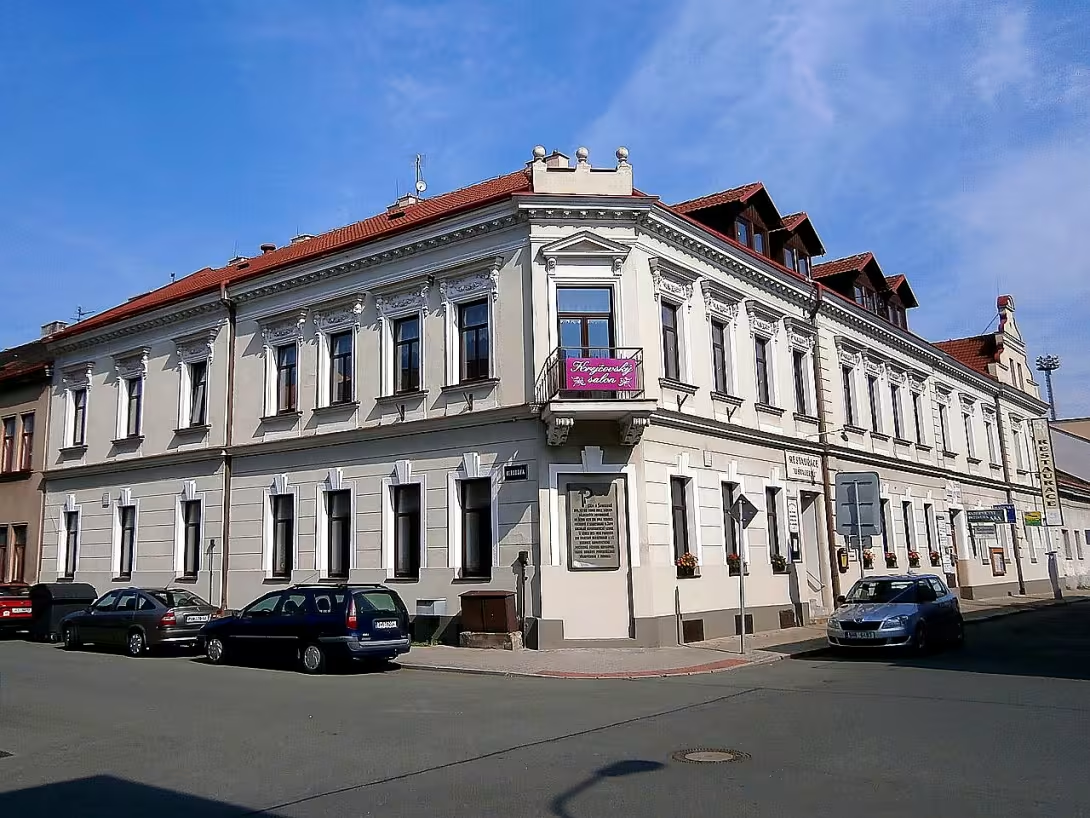
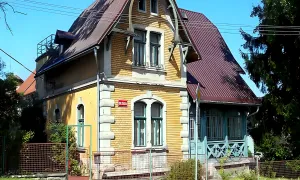
Dům U Švagerků on Prague Suburb in Hradec Kralove is a historical building from 1902. Since its inception it has served as an inn and as an important centre of the workers' and communist movement. The building is especially important as a venue for political activities in the first half of the 20th century. In its premises, the local authorities of the KSČ, the editorial press and a number of cultural and educational events were held.
The object was built by Emanuel Švagerka, a native of Chrudim and a pioneer of social democracy, who became acquainted with the workers' movement during his teaching in Vienna. The inn has become a natural background for political activity. After World War I, in 1921, the owner and the building went to the newly formed Communist Party. The historical context of the creation of the house is closely related to the period of expansion of the workers' movement in Austria-Hungary and subsequent radicalisation of left currents after the creation of Czechoslovakia.
The original building from 1902 was gradually expanded. Since the end of the 20th century, the extension was added to it, the laundry was built in 1926 and further modifications of the premises were made in 1935. In 1970, extensive reconstruction began, which adapted the building to the needs of the museum and agitation centre. Since 1967, a memorial plate of sculptor Josef Bílek has been placed on the corner of the building, reminiscent of the revolutionary past of the place and the activities of organizations such as the Red Unions and Proletarian Body.
The owner was Emanuel Švagerka since 1902. After his death in 1938 his son Eduard took over the innkeeper's concession, who sold the building to the state in the 1960s for 400,000 crowns. Between 1945 and 1990 the house often changed its shape, from a classic restaurant to a buffet. In 1959 he became a museum of the workers' movement and since 1975 he was part of the Regional Museum of Eastern Bohemia. After 1990, the Communist Party that bought the building returned to the premises above the inn. Between May 3, 1958 and April 27, 1993, the house was held as a cultural monument.
The key events associated with this place include the work of the Regional Authority of the KSČ Torch, which has been based here since 1 December 1920. A number of working-class meetings took place in the building, there was a shop called Self-Help, and between 1945 and 1946 there were open rooms for teaching general school pupils whose building was occupied for the German Lazaret. In 1937 Klement Gottwald agitated here and in the 1980s, under the patronage of metal from the Race of the Victory February, an agitation centre was established.
Dům U Švagerků today presents a specific document of the political and social history of the 20th century in Hradec. Visiting this place offers insight into the history of the workers' movement and the changes that the building has undergone from a private inn to a museum and political centre. For those interested in modern Czech history, this house remains an important point which documents the idea and organizational background of the time.
Historical milestones
- 1902
- Building an inn by Emanuel Švager.
- 1921
- The establishment of the Proletcult and the organisation of lectures on Marxism in the building.
- 1959
- The object became a museum of the workers' movement.
- 1967
- Installation of memorial plate by sculptor Josef Bílek.
Architectural development
The original inn from 1902 was gradually expanded, with an addition since the end of the 20th century. In 1926 the laundry was added and in 1935 further adaptation of the premises took place. A large reconstruction of the building for museum and agitation purposes started in 1970.
Historical events
1902: Building an inn with Emanuel Švagerkou. 1921: Moving the owner and the building to the newly created Communist Party. 1959: Establishment of a museum of the workers' movement in the building. 1967: Unveiling a commemorative plate reminiscent of the revolutionary past of the place.
Owners
Emanuel Švagerka (1902- 1938), Eduard Švagerka (after 1938), State (since the 1960s).
Points of interest
- The building was built in 1902 by Emanuel Švagerka, which was a pioneer of social democracy and became acquainted with the workers' movement during the teaching in Vienna. - The building served as an inn as well as as as an important centre of the workers' and communist movement, where the local authorities of the KSČ or editorial press. - Between 1945 and 1946, the open rooms of the house were used to teach pupils at the general school, because their building was taken for the German Lazaret. - Since 1967 there has been a commemorative plaque of sculptor Josef Bílek on the corner of the building, which commemorates the revolutionary history of the place and the activities of organizations such as the Red Unions. - In 1937 Klement Gottwald agitated in the premises of the house and in the 1980s there was established an agitation centre under the patronage of metals.
Guide
Show guide text
This text was created by artificial intelligence and has not been editorially reviewed. It may contain inaccuracies.
Welcome, distinguished visitors. Right now you're standing in front of a building called Dům U Švagerků. Stop for a moment, take a breath and feel the atmosphere of Prague Suburb in Hradec Kralove. In front of you is a building that can act at first glance as an ordinary city house, but its walls keep stories that have deeply influenced the history of this city and the entire region. It is a place where ordinary people's needs were met with great politics and ideas were born that changed the face of society in decades to come.
Let's go back more than a hundred years together, exactly until 1902. It was this year that the building was built by a man named Emanuel Švagerka. At the time there was no museum, but an inn. So imagine this place as the center of social life, where people would come together to have a cup of beer, to eat and, above all, to talk. The inn was at that time much more than just a gastronomic business; It was a natural hub of communication, a place where news spread and people organized. But Emanuel Švagerka was not just a regular innkeeper. He was a man of clear conviction, a pioneer of social democracy, who brought the spirit of social change into his business.
Now that you're standing outside the building, pay attention to its external appearance. Look at the facade and see its stability and character. Even though the building now serves as a museum, we still feel a trace of its original destination. Look closely at the facade details. One of the most important elements that you can see right now is the memorial board. It was installed in 1967 and its author is a recognized sculptor Josef Bílek. This board is not just an ornament, but a silent witness to the events that took place here, and a reminder of the people who worked here. It's a symbol of gratitude and recognition for the movement this house served.
When we think about what was going on behind these walls, we find that Dům U Švagerků has grown very quickly beyond the ordinary inn. He became a major center of the workers' and communist movement. Imagine the hustle and bustle, the noise of discussion and the passionate feud that took place here. The building became the seat of the regional authorities of the Communist Party of Czechoslovakia. This was where political action was planned, where strikes were organised, and here the vision of a new society was formed. The building was also housed by the editorial office of the newspaper Torch, which was at that time a key press agency that brought news to workers and shaped their views.
Now let's think about the personalities that fate has linked to this place. Apart from the founder of Emanuel Švagerka and his family, such as Eduardo Švagerka, there were people whose names are written in gold or controversial letters in history books. Here in Hradec Kralove, in this house, local representatives of the personality movement such as Bohumír Šmeral, Klement Gottwald or Antonín Zápotocký visited the discussions. These are the names that defined the political map of Central Europe in the first half of the twentieth century. When you realize that these men have probably walked the same path that you are, this place has a whole new dimension.
An interesting period was 1921, when the so-called Proletcult was created in the building. It was a stream that tried to create a new, working culture, separated from traditional, bourgeois art. There were lectures on Marxism at the time, political tractates were read and people tried to educate to better understand the world in which they lived and worked. The inn became an informal school for thousands of people who had no access to regular education.
You might be wondering how Emanuel Švagerka got these ideas in the first place. Here is one of the most interesting parts of his life story. Emanuel became acquainted with the workers' movement and social ideals during his teaching in Vienna. Vienna was a real cauldron of ideas at the turn of the century, a place where Europe's most modern political currents met. It was there, in the heart of the Austrian-Hungarian Empire, that Emanuel drew a vision of social justice and equality, which he then brought home to Hradec Králové and materialized in the form of this house. It is fascinating to think how one experience of youth in a strange city can affect the architecture and history of the entire Prague suburb in our city.
But time passes and the roles of the building had to change. There was a major twist in 1959. The object stopped being an active political center and was transformed into a museum of the workers' movement. That was the moment when the place of life became a place of memory. The history that was written here in real time was now arranged in exhibits and archives so that future generations could study it. Later, Dům U Švagerků became part of the Regional Museum of Eastern Bohemia, which provided him with a broader technical framework and provided his care for the next decade.
Now if you look at the building again, try not to see it as just a museum, but as a layered story. You see the inn from 1902, you hear the echoes of the 1921 debate in it, you see the political tension of decades afterwards, and finally you see in it a calm institution that teaches us about the past today. It's a place where one man's personal ambitions, Emanuel Švagerka, intertwined with the great historical processes of the state.
Now that you know the story of this house, I invite you to further explore. If you have the chance, enter and be carried out through exposures that will show you in more detail what the life of the workers looked like and what fights they fought for their rights. Note the objects, documents and photographs that complement what we have just imagined together. Every piece in this museum is a piece of truth about people who wanted to change the world.
Thank you for your attention and for stopping by the Swiss house with me. I hope this short journey in time has helped you better understand the importance of this place in the heart of Hradec Kralove. I wish you a pleasant continuation in your discovery of our beautiful city and an inspirational tour of the museum premises. Goodbye.
Tips for visitors
We recommend a visit in the morning during the working week when the exposure has a quieter atmosphere and you can better see the historical details of the building from 1902 without a large number of other visitors.
Dům U Švagerků is located in Prague Suburb in Hradec Kralove. The location is well accessible by public transport and by car. We recommend that specific connections and parking facilities near the property be checked in the current map materials or search engines.
For a visit, take comfortable shoes to move in historical areas. Photography of interiors is possible, the best lighting conditions for capturing the architecture of the inn are usually in the afternoon when the sun lights up the facade of the building.
In the immediate vicinity you can visit the historical center of Hradec Kralove or take a walk to the confluence of the Elbe and Orlice rivers. The location is suitable for families with children thanks to the proximity of parks and pedestrian zones, which allow pleasant movement with prams and older children.
Businesses nearby
Do you run a restaurant, accommodation, shop, museum, rental, wellness or other visitor service near this monument? Show yourself directly to the people heading to it — this is how they will see you in the app and on the web:
Nearby
Hradec Králové, historical center of the city, the competition Elbe and Orlice.
Accommodation nearby
Themed route
1. Hradec Kralove - Type: City. Why: The starting point for knowing the entire regional centre. 2. Riot Elbe and Eagle - Type: Natural Place. Why: The meeting place of two rivers offers peace and beautiful views. 3. Historical center of the city - Type: City zone. Why: Walk through the streets with rich architecture and history. 4. Dům U Švagerků - Type: Museum. Why: The main destination of the trip where local traditions can be discovered.
Seasonal recommendations
In spring, the surrounding area is dominated by lush greenery and awakening nature, which gives the place ease. The soft spring light will highlight the facade details beautifully. We recommend visiting the museum in the morning on business days to avoid weekend groups. Due to the variable weather, it is advisable to wear a light jacket or raincoat.
The summer season brings intense sun and noisy, lively atmosphere of Prague streets. In the interior of the house you will feel a pleasant cold of old walls. Because of the season and the biggest crowds, it's best to come right at the opening. Dress up light, airy materials and do not forget enough fluids.
In autumn, the surroundings of the monument are coloured in golden tones, and morning fog gives Suburb a mysterious, nostalgic mood. The light is softer in this period and alternates with frequent collisions. Ideal is a visit in the afternoon when the atmosphere is quietest. It's practical to dress up in more layers and carry an umbrella.
In winter, the freezing air and short days rule, creating a strong contrast between the cold outside and the cosy inner spaces. The atmosphere is calmer, especially in advent time. Don't forget the warm clothes and wool accessories. Before travelling, check the opening hours which are usually shortened during this period.
Visualizations and artistic views


The visualisations are generated by artificial intelligence and serve as inspiration.
Photos from the area
Real photos taken near the monument


Zdroj a licence jsou uvedeny u každého snímku.
Tips from visitors
No tips yet. Be the first!
Log in and add your tip.
Sources and literature
Photos: Boris-Jelinek / CC BY-SA 4.0 — Wikimedia Commons. The author and licence also appear when you hover over the image.
Faktickým podkladem tohoto textu byl článek na Wikipedii, jehož autory jsou přispěvatelé Wikipedie. Článek je dostupný pod licencí CC BY-SA 4.0.
Location on the map
Příběhy a pověsti
Legendy, pověsti a příběhy spjaté s touto památkou
Fotografie návštěvníků
Zatím žádné fotografie. Buďte první, kdo přidá fotografii z návštěvy!
Log in a přidejte svou fotografii nebo hodnoťte.
Za ověřenou návštěvu v aplikaci získáte víc bodů — poznáme podle GPS, že jste na místě.
Reviews and comments