






Dům U Zlatého hroznu Apartment house
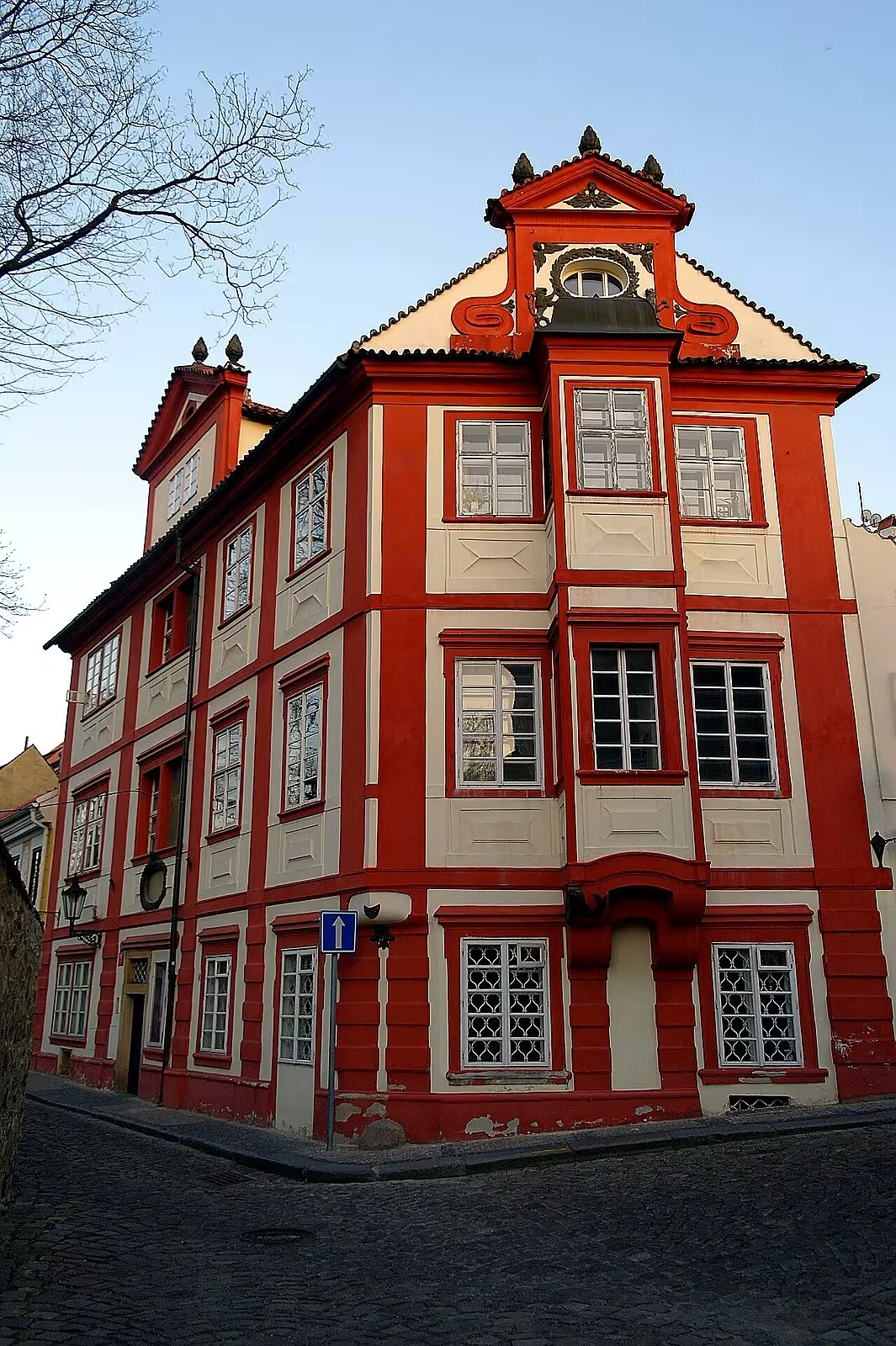
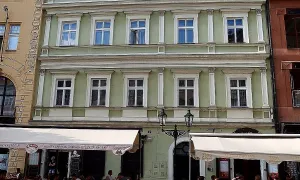
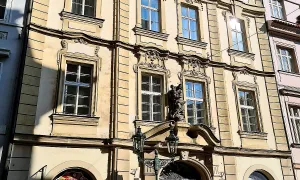
Dům U Zlatého hroznu on Prague Hradčany in Nové Svět Street (no. 78 / no. 5) is a Baroque city building built shortly after 1694 by Abraham Unkoffer. The building stands on the corner of the streets of New World and Capuchin and occupies its architecture with elements of early Baroque style. The interior was originally decorated with frescos, painted ceilings and Venetian mirrors. The construction is also known as the pianist and composer Rudolf Friml.
The history of the object dates back to the end of the 17th century. This was the time of the expansion of Baroque architecture and urbanization of Prague in Bohemia. Dům U Zlatého hroznu is a representative urban building that was intended to meet the needs of rich people while serving as a decorative element of urban space.
Architecture is typical of early Baroque. The north front is six-axis, while the west three-axis. The western facade was preserved in a rectangular bay on stone crackers. The two-story main wing of the building has a lower extension with trapezoidal facade at the oblique west facade. The basement under the street track is in the right part of the glass with a stone vaulted vault, which increases the architectural value of the building.
After the construction, the property of the house changed several times. The most prominent resident was the pianist and composer Rudolf Friml. The building was also known in the past under the name The Blue Grape.
Today Dům U Zlatého hroznu is an important monument that attracts attention to its history and appearance. Thanks to its location in the vicinity of Prague Castle, it is an ideal destination for people interested in Baroque architecture and history of Prague. The good condition allows visitors to feel the atmosphere of the past and appreciate the rich history of this place.
The construction resembles the rich history of Prague and its urban development. It is clear what influence the Baroque style had on the city's appearance and structure. Visiting the house is not only a way into the past, but also an opportunity to appreciate the artistic and historical value that this object represents.
Historical milestones
- 1694
- building of the house by Abraham Unkoffer
Architectural development
The building has a six-axis north and three-axis west front. On the western facade is preserved a rectangular bay on stone crackers. The main wing is connected to the annex with trapezoidal facade and underground is a stone rolled vault.
Owners
Abraham Unkoffer (after 1694)
Points of interest
Abraham Unkoffer built the building shortly after 1694. - The interior was originally decorated with frescoes, painted ceilings and Venetian mirrors. - There was a pianist and composer Rudolf Friml in the house. - The building was also known in the past as The Blue Grape. - There was a rectangular bay on the west facade on the stone crackers.
Guide
Show guide text
This text was created by artificial intelligence and has not been editorially reviewed. It may contain inaccuracies.
Welcome to one of the most picturesque and peaceful corners of old Prague. You're standing right on New World Street, a place where time seems to have stopped and allowed history to relax from the constant rush of the city. Feel the strange atmosphere that rules here. It is a silence that is not empty but full of echoes of the past that reflect from old walls and paved roads. In front of you is the building that is a solid part of this unique environment. Dům U Zlatého hroznu. Before we go into his secrets, just stop for a moment and feel this space around you. Take a look at his face as it bowed between the neighboring houses, and try to imagine what faces and what voices these walls have hosted for centuries.
Now let's go back to the past together to understand how this house came into being. To understand its essence, we need to move on to the end of the seventeenth century. It is the time when Prague began to change, when the Baroque style began to spread through the city as a wave of new ideas about beauty and grandeur. This particular house was built by Abraham Unkoffer. He was a man who, in the short period of a thousand six hundred and ninety-four, was able to build a building that could resist the trials of time. At the time, it was not just about building houses for living, but about creating symbols of stability and nobility in the heart of the royal city. Unkoffer's work here has left a trail leading us to today.
Now pay attention to the architecture itself, which you are now observing. You are facing a typical example of an early Baroque style. Notice how the building is divided. The main part of the house consists of two floors, which gives it proper emphasis and height, but also acts harmonically. This main tract is connected with a lower annex, which gives the whole building an organic character as if the house grew naturally along with the surrounding aisle. If you look at the west side of the building, you can see one of its most significant details. It's a rectangular bay, a stone niche that stands out of the facade. This element is not only an aesthetic element but also a witness to history, which shapes the appearance of the whole side of the house and offers a view of the world from a different angle. Feel the geometry, the balance of the lines, which is so typical of the period when the balance between the ornamentationone and the fixed order was sought.
While you now see the exterior walls and the face of the building, allow me to take you to his interior for a moment, his former glory. Imagine what life inside looked like when the house was in its greatest beauty. The interior was once a space of unparalleled luxury. The walls decorated the beautiful frescoes that told stories through colors and shapes. The ceilings were not just ordinary surfaces, but they were painted, creating a sense of infinite space and celestial beauty. And perhaps most fascinating, there were Venetian mirrors. Imagine how light was reflected in them with candles, how space was multiplicated in them, and how the house provided brightness and depth. These elements together formed a whole that was a celebration of the senses and proof of the wealth and taste of the people at the time.
But every such house has a soul made up of people who lived in it. And this house has one very strong and melodic soul. There was a man in these spaces whose name should know every ear that loved music. Rudolf Friml. He was an excellent pianist and also a composer who could transfer emotions into the notes. Imagine the tones that once echoed through these corridors, as music spread from the rooms to the quiet streets of the New World. Perhaps in this calm, in this environment, he found inspiration for his creation. His presence in this house gives the place a certain elegance and poetic touch that even today, when you look at these walls, you can feel.
If you're interested in this history, you might be surprised by one interesting thing about the name of this place itself. Today we know him as Dům U Zlatého hroznu, but in the past he was called otherwise. He was also known as The Blue Grape. A change of name, from blue to gold, may sound like a minor detail, but at that time it could have been a signal of change of owner, change of atmosphere, or simply a different perception of beauty. This name change is just one of the many stories that have taken place on these streets, and which we can hardly grasp anymore.
Now you can go free on your next journey. This house is just one of the many treasures Prague offers you in Hradčany. Let yourself drift through the atmosphere of the New World, walk these narrow streets and look around you with wonder as if you've seen the world for the first time. Every stone, every window, and every facade has its own story waiting to be discovered. Thank you for stopping by Dom's Golden Grape. We wish you a beautiful and inspiring walk through the history of our beautiful city. To a reunion.
Tips for visitors
The best time to visit Dom U Zlatý Grape is in the spring or autumn season, when the weather is pleasant and fewer people are coming to Hradčany. This time also offers a beautiful view of Prague Castle in the light of morning or evening.
Parking in the surroundings of Dom U Zlatý grape can be difficult, therefore we recommend the use of public transport. The location is well accessible by tram and bus; the current connection can be found in online search engines or mobile applications.
When visiting, bring protective clothing, especially if you visit at a colder time of the year. The house is a historic building and can be cold inside. The pictures thrive here especially at noon, when the light is best for capturing details of Baroque architecture.
There are several interesting places to walk in the surroundings of the Golden Grape House. Visit Prague Castle, for example, which is nearby and offers views of the whole Old Town area. Another option is to walk through Republic Square or visit St. Nicholas Church.
For families with children, an interesting programme can be a tour of historical buildings in the surroundings, offering diverse information about the past of Prague. Children can also enjoy walking around Republic Square and searching for details on the facades of old houses.
Businesses nearby
Do you run a restaurant, accommodation, shop, museum, rental, wellness or other visitor service near this monument? Show yourself directly to the people heading to it — this is how they will see you in the app and on the web:
Events nearby

Zdroj akcí: otevřená data měst a obcí ČR (Národní katalog otevřených dat) a kalendář akcí Národního památkového ústavu.
Nearby
Hradčany, Praha 1, okolí Pražského hradu
Accommodation nearby
Trips and activities nearby
Guided tours, tickets and activities nearby from GetYourGuide
Affiliate link: if you buy from the partner, we may receive a commission. The price for you does not change.
Search tours and activities →Themed route
Thematic cruise route: Dům U Zlatého hroznu and surroundings
1.Dům U Zlatého hroznu - Type: historical house, restaurant - Why is it worth a visit: This beautiful Baroque house from the 17th century is one of the oldest and most famous shopping houses in Prague. He is known for his history where famous personalities like Jan Amos Komenský once lived. Today it hosts a restaurant where you can enjoy traditional Czech food while looking at Prague Castle.
2. - Type: bookstore - Why is it worth visiting: This small but legendary bookstore is famous for its rich offer of Czech and foreign books. It's a place for literature lovers where you can find rare editions and authors' editions.
3. Old Town Hall - Type: historical monument - Why is it worth visiting: This famous town hall is famous for its Gothic architecture and tower of the Virgin Mary. It's a symbol of the Old Town that deserves attention for its history and beauty.
4. Prague Castle - Type: historical location - Why is it worth a visit: Even though Prague Castle is outside the direct surroundings, its proximity to the Golden Grape Dome makes it an essential part of the trip. The castle is a historical and cultural centre of the Czech Republic with a rich history and a view of the whole Prague.
This route offers a mixture of history, culture and gastronomy, which makes it ideal for every traveler interested in the deeper knowledge of Prague.
Seasonal recommendations
Spring: In the spring period, Dům U Zlatého hroznu is transformed into a peaceful refuge, where the still life is interrupted only by the noise of newly growing trees. Sun rays illuminate marble facades and create beautiful shadows that transform with the daily course. At this time it is advisable to visit the memory of an earlier afternoon to escape excessive temperatures and rising crowds. Clothes should be easy, but with the possibility of adding a layer to a cooler lunch hour.
Summer: Summer in Prague brings the greatest attendance of the Golden Grape Mine, where the atmosphere is full of life and warmth. Sunshine days intensify the colour of old walls and interior interiors, but also bring the risk of excessive sunlight. Visitors should bring a protective hat and UV cream. The best time to visit is early morning or late afternoon to avoid high-end watches with large crowds.
Autumn: In autumn, Dům U Zlatého hroznu offers visitors a peaceful and comfortable atmosphere when tree leaves turn into living colors. Sunshine days are beautiful for walking the streets around the sights, while cooler afternoons and evenings require warmer clothes. Visitors should use the middle part of the day to visit when the temperature is pleasant and the crowd is increasing more slowly.
Winter: Winter season brings cool weather, but also a unique atmosphere around the Golden Grape Mine. Sun rays illuminating marble facades create fine shadows and winter light gives the interiors something magical. The opening hours are usually shorter, so it is advisable to visit the memory early in the day. Warm clothes and protection against cold are essential for a comfortable experience, especially during cold cold days.
Visualizations and artistic views


The visualisations are generated by artificial intelligence and serve as inspiration.
Photos from the area
Real photos taken near the monument


Zdroj a licence jsou uvedeny u každého snímku.
Tips from visitors
No tips yet. Be the first!
Log in and add your tip.
Sources and literature
Photos: Jklamo / CC BY-SA 3.0 — Wikimedia Commons. The author and licence also appear when you hover over the image.
Faktickým podkladem tohoto textu byl článek na Wikipedii, jehož autory jsou přispěvatelé Wikipedie. Článek je dostupný pod licencí CC BY-SA 4.0.
Location on the map
Příběhy a pověsti
Legendy, pověsti a příběhy spjaté s touto památkou

Fotografie návštěvníků
Zatím žádné fotografie. Buďte první, kdo přidá fotografii z návštěvy!
Log in a přidejte svou fotografii nebo hodnoťte.
Za ověřenou návštěvu v aplikaci získáte víc bodů — poznáme podle GPS, že jste na místě.
Reviews and comments