



evangelický kostel v Libenicích Church
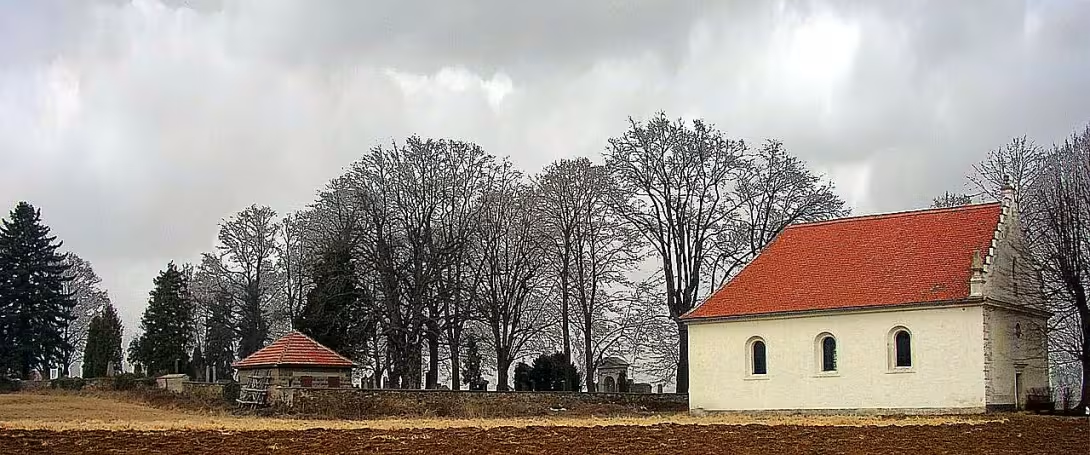
The Evangelical Church in Libenice is a classical tolerance prayer house from 1827. It stands in the cemetery at the west edge of the village. Since 23 May 2014 the building is protected as a real-estate cultural monument of the Czech Republic. The reason is its historical value and a preserved set of 19th-century mobility.
The construction was created during the period of national renewal within the Austrian Empire. It was allowed by the tolerance patent of Emperor Josef II from 1781, which guaranteed the evangelists legal existence. The then regulations forbade prayer houses to have a tower or entrance directly from the street, which was also reflected in the form of a libenic sanctuary. There's a blind path to his entrance from the village. The area is complemented by a wall with a gate, cemetery and morgue built into the southeast corner of the burial ground.
The architecture of the House of Prayer underwent successive modifications between 1880 and 1947. The interior excels with preserved calligraphic biblical quotes from the Old and New Testament. Historical equipment, mainly taken by the cargo of members of the Evangelical Choir in the 19th century, includes the pulpit, the table of the Lord, the baptizer, the bench, the boards for inserting numbers of songs, organ and cast iron stove. In 1827 Matěj Jelínek made a pulpit from Malina, in the same year he bought Jan Jelínek from Malina the table of the Lord. The New Gothic Baptist is probably from the second half of the 19th century.
The organ was built by Jan Tuček from Kutná Hora in 1912 and are placed in an older classicist cabinet. Ten pieces on the south side of the ship and one Presbyter bench were preserved from the original benches decorated with the motif of classical suns. After 1990, part of the equipment was changed when three blocks of benches replaced younger pieces of another type.
The Czech Brotherhood Church is the owner of the object. In addition to the prayer house and cemetery, the memorial protected area also includes the tombstone of Matìj Jelínek and his wife Marie.
This church represents an important proof of the religious life of evangelists in the region. Thanks to the preserved interior, it offers authentic insight into the history of tolerance prayers. Visiting this place is an opportunity to learn the cultural heritage, which is closely linked to the history of nearby Kutna Hora.
Then and now
Drag the slider to compare how the landmark may have looked when it was built with the view today.
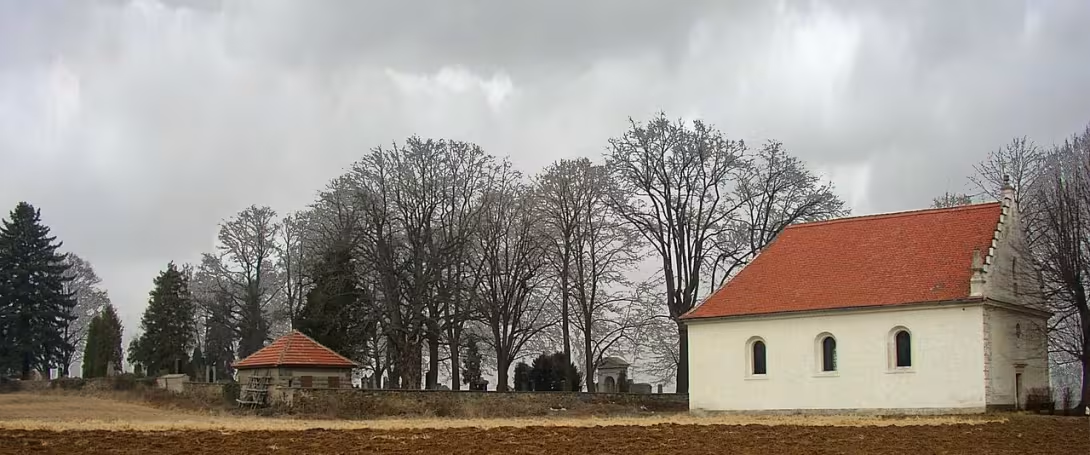
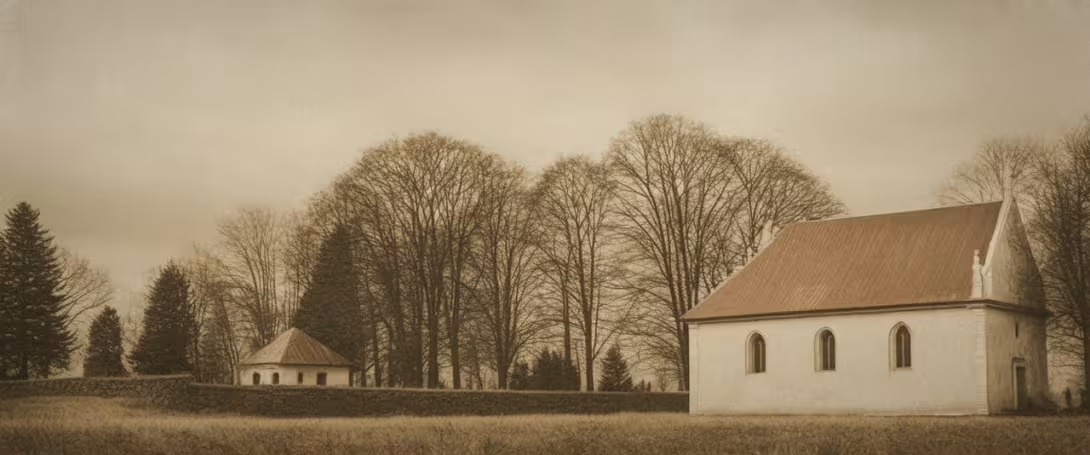
The historical appearance on the left is an AI-generated visualisation and serves as inspiration only.
Historical milestones
- 1827
- Construction of the tolerance prayer room and acquisition of the pulpit and table of the Lord.
- 1912
- Installation of organ from the workshop Jan Tuček from Kutná Hora.
- 2014
- Registration of the building between real cultural monuments of the Czech Republic.
Architectural development
The original prayer hall from 1827 was gradually modified between 1880 and 1947. The interior contains a classicist organ cabinet, in which the organ from Jan Tuček's workshop was built in 1912. Equipment also includes a neo-gothic baptizer from the second half of the 19th century.
Historical events
1827: Construction of a tolerance prayer room. 1880-1947: Period of building modifications of the building. 2014: Declaration on real estate cultural monument of the Czech Republic.
Owners
Czech Brotherhood Church Evangelical
Points of interest
- The construction is a classical tolerance prayer house from 1827, which stands in the cemetery. - The rules then forbade prayers from having a tower or entrance directly from the street, which is why a blind path leads to it. - The interior contains preserved calligraphic biblical quotes and historical equipment such as organ, pulpit or table of the Lord. - Since 2014 the building is protected as a real-estate cultural monument due to its historical value and preserved mobility. - In addition to the prayer house and cemetery, there is also a tombstone of Matìj Jelínek and his wife Marie.
Guide
Show guide text
This text was created by artificial intelligence and has not been editorially reviewed. It may contain inaccuracies.
Welcome to Libenice. You've just put on headphones so you can accept the story of the place you're walking around in peace and focus. You are standing on the western edge of the village, in a place where the city meets with peace and quiet of the cemetery area. Before your eyes, there is an evangelical church, a building that may seem modest at first glance, but its presence here is extremely strong. Feel this atmosphere. Feel the silence that exists here, and remember that you have just entered the space that is connected to prayer, history and deep human belief.
Let's go back in time together to understand why this building looks like this. Imagine a year of a thousand eight hundred twenty-seven. That's the year this prayer house was built. At that time, the situation for the evangelical religion was not as free as it is today. Human faith had to seek a way to exist within the laws and rules at the time. Therefore, this type of building is called a tolerance prayer room. The word tolerance is of great importance here. It means that people had the opportunity to confess their religious beliefs, but they had to do it under the strict conditions that the power provided for them at the time. So this prayer room is not just a building, it is a symbol of the struggle for the right to believe and pray according to your conscience.
Now pay attention to what you see around you. Look at the structure itself. Her style is Classicist, which means that in her lines you seek order, peace and balance. Notice the building has no tower. You might expect the church to have a tall tower that can be seen from a distance, but you won't find it here. It's not a coincidence or a missing component. It's a consequence of the regulations at the time. At that time, it was strictly forbidden for prayer houses to have a tower or to have their entrance directly from the main street. They had to be inconspicuous so they wouldn't draw too much attention. That's why you have to get to them through this blind path. This path leads you quietly as if she wanted to hide you from the eyes of the outside world, and this is exactly how this prayer room was supposed to work. It's an architecture that was dictated by the law, but it found its own dignity.
Although you are now out, allow me to guide you inside this prayer room. Even if you can't look directly at every detail, know that the interior is a place that can really move you. Notice how history is preserved. The interior features preserved calligraphic inscriptions. These are biblical quotes that were carefully carried out at the time. These words were supposed to give people strength and hope when faith was under pressure. In addition to these inscriptions, you will find historical furniture, which dates back to the nineteenth century. There is a pulpit and a table of the Lord, which was taken just during the construction in the year one thousand eight hundred twenty-seven. These objects are not just pieces of wood, they are tools that served generations of people in their most serious moments.
There are specific names in the history of this place that help us to understand that this building was a living center of the community. Names such as Matěj Jelínek or Jan Jelínek are linked to this place and its existence. These people were part of the world that built and maintained this prayer house. Another important name is Jan Tuček from Kutná Hora. It was his workshop that delivered the organ to this church in a thousand and nine hundred and twelve. Imagine the sound of him coming out of these spaces. The organ adds depth and grandeur to prayer, and even after more than a hundred years of installation, it is still a key element of this place.
You might be interested in one thing that links the past to the present. This building was not just an ordinary house for prayer, but it became such a valuable piece of our heritage that the state recognized it as something special. Since the year two thousand fourteen, this cultural monument of the Czech Republic has been protected. This means that its value is recognised not only by local people but by the whole state. It is proof that even such a modest, tolerant prayer room can be of great importance to our culture and history.
Now I want to invite you to further explore. Take a walk around the cemetery, which is part of this area. Feel the peace and quiet that exists here. Every stone and every road here tells its own story about the people who lived here, believed and left. Let yourself drift through the atmosphere of this place and perceive its history in every step. Thank you for spending this moment with this monument. I wish you a pleasant walk.
Tips for visitors
The best time to visit is from spring to autumn when the weather is sunny and warm.
It is advisable to bring a pocket lamp because the church interior is dark.
The best places for photography are the outside facade of the church and surrounding the cemetery.
It is possible to visit the town of Kutna Hora with UNESCO monuments such as St. Barbara Cathedral and St. James Church.
Frequently asked questions
Can the monument be visited?
Religious buildings are usually open mainly during services; at other times a visit is normally arranged with the parish or the operator. We have not verified specific times.
Where is the monument?
Location: Středočeský kraj. The map on this page shows the exact spot.
Why is the monument protected?
It is listed in the Central List of Cultural Monuments of the Czech Republic as a cultural monument (register no. 1079746704).
Businesses nearby
Do you run a restaurant, accommodation, shop, museum, rental, wellness or other visitor service near this monument? Show yourself directly to the people heading to it — this is how they will see you in the app and on the web:
Nearby
Obec Malín, město Kutná Hora s památkami UNESCO.
Accommodation nearby
Trips and activities nearby
Guided tours, tickets and activities nearby from GetYourGuide
Affiliate link: if you buy from the partner, we may receive a commission. The price for you does not change.
Search tours and activities →Seasonal recommendations
Spring: In the spring season evangelický kostel v Libenicích appears in the light of changing sunlight, which increases the beauty of its architectural details. Flowers and trees begin to bloom around the monument, creating a lively and attractive environment. It is advisable to leave in the morning or in the evening when the crowds are well and can be observed more calmly. It is recommended to wear clothes on variable weather because spring temperatures can fluctuate rapidly.
Summer: Summer brings long days and often sunny weather, allowing you to explore the church in the best light. The natural green of the surrounding forests and fields is in full bloom, which gives the visit an atmospheric accent. During the main summer season may increase the number of tourists, so we recommend visiting a memorial in the morning or late afternoon to avoid the peak rush. Don't forget to protect yourself from the sun and wear light clothes.
Autumn: In autumn the church in Libenice becomes melancholic beauty when the tree leaves change colour to gold and red. The sunny days are often followed by cold evenings, which adds an atmosphere of peace and quiet. It is advisable to visit the memory at noon when the sun is still in the sky, because open days are gradually shortening. It is recommended to wear warmer clothes and bring an umbrella with you in case of sudden weather changes.
Winter: Winter represents the church in Libenice in its most beautiful form, covered with snow, which gives the place a magical atmosphere. The sunny days are short and the temperatures are low, so it is advisable to visit the memory in the sun to enjoy from its heat. It is necessary to wear warm clothes and suitable snow shoes to ensure safety during the journey.
Visualizations and artistic views


The visualisations are generated by artificial intelligence and serve as inspiration.
Photos from the area
Real photos taken near the monument

Zdroj a licence jsou uvedeny u každého snímku.
Tips from visitors
No tips yet. Be the first!
Log in and add your tip.
Sources and literature
Photos: cs:User:Honyaboy / CC BY-SA 3.0 — Wikimedia Commons. The author and licence also appear when you hover over the image.
Faktickým podkladem tohoto textu byl článek na Wikipedii, jehož autory jsou přispěvatelé Wikipedie. Článek je dostupný pod licencí CC BY-SA 4.0.
Location on the map





Příběhy a pověsti
Legendy, pověsti a příběhy spjaté s touto památkou

Fotografie návštěvníků
Zatím žádné fotografie. Buďte první, kdo přidá fotografii z návštěvy!
Log in a přidejte svou fotografii nebo hodnoťte.
Za ověřenou návštěvu v aplikaci získáte víc bodů — poznáme podle GPS, že jste na místě.
Reviews and comments