



Františkánská zahrada Garden
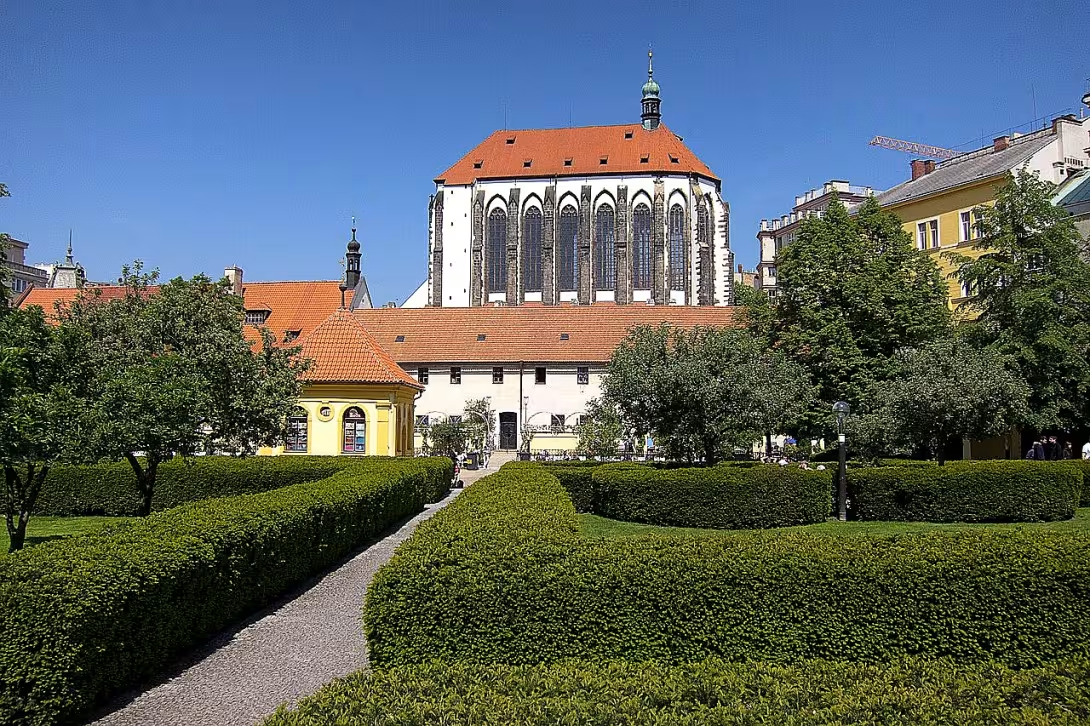
Františkánská zahrada is a historic interblock park in New Town Prague 1. It is located between Jungmann Square, Wenceslas Square and Vodicek Street in the immediate vicinity of the Church of Our Lady of Snow. It is a Baroque garden of the French type with a regular plan which represents a unique natural enclave in the heart of the capital. The garden is famous for its hedges, roses and sculpture fountain.
The garden was created at the neighboring Franciscan monastery (originally Carmelite) with the church of Our Lady of Snow. Since 1604 the monastery has been occupied by Franciscan who have restored the garden several times. In Baroque times it was modified as a regular decorative park with a Baroque chapel in the middle. During World War II, German occupants built a large fire tank here. After the internment of the Franciscan brothers, the garden was opened to the public in 1950. After 1989, the monastery area was returned; The garden, however, remained the property of the City of Praha 1. The chapel was transformed into a garden gazebo after 1950. Between 1989 and 1992 the garden underwent reconstruction according to the design of the architects Otakar Kuchi and Ivana Tiché.
The garden is accessible from Jungmann Square or Alfa passages leading here from Wenceslas Square, or Světozor passages leading from Vodičkov Street. The garden is open all year round and closed only for the night. The entrance gate is decorated with 24 figural reliefs connected with Saint Francis. Statues of academic sculptors Stanislav Hanzik and Josef Klimesh were newly installed. In the garden there are live fences and roses, there are a number of benches and sculptor fountain.
Františkánská zahrada is remarkable by its unique combination of historical architecture and nature. It's a place where you can stop and relax from the noise of the city. The garden is also a great place for families with children to play and relax. If you're in Prague, it's worth a visit.
Historical milestones
- 1604
- The Franks have taken the key
- 1950
- The garden has been opened for annealing
- 1989
- The area of the key was returned to the French
- 1992
- Garden for reconstruction
Architectural development
During the Baroque period the garden was modified as a regular decorative park with a Baroque chapel. After World War II, a fire tank was built in it, which was later removed. The reconstruction took place between 1989 and 1992 according to the design of the architects Otakar Kuči and Ivana Tiché.
Historical events
- 1347
- The founding of the Church of the Virgin Mary of Snow.
- 1604
- The Franciscan occupied the monastery and subsequently restored the garden.
- 1950
- The garden was open to the public after the internment of the Franciscan.
Owners
Beginning in 1604, the monastery was occupied by Franciscan who restored the garden several times. After 1950, the garden was opened to the public and is property of the City of Praha 1.
Points of interest
- Františkánská zahrada is a historic interblock park in New Town in Prague 1. - It is located between Jungmann Square, Wenceslas Square and Vodicek Street in the immediate vicinity of the Church of Our Lady of Snow. - The garden is famous for its hedges, roses and sculptor fountain. - The garden was created in the neighboring Franciscan monastery (originally Carmelite) with the church of Our Lady of Snow. - The garden is accessible from Jungmann Square or Alfa passages leading here from Wenceslas Square, or Světozor passages leading from Vodičkov Street.
Guide
Show guide text
This text was created by artificial intelligence and has not been editorially reviewed. It may contain inaccuracies.
Welcome to the heart of Prague, where time seems to slow down and the noise of the city retreats in green silence. You are standing right before the entrance to the Franciscan Garden, which is a hidden treasure in the middle of the busy New Town. If you look around you, you'll probably feel a slight contrast between the surrounding architecture and this quiet space. You are located in the immediate vicinity of the famous church of Our Lady of Snow, between Jungmann Square, Wenceslas Square and Vodicek Street. This interblock park is a unique natural enclave in the heart of the capital, a place where people go to meet to relieve stress and find a moment of rest in the middle of the concrete jungle.
To understand why this garden is so important, we have to go back more than four centuries. In 1604 the Franciscan occupied this area and started building their monastery here. The Franciscan, known for their poverty and devotion, have created a place for prayer, study, but also for growing herbs and flowers to treat the sick. Thus, the garden was not created as a public park for tourists, but as a private space for monks, where harmony between man and nature was cultivated. This original spirit is still in the garden today, although its status has changed considerably over the years.
Now let's focus on what surrounds you. Františkánská zahrada is a classic example of the Baroque garden of the French type. What does that mean for your eyes? It means you're not going to find a wild, disorderly growth here, but a perfectly thought-out geometry. The garden plan is regular, with clearly defined paths and beds that guide your view and steps. Note the hedges that form the walls and separate the individual parts of the garden. These deciduous shrubs are not only an ornament, but they also serve as natural barriers to noise from the surrounding streets, which creates the specific sense of silence you feel here.
Between these fences and along the paths, roses bloom, which are one of the most characteristic elements of this garden. The diversity of colors and the fragrance these flowers spread gives the space a romantic and relaxed touch. Baroque gardens placed great emphasis on symmetry and order, and that is what you will find here. The paths cross in true angles, the beds are straight and carefully maintained. This regularity is not random, but reflects an attempt to control nature and adapt it to the human image of beauty and harmony.
In the middle of this green labyrinth is a sculpture fountain, which is another key element to watch out for. The fountain not only fulfils the aesthetic function but also sounds like a fine noise that complements the silence of leaves. Water, reflected in sunlight, adds sparkle and life to the atmosphere. The combination of the geometric accuracy of the baroque plan with organic plant shapes and water liquids creates a unique visual and tactile experience that is typical of this garden.
The history of this place is not only about flowers and monasteries, but also about changes brought about by the twentieth century. In 1950 the garden was opened to the general public. This move meant the end of a long period, when the area was a private space of order, and the beginning of a new era, when Františkánská zahrada became a place where the inhabitants of Prague could walk. It was an important moment that saved this green area from possible concrete or demise due to construction work in the city centre.
After the fall of the Communist regime, there was another major turnaround. In 1989 the monastery was returned to the Franciscan. Thus the original spiritual atmosphere returned and the management of the garden went back to the hands of a order that knew and loved it from the very beginning. The following years have been busy restoring original beauty. In 1992 the garden underwent extensive reconstruction, which aimed to restore its baroque character and remove traces of neglect or inappropriate modifications from the past. Today, when you walk around it, you see the result of this care - the garden is full of flowers, neat and full of life.
One of the greatest mysteries and benefits of this garden is its location. It is surrounded by some of the busiest places in Prague. Wenceslas Square is vibrating with life, Jungmann Square is crowded with people and shops, and Vodičkova Street is full of cars and pedestrians. And yet, just a few steps in, and the noise seems distant. This effect is given not only by hedges, but also by the fact that the garden functions as an acoustic barrier. It is a fascinating experience for a visitor when you get into silence and calm from the chaos of the city without having to get far away from the center of events.
Many people ask why this garden is so popular. The answer is simple: it offers what is so little in the city centre. A place where you can sit, breathe clean air and watch the light turn into leaves. The roses that grow here are not just a decoration, but a symbol of care and patience. Every flower is the result of the long-term work of gardeners who make sure that the garden looks best throughout the year.
Watch out for details that can be easily overlooked while walking. The connection of stone paving with the soft surface of grass, the way shadows change with the course of the day, and the sound of birds looking for shelter here. Františkánská zahrada is not just a group of trees and flowers, but a living organism that breathes with the city. It is a place where history and the present meet, where traces of the seventeenth-century Franciscans live next to modern Pražans who enjoy the afternoon.
In conclusion, I'd like to invite you to stop at the main road. Explore the side pavements, sit on the bench and let the atmosphere drift. Františkánská zahrada is a place where time slows down, where you can get rid of your worries and gain strength. This is proof that even in the heart of one of Europe's oldest cities we will find a corner of peace and beauty. Thank you for your attention and I wish you a pleasant stay in this wonderful Baroque garden architecture. May the silence and smell of roses remain in your memory as a beautiful memory of your visit to Prague.
Tips for visitors
The best time to visit is early morning or late afternoon, when the garden is the most quiet and the light is most suitable for relaxation. We recommend taking comfortable shoes and drinking arrangements with us, which will ensure a pleasant stay in this historic area. For the best photos, use the Baroque layout of the garden and the game of light in the trees, especially during the late afternoon. In the surroundings you can visit the Church of the Virgin Mary Snow, Jungmann Square or Wenceslas Square. For families with children the park is an ideal place for a short rest safe away from the main traffic stream.
Frequently asked questions
Can the monument be visited?
Parks and gardens are often open to the public, but some have opening hours or are part of a closed site. We have not verified the entry conditions.
What are the opening hours and admission?
We have not verified the opening hours or admission. Current information is published by the operator.
Where is the monument?
Location: Praha 1, Hlavní město Praha. The map on this page shows the exact spot.
Why is the monument protected?
It is listed in the Central List of Cultural Monuments of the Czech Republic as a cultural monument (register no. 1000151861_0009). It is protected as part of a larger listed ensemble.
Businesses nearby
Do you run a restaurant, accommodation, shop, museum, rental, wellness or other visitor service near this monument? Show yourself directly to the people heading to it — this is how they will see you in the app and on the web:
Events nearby

Zdroj akcí: otevřená data měst a obcí ČR (Národní katalog otevřených dat) a kalendář akcí Národního památkového ústavu.
Nearby
Kostel Panny Marie Sněžné
Jungmannovo náměstí
Václavské náměstí
Accommodation nearby
Trips and activities nearby
Guided tours, tickets and activities nearby from GetYourGuide
Affiliate link: if you buy from the partner, we may receive a commission. The price for you does not change.
Search tours and activities →Themed route
Travel route to Franciscan garden and surroundings
1.Františkánská zahrada (park) Type: Garden Why is it worth a visit: This garden oasis is a beautiful place for relaxation in the heart of Prague, where you can enjoy the peace and natural flowers. It is an ideal place to spend time after visiting nearby monuments.
2. Church of the Virgin Mary Snow Type: Church Why is worth a visit: This church is famous for its history and architecture, which attracts many visitors. It is a beautiful example of baroque art and offers a view of the surrounding area.
3. Jungmann Square Type: Square Why is it worth visiting: This place is named after the famous Czech writer and historian, which gives it cultural importance. It is a quiet and comfortable place for a short break on the way.
4. Wenceslas Square Type: Square Why is it worth a visit: This historic square is the heart of Prague, known for its architecture and importance in Czech history. It's the perfect place to project culture and history.
Route order: - Start from the Franciscan Garden, where you will enjoy the quiet moments. - Then move towards the Church of Our Lady of Snow to visit this historic place. - Continue to Jungmann Square, where you can enjoy a quiet break and a look at the surroundings. - Close your trip by walking on Wenceslas Square, which offers rich history and culture.
This route will guide you through beautiful and culturally important places in Prague 1, an ideal way to explore this part of the capital.
Seasonal recommendations
Spring: During the spring season, Františkánská zahrada is transformed into a flowering landscape paradise, where various kinds of flowers are developing and trees are starting to grow. The dazzling sun rays illuminate the garden, creating a pleasant atmosphere for walks between flowering shrubs and flower seeds. This season it is advisable to visit in the morning or evening to avoid mid-winter temperatures and possible crowds during sunny days. It is recommended to wear clothes that are suitable for mild weather such as sweaters or light jackets.
Summer: Summer in the Franciscan Garden brings long sun days and warm nights. The garden is full of life, where different plants and trees bloom, providing refuge from the sun. The atmosphere is full of energy, making it an ideal place for family trips or picnics under the shadow of old oak trees. This season it is advisable to come earlier on the day to avoid the biggest crowds, and it is recommended to wear light clothes, hat and plenty of drinking.
Autumn: In autumn months, Františkánská zahrada takes on a different look when tree leaves are colored in living shades. The sun is milder and temperatures are pleasant, allowing relaxing walks between golden and pink leaves. The atmosphere becomes quieter and ideal for a moment of escape from urban life. In this season it is advisable to visit the garden in late morning or evening to be used in the sun even in quieter moments. It is recommended to wear clothes for mild weather and perhaps take an umbrella or hat with you.
Winter: Winter Františkánská zahrada offers cosy space, although flowering plants recede to the background. The sun is less intense and temperatures are cold, which creates a calm atmosphere suitable for reflection or viewing historical park design. It is recommended to wear warm clothes such as jackets or shirts, and suitable shoes on cooler surfaces.
Visualizations and artistic views


The visualisations are generated by artificial intelligence and serve as inspiration.
Photos from the area
Real photos taken near the monument


Zdroj a licence jsou uvedeny u každého snímku.
Tips from visitors
No tips yet. Be the first!
Log in and add your tip.
Sources and literature
Photos: Thomas Quine / CC BY 2.0 — Wikimedia Commons. The author and licence also appear when you hover over the image.
Faktickým podkladem tohoto textu byl článek na Wikipedii, jehož autory jsou přispěvatelé Wikipedie. Článek je dostupný pod licencí CC BY-SA 4.0.
Location on the map

Příběhy a pověsti
Legendy, pověsti a příběhy spjaté s touto památkou

Fotografie návštěvníků
Zatím žádné fotografie. Buďte první, kdo přidá fotografii z návštěvy!
Log in a přidejte svou fotografii nebo hodnoťte.
Za ověřenou návštěvu v aplikaci získáte víc bodů — poznáme podle GPS, že jste na místě.
Reviews and comments