



Hamousův statek Building
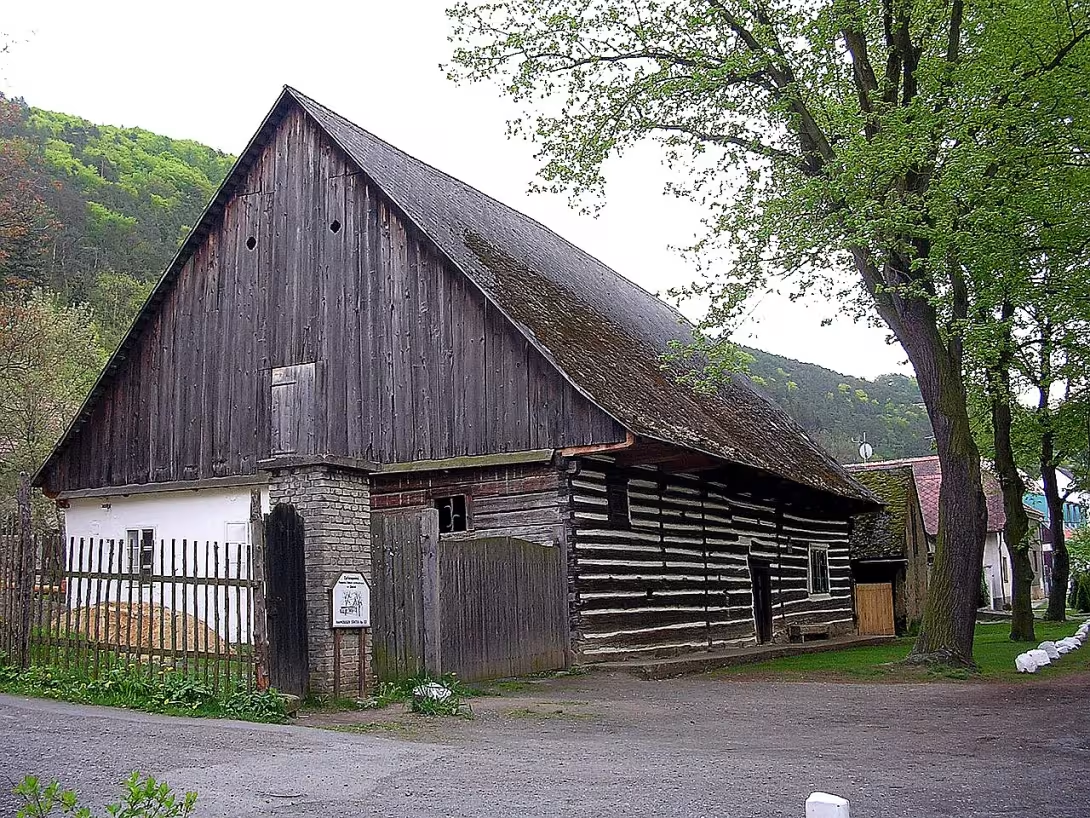
Hamousův statek in Zbečna in the district of Rakovnik is an exceptionally well preserved rural building. In the past, she served as fast as a tavern. This monument-protected object is important mainly because it did not succumb to radical modernization in the middle of the 20th century, which affected other settlements in the village.
The history of the construction dates back to the end of the 16th century, which is confirmed by dendrochronological research. The lower part of the chamber in the left available above the cellar was composed of oak beams cut down between 1577- 1583. The fir beams for the construction of the two chambers dates from 1579- 1756, while the walls of the great saint were cut down in 1746- 1747. The construction of the roof was created in 1791-1792. In 1716, the original wooden black kitchen was redecorated.
The area lies on the north side of the village opposite the parish church of St. Martin. The house occupies the southwest part of the property and is mainly grafted. Black kitchen with bread oven is built into the entrance hall. On the right side of it is a large living room, which has a smaller room with its own kitchen. On the left of the hall, two floors contain food storage chambers and economic equipment. Part of them were modified as a driver's apartment. The rear wig is directed towards the replacement of the quarry wall, which is equipped with its own kitchen with a walled stove. There is also a pillar barn, from which only a torso with partially preserved grafted walls between the walled pillars, and a newer walled barn with a granite in the attic and a follow-up pillar column.
The historical importance of the building is also related to its use. A tavern worked here before 1763. After 1817 he worked here as a speedster Dominik Hamous. The building was inhabited until 1992 when it was purchased by the then Memorial Institute of Central Bohemia. In the years 1997- 1998 the bread oven was newly found.
Today Hamousův statek is owned by the state and managed by the National Heritage Institute. Since 1995, the construction has been made available to the public. Visitors can get acquainted with the exhibition of historical equipment of living rooms and agricultural and craft equipment.
This monument offers an authentic view of the historic rural environment. It's a valuable testimony from the past worth visiting.
Then and now
Drag the slider to compare how the landmark may have looked when it was built with the view today.
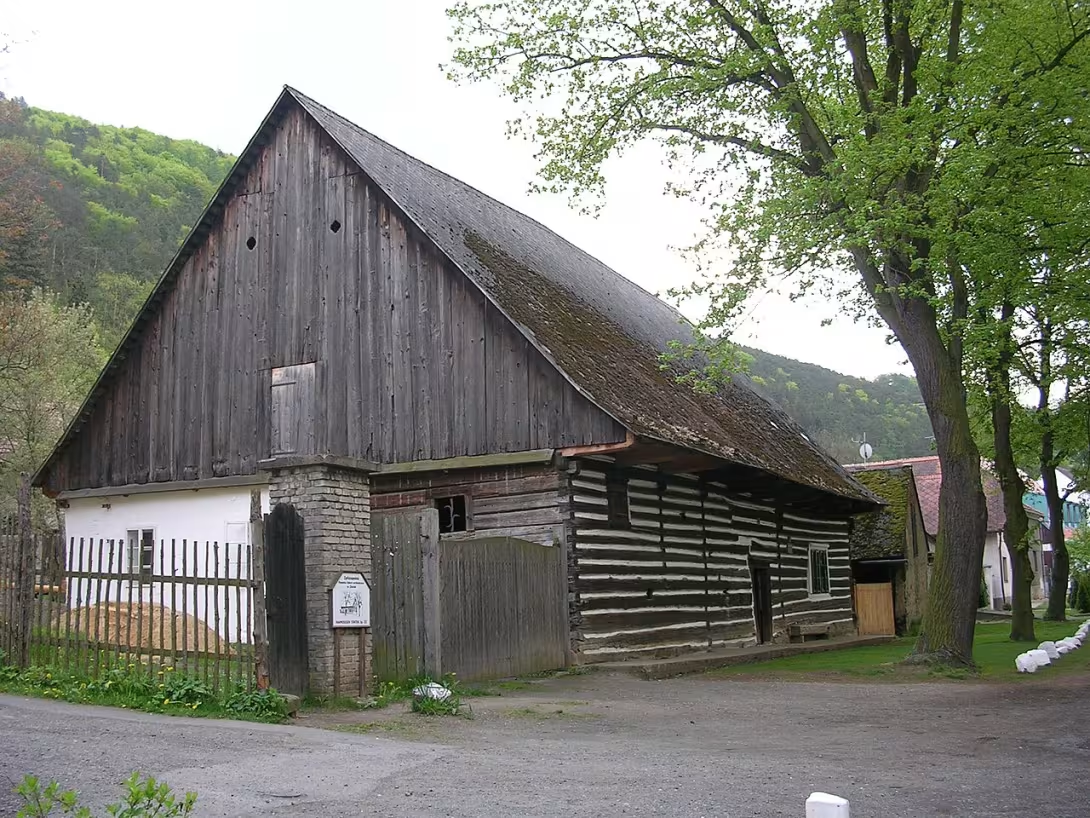

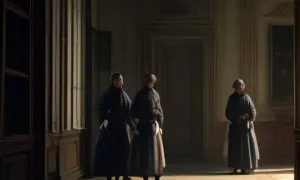
The historical appearance on the left is an AI-generated visualisation and serves as inspiration only.
Historical milestones
- 1577
- Construction of the lower part of the chamber according to dendrochronological research.
- 1716
- The rattle of the original wooden black kitchen.
- 1817
- Dominik Hamous is a speedster here.
- 1992
- Purchase of the building by the Central Bohemia Memorial Institute.
- 1995
- Access to the public.
Architectural development
The construction contains parts from the late 16th century, as confirmed by dendrochronological research. Over the centuries, there have been modifications, such as the rattle of black cuisine in 1716. The construction includes grafted parts and walled elements.
Historical events
A tavern worked here before 1763. After 1817, Dominik Hamous performed as a speedster. In 1992 the building was purchased by the Memorial Institute of Central Bohemia.
Owners
Since 1992 owned by the state (the administration is the National Monument Institute), before the Memorial Institute of Central Bohemia.
Points of interest
- In the past, he served as fast as a tavern. - Construction history dates back to the end of the 16th century. - He didn't succumb to radical modernization in the mid-20th century. - There's a pillar barn in the compound that's left with only a torso. - Since 1995, the building has been made available to the public.
Guide
Show guide text
This text was created by artificial intelligence and has not been editorially reviewed. It may contain inaccuracies.
Welcome to Zbečna. You are standing right in front of one of the most important and preserved rural units in this area, in front of Hamous's farm. Before you take the next step, stop for a moment and feel the atmosphere of this place. Look at the buildings that surround you. It's not just a set of old walls and roofs, it's a living story that's been going on here for hundreds of years. Do you perceive the peace that exists here? It is the peace of a place that has survived centuries, survived many generations, and yet preserved its original face and dignity.
But in order to really understand what you're seeing right now, we need to take time with you. The history of this place is not short. If we want to look at the foundations themselves, we have to go back to the end of the 16th century. According to the scientific examination of the years in wood that the experts carried out in the construction, we can say exactly that the lower part of one of the chambers was built in the year fifteen hundred seventy-seven. Imagine this - this building has been standing here for almost half a millennium. But this farm in the past was not just a normal home for an agricultural family. He had a much more important and socially superior role. There was a rush in these areas. This means that there was an official who represented the law and administration of the municipality. It was a place of decision, a place of power, and a place of order. And that's not all. Seven hundred and sixty-three years ago, there was a tavern. Imagine the atmosphere that people have been spending their free time here, telling stories here in the heat of the fire, drinking the brewery and connecting the whole village. This farmhouse was the heart of local life, the center where people returned after hard work in the fields.
Now pay attention to what's right in front of your eyes. Look at the individual parts of this area. You see here a residential house that has been a home for centuries for those who have done important work here. Next to him stands a walled barn, which is firmly connected to the granary. The granary was an extremely important place in the past, because it was here that the crops were stored, the most valuable thing people had to survive the winter. If you look at the rest of the area now, you can see the rest of the pillar barn. Even though today it has remained a torso, its presence still resembles the extent of the former economy and how much work was expanded in this place. Note also how buildings complement each other and how they form one whole. One of the very interesting details that you can perceive in the design is that in seven hundred and sixteen, the original wooden black kitchen was decorated. This shows the gradual development of the construction, the pursuit of its durability and how people adapted to changing needs and available materials.
Now let's focus on people whose names are inextricably linked to this place. One of the most important characters you should know about is Dominik Hamous. In the year of a thousand eight hundred and seventeen here he served as a speedster. This means that at that time this farm was once again at the centre of administration and authority. Imagine Mr Hamous doing his duty in these rooms, solving disputes between neighbors, and taking care of order in Zbečno. His name has become so closely connected to this building that his name has become permanent and we still use it today. It's fascinating how the name of one person can remain in the memory of the place for centuries.
Perhaps now you might wonder why this farm looks so authentic. Why doesn't it look like a modern building that has been rebuilt several times? And that is where one of the greatest attractions of this place lies. In the mid-twentieth century, this farm was avoided by radical transformation in modern style. Many similar buildings lost their souls at the time because of an effort for fast and cheap modernization, which often destroyed historical details. But Hamousův statek remained true to its original form. Thanks to the absence of drastic changes, we can now perceive the true atmosphere of the old countryside. It's like time has stopped for a while and allowed us to look into the past without unnecessary filters. This extraordinary preservation was appreciated and therefore the Central Bohemia Memorial Institute applied for care of this building in the year one thousand nine hundred ninety-two. Since the year one thousand nine hundred ninety-five, this place has been open to you so that everyone can experience this unique atmosphere.
Now I want to invite you to further explore. If you go inside, you'll have an exhibition of historical equipment. Feel every thing you see in there. These tools are not just pieces of iron or wood. They're tools that were an extended hand of man. Each of them tells a story about hard work, about trying to make a better life and about fighting nature every day. You will see the tools used by people in the house, in the barn and in the fields. Every object has a history, and every spark in the fire at the former tavern has a memory.
Don't forget to stop by and watch. Feel the texture of the walls, the smell of old wood and the silence that resonates in these areas. Hamousův statek offers you a rare opportunity to become part of history. We wish you this journey in Zbekna to enrich you and to be inspired by these old walls to reflect on how the world was changing around us, but how some things remain constant. Thank you for visiting us, and we wish you nice and quiet tours.
Tips for visitors
For the best experience we recommend a visit in the morning or late afternoon hours, when natural light best stands out on the facade of this historic rural building.
During the photo shoot we recommend to capture a general view of the farm from the village where you will see the parish church of St. Martin in the background. Don't forget to wear comfortable shoes suitable for walking on rural terrain.
Families with children will appreciate the opportunity to explore the history of the old hasty and tavern, which is a great way for children to familiarise themselves with life in the village in the past. In the immediate vicinity, just opposite the building, you can visit the parish church of St. Martin.
Frequently asked questions
Can the monument be visited?
Some buildings of this kind are open for guided tours, others serve another purpose or are privately owned. We have not verified whether and when this monument is open – please ask the operator.
What are the opening hours and admission?
We have not verified the opening hours or admission. Current information is published by the operator.
Where is the monument?
Location: Zbečno, Středočeský kraj. The map on this page shows the exact spot.
Why is the monument protected?
It is listed in the Central List of Cultural Monuments of the Czech Republic as a cultural monument (register no. 1000135140).
Businesses nearby
Do you run a restaurant, accommodation, shop, museum, rental, wellness or other visitor service near this monument? Show yourself directly to the people heading to it — this is how they will see you in the app and on the web:
Events nearby
Zdroj akcí: otevřená data měst a obcí ČR (Národní katalog otevřených dat) a kalendář akcí Národního památkového ústavu.
Nearby
Objekt se nachází u severní strany návsi naproti farnímu kostelu svatého Martina.
Accommodation nearby
Themed route
Hamousův statek Type: Historical building / Cultural monument Why is it worth a visit: This is the main destination of a trip located on the north side of the village. Its location opposite the parish church creates a unique historical entity, which is a key element of local architecture.
St. Martin's Parish Church Type: Sacral monument Why is it worth a visit: It is located directly opposite Hamous's farm on the village. Together with the farm, it forms the dominant part of the village Zbečno and offers a view of the traditional sacral architecture of the region.
The village of Zbečna Type: Public area / Historical core of the village Why is it worth a visit: The space between the estate and the church is the heart of the village. It is an ideal place for a short walk that connects both main objects and allows you to look into the everyday life and history of this location.
Around Hamous's farm Type: The immediate area Why is worth a visit: The area around the north side of the village offers a view of the historical buildings and the structure of the village. The walk here allows you to explore in more detail the relationship between the farm and its surroundings without leaving the central part of Zbečna.
Final tour of the village Type: Vacation activities Why is worth a visit: Re-circumventing the area between the church and the farm allows you to capture details that might have escaped attention on the first visit. This concludes the thematic route focused on the historical core of the village.
Seasonal recommendations
Spring: During the spring season, the surroundings of the farm are painted in fresh green and the air smells of blooming nature. Light is soft and rough these days, which is ideal for observing the details of the building. We recommend a visit in the morning when everything is the most lively. Clothing should be layered to easily adjust to the variable temperatures between morning cold and afternoon heat.
Summer: In the main summer time, there is the greatest excitement and the sun clearly illuminates every part of the monument. Nature around Zbečno is in the greatest expansion and offers a rich shadow. Due to the increased interest of people, we recommend that you come right after opening to avoid the biggest crowds. Prepare light and breathable clothes and remember to protect yourself from direct sun.
Autumn: Autumn moons bring golden spirits and peace to the landscape. Leaves change colors, and morning fog supplies the place of magical religion. It's the best time for quiet walks and watching color changes around. It is advisable to wear warmer clothes and not forget the waterproof jacket because the weather is unpredictable.
Winter: In winter, the monument is a very quiet and even distant impression, especially in the case of snow. The light is weak and the days are short, which creates a specific, harsher mood. In this period there are the least visitors, which allows us to perceive history in almost complete solitude. The necessity is very warm clothes and solid shoes, and also to count on a shorter time when the monument is accessible.
Visualizations and artistic views


The visualisations are generated by artificial intelligence and serve as inspiration.
Photos from the area
Real photos taken near the monument


Zdroj a licence jsou uvedeny u každého snímku.
Tips from visitors
No tips yet. Be the first!
Log in and add your tip.
Sources and literature
Photos: cs:ŠJů / CC BY-SA 3.0 — Wikimedia Commons. The author and licence also appear when you hover over the image.
Faktickým podkladem tohoto textu byl článek na Wikipedii, jehož autory jsou přispěvatelé Wikipedie. Článek je dostupný pod licencí CC BY-SA 4.0.
Location on the map






Příběhy a pověsti
Legendy, pověsti a příběhy spjaté s touto památkou
Fotografie návštěvníků
Zatím žádné fotografie. Buďte první, kdo přidá fotografii z návštěvy!
Log in a přidejte svou fotografii nebo hodnoťte.
Za ověřenou návštěvu v aplikaci získáte víc bodů — poznáme podle GPS, že jste na místě.
Reviews and comments