



Harrachovský dům Town hall
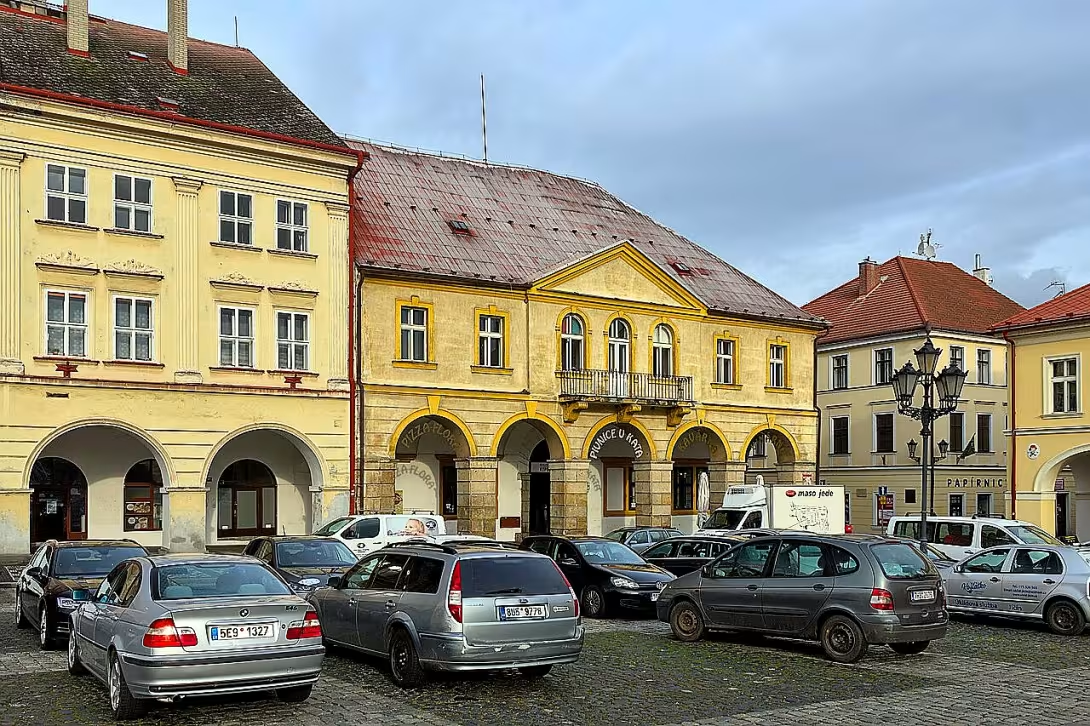
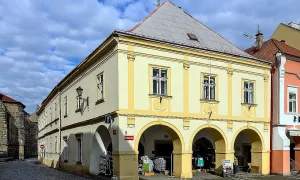
Harrachovský dům, known also as Nová radnice, is a significant Renaissance corner building on Valdštejnově náměstí in Jičín. This heritage-protected structure was created at the beginning of the 1630s as part of an ambitious urban development project under the patronage of Albrecht z Valdštejna. Today, it forms an integral part of the city's historic preservation area.
The building originated during the Thirty Years' War when Albrecht z Valdštejna shaped Jičín as a center of his Frýdlantského vévodství. Italian architects contributed to its construction, introducing elements of early Baroque into Czech architecture. Originally a noble residence, named after its first owner Václav Záruba mladší z Hustířan as the Zárubovský dům, it was built on the foundations of an older medieval structure. The width of the plot suggests that two separate buildings originally stood there.
Architecturally, it is a single-story building with three wings and Renaissance vaults. The main building facing the square had a five-window axis façade and a ground-floor arcade with five half-circular arches, constructed using Czech planks. The ground floor was decorated with band rustication, while a cornice frieze separated the floors. In the first floor, there was a central risalit with a balcony supported by three corbels. Early Baroque renovations from 1631 to 1632 were led by builder Jakub Maceta. After devastating fires between 1778 and 1809, the building underwent an Empire-style renovation of both façade and interior in 1826.
The ownership history of the house is closely linked with prominent noble families. After Václav Záruba z Hustířan, who was condemned for participating in a rebellion, Albrecht z Valdštejna acquired the property in 1628. He gifted it to his brother-in-law, General Otto Bedřich z Harrachu, in 1632. It is presumed that Otto Bedřich never resided there and the purchase was part of Valdštejna's plans for urban development. In 1651, Arnošt Vojtěch z Harrachu sold the house to the city, which began using it as a town hall. By mid-19th century, when regional and district offices moved to Jičín, parts of the building also served as a prison and were used by law enforcement.
Among its interesting features is that during construction in 1632, a rift occurred between Albrecht z Valdštejna and his brother-in-law. The steward Dětřich Malovec z Malovic completed the building using funds from Otto Bedřicha z Harrachu's estate without his consent. Today, the house is a protected heritage site that attests to an important era in Jičín urbanism through its history and architecture. A visit offers insight into the form of noble and later administrative architecture that significantly influenced the face of the city's historic center.
Historical milestones
- 1628
- Albrecht z Valdštejna acquired ownership of the house.
- 1632
- Albrecht z Valdštejna gifted the house to his brother-in-law Otto Bedřich z Harrachu.
- 1651
- The house was sold and began to serve as a new town hall.
- 1826
- Following a fire, the building underwent an Empire-style renovation.
Architectural development
The original Renaissance noble house was built on the foundations of older medieval structures. Between 1631 and 1632, an early Baroque reconstruction took place under the direction of the builder Jakub Maceta. In 1826, an Empire-style renovation of the facade and interior was carried out following devastating fires.
Historical events
In 1628, Albrecht z Valdštejna acquired the house. In 1651, the house was sold and began to serve as a town hall. In 1826, following a fire, the house was remodeled in the Empire style.
Owners
Václav Záruba mladší z Hustířan (before 1628), Albrecht z Valdštejna (from 1628), Otto Bedřich z Harrachu (from 1632), the Harrach family (until 1651), the town of Jičín (from 1651).
Points of interest
– The house was built on the foundations of older medieval structures, and the width of the plot suggests that two separate buildings originally stood on the site. – During construction in 1632, a dispute arose because the captain Dětřich Malovec z Malovic used funds from the estate of Otto Bedřich z Harrachu to complete the building without his consent. – It is believed that General Otto Bedřich z Harrachu, to whom the house was donated, never actually resided there. – In the mid-19th century, part of the building served as a prison, and the premises were used by the gendarmerie. – Following devastating fires in 1826, the building underwent Empire-style renovations to both its facade and interior.
Guide
Show guide text
This text was created by artificial intelligence and has not been editorially reviewed. It may contain inaccuracies.
Welcome to the heart of Jičín, right on Valdštejnové náměstí. Right now, as you put on your headphones and stop in front of one of the most important and distinctive architectural ensembles at this location, take a look around you and pay attention to how this building dominates the space. You are standing before Harrachovský dům, also known in these parts as Nová radnice. It is a significant corner building whose presence defines the entire character of this square. Experience the atmosphere of a place where the grandeur of a noble seat meets the public life of the city.
To understand why this house looks the way it does, we must go back deep into the past, to the early 1630s. At that time, the whole town was embracing a period of generous development guided by one of the most powerful men of his era, Albrecht z Valdštejna. He was the one who acquired this house in 1628. Albrecht had grand visions for how the city should grow and look, and this building was part of his broader plan for the prosperity of this region. Just a few years later, in 1632, however, the history of this house took a turn towards the Harrach family. Albrecht decided to donate the house to his brother-in-law, Otto Bedřich z Harrachu. With this single act, the fate of the building was forever linked with this significant name.
Now take a look at the building itself and try to find traces of time in its lines. Although it may seem like one solid whole, pay attention to its width and overall structure. If you consider how the house occupies space, you can start imagining what was here before. Historical records tell us that this house did not rise from nothing but emerged on the foundations of much older medieval structures. The width of the land where the house stands strongly suggests that originally there were two separate buildings on this site, which were later combined into one grand ensemble.
Notice how the house is laid out. It has three main wings, giving it its specific corner character. Originally a noble residence intended for aristocratic families, but city life demanded another direction. In mid-17th century, precisely in 1651, there was a fundamental change in its function. The house stopped serving as just a private seat and became the new town hall. Since then, important decisions for the entire town have been made here. Although the building has undergone many changes over time, its essence has remained preserved. Even after a major fire that struck the structure in 1826, the house did not fall into oblivion but underwent thorough repairs in Empire style, thanks to which it still retains its dignity and beauty today.
However, when looking at this object, it's not just about stones and masonry. It is a place full of human destinies and dramatic events. Let us briefly stop at one of the most interesting stories that took place right during its construction. Imagine the year 1632, when the building was nearing completion. Instead of a peaceful conclusion to the work, there was a major rift. The cause was the then governor, Dětřich Malovec z Malovic. He decided to act on his own and used resources belonging to Otto Bedřich z Harrachu for completing the construction without his consent. Imagine the tension and anger this must have caused in that noble society. This dispute is just one of many stories hidden within these walls.
In this place, people moved who had the power to change the world around them. Alongside Albrecht z Valdštejna and Otto Bedřich z Harrachu, other significant personalities left their mark here, such as Arnošt Vojtěch z Harrachu or Václav Záruba mladší z Hustířan. Each of these names is tied to this house and its history.
Now that you know the secrets of this corner building, I recommend you stop for a while longer and simply observe its façade. Experience how it blends medieval roots with 17th-century elements and later modifications. It's like an open book right before your eyes; you just need to learn how to read through the details of its shape and space.
I hope this brief glimpse into the past of Harrachovský dům has intrigued you. Jičín still holds many more secrets and beautiful places for you to discover. Continue your stroll around this magnificent square and let yourself be carried away by the atmosphere of a city that can so beautifully unite its rich history with the present. I wish you an enjoyable continuation of your tour and hope you enjoy every moment spent in this historic setting. Goodbye.
Tips for visitors
The best time to visit is in the morning on weekdays, when you can avoid the largest crowds at the square and enjoy the peaceful atmosphere of the historic center. In the early light, the facade of the building will also look beautiful.
You can conveniently reach the site by car or public transport.
For photography, we recommend using the corner view from Valdštejnova Square, where the architecture of the building stands out. The best light for photos is during the morning when the sun illuminates the front of the building.
For families with children, the site is ideal due to the flat terrain of the square and proximity to the castle.
Frequently asked questions
Can the monument be visited?
The building is in use (offices, a school, shops and the like). The interior is generally accessible only during operating hours and tours are not usually offered; we have not verified the details. You can see the exterior from the street.
Where is the monument?
Location: Staré Město, Královéhradecký kraj. The map on this page shows the exact spot.
Why is the monument protected?
It is listed in the Central List of Cultural Monuments of the Czech Republic as a cultural monument (register no. 1000143878).
Businesses nearby
Do you run a restaurant, accommodation, shop, museum, rental, wellness or other visitor service near this monument? Show yourself directly to the people heading to it — this is how they will see you in the app and on the web:
Nearby
Valdštejnovo náměstí, zámek v Jičíně, budova jezuitského semináře, městská památková rezervace Jičín.
Accommodation nearby
Themed route
1. Jičín Castle (Type: Castle) This historical site represents a significant residence in the area. It is a great introduction to exploring history.
2. Jesuit Seminary Building (Type: Building) This building showcases religious and educational traditions. It is located near the center.
3. Valdštejn Square (Type: Square) A central space that connects different parts of the city. It offers views of beautiful architecture.
4. Harrachovský dům (town hall) (Type: Town Hall) The main destination of your route, serving as an important urban landmark. It is located in the heart of the historic district.
5. Jičín Urban Heritage Reservation (Type: Heritage Area) This area encompasses all the visited sites. It is a unique collection of historical buildings.
Seasonal recommendations
In spring, nature brings the surroundings of the town hall to life, and the gentle light accentuates the details of the facade. The atmosphere is fresh and full of hope. We recommend wearing layers, as the weather can be changeable. Visitor numbers are moderate, making the morning an ideal time for a tour.
The summer season brings bright sunshine and vivid colors that illuminate the house. The town is full of life and energy. Due to large crowds during the peak season, arrive as early as possible in the morning to avoid queues. Opt for light, breathable fabrics and remember to bring plenty of water.
In autumn, the surroundings turn to golden tones, and morning mists lend the monument a mysterious air. The light is softer and very suitable for capturing the architecture. Equip yourself with a waterproof raincoat and a warm scarf. During this time, the building is much quieter than in the summer months.
In winter, the building appears majestic, especially when covered in snow. Evening lighting during the Advent season creates a cozy atmosphere. It is essential to wear very warm boots and gloves.
Visualizations and artistic views


The visualisations are generated by artificial intelligence and serve as inspiration.
Photos from the area
Real photos taken near the monument


Zdroj a licence jsou uvedeny u každého snímku.
Tips from visitors
No tips yet. Be the first!
Log in and add your tip.
Sources and literature
Photos: Miloslav Rejha / CC BY 4.0 — Wikimedia Commons. The author and licence also appear when you hover over the image.
Faktickým podkladem tohoto textu byl článek na Wikipedii, jehož autory jsou přispěvatelé Wikipedie. Článek je dostupný pod licencí CC BY-SA 4.0.
Location on the map

Příběhy a pověsti
Legendy, pověsti a příběhy spjaté s touto památkou

Fotografie návštěvníků
Zatím žádné fotografie. Buďte první, kdo přidá fotografii z návštěvy!
Log in a přidejte svou fotografii nebo hodnoťte.
Za ověřenou návštěvu v aplikaci získáte víc bodů — poznáme podle GPS, že jste na místě.
Reviews and comments