






Hendlův dvůr Homestead
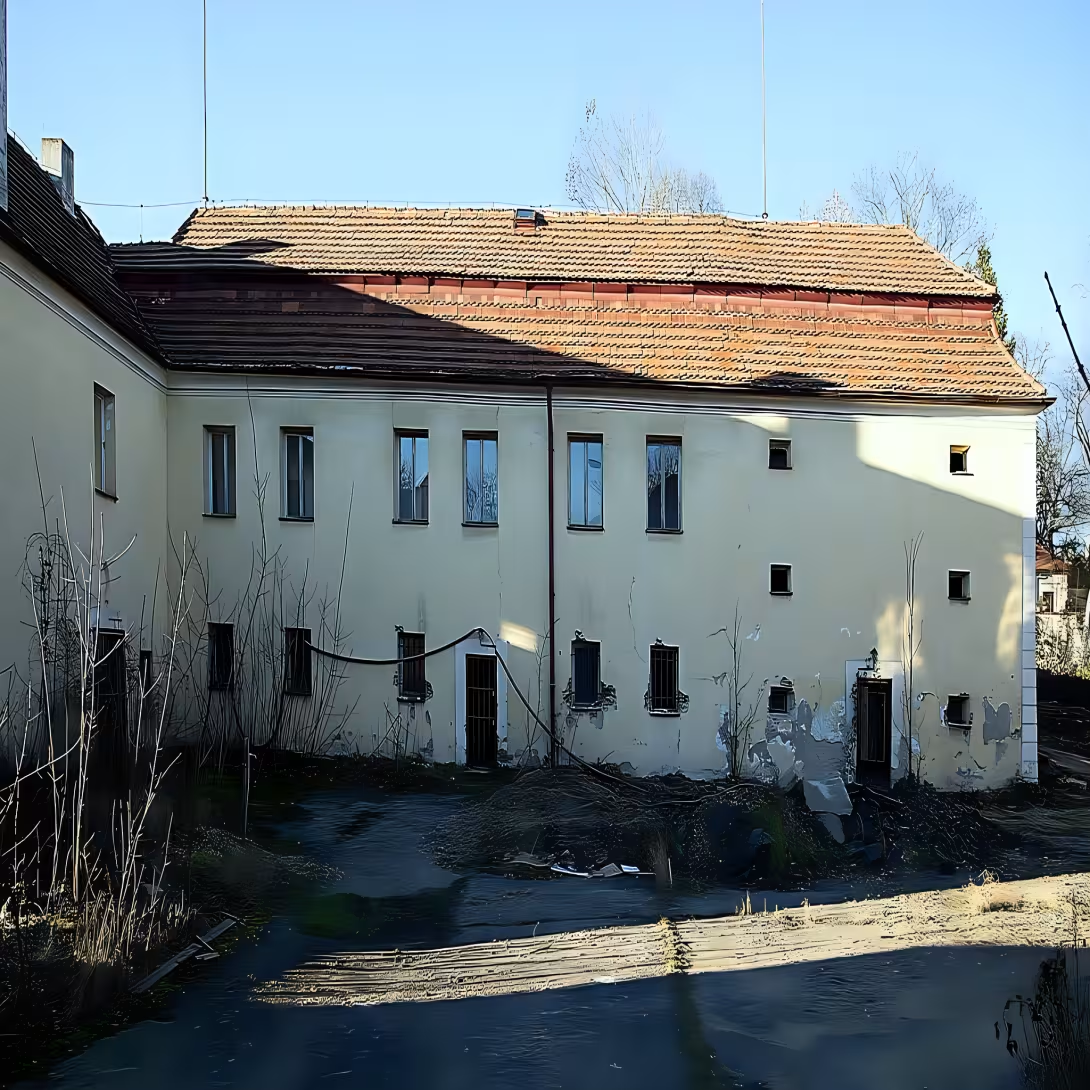
Hendlův dvůr, formerly called the Sárecká Court, is a historical residence in Prague's Dejvice. Its beginnings date back to the Shareč tavern, which was documented in 1551. This monument protected area has gradually evolved from an agricultural and wine farm into a famous inn. Today's appearance of the building is the result of reconstruction from the 19th century and subsequent reconstruction.
The oldest mention of the site dates back to 1551, when there was a tavern. During the 16th and 17th centuries, the site grew from a small economy to a large estate. The important milestone was 1621, when Linhart Švarcbart purchased the house for 5,500 kicks of Míshín grosches. He then bought a tavern, a field and a vineyard, which shows that it was already an exhibition building. In the 18th century, the yard obtained its typical rectangular space with residential and economic buildings and a hoarder.
The architectural form of the complex was created in several stages. The original baroque core at the entrance is supplemented by the younger corner section and the north wing. In 1815, the estate went through a classical reconstruction, which impressed its current character. In 1882, the owner of the Antonín Hendl added the house No. 152, which served as a new inn. In the 20th century, the roof and ceiling were modified; According to the Václav Suk project, a collapsed vault was restored between 1941 and 1942.
The property history of the place is varied and includes townspeople, butchers and nobles. The owners included Jan Chlum, Ondřej Koutek, Balcar Tyliš or the House of Wrocław from Mitrovice, who acquired the court in 1699. At that time, the Wrocław committed themselves to brewing Probostské beer and restricting livestock farming. In 1803, Baroness Antonie Skronská z Bydžova purchased the premises and in the middle of the 19th century he passed through the inheritance to Antonín Hendl, after which he bears his current name. After 1948, the building was managed by the Keramoprojekt National Company, which carried out extensive building interventions.
A number of attractions are attached to the estate. In the past there was an amateur theatre and a school was rented. There was a small water tank before the farm. In the 17th and 18th centuries the owners intensively managed large vineyards. In modern history, at the beginning of the 21st century, Skanska's intention to turn the yard into a housing complex of public protests due to fears of inconsiderate interference with the monument.
Today Hendlův dvůr serves as an apartment complex. The area, consisting of houses no. 23, 24 and 152, represents valuable proof of the transformation of Prague suburb. The visit to this place offers insight into the history of the Dívice building and recalls the importance of the former economic courts for the development of Prague's surroundings.
Then and now
Drag the slider to compare how the landmark may have looked when it was built with the view today.
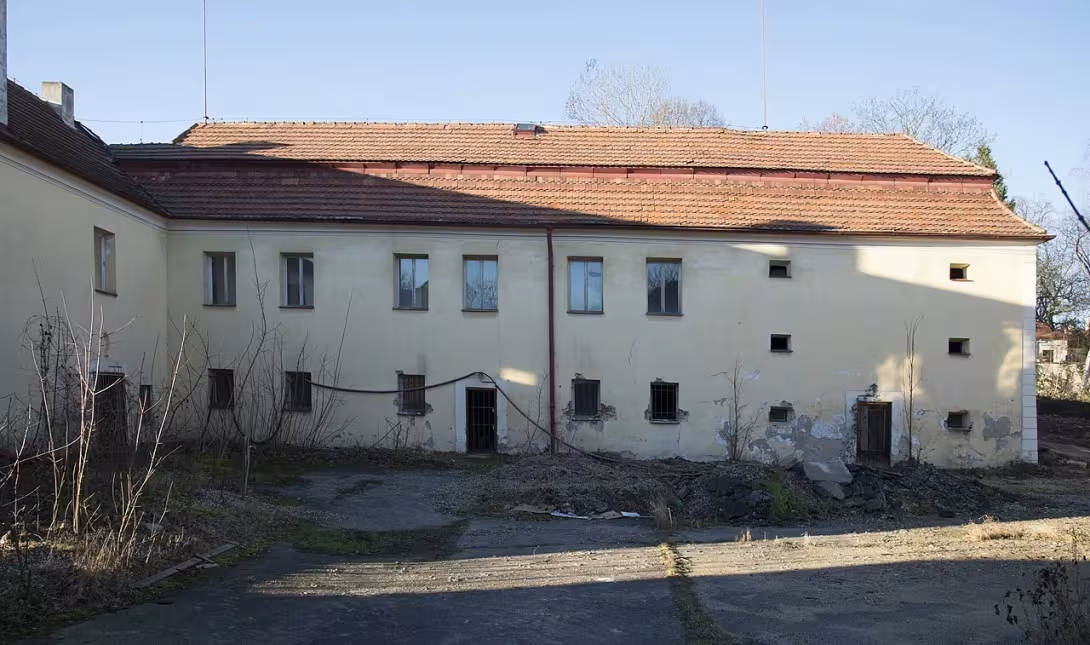
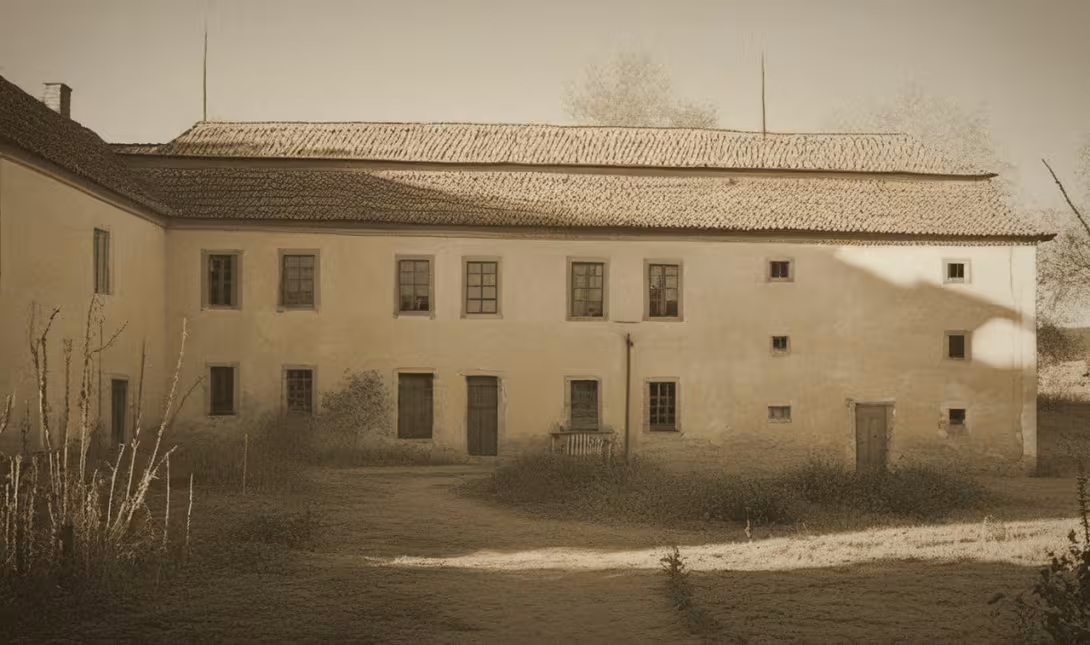
The historical appearance on the left is an AI-generated visualisation and serves as inspiration only.
Historical milestones
- 1551
- First written mention of the tavern in the location.
- 1699
- Ignac Vratislav of Mitrovic buys the court from the heirs of Valentino Ditrich.
- 1882
- Antonín Hendl has a new house built no. 152 serving as an inn.
- 1941
- Opening of the reconstruction of the vault after its collapse according to the Václav Suk project.
Architectural development
The original 16th century tavern was extended in the 18th century by economic and residential buildings in the form of a rectangular courtyard. In 1815 a classical reconstruction was carried out which gave the Court its present form. In 1882 a new inn no. 152 was added and in the 20th century there were modifications of roofs and ceiling structures.
Historical events
1551: First written mention of the tavern in the location. 1699: Ignac Vratislav from Mitrovic acquires the court and undertakes to use Probostský beer. 1939: Crushing part of the vault leading to subsequent renewal. 1974- 1979: Extensive reconstruction of buildings No 152 and 24.
Owners
Jan Chlum (1559), Jan Hermelín (end of the 16th century), Ondřej Koutek (beginning of the 17th century), Linhart Švarcbart (1621), Balcar Tyliš (1623), the House of Wrocław from Mitrovic (from 1699), Kašpar Zachriáš Wussin (1728), Antonie Skronská z Bydžova (1803), Antonín Hendl (half of the 19th century), Keramoprojekt (after 1948), Skanska (beginning of the 21st century).
Points of interest
- Hendlův dvůr was formerly called the Sárecká court and its beginnings date back to the Shareká tavern, documented in 1551. - In the 17th and 18th centuries the owners were engaged in intensive management of large vineyards. - In the past there was an amateur theatre and there was a school in the rental. There was a small water tank outside the farm in the past. - From 1941 to 1942, according to the Václav Suk project, a collapsed vault was restored.
Guide
Show guide text
This text was created by artificial intelligence and has not been editorially reviewed. It may contain inaccuracies.
Welcome, distinguished visitors, to one of the fascinating corners of Prague's Dejvice. Right now, you're standing in front of a place that carries a layer of centuries, in front of Hendl's court. Stop for a moment, take a breath and feel the atmosphere of this space. In front of you, there is an area that may seem calm today, but in the past it has been the center of constant movement, work and social life. Look at the overall form of the object and try to imagine how this place has changed over the last 500 years.
To understand what we're seeing, we have to go back very far, until 1551. It is this year that the first written mention of the tavern appears in this location. At that time there was no exhibition yard, but a simple inn that served passengers and locals. This Sharehouse was the cornerstone on which everything else was built. It is fascinating to think that while the whole city was changing around us, here in Dejvice the spirit of hospitality and management remained.
Over time, a small tavern has become an economic estate. In the seventeenth and eighteenth centuries, the owners of the complex focused on intensive management of large vineyards. So imagine that instead of today's streets and houses, you were surrounded by a series of grapes that went up the surrounding slopes. The work in the vineyards was difficult, but the proceeds made it possible for the farm to develop gradually. In the eighteenth century, the court gained its typical rectangular space, which you can see today. This geometric arrangement was common at the time for functional economic courts where it was important to have everything clearly distributed for the effective operation of the farm.
Now let's focus on architecture and the details that you can see right in front of you. Look at the facade and the overall structure. One of the most important elements is a house with the number hundred and fifty-two. This building was built in 1882 for the efforts of the man after whom the court bears its name today, Antonín Hendl. Hendl didn't just want an ordinary house here, but he had a inn built here, which soon became a designated meeting place. Note how the housing and business functions are mixed up in this building.
Speaking of architecture, we must not forget the interventions at a later stage. If you think about building construction, think about 1941. At that time, the vault collapsed, which was a serious blow to the building. However, the renowned architect Václav Suk took over the reconstruction of the vaults. His project ensured that the historical nature of the building would be preserved even after this unfortunate event. Václav Suk's work helped maintain the integrity of the court and ensured that the monument will live to our times.
Hendlův dvůr wasn't just a building, it was a space defined by humans. The history of this place is a list of names that left a trail. In 1699, for example, the court bought from the heirs of Valentino Ditrich Ignác Vratislav from Mitrovic. The Mitrovic family of Wroclaw brought their experience and influence to the administration of the court. In addition to them, other personalities such as Jan Chlum, Jan Hermelín or Ondřej Koutek have moved here over time. We also remember Linhart Svarcbart, Balcar Tylish and Kaspar Zachriah Wussin. Let us not forget Antonia Skronsky of Bydžov. Each of these people added their own chapter to the form of court, whether it was economic improvement, change of ownership or simple maintenance of traditions.
Now I want to take you to a few interesting things that make this place more than just a set of old walls. As we mentioned before, the court used to be called the Court of Shares. It's interesting how the names of places change along with their owners and functions. But Hendlův dvůr has had a much wider social use in the past than you might imagine today. It was not only the inn and the farm that operated on the premises. At some point there was an amateur theatre. Imagine those nights when people would come together to watch the show, laugh and discuss life, while the Dívice Gardens would be behind the windows.
In addition to culture, there was an educational atmosphere. There was a school in the past. It is fascinating to think that in areas where wine has been stored before or where guests' meals have been prepared at the inn, children have sat at benches and learned the basics of knowledge. This transformation from an economic farm to a cultural and educational centre shows how Hendlův dvůr adapted to the needs of the time and inhabitants of the area.
When you stand before this monument today, try to combine all these images together. You see the rectangular space that once surrounded the vineyards. You hear the voices of guests in Antonín's famous inn, the noise of the theatre screen and the voices of the students from school. Feel the stability of the vault that Václav Suk saved, and think of all the generations of owners, from Wroclaw to Hendla, who took care of this place.
Hendlův dvůr is living proof of how rural roots gradually intersect with urban development. A small tavern from 1551 became a symbol of Dívice history. It is a place where the practical management of culture meets and where every stone tells its own story about the people who lived and worked here.
Now that you know the story of this special place, I suggest you go around it one more time. Notice the details of the facade, think about the layout of the yard and let yourself be carried away by the ideas of the old Prague vineyards. Take a look around and see how the history of the Court of Hendl connects to today's rhythm of Dejvic.
Thank you for accompanying me on this short journey through time. I hope that this insight into the past has helped you to appreciate the beauty and history of Hendl's court. I wish you a pleasant continuation in discovering the secrets of our city. Goodbye.
Tips for visitors
{'navsteva': 'The best time to visit Hendl's court is during the morning in sunny weather, when the historical architecture of the estate and the quiet atmosphere of the Dívice location stand out. Since this is a historical object, we recommend choosing days with a lighter operation for uninterrupted observation of exteriors.', 'transport': 'Place is available by car and public transport. Parking in the surrounding streets may be limited, therefore we recommend you use the search engine for the current public transport routes that will bring you to walking distance from the estate.', 'equipped': 'For a visit, take comfortable shoes suitable for walking on historic tiles and surrounding roads. Don't forget the camera because the yard offers its preserved architecture great compositions for images, especially in the soft afternoon light.', 'o': 'In the immediate vicinity of the 30 minutes walk you can visit the picturesque church of St. Matthew, take a walk in the historic neighborhood of Hanspaulka or take a walk in nature surrounded by the Sárecká Valley.', 'families': 'For families with children the location is suitable as a starting point for easy walks. We recommend to combine a tour of the court with a trip to the Šárecký Valley, where children will appreciate the natural environment and the space for movement outside urban tourism.'}
Businesses nearby
Events nearby

Zdroj akcí: otevřená data měst a obcí ČR (Národní katalog otevřených dat) a kalendář akcí Národního památkového ústavu.
Nearby
St. Matthew's Church, Hanspaulka, Shareka Valley.
Accommodation nearby
Trips and activities nearby
Guided tours, tickets and activities nearby from GetYourGuide
Affiliate link: if you buy from the partner, we may receive a commission. The price for you does not change.
Search tours and activities →Themed route
Thematic trip route from Dejvice
1.Hendlův dvůr - Type: Historical Square - Why is it worth visiting: Hendlův dvůr is one of the oldest monuments in Prague 6, whose history dates back to the 14th century. Today it serves as a centre of cultural life of the village with various actions and exhibitions.
2. St. Matthew's Church - Type: Church - Why is it worth visiting: This Baroque church, built in 1735, is famous for its architecture and history. It is part of the monastery complex and provides a view of the rich history of the area.
3. Hanspaulka - Type: Park - Why it is worth a visit: Hanspaulka is a picturesque park with beautiful garden architecture and modern water element that attracts many visitors. It is ideal for relaxing and walking.
4. Sárecká Valley - Type: Green Zone - Why is it worth a visit: This place is famous for its natural beauty and calm in the middle of the city. The Šárecká Valley offers hiking trails that are popular for jogging or just for a while rest in green.
This route allows you to discover the cultural and natural beauty of Dejvice with emphasis on historical and modern elements of the area.
Seasonal recommendations
In spring, space awakens into life, underlining flourishing plants and lush greenery. The morning sun gently illuminates the facades and creates an optimistic mood. We recommend layered clothing because temperatures may fluctuate, and visit in the morning when the area is the most quiet.
The summer season brings radiant warmth and deep shadows under grown trees that offer a pleasant shelter. The atmosphere is full of energy and life. Because of the biggest number of visitors in the season, it's best to come first thing in the morning. Don't forget light, breathable substances and plenty of fluids.
The autumn covers the memory in golden and brown tones of fallen leaves, while morning fog gives the place a mysterious touch. The ideal time for a walk is the late afternoon, when the light is the hottest. The practical foundation is waterproof shoes and a warm sweater.
In winter, the silence and rugged beauty of the frozen crystals reigns on bare branches. The low winter sun creates long shadows and melancholy atmosphere, which is very cozy in advent time. Due to the shortened opening time, plan to visit ahead and select warm thermal clothing.
Visualizations and artistic views


The visualisations are generated by artificial intelligence and serve as inspiration.
Photos from the area
Real photos taken near the monument


Zdroj a licence jsou uvedeny u každého snímku.
Tips from visitors
No tips yet. Be the first!
Log in and add your tip.
Sources and literature
Fotografie: Jirka Dl / CC BY-SA 4.0, rozlišení zvýšeno umělou inteligencí — Wikimedia Commons. The author and licence also appear when you hover over the image.
Faktickým podkladem tohoto textu byl článek na Wikipedii, jehož autory jsou přispěvatelé Wikipedie. Článek je dostupný pod licencí CC BY-SA 4.0.
Location on the map
More monuments – Dejvice
Show all in the municipality


Příběhy a pověsti
Legendy, pověsti a příběhy spjaté s touto památkou

Fotografie návštěvníků
Zatím žádné fotografie. Buďte první, kdo přidá fotografii z návštěvy!
Přihlaste se a přidejte svou fotografii nebo hodnoťte.
Za ověřenou návštěvu v aplikaci získáte víc bodů — poznáme podle GPS, že jste na místě.
Reviews and comments