



Hradiště Baba (hradiště) Hillfort
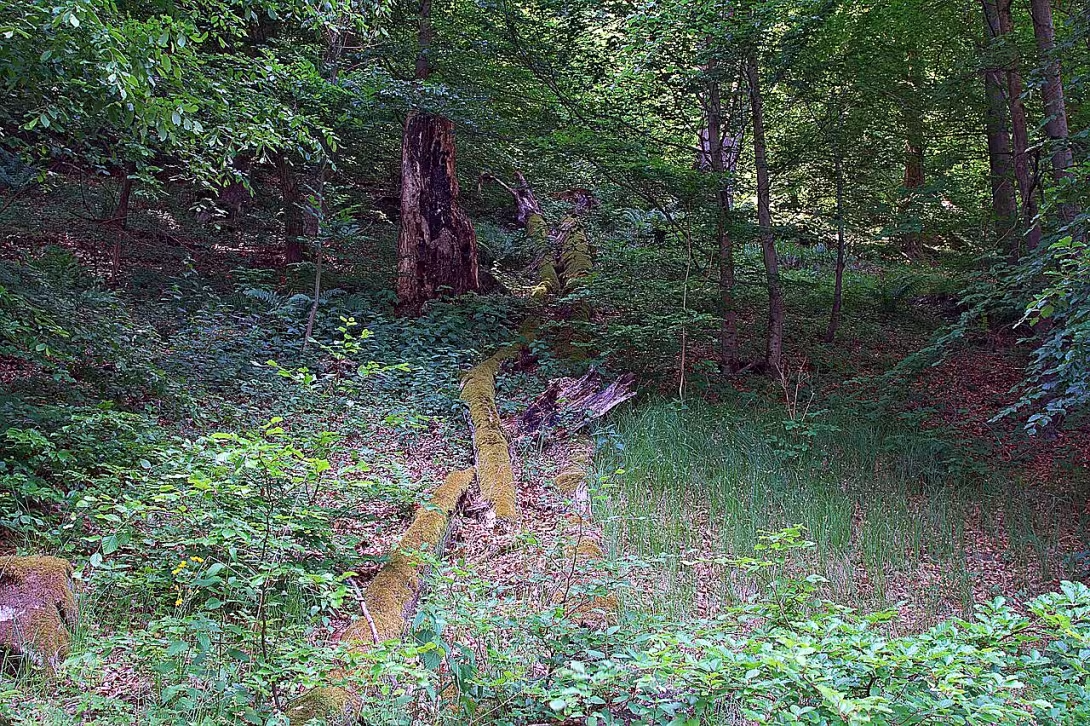
The castle Baba is an ancient archaeological site on the hill above Vltavou near Hluká nad Vltavou in the district of České Budějovice. The locality comes from the older and late Bronze Age and served as a strategic point at the trade route along the river. Its fortifications consist of two lines of parallel valleys and moats which define an area of 2.65 hectares. Since 1963, it has been protected as a cultural monument.
The roots of the fort range back to the older Bronze Age, when the location was inhabited within the so-called wind group. In a later period, specifically in the late Bronze period, it falls into the shield culture. In both of these stages, the fort served as a support point for an important trade route along the Vltava. While in the older Bronze Age the site was part of a densely populated landscape, in the late Bronze period it represented an isolated point in a sparsely populated area.
Architecturally, Baba Castle is interesting with its two-litre fortifications consisting of valleys and moats. The outside wall measures 380 metres and reaches a height of up to nine metres, behind which the moat is five to eight metres wide. The second line of fortifications is located further inside and its inner wall has a length of 255 meters. Between the two lines there is an arc platform with a width of 10 to 15 metres, which was previously mistaken for another wall.
The first written mention of the castle dates back to 1883, when Jan Nepomuk Woldřich published the results of his archaeological research. In 1963, the castle was declared a cultural monument. Modern focus and small-scale research took place in 2005, allowing two phases of settlement to be identified.
Today, the castle Baba is accessible within the fenced field, where there are red marked tourist trails and the educational path Hluboká nad Vltavou - Potesice. The locality offers not only an archaeological interest, but also an opportunity to explore the natural beauty of the surrounding area, including the natural monument Baba and other historical sites such as Hradec Hradec near Dobřejovice.
The castle Baba is an important witness to the prehistoric settlement and strategic importance of the region along Vltava. Its fortifications and history represent rich material for archaeologists and tourists interested in the history of the Czech Republic. Visiting this site offers a unique view of the life and strategy of people older than the Bronze Age, making Hradiste Baba not only a cultural monument, but also a valuable source of knowledge of the past.
Historical milestones
- 1883
- Jan Nepomuk Woldřich publishes the results of archaeological research fortifications.
- 1963
- The castle is declared a cultural monument.
- 2005
- Modern focus of the castle and small research in place.
Architectural development
The fortification consists of two lines of valleys and ditches which define the area of the castle. The outside wall has a length of 380 meters and its height is up to nine meters. Between the two lines there is an arc platform 10 to 15 metres wide.
Historical events
1883: Publication of results of archaeological research by Jan Nepomuk Woldrich. 1963: The castle is declared a cultural monument.
Points of interest
- The castle Baba is an ancient archaeological site on the top of the Vltavou near Hluboká nad Vltavou. - The locality comes from the older and late Bronze Age and served as a strategic point at the trade route along the river. - The fortification of the fort consists of two lines of parallel valleys and ditches which define an area of 2.65 hectares. Since 1963, it has been protected as a cultural monument. - The first written mention of the castle dates back to 1883 from archaeologist Jan Nepomuk Woldřich.
Guide
Show guide text
This text was created by artificial intelligence and has not been editorially reviewed. It may contain inaccuracies.
Welcome, distinguished visitors. Please stop for a moment, take a breath and look around you. You've just arrived at a place that keeps secrets within thousands of years. You are standing on the castle of Baba, on the high hill, which offers an amazing view of the valley of the Vltava river near Hluboká nad Vltavou. At first sight you may see only a wooded peak or mild terrain inequality, but under your feet and in the surrounding space there is a fascinating story from a time when the world looked completely different than today. Feel the atmosphere of this place, the silence interrupted by the shading of the leaves, and imagine that life was once throbbing in this space, there were voices of people, and there was a river in the distance that served as the main artery of the world at that time.
Let us now return together in time deep into the past, namely the Bronze Age. The castle Baba was not just an ordinary village, but a fortified mansion, which arose in the period of the older and late Bronze period. Why here? The answer lies in the country itself. This site has been chosen with complete sense. The peak above Vltavou provided natural protection and above all an incredible overview of the surroundings. At that time, the roads were not as we know them today, but the Vltava River was a key commercial route. Whoever controlled this strategic point controlled the movement of goods, people and information flowing along the river. Imagine the residents here as guardians and businessmen who have followed every boat from this place and every caravan that dared to enter their domain.
Now that we are aware of the importance of this place, pay attention to what surrounds you. Although time and nature have changed the fort considerably, you can still perceive traces of ancient architecture here. Look carefully at the terrain. The fortification of Baba Castle consisted of two lines of parallel valleys and moats. These structures were not just a pile of clay and stones, but a carefully thought-out defense system designed to repel enemies and ensure the safety of the people. The entire area that these walls defined had an area of approximately two and a half hectares, namely two and sixty-five hundred square metres. Try to draw these lines in your mind as they surround the top of the hill and create a safe island in the wilderness. Note how strategically the walls are located relative to cliffs and cliffs, so that the maximum field work completes the natural obstacles of the landscape.
Archaeological research revealed that the castle was not inhabited by just one group of people. We are talking about two distinct stages of settlement that are linked to the so-called vortex and shield culture. This means that Baba has been an important centre for many generations and various communities have left their mark. Each of these cultures has brought its own customs, a way of processing bronze and organizing society. It is fascinating to think that in the same place where you stand today, people with a completely different view of the world lived, but shared the same need for security and prosperity.
However, this space would not only be the home of prehistoric people, but it has also become a subject of interest for many personalities in much more recent times. The first important steps to uncover the secrets of the castle were made by Jan Nepomuk Woldřich. It was in the year of the thousand eight hundred eighty-three that he published the results of his archaeological research fortifications, thereby helping to make the value of this place visible to future generations. Other names such as Jan Adolf the second from Schwarzenberg, Bedřich Dubský or Josef Maličký appear in the history of the site. These men, whether as land managers, researchers or science promoters, contributed to the fact that Baba Castle was not forgotten and its history could gradually be composed as a complex puzzle.
An important milestone in protecting this place was the year one thousand nine hundred sixty-three, when the castle was officially declared a cultural monument. This meant that the state recognized its unique value and undertook to protect it. However, in order to have a more precise idea of the castle, in the year two thousand and five, a modern survey and focus of the entire area was carried out together with small research in place. Thanks to modern technologies, we now know much more about the size and structure of the waves than Jan Nepomuk Woldřich knew over a century ago.
Perhaps now you might wonder what was most important to the people at the time. Here comes one of the greatest attractions. The castle Baba was not only a military fortress, but probably also an important hub in the network of trade routes. Imagine what objects could have wandered here. Perhaps there was precious salt, skin, or metals that were perceived as magic at the time of bronze. The mystery remains, how exactly the interaction between the people inside the castle and those who traveled along the Vltava. Was it a friendly trade or rather a strictly controlled passage for a fee? It is this uncertainty that gives the place special tension and makes us fantasize about everyday life thousands of years ago.
Now, when you look around you, feel the fort as a silent witness to history. It's a place where nature meets human ambition, and in the details of the terrain, the efforts of ancient people to control their surrounding landscape. Even though we can't see the houses that stood here today, even the heads of the guards on the rolls, the energy of this place is still felt. It is a reminder of how important the strategic position was and how strong the bond existed between the people and the river that gave them life and wealth.
We now invite you to go on your own journey. Walk slowly through the castle space, follow the line of valleys and try to imagine what this place would look like at the time of its greatest glory. Let yourself be guided by your intuition and watch the landscape change with every step you take. The Baba Castle will not open its history to you in the first seconds, but if you pay attention to it, it will begin to tell you its stories.
Thank you for spending this short time with us in the depths of history. We hope that you felt a connection with the people who lived here a thousand years ago, and that your visit to this prehistoric mansion enriched you. We wish you a pleasant further walk and remember that history is all around us, just know where to look. Goodbye.
Tips for visitors
For the best experience we recommend visiting during the morning hours or just before sunset. In these times, the light is best suited for shooting archaeological structures and avoiding the greatest heat and crowds.
You can transport by car and public transport to the location.
Take with you comfortable shoes suitable for unequal terrain, plenty of water and small snacks. Since these are archaeological sites in nature, it is important to be prepared for each other in terms of equipment.
In the surrounding area you can visit other interesting places such as the natural monument of Baba, the castle on Hradec near Dobříjovice, the surroundings of the river Vltava, Křísín or the Girl Stone.
For families with children a visit is an interesting opportunity to discover history in nature, however it is necessary to count on the movement in the field which requires attention and suitable shoes.
Frequently asked questions
Can the monument be visited?
This is an archaeological site. Often there is little to see on the ground and the land may be private. We have not verified access.
Where is the monument?
Location: Hluboká nad Vltavou, Jihočeský kraj. The map on this page shows the exact spot.
Why is the monument protected?
It is listed in the Central List of Cultural Monuments of the Czech Republic as a cultural monument (register no. 1000135407).
Businesses nearby
Do you run a restaurant, accommodation, shop, museum, rental, wellness or other visitor service near this monument? Show yourself directly to the people heading to it — this is how they will see you in the app and on the web:
Events nearby
Zdroj akcí: otevřená data měst a obcí ČR (Národní katalog otevřených dat) a kalendář akcí Národního památkového ústavu.
Nearby
The natural monument of Baba, the castle on Hradec near Dobříjovice, Vltava, Křísín and Girlstone.
Accommodation nearby
Trips and activities nearby
Guided tours, tickets and activities nearby from GetYourGuide
Affiliate link: if you buy from the partner, we may receive a commission. The price for you does not change.
Search tours and activities →Themed route
Thematic cruise route around the Hradiště Baba
1. Baba Castle (archaeological site) Type: Archaeological site Why is worth a visit: Baba Castle is one of the most important and best preserved pre-Celtic castles in Europe. Since 1995, an archaeological exhibition has been in place that will impress visitors with a fascinating view of the life of ancient inhabitants.
2. Natural landmark Baba Type: Natural monument Why is worth a visit: This natural monument is famous for its unique geomorphological shape and rich flora. It is an ideal place for nature lovers who want to enjoy quiet moments around the castle.
3. Hradec Hrad near Dobříjovice Type: Archaeological site Why is it worth a visit: This castle, located not far from the castle Baba, is another important archaeological place. It offers interesting information about the living conditions and defense systems of ancient inhabitants.
4. Vltava Type: River Why is worth a visit: Vltava is not only an iconic element of the Czech landscape but also provides beautiful views and opportunities for relaxation. When walking along the river, you can enjoy comfortable corridors and quiet floods.
5. Armchairs and Girl Stone Type: Historical site Why is worth a visit: The chair is famous for its history and natural beauty, while the Girl Stone offers a unique view of the surrounding landscape. These places are ideal for those who want to expand their knowledge of the history and nature of the region.
Seasonal recommendations
In spring, the fort comes alive with the first greenery and blooming nature, which gives the place a fresh atmosphere. The soft spring light highlights the relief of the terrain and the awakening of the landscape makes a encouraging impression. We recommend moisture-resistant shoes due to frosted roads and a light jacket. An ideal visit in the morning is when the air is the cleanest.
The summer season brings a dense shade of trees and a rich green landscape that creates a sense of isolation from the outside world. The sun in full zenita can be painful, so it is best to come first thing in the morning to avoid the biggest crowds of visitors in the season. Don't forget enough fluids, sun protection and light, airy clothes.
In autumn, the surroundings of the castle turn into golden and red tones, creating a nostalgic and calm mood. Clean air offers great views of the surrounding countryside and temperate temperatures are pleasant for walks. Layer clothing and fixed shoes are suitable to prevent slip on wet leaves. The best time to visit is late afternoon.
In winter, the monument is a strict and quiet impression, while the freezing air and any snow cover reveal the basic shapes of the castle. The atmosphere is mystical and desolate, which allows you to better perceive the history of the place. It is necessary to have warm clothes and count on a shorter day. We recommend you plan your trip for the morning, so you can have daylight.
Visualizations and artistic views


The visualisations are generated by artificial intelligence and serve as inspiration.
Photos from the area
Real photos taken near the monument


Zdroj a licence jsou uvedeny u každého snímku.
Tips from visitors
No tips yet. Be the first!
Log in and add your tip.
Sources and literature
Photos: Atriplexmedia / CC BY-SA 3.0 — Wikimedia Commons. The author and licence also appear when you hover over the image.
Faktickým podkladem tohoto textu byl článek na Wikipedii, jehož autory jsou přispěvatelé Wikipedie. Článek je dostupný pod licencí CC BY-SA 4.0.
Location on the map


Příběhy a pověsti
Legendy, pověsti a příběhy spjaté s touto památkou
Fotografie návštěvníků
Zatím žádné fotografie. Buďte první, kdo přidá fotografii z návštěvy!
Log in a přidejte svou fotografii nebo hodnoťte.
Za ověřenou návštěvu v aplikaci získáte víc bodů — poznáme podle GPS, že jste na místě.
Reviews and comments