



Hřbitov se zvonicí a sloupem Cemetery
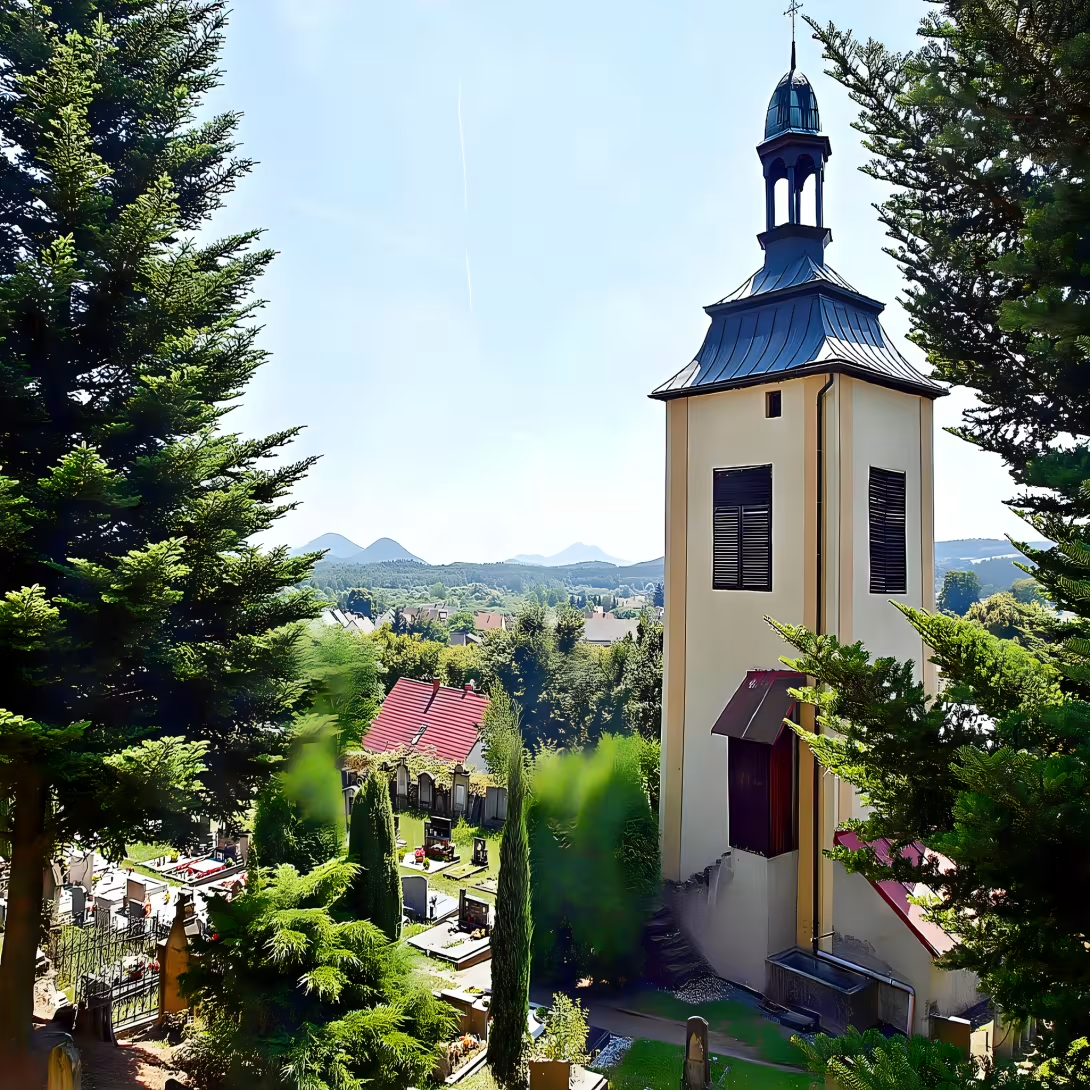
Hřbitov se zvonicí a sloupem in the village Jestřebí in the district of Česká Lípa is a cultural monument of the Czech Republic. Located on the sandstone rock terrace under castle Jestřebí. The building is particularly remarkable with its location, a niche chapel carved into the rock and a preserved tower of the original parish church.
The cemetery was built in the immediate vicinity of the original parish temple, which disappeared during the 1930s. It then served the church services of the chapel on the village and since the end of the 18th century a new church, built on the edge of the village by the way to Doksy. The burial ground was subsequently extended to the area of the original church, which was completely demolished with the exception of the tower. Since then it has served as the main cemetery for Jestřebí and settlement Escape.
From the point of view of the construction design the complex has an irregular ground plan. It is divided into two levels, which on the main road connects the staircase. The barrier is made of quarry stone, with a sandstone rock wall on one side. A two-arm staircase leads to the main gate, the second entrance is accessible from the unpaved path towards the castle.
The dominant is the tower, the only remnant of the original parish church, which today serves as a bell tower. There's an arched room on her ground floor. In the catalogue of the lithomeric diocese it is led as a chapel of the Resurrection of the Lord, but at present it serves rather as a warehouse of cemetery supplies. The first floor of the tower is accessible by the outer staircase.
A significant element is the ornament chapel of the Holy Way carved directly into the sandstone rock. It's about stopping a similar cross road, reminiscent of events from the life of Jesus Christ. Some churches form part of the graves over which they are placed. The rock wall of some of them is lined with a rough tile cladding laid on the coso. Along them are historical graves, including the graves of spiritual administrators of the local Catholic parish.
Another architectural element is the column with the Ionian head behind the staircase. Originally concluded by a richly decorated metal cross from 1826. Due to the poor condition of the column the cross fell around 2012 and has not yet been restored. In the northwest corner of the cemetery there is a distinctive tombstone of three Red Army soldiers. While stonewalled graves predominate the walls, the inner part of the complex consists mainly of tombstones of simple shapes.
Over the years there have been several changes available, for example after 1945 many of the original graves were abolished. A modern step in the management of the monument was the creation of a digital pasport cemetery in 2020, which is subsequently available in the Internet database.
The cemetery in Jestřebí represents a unique link between sacral architecture and natural sandstone subsoil. Visiting this place offers the possibility to observe the historical layers of the village and specific elements of popular piety.
Historical milestones
- 1826
- The dating of a heated, richly decorated metal cross on a pillar
- 2012
- Around this year, a metal cross fell from a pillar due to a bad condition
- 2020
- Creation of a digital paporus cemetery
Architectural development
The cemetery is covered with quarry stone and sandstone rock walls. The bell tower contains an arched room on the ground floor, which served as a chapel of the Resurrection of the Lord. In the cemetery there is a pillar with an Ionian head, which originally carried a metal cross from 1826.
Historical events
The demise of the original parish church during the Thirty Years' War; the abolition of many original graves after 1945.
Points of interest
- The monument lies on the sandstone rock terrace under castle Jestřebí. - In the rock are carved niche chapel of the Holy Way, which resembles the events of the life of Jesus Christ. - The dominant is the tower, which is the only remnant of the original parish church that died during the Thirty Years War. - The column with the Ionian head originally had a heat metal cross from 1826, which fell around 2012. - In 2020 a digital passport was created for the management of the monument available in the Internet database.
Guide
Show guide text
This text was created by artificial intelligence and has not been editorially reviewed. It may contain inaccuracies.
Welcome to Jestřebí. Right now you're standing in a place where history meets nature in complete harmony. Look around you. You are located on the sandstone rock terrace, which stretches directly under the castle Jestřebí. In front of you is a cemetery with a bell tower and a pillar, a place that radiates peace and respect for the past. Feel this space where the silence of rocks and monuments tell stories from many centuries. It is a resting place for residents of Jestřebí as well as neighboring settlements Escape, which is truly exceptional due to its location in the landscape.
Let's take a look at the history of this place together. If you look around, you'll see a tower that serves as a bell tower today. But this tower is not just an ordinary addition to the cemetery. It's the only surviving remnant of the original parish church. Imagine that once there was a whole temple that was the center of spiritual life around here. Unfortunately, however, a time of devastating conflict has come. During the Thirty Years' War, which destroyed much of our countries, the church was destroyed. What you see today is a silent witness to that time. The tower remained a reminder of what had happened, and over time it became a dominant part of the complex. It's fascinating to think of how many generations of people have passed this tower and how much the world around us has changed since then.
Now pay attention to the architectural elements surrounding you. Look at the column that's standing here. Notice its top, specifically the warhead, which is performed in Ionian style. This element gives the whole place a sense of classical elegance. If you focus on the very top of the column, you'll see a metal cross. This cross has its own history. Originally, it was a richly decorated, warm metal cross, dating back to twenty-six eighteen. Imagine the precise work of a blacksmith who put so much detail into the metal. Unfortunately, however, time and weather take their toll. Around the year two thousand twelve crosses fell from the pillar due to bad condition. It's a reminder of how fragile even the strongest materials are if we don't want them. The whole complex, from bell tower to pole to grave area, is today protected as a cultural monument of the Czech Republic, which ensures that its value is not lost.
Now let's move on to one of the most interesting parts of this cemetery. Please look towards the rock wall. Notice there are carved niche chapels. This is the so-called Holy Way. These small chapel are not just decoration carved into sandstone, but have profound meaning. Each niche resembles the specific events of the life of Jesus Christ. For pilgrims and visitors from the past, this journey was a journey of reflection and prayer. Imagine people walking slowly along the rock wall, stopping at each chapel, thinking about the meaning of life and faith. It's an amazing combination of human hand and natural rock that creates an atmosphere of deep calm.
If you stand here like this, you might wonder how this place is handled today. In modern times, monuments are also technically accessed. In the year two thousand twenty, a digital passport was created for this cemetery. It is a modern way of documentation that helps maintain records of the state of the monument so that future generations know what state it was in in our century. It's a bridge between ancient sandstone and today's digital era.
The mystery remains the names of the architects who designed this space. We don't know exactly who invented the location of the bell tower or who carved the Holy Way Chapel into the rocks. We don't know these people, but their work speaks for them. They left a trail that lasted centuries. It is this ignorance that gives the place some charm. It is a work created for the community, for the people of Jestřebí and Escape, not for the glory of a particular name.
Now I'm just recommending that you take a moment in silence. Feel the contrast between the massive rock terrace on which you stand and the fineness of decorating on the pillar. Look up to the castle that watches over you, and then back to the silent bell tower. It's where time stopped.
I hope you enjoyed this short trip to history. Now you can calmly continue your journey, explore the surroundings of the castle or just be inspired by the silence of this cemetery. Thank you for your attention and I wish you a pleasant rest of the day in Jestřebí. Goodbye.
Tips for visitors
The best time for a visit is late spring or autumn, when the colors of nature highlight the sandstone terrace and the atmosphere of the piety site is the most significant. Transport to the village Jestřebí is possible by car and public connections. Check the specific path in the maps.
For your journey, wear comfortable shoes suitable for the terrain, as the monument is located on the rock terrace. We also recommend taking water with us and in case of colder weather layered clothes.
For the best photos, use the morning or late afternoon light, which lights up the bell tower and sandstone rocks beautifully. The ideal angle is a view from the bottom that highlights the location of the cemetery under the castle.
During the visit you can visit the castle Jestřebí, the village Jestřebí or the settlement Újezde. For families with children, an interesting experience is the observation of the surrounding nature and the story of the history of the defunct church from the time of the Thirty Years War.
Frequently asked questions
Can the monument be visited?
Cemeteries and graves are usually accessible; please respect the dignity of the place. We have not verified the opening hours of this cemetery.
Where is the monument?
Location: Jestřebí. The map on this page shows the exact spot.
Why is the monument protected?
It is listed in the Central List of Cultural Monuments of the Czech Republic as a cultural monument (register no. 1000125634).
Businesses nearby
Do you run a restaurant, accommodation, shop, museum, rental, wellness or other visitor service near this monument? Show yourself directly to the people heading to it — this is how they will see you in the app and on the web:
Events nearby
Zdroj akcí: otevřená data měst a obcí ČR (Národní katalog otevřených dat) a kalendář akcí Národního památkového ústavu.
Nearby
Hrad Jestřebí, obec Jestřebí, osada Újezd.
Accommodation nearby
Themed route
Here is the design of the thematic route:
1. Castle Jestřebí - fortress. The trip begins with historical remains that offer a view of the surrounding landscape. 2. Municipality of Jestřebí - municipality. Walk through the centre of the village allows to observe local architecture and atmosphere. 3. Hřbitov se zvonicí a sloupem - cemetery. The main destination of the trip, where one can admire the unique bell tower and memorial column. 4. Oslo Escape - settlement. The final part of the route leads to the next part of the village for a quiet walk in nature.
Seasonal recommendations
When spring comes, the cemetery in Jestřebí comes alive thanks to the first green shoots and blooming flowers in the sights. The atmosphere is fresh and full of hope, which is reflected in the fine, soft light that hits the bell tower. We recommend to arrive early in the morning, when the air is the cleanest and nature the quietest. Due to the variable weather, you can use clothes that can be easily layered to protect you from morning cold.
During the summer months, the place is covered with thick greenery and the sun shines the strongest. Heat and silence create a sense of calm, but in the high summer season there may be more people around. It is advisable to carry a headgear and plenty of fluids. The best time to visit is an early evening when shadows are longer and the temperature is more pleasant for walking between tombstones.
The autumn season brings a melancholy mood to the surroundings, underscored by falling leaves and occasional morning fog surrounding columns. The light is golden at this time and very beautiful to capture the image, which gives the monument a noble look. Due to wet soil and leaves on the road, it is recommended to wear solid and waterproof shoes. A warm jacket is essential for a relaxed observation of the calm of this period.
In winter the cemetery works in a very steep and quiet way, especially if everything is covered with snow or freeze. The landscape is mostly grey and bare during this period, which highlights the shape of the bell tower. It is necessary to prepare for significant cold conditions, therefore choose very warm clothes and robust shoes. Because the days are short, the best thing is to schedule a visit around the noon hours when the lights are most.
Visualizations and artistic views

The visualisations are generated by artificial intelligence and serve as inspiration.
Photos from the area
Real photos taken near the monument


Zdroj a licence jsou uvedeny u každého snímku.
Tips from visitors
No tips yet. Be the first!
Log in and add your tip.
Sources and literature
Photos: VitVit / CC BY-SA 4.0, rozlišení zvýšeno umělou inteligencí — Wikimedia Commons. The author and licence also appear when you hover over the image.
Faktickým podkladem tohoto textu byl článek na Wikipedii, jehož autory jsou přispěvatelé Wikipedie. Článek je dostupný pod licencí CC BY-SA 4.0.
Location on the map
More monuments – Jestřebí
Show all in the municipality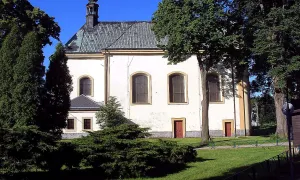
Příběhy a pověsti
Legendy, pověsti a příběhy spjaté s touto památkou
Fotografie návštěvníků
Zatím žádné fotografie. Buďte první, kdo přidá fotografii z návštěvy!
Log in a přidejte svou fotografii nebo hodnoťte.
Za ověřenou návštěvu v aplikaci získáte víc bodů — poznáme podle GPS, že jste na místě.
Reviews and comments