



Hrobka Belcrediů Tomb
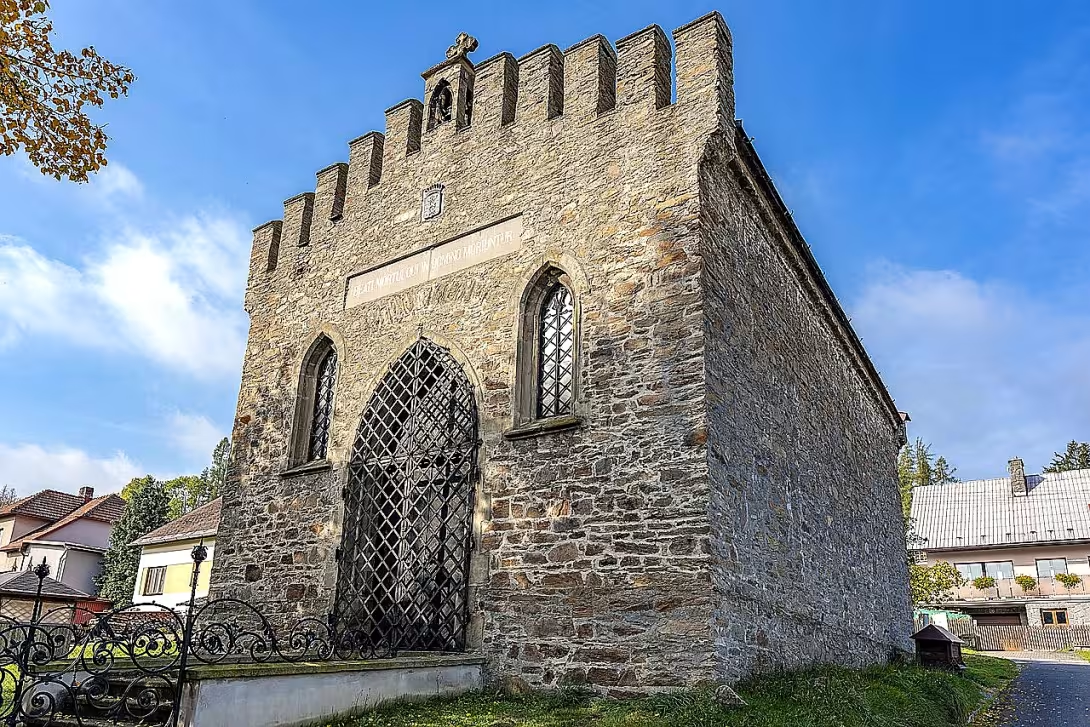
Hrobka Belcrediů, located on the hill slope of the Counterfeit in the village Jimramov, is a neo-gothic monument built in 1869 by Egbert Belcredim for his family. This cultural monument of the Czech Republic represents an important historical and architectural object in the district of Ždár nad Sázavou.
The history of the tomb dates back to 1778, when the imram estate went into the hands of the Belcredi family. This family was increasingly involved in local life and significantly influenced regional history. The position of the tomb was motivated by the need to provide a suitable burial ground for the genus that had long settled in the area and had deep roots there.
The tomb is an example of the neo-gothic style. The construction was built from a concrete quarry masonry, which gives its appearance solid and durability. The Gothic tiered facade ends with an open bell tower and cross, which adds a touching character of the whole building. The entrance part of the tomb is located on the east side and is decorated with a massive door with a heated metal grid. Above the entrance there is a coat of arms of the Belcredi family together with the Latin inscription "BEATI MORTUI, QUI IN DOMINO MORIUNTUR." That means "Blessed are the dead who died in the Lord.".
The interior of the tomb is covered with a quilted vault and has a stone floor. On the front wall there is an altar menza with the great plastic of the crucified Christ, which gives space religious importance. On both sides of the tomb there is a degree of elevated space for storing oak coffins and urn with the remains of deceased Belcredi members. Above these coffins are fixed inscription plates containing names, coats of arms, birth data and titles buried.
The Belcredi family was an important noble family with a long history. The first mention of this family dates back to 1010. In 1721 they were awarded the hereditary Austrian Lombardy title of the Marquis and in 1769 they acquired the Czech count and the incubate. The tomb served as a final rest for eighteen members of this prestigious family.
After the communist coup in 1948, many members of the Belcredi family left Czechoslovakia. Some of them were buried in a cemetery in Allan, Lower Austria, reflecting their new fates and access to burial outside their home country. Among them were Karl Georg Belcredi and his wife Therese Maria, their son Richard and other family members.
Today, the Belcredi tomb is protected by a cultural monument and is worth visiting not only for its historical value but also for its architectural appearance. Its location on the hill of the Counterfeit offers a beautiful view of the surrounding landscape and reminds us of the importance of remembering history and family traditions.
Hrobka Belcrediů is not only a resting place for the deceased but also a witness to rich historical events and changes. It is a reminder of the importance of remembering the past and recognising the importance of family traditions. For those who are interested in history and architecture, the visit to this monument is not only engaging but also instructive.
Then and now
Drag the slider to compare how the landmark may have looked when it was built with the view today.
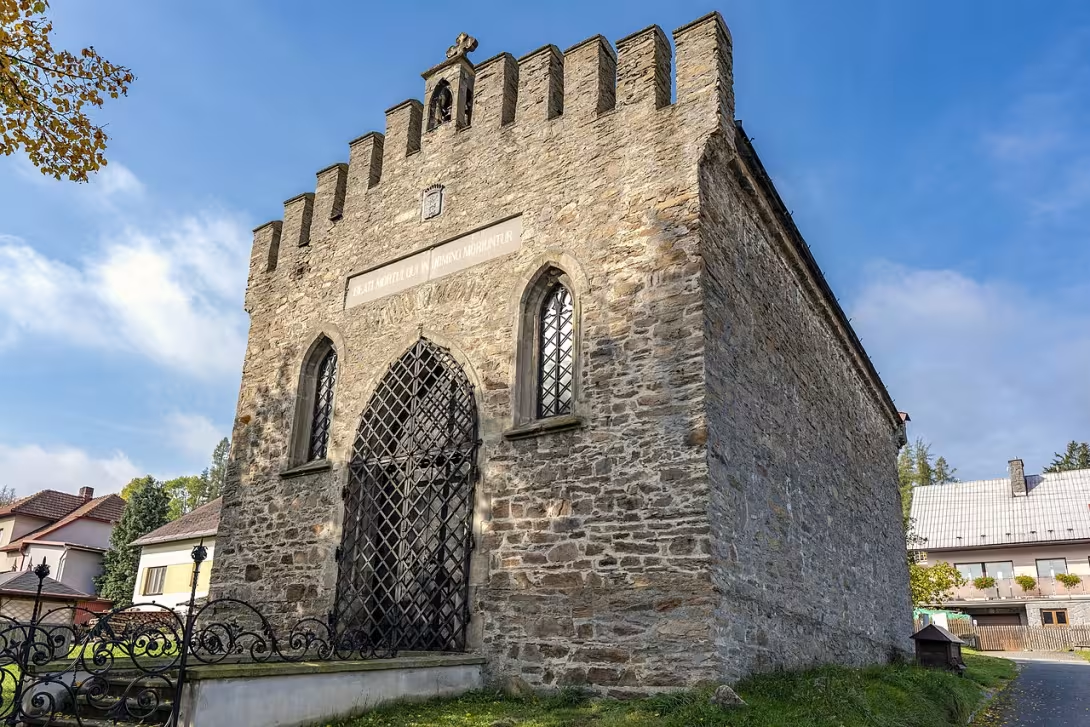

The historical appearance on the left is an AI-generated visualisation and serves as inspiration only.
Historical milestones
- 10
- First mention of the Belcredi family.
- 1778
- The transition of the Jimram estate into the hands of the Belcredi family.
- 1869
- Building a neo-gothic tomb by Egbert Belcredi.
- 1948
- The departure of many Belcredi family members from Czechoslovakia after the coup.
Architectural development
The construction is neo-gothic and was built from a concrete quarry wall. It is characteristic of the gotifying tiered front end with bell tower. The interior is encased with a broken-down vaults.
Historical events
In 1778, the Jimram estate was owned by the Belcredi family. In 1869, a family tomb was built.
Owners
The Belcredi family since 1778.
Points of interest
- The tomb is a neo-gothic monument built in 1869 by Egbert Belcredim. - The construction is built from a concrete quarry wall and has a gotifying tiered front with a bell tower. - The interior is encased with a quilted vault and contains an altar menza with the plastic of the crucified Christ. - The tomb served as a final rest for 18 Belcredi. - It is located on the slope of the hill.
Guide
Show guide text
This text was created by artificial intelligence and has not been editorially reviewed. It may contain inaccuracies.
Welcome to Jimramov. You have just stopped on the hill slope of the Counterfeit where you are surrounded by peace and atmosphere of a place that is deeply linked to the history of this region. Before your eyes is the tomb of the Belcredi family, a monumental structure that carries the weight of centuries and the silent story of one of the most important families that once ruled here. Feel this moment, feel the silence of the surroundings and look at this object not as a mere stone structure, but as a witness to the time that stands firm, even though the world around it was constantly changing.
Let us now look together at what this building represents. The tomb that you are now observing is built in a neo-gothic style, a style that in the nineteenth century produced deep nostalgia after medieval nostalgia and spiritual ascension. But in order to understand why this tomb is here, we need to go much further back into the past. The Belcredi family is not a random name in history; their roots go back to the year thousands of ten, which is an incredible time dimension that we can hardly imagine in today's rapidly changing times. After centuries of existence, in the year seventy-eight eighteenth century, the imperious estate became part of their heritage. This tomb was then the result of an effort to preserve family memory and dignity. In the year of the thousand eight hundred sixty-nine here Egbert Belcredi had built this monumental space to serve as an eternal home for his loved ones and as a symbol of the continuity of his family in this country.
Now pay attention to the architecture itself and the details you have right in front of you. Notice how the construction is perceived through its material nature. The tomb is built from a concrete quarry wall. This material gives the whole building a sense of resistance and natural strength. Stone blocks, the surface of which is not perfectly smooth, but retains its rough, authentic texture, give the impression that the tomb grows directly from the hill's very slope. The whole object has a rectangular plan, which gives it stability and balance. Look up at the facade now. It shows this characteristic gotifying concept, which manifests itself through tiered shapes. This tightness leads your view upwards to the top of the bell tower. This vertical line is typical of neo-gothic and aims to direct man's thoughts towards heaven.
If you had the opportunity to enter the interior, you would see the space that is designed to create wonder and humility. The entire inner space is covered with a broken-down vaults. This ceiling curve is not only a technical solution, but creates a sense of dynamism and nobility in space. In the midst of this sacred space, there is an altar menza, the centre of which is the sculpture of the crucified Christ. This statue forms the spiritual core of the whole place and reminds the visitor of the topic of sacrifice, eternity and hope, which are inherent in such monuments.
Looking at this tomb, however, we cannot forget the human dimension and fate of the personalities who shaped it. Egbert Belcredi, the man who decided on this construction in a thousand eight hundred sixty-nine, was a man of his time who wanted to leave a permanent mark. His decision to build such a decorative and durable tomb reflects the ambition and pride of his family. But history has a darker and sadder side. We must remember the year one thousand nine hundred and forty-eight. After the political coup in Czechoslovakia, there was a major break. Many members of the Belcredi family have been forced to leave the country they have cocreated for centuries. This tomb, which was supposed to be a symbol of their permanent presence, became a silent monument to their departure and loss. It's a place where the grandeur of a family heirloom collides with the tragedy of historical twists.
The interesting thing that may interest you when you look at this object is the contrast between the incredible longevity of the genus and the relatively recent emergence of this particular building. While Belcredi roots go deep into the dark ages of the early Middle Ages, this neo-gothic tomb is the product of a more modern era, when people began to look back on their history with respect and desire for aesthetic perfection. It's a fascinating example of tradition trying to capture time in the solid boundaries of stone. The tomb stands here as a protected cultural monument of the Czech Republic, which confirms to us that its importance exceeds mere family memory and becomes part of our common cultural wealth.
Now that you've gone over the basic features of this monument, I suggest you devote a few more moments to observing the details of the masonry and the overall geometry of the construction. Feel how light changes on a rough stone and how the tomb fits into the landscape around you. It is a place to think, to understand the permeability of human life and to acknowledge the power of tradition that can survive even the most turbulent political changes.
Thank you for staying and paying attention to this history. We hope this view of the Belcredi tomb has helped you better understand the importance of this place. Please continue your walk with Jimramov and discover the other secrets that this city hides within you. Goodbye.
Tips for visitors
The best time to visit the Belcredi tomb is in the spring or autumn period when winter is milder and nature offers a beautiful view. This time of the year also provides ideal lighting conditions for shooting architectural details of the tomb.
We recommend checking the current connection in the traffic search engine.
When planning a visit, bring a suspender, shoes suitable for walking on the hill and protection from sunlight. Hrobka Belcrediů is located on a slope, which can be more challenging for walking, especially in mountain conditions.
The best place to photograph the Belcredi tomb is at the top of the hill. Here you can enjoy the panoramic view and capture the architecture in different light conditions, especially at noon or in the evening when the light is less powerful.
In the vicinity of the Belcredi tomb is located the hills of the Counterfeit which offer a beautiful view of the Jimramova area. For families with children this place is ideal for a short walk and enjoy nature.
Frequently asked questions
Can the monument be visited?
Cemeteries and graves are usually accessible; please respect the dignity of the place. We have not verified the opening hours of this cemetery.
Where is the monument?
Location: Jimramov, Kraj Vysočina. The map on this page shows the exact spot.
Why is the monument protected?
It is listed in the Central List of Cultural Monuments of the Czech Republic as a cultural monument (register no. 1000152996).
Businesses nearby
Do you run a restaurant, accommodation, shop, museum, rental, wellness or other visitor service near this monument? Show yourself directly to the people heading to it — this is how they will see you in the app and on the web:
Nearby
Pound Counterfeit near the village Jimramov.
Accommodation nearby
Themed route
Hrobka Belcrediů Type: Historical monument, tomb Why is it worth visiting: This monumental set of tombs presents a unique example of noble architecture and family history. Visitors can look at detailed sculptures and learn about the fate of the important Belcredi family in the region.
Hill Counterfeit Type: Natural formations, peaks Why is it worth a visit: These hills located in the immediate vicinity of the village Jimramov offer a quiet atmosphere for short walks. Their slopes open views of the surrounding landscape and the village itself, which complements the historical context of the tomb.
Circuit Tombs Belcredies Type: immediate area, park greenery Why is worth a visit: The space around the tomb is adjusted to allow a thoughtful walk between trees and historical elements. It allows visitors to explore details of sculpture decoration and tomb structures in peace and privacy.
Top of the hill Type: Sightseeing points, natural landscape Why is it worth a visit: The entrance to the higher parts of these hills will reward hiking tourists overlooking the wider surroundings of Jimramova. It is an ideal place for a short pause and admiration of the natural nature, which contrasts with the stone monumentality of the tomb.
Village Jimramov (immediate surroundings of the monument) Type: Historical buildings, cultural environment Why is it worth a visit: Walking the streets of the village near the tomb allows you to understand the local context and atmosphere. Visitors can appreciate the combination of historical monuments with the daily life of the village and its architectural impact.
Seasonal recommendations
Spring: The spring season offers a fine, scattered light that beautifully highlights the details of architecture in line with the awakening vegetation around Jimramova. The atmosphere is fresh and full of hope, which creates an interesting contrast to the silent nature of the monument. It is ideal to choose the morning hours when the air is the cleanest. We recommend layered clothes because the morning cold can still be felt, although the sun is already starting to warm.
Summer: During the summer months, the area surrounding the tomb is surrounded by dense greenery and the sun's rays hit the stone very intensely. In the main summer season, however, there may be a larger number of visitors near the monument. To avoid you in peace and without excessive heat, we recommend you arrive as soon as possible after opening. Dress lightly and don't forget to protect yourself from the sun, especially if you move in open spaces.
Autumn: Autumn months bring to Jimramova melancholic and nostalgic atmosphere, which is perfectly suited for a tour of the historic tomb. Foggy mornings and golden colors of decaying leaves create a magical environment for photography. The number of visitors falls significantly, which ensures greater privacy. Prepare yourself a waterproof jacket and warmer clothing, because humidity and cooler air can be pronounced in this period.
Winter: In winter, the tomb is very distant and quiet, especially if the landscape is covered with snow or frost. The atmosphere is the most profound in quiet, freezing days when the surroundings are almost empty. For a comfortable visit it is necessary to wear very warm clothes, high-quality shoes and gloves to manage your stay outside.
Visualizations and artistic views


The visualisations are generated by artificial intelligence and serve as inspiration.
Photos from the area
Real photos taken near the monument


Zdroj a licence jsou uvedeny u každého snímku.
Tips from visitors
No tips yet. Be the first!
Log in and add your tip.
Sources and literature
Photos: Roman Šulc / CC BY-SA 4.0 — Wikimedia Commons. The author and licence also appear when you hover over the image.
Faktickým podkladem tohoto textu byl článek na Wikipedii, jehož autory jsou přispěvatelé Wikipedie. Článek je dostupný pod licencí CC BY-SA 4.0.
Location on the map


Příběhy a pověsti
Legendy, pověsti a příběhy spjaté s touto památkou
Fotografie návštěvníků
Zatím žádné fotografie. Buďte první, kdo přidá fotografii z návštěvy!
Log in a přidejte svou fotografii nebo hodnoťte.
Za ověřenou návštěvu v aplikaci získáte víc bodů — poznáme podle GPS, že jste na místě.
Reviews and comments