



Husův sbor v Nové Pace Church
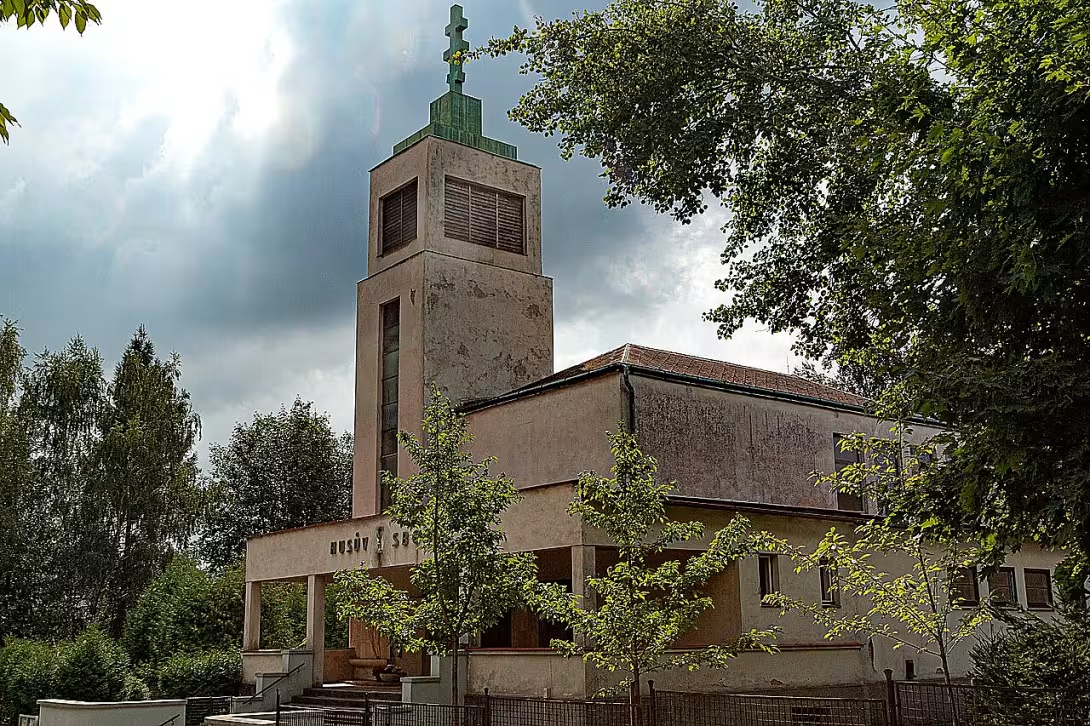
Husův sbor v Nové Pace, located in Kumburg Street in the Jičín district, is one of the cultures of the monuments declared in 2004. It is a church of the Czechoslovak Hussite Church built according to the design of architect Josef Kavan from Nová Paka.
The construction was completed in 1937, during the period when the architecture of the Hussite Corps changed. While the end of the 1920s brought experiments and searching for its own shape, the 1930s were headed towards forms already established. Thus, the Hussite church gradually approached the appearance of the traditional Catholic temple type with a medium boat and side boats, dedicated tower in the main facade. The whole building represents a typical interwar modernist architecture with functionalist features.
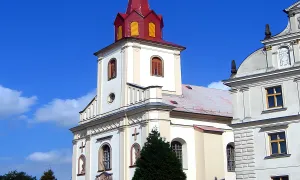
The memoirs of its construction are considerable. It's a walled three-boat structure on a longitudinal floor plan. The tower is on the east side of the building, where the adjacent prayer room opens to a parish apartment situated on the west side. The roof is valbic, the tower is decorated with a straight roof with a papal cross on top. Both the prayer room and the tower have narrow vertical windows; In the prayer room, they are arranged right next to each other. Some windows are decorated with figural motifs created in 1938 by Josef Sail. There is a high plinth around the building (1.5-1.8 m), and it enters the prayer room through a straight staircase leading to the covered terrace, supported by columns in the entire width of the facade. Behind a two-wing glass door is followed by a door with a staircase to the tower and to the circle. The prayer room itself has dimensions of approximately 13,5 × 15 metres and its side ships are separated from the middle by pairs of round columns.
The bells in the tower are an interesting part. The original bells were restored during World War II. Today there are three bells that come from the repealed church in Ruštěr. This is a classic work of German origin from 1868 with German inscription. The big bell reaches a height of 93 centimeters and a diameter of 105 centimeters, the medium bell is 75 centimeters high with a diameter of 73 centimeters, and the smallest is 65 centimeters high with a diameter of 73,5 centimeters.
The building, including its urban area, fenced walls, a cemetery separated by stone wall and fence, forms a uniform functionalist complex. By law, the Ministry of Culture has decided that the construction of the building deserves protection.
Today, Hus' choir is used not only for religious ceremonies, baptism and confirmation, but also serves as a venue for social events. It hosts exhibitions of paintings of local artists, concerts of organ and choir, exhibitions of artistic craft. It is thus живым the centre of social and cultural activities at Nová Pace.
Then and now
Drag the slider to compare how the landmark may have looked when it was built with the view today.
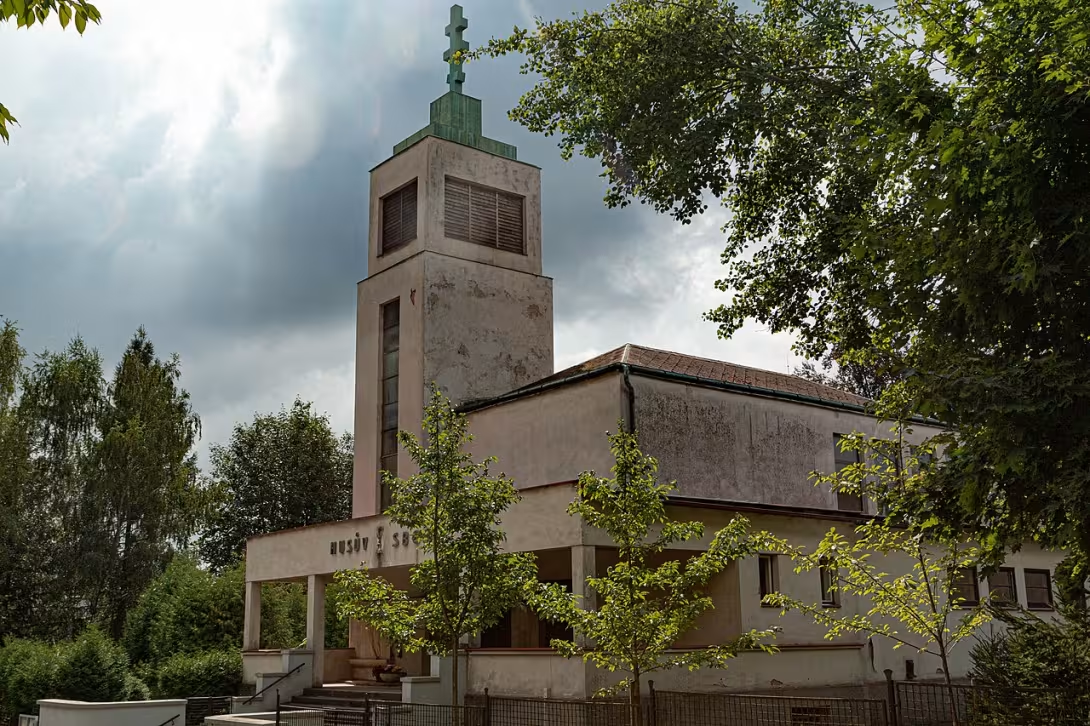

The historical appearance on the left is an AI-generated visualisation and serves as inspiration only.
Historical milestones
- 1937
- Completion of the construction of the Husova choir in Nová Pace according to the design of Josef Kavan.
- 1938
- Production of figure window fillings by Josef Sail.
- 2004
- Declaration for a cultural monument.
Architectural development
A single-storey brick structure on a longitudinal floor plan with a tripod layout, a middle ship separated from the side boats by pairs of round columns. The roof of the Valba, the tower with the flat roof and the papal cross. The windows of the prayer room and the tower are narrow and vertical, the part of the windows has figural fillings. Around the building is fencing and terrace with support columns. The tower contains three classicist bells from 1868 transferred from the repealed church in Ruštěr.
Historical events
- 1930-1937
- Built three-boat brick building according to the Josef Kavan project, which represents the transition from experimental Hussite choirs to classic boat available with tower.
- 1938
- Production and installation of figural window fillings by Josef Sail.
- 2004
- Declaration for cultural monument by the Ministry of Culture of the Czech Republic.
Points of interest
- The construction was completed in 1937 and represents a typical interwar modernist architecture with functionalist features.
- The church has a walled three-boat structure with a valb roof and a tower on the east side, which ends with a roof with a papal cross.
- The windows of the prayer room are narrow and vertical, some decorated with figural motifs from Josef Sail from 1938.
- The tower contains three bells from 1868, originally from the church in Ruštěr, with German inscriptions and various dimensions.
- The building, including its surroundings, including the fenced walls and the cemetery, forms a unified functionalist complex.
Guide
This guide is narrated by a synthetic voice generated by artificial intelligence.
Show guide text
This text was created by artificial intelligence and has not been editorially reviewed. It may contain inaccuracies.
Husův sbor in Nová Pace is a church of the Czechoslovak Hussite Church located on Kumburská street. It was completed in nineteen thirty-seven according to a design by Nová Pace architect Josef Kavan. In two thousand and four, the Ministry of Culture declared it a cultural monument.
The building is an example of interwar modernist architecture with functionalist elements. In the nineteen thirties, Hussite churches moved away from the experimental buildings of the late nineteen twenties. Their appearance became closer to the Catholic aisled church with a tower on the main façade. This is the case here as well. The tower stands on the eastern side next to the chapel, while the administrative building with the vicar's apartment adjoins on the western side. The building has a hipped roof, the tower is topped with a flat roof and bears a papal cross at the peak.
The chapel and tower are pierced by narrow vertical windows, arranged closely together in the chapel. Some of them have infills with figurative motifs by Josef Plachota from nineteen thirty-eight. The entire structure is surrounded by a plinth over one and a half metres high. Straight stairs lead to a covered terrace with columns that runs across the entire width of the façade. From the vestibule, stairs ascend to the gallery and into the tower. The gallery partially projects into the chapel. The chapel measures approximately thirteen and a half by fifteen metres and is divided into three aisles by a pair of round columns.
The original bells were requisitioned during the Second World War. Today, three bells hang in the tower, transferred from a demolished church in Rudník. They are a neoclassical work of German origin. All three bear German inscriptions around their circumference and the same date of eighteen sixty-eight. The largest of them, hung in the centre, is ninety-three centimetres high and has a diameter of one hundred and five centimetres.
An integral part of the church complex are the carefully planned surrounding plots with fencing. These include a boundary wall made of dressed stone and a stone embankment that separates the complex from the adjacent cemetery. The entire complex thus represents a functionalist sacred building along with its carefully maintained surroundings.
Besides services, baptisms and confirmations, various social events are held here. Exhibitions of visual artists are organized, as well as traditional Advent and organ concerts and performances by choirs. In recent years, there has been a postage stamp exhibition, a fashion show and a scout pledge ceremony.
Frequently asked questions
Can the monument be visited?
Religious buildings are usually open mainly during services; at other times a visit is normally arranged with the parish or the operator. We have not verified specific times.
Where is the monument?
Location: Nová Paka, Královéhradecký kraj. The map on this page shows the exact spot.
Why is the monument protected?
It is listed in the Central List of Cultural Monuments of the Czech Republic as a cultural monument (register no. 100918).
For kids
Imagine going back 96 years and finding yourself in a small village of New Pace in Bohemia. The local people will tell you that there was a church called Hus' choir built in 1930.
How did it look here? Who lived here? What happened here? The village was full of life and work. Agriculture was the main business. People gathered in church at worship and wedding ceremonies. Local kids played in front of the church, joined groups and played games.
Businesses nearby
Do you run a restaurant, accommodation, shop, museum, rental, wellness or other visitor service near this monument? Show yourself directly to the people heading to it — this is how they will see you in the app and on the web:
Accommodation nearby
Themed route
Thematic cruise route to Nová Pace with focus on Hussite tradition and nature
1.Husův sbor v Nové Pace Type: Church Why is he worth a visit? This is an important monument to the Hussite movement, built in the early 15th century. Its simple Gothic architecture and historical importance associated with the reform movement are fascinating for lovers of history.
2. Church of St. Jacob the Greater Type: Gothic church, approximately 1 km from Husova Choir Why is he worth a visit? This 13th century church is another pearl of sacral architecture in the city centre. Its Gothic elements and location in the historical core of Nová Paka create an interesting contrast with the Husova Choir.
3. Kumbury Forest Type: Protected landscape area, approximately 2 km from the centre Why is he worth a visit? This forest area offers peaceful nature with rich biodiversity and historical paths. Ideal for a short walk or rest after sightseeing.
The route is designed to combine the spiritual and natural beauty of New Paka. It begins at the Husova congregation, continues to the center of the city to the church of St. James and ends in the natural environment of the Kumbury Forest.
Seasonal recommendations
Spring In the Husova choir in Nová Pace there is at this time the living color of nature - the green walls of the church appear to be living leaves that flourish under sunlight. The interior light from the okien is turned into a warm, sunny glow that highlights the detailed decoration of the choir interior. The atmosphere is airy, as if the church had opened for a new life. At this time it is advisable to visit the memory early in the morning when there are fewer visitors and the light is finer. Clothes should be light, but ready for sudden changes in weather - it can cool quickly in spring days. It is also recommended to take a small water-resistant hot thing because indoor temperatures tend to be slightly colder.
Summer In the main summer season the church is lit with natural sunlight, which highlights its architectural details. The outer walls are warm and welcoming, while the inner spaces are taking on depth due to long hours of the day. The atmosphere is full of energy but at the same time calm when visitors focus on detailed decoration. The best time to visit is early afternoon when the temperature is more pleasant and the crowds are less dense. Suitable clothing includes light clothes, hat or scarf and sun glasses. It is also important to take with you enough water, because the inner spaces can be colder.
Autumn In autumn days the church turns into a mysterious but pleasant space, where the light from the okien creates long shadows and creates a sense of peace. The outer walls are covered with leaves that are starting to fall off, and the inner light is getting slightly darker. The atmosphere is melancholy but comfortable at the same time, as if the church were preparing for winter silence. The best time to visit is in the morning or before noon when the air is clean and visitors are less numerous. Clothes should be warm, but light, with layers that are easily removed. It is also advisable to take a warm thing on your hand because the internal temperatures can be colder.
Winter In winter, the church is lit with artificial light, which creates a delicate but strong atmosphere. The outer walls are covered with snow, which gives the place a mysterious, winter character. The atmosphere is calm and quiet, as if the church were preparing for Christmas silence. The best time to visit is in the afternoon when light is pleasant and visitors are less numerous. Suitable clothes include warm clothes, wool pants, hats and gloves. It is important to also bring a warm peony or tea, because the inner spaces can be colder.
Visualizations and artistic views


The visualisations are generated by artificial intelligence and serve as inspiration.
Photos from the area
Real photos taken near the monument


Zdroj a licence jsou uvedeny u každého snímku.
Atmosphere of the place
This atmospheric visualisation of the place and period was generated by artificial intelligence. It is not real footage of the location.
Tips from visitors
No tips yet. Be the first!
Log in and add your tip.
Sources and literature
Photos: Petr1888 / CC BY-SA 4.0 — Wikimedia Commons. The author and licence also appear when you hover over the image.
Faktickým podkladem tohoto textu byl článek na Wikipedii, jehož autory jsou přispěvatelé Wikipedie. Článek je dostupný pod licencí CC BY-SA 4.0.
Location on the map
Příběhy a pověsti
Legendy, pověsti a příběhy spjaté s touto památkou
Fotografie návštěvníků
Zatím žádné fotografie. Buďte první, kdo přidá fotografii z návštěvy!
Log in a přidejte svou fotografii nebo hodnoťte.
Za ověřenou návštěvu v aplikaci získáte víc bodů — poznáme podle GPS, že jste na místě.
Reviews and comments