



Jindřichův Hradec (nádraží) Railway station
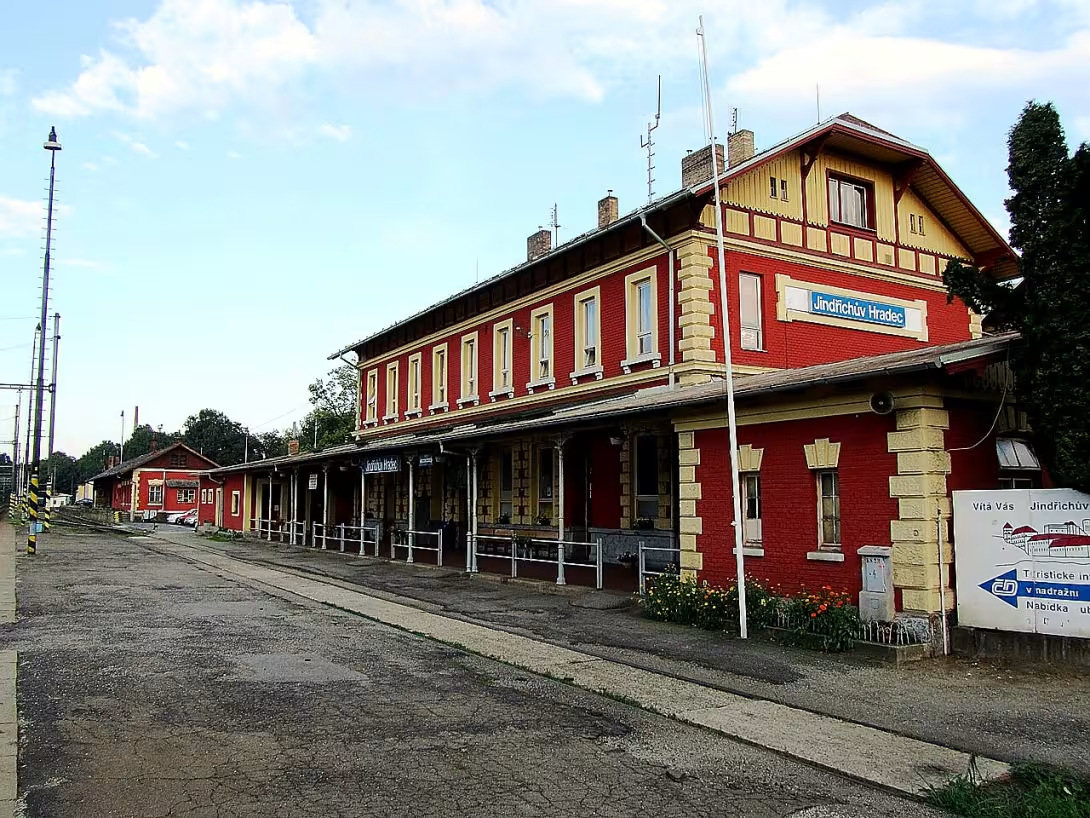
Jindřich Hradec is a railway station located in the northern part of the same-name district town in South Bohemia, near the river Nežirka. This monument is remarkable with its historical value and a combination of a normal-gauge electrified track with narrow track (760 mm) with Bosnian gauge. The station was built in the late half of the 19th century by the Českomoravská transverse railway company and served as a key hub for connecting the city with Havlíčková Brod, Veselí nad Lužnice and the surrounding municipalities.
The history of the station dates back to 1887, when the regular operation of the section between Veselí nad Lužnice and Jihlava started. In 1897 the localized initiative of the connection with Nová Bystřice was completed, which allowed the extension of the railway network in the area. This development was linked to intensive industrialization and the need for better links between Western Bohemia and other regions of Austria-Hungary, such as Trenčianska Teplá. In 1906 the narrow-track line was extended towards Oretani, which further increased its importance for regional transport.
The architecture of the station is characterized by a typical architectural pattern used by the company Českomoravská transverse railway. This style manifests itself in the simple and functional structure of the railway station building. In 1980, the normal track section was electrified, which meant modernising transport infrastructure.
The station was managed by various railway companies over the years. After its creation, the station was under the administration of the Imperial-Royal State Railways (kkStB), after 1918 it went into the hands of the Czechoslovak State Railways (CSD). Today the station is part of a modern railway network and serves as a hub for passengers from surrounding villages.
Key events in station history include its start of operation, completion of connection with New Bystřice and putting electric traction into operation. The station is today a unique place where a normal track is established, which is interesting for historians and passengers.
The station Jindřich Hradec is currently well accessible and serves as an important hub for regional transport. There is a second station directly opposite the main building operated by Jindřichohradec local railway company, which provides transport of passengers from surrounding municipalities and the organisation of tourist trips. The station is also located in a close proximity to the city bus station, which increases its accessibility.
Henry Hradec is not only an important transport hub, but also a monument to the historical development of the railway network in the region. Visiting this station offers an opportunity to explore its rich history and understand its role in the development of local infrastructure. It's a place worth visiting, both in terms of traffic and historical.
Historical milestones
- 1887
- Opening of regular operation in the section Veselí nad Lužnicí to Jihlava.
- 1897
- Completion of the railway connection with New Bystřice.
- 1906
- The extension of the narrow track towards the Oblatani.
- 1980
- Activation of the electrical traction system.
Architectural development
The building was built according to a typical BMTB model. In 1906, the line was extended towards Obratani. In 1980, electricity was electrified by a normal-breakup part.
Historical events
3 November 1887 start of regular operation in the section Veselí nad Lužnicí - Jihlava; 31 October 1897 completion of the connection with New Bystřice; On 28 May 1980, the entry into service of electrical traction.
Owners
Czech-Moravian Transverse Railways (BMTB), Imperial-Royal State Railways (kkStB), Czechoslovak State Railways (ČSD)
Points of interest
- Henry Hradec is a railway station with historical value located near the river Neženka. - The station combines a normal-gauge electrified track and narrow-line (760 mm) with Bosnian gauge. - It was built in the late half of the 19th century by the Czech Moravian Transverse Railways. - In 1897 the connection with Nová Bystřice was completed, which allowed the extension of the railway network in the area. - The architecture of the station is characterized by a typical architectural pattern used by Českomoravská transverse railway.
Guide
Show guide text
This text was created by artificial intelligence and has not been editorially reviewed. It may contain inaccuracies.
Welcome to Henry's Hradec. You're standing right where different paths meet, where time stops and where it moves all the time. Before your eyes, there is a railway station that is not just an ordinary building for waiting for a train, but a real heart of railway traffic in this region. Feel the atmosphere of a place that serves as an important knot. Can you feel the power of movement and bonding? This place, located in the northern part of town, is a gateway that can take you to far corners of the earth. Note how this place works in harmony with the environment, although it is a clear sign of human progress and technical art. The river Nežirka flows just outside of you, which gives the whole place a peaceful and natural framework, creating an interesting contrast between flowing water and solid tracks.
Let us now move further into the past together and understand how this place came to be. Imagine the late half of the nineteenth century. The world was changing very quickly at the time, people wanted to move and a new connection between towns and villages. It was at this time that this railway station was built by a company called the Czech Moravian Transverse Railway. It was not just a transport project, but a project for the future of the entire region. The history of this place is the history of constant expansion and growth. The first big step in the history of this railway station took place in the year one thousand eight hundred and eighty-seven, when regular traffic started on the section that connected Vesel nad Lužnica to the city of Jihlava. That was when this place became part of a wider network.
Further years of work and construction followed. In the year of the thousand eight hundred ninety-seven, an important connection with the New Bystřice was completed, which extended the network further. Ten years later, in the year one thousand eight hundred and six, the narrow-track line then moved towards Orettani. Every year, every new section of the track meant that the world became a little smaller and more affordable for the inhabitants of Henry's Hradec. And even though the technology was changing, this place remained a stable point. Even in modern times, namely in the year one thousand nine hundred and eighty, there was an important milestone when the electric traction system was put into service, which brought new possibilities and modern way of moving trains.
Now pay attention to the architecture of the building itself, which is right in front of you. Although it may seem like a normal station building, look at her face with attention. This building was not built randomly or without order. At that time, certain models were often used to ensure quality and to make buildings easy to implement within wider plans. This station was built according to a typical architectural pattern. Although it is a pattern that may have been known in other places, it is here that it has acquired its own character. The sound names of experts were behind his appearance. The architects Leitner and Fröhlich worked on it, and in its details we can feel the manuscript of other experts, such as the engineer Antonín Loos. Feel the harmony that the building radiates, and how it dominates the environment with its presence, even though it tries to work with the surrounding space.
Although specific persons who have lived in these premises have been working, or have been waiting for their loved ones every day, they are not very much in history textbooks today, we need to be aware of their importance. Imagine the thousands of unknown faces that have passed through here. Those people who laid these tracks, who kept order in the building, who, as guides or station workers, helped passengers find the right way. This place is a monument not only to architects and engineers, but above all to all those people who left their mark here with their daily work.
Do you know what is really special about this place and what makes it a technical one? It's the rare and fascinating combination of two completely different railway worlds. You're standing in a place where normal track gauge meets narrow gauge. That's something unusual and very interesting. On the one hand, you have an electrified track for larger and faster trains that connect you to large cities like Havlíček's Brod or Veselí nad Lužnice. On the other hand, you will find a narrow track with a gauge of seven hundred sixty millimeters, which is also known as Bosnian gauge. This double connection allows the city to remain connected not only to large transport nodes, but also to the smallest, smallest villages around. It's like two different arteries in one body that have to work together in perfect balance. This ability to connect the great world to the small, rural one is what makes this station such a special knot.
Now stop for a moment and just feel the surroundings. Hear the sound of trains coming from a distance, and imagine all the roads that start and end here. Henry's Hradec is not just a stop, it's a place where stories are still written. Every train that stops here brings new people and new possibilities.
Thank you for joining us on this short journey through time and space. We hope that this view of the history of our station has helped you better understand the importance of this place. The railway station in Henry Hradec is a living witness to the past, which still serves the present faithfully. Continue to walk, observe the surrounding countryside, perceive the atmosphere of this historic place and enjoy your next trip. Goodbye.
Tips for visitors
The best time for observation is in the morning when the light is most suitable for photography.
You can easily get here by combining connections or walking.
If you are planning to take pictures, focus on the views of platforms and changing different types of cars. Use natural daylight for best results. Don't forget to bring a drink and possibly comfortable shoes for walks.
Frequently asked questions
Can the monument be visited?
The building is in use (offices, a school, shops and the like). The interior is generally accessible only during operating hours and tours are not usually offered; we have not verified the details. You can see the exterior from the street.
Where is the monument?
Location: Jindřichův Hradec II, Jihočeský kraj. The map on this page shows the exact spot.
Why is the monument protected?
It is listed in the Central List of Cultural Monuments of the Czech Republic as a cultural monument (register no. 1125789784).
Businesses nearby
Do you run a restaurant, accommodation, shop, museum, rental, wellness or other visitor service near this monument? Show yourself directly to the people heading to it — this is how they will see you in the app and on the web:
Events nearby
Zdroj akcí: otevřená data měst a obcí ČR (Národní katalog otevřených dat) a kalendář akcí Národního památkového ústavu.
Nearby
Řeka Nežárka a městské autobusové nádraží v těsném sousedství.
Accommodation nearby
Themed route
Thematic cruise route from Jindřich Hradec Station
1. City Bus Station (Transport equipment) We'll start our journey at the local bus station, which is in a close neighborhood with the main station. This place serves as an ideal starting point for starting our route and allows easy access to other locations. It is advisable to go through the bus station to learn about local routes and timing.
2. The river Nežirka (Natural location) Shortly after leaving the bus station, we will reach the river Nežárek, which flows through the city. This river is an important nature of the local area and offers beautiful views of the surrounding countryside. It is an ideal place for relaxing or short walks along the shores where you can enjoy a quiet environment and possibly observe wildlife.
3. City park near the river Nežirka (Zelení) The next point of the route is the local park located near the river Nežirka. The park offers green spaces suitable for relaxation and leisure. It is a place where you can enjoy a quiet moment on the bench or walk with your family or friends.
4. Historical buildings in the village Jindřichův Hradec II (architectural monument) The final point of our route is historical buildings located near the railway area. These buildings represent architectural value and part of local history, which is interesting to explore. Visit these monuments to learn more about the past of the area and its development.
This route offers a clear view of the local attractions of Jindřichov Hradec II, focused on peaceful and historical aspects of the region.
Seasonal recommendations
Spring: In spring, Henry's Hradec is transformed into a flowering garden full of diverse flowers, giving the city a beautiful and lively look. The sun rays illuminate historic buildings with a softer light, which is particularly impressive against the background of green trees and flowering shrubs. At this time the visit can be advantageous thanks to mild weather, which is friendly for walking. It is recommended to wear clothes suitable for warm and cold hours, because in the morning they can be cold, while in the shade of trees can maintain a pleasant temperature. The best time to visit is in the afternoon when the sun is in the highest place and lights up to all angles.
Summer: In summer, Henry's Hradec offers itself as a place full of life and activities. The sun rays illuminate historical architecture in their brightest shade, while the presence of crowds can revive the entire square. Summer is a time when people gather at various events and events that are common in this period. For a visit recommended suitable clothes for warm weather and sun protection such as hat or parasol. The best time for a tour is in the morning or evening to avoid the hottest hours of the day while avoiding more visitors.
Autumn: In the autumn period, Henry Hradec offers a unique atmosphere when leaves on trees go into golden and red shades. The sunlight at this time illuminates the city in a specific way that highlights the history and beauty of its monuments. The atmosphere is calmer than in the summer, allowing comfortable walks and observations of local life. It is recommended to wear clothes suitable for cold time with the possibility to add layers depending on the temperature which may vary significantly during the day. The best time to visit is usually the afternoon when the weather is best prepared for the tour.
Winter: Winter Henry Hradec offers its own beautiful atmosphere, where the sun rays illuminate the city in a specific way and highlight its historic buildings. Many parts of the city can be closed during this period, which means shorter opening times for some attractions. Due to cold temperatures, it is important to equip yourself with warm clothes and suitable shoes that provide adequate protection against freezing weather. The best time for a tour is usually at noon when the sun reaches the greatest intensity and lights up to all angles, allowing a better experience of the winter city.
Visualizations and artistic views


The visualisations are generated by artificial intelligence and serve as inspiration.
Photos from the area
Real photos taken near the monument


Zdroj a licence jsou uvedeny u každého snímku.
Tips from visitors
No tips yet. Be the first!
Log in and add your tip.
Sources and literature
Photos: Stehule / CC BY-SA 3.0 — Wikimedia Commons. The author and licence also appear when you hover over the image.
Faktickým podkladem tohoto textu byl článek na Wikipedii, jehož autory jsou přispěvatelé Wikipedie. Článek je dostupný pod licencí CC BY-SA 4.0.
Location on the map




Příběhy a pověsti
Legendy, pověsti a příběhy spjaté s touto památkou
Fotografie návštěvníků
Zatím žádné fotografie. Buďte první, kdo přidá fotografii z návštěvy!
Log in a přidejte svou fotografii nebo hodnoťte.
Za ověřenou návštěvu v aplikaci získáte víc bodů — poznáme podle GPS, že jste na místě.
Reviews and comments