






Kostel Nanebevzetí Panny Marie v Bechyni Church
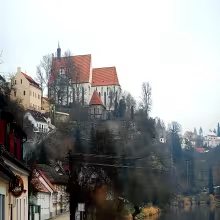
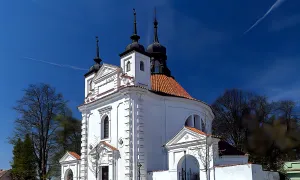
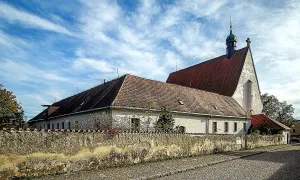
The church is part of the Franciscan monastery in the South Bohemian town of Bechyni and forms a protected whole with it. It is a construction of a late Gothic character that combines various architectural influences - from the traditional pre-Hussite hall layout to the stimuli adopted from Saxony.
The floor plan of the church consists of a main double boat and a single boat presbytery, which connects the double boat asymmetrically - directly to its left boat. The church is oriented: the main entrance is located from the west, by the old town, while the presbytery heads towards the east with a deviation to the southeast. The church can be entered by three different entrances - the main from the west, from the ambition of the entrance on the left side of the presbytery or through the passage through the extension of the Baroque chapel.
Immediately after entering the main entrance, the visitor finds himself under the baroque crust, which was only built into the Gothic space in 1634. The bark is drawn out by two arches and undercut by a cross arch without ribs - a deliberate imitation of goth, so that the structure does not lose its unity. Unfortunately, this construction destroyed one of the most valuable late Gothic fresco of the monastery complex: it depicted the Last Court and today only two small parts - one under the bark, the other above. The organ is placed on the bark today. In the space below it stands a late gothic sprinkler dating from the 16th century, decorated with a vegetable decoration intertwined with dry branches. Wendel Roskopf, a builder and sculptor, is considered to be the likely author, who at the time of its creation worked on the nearby chateau of Bechynia.
The area of the main double ship was completed around 1500. The cladding is divided into eight identical arches - otherwise also diamond arches. It creates penetration of many parts of rolled vaults; The transitions between them create patterns that resemble diamonds, i.e. diamond squares. It is a typical element of late Gothic architecture and also the only kind of Gothic vault that lacks ribs. Individual fields always run directly from the wall, without connections or console; In the middle of the vault space, they carry three round columns, at the bottom end with eight-sided feet. The double ship measures approximately 27 meters in length, 13 metres in width and reaches a height of about 10 metres. It is illuminated by three broken windows with a stone circle - one in the right side of the east wall, two in the south wall. The space is still used for worship.
The presbytery, separated from the double boat by a distinct quarry with a massive stone rib, is approximately two metres lower than the double boat. In the east there is a five-side ending, with a high Gothic window in each of the five sides with a four-flared stone circle; three other windows with the same pattern are on the right side. On the left, the windows are reduced and placed above due to the adjacent building of ambition. The presbytery is covered by a network vault of the so-called Milevsky type - according to the relative vault from the monastery in Milevsko. The brick ribs with their crosses create the impression of the net, most of which have only a decorative function in this part, not a carrier function. The embellishment is revived by the characters of the main benefactors of the Becyne monastery - for example, the Golden Star of the House of Sternberk - located in the place of the main terminals. The entire vault of the presbytery runs out of the needle brackets located around the wall.
Whoever seeks an honest late Gothic architecture outside the crowded tourist routes, Bechyně is worth a stop. The church offers a rare example of the vaults, whose geometric rigor still gives respect, while reminding us how baroque reconstruction has been able to indefinitely absorb older, equally valuable layers.
Then and now
Drag the slider to compare how the landmark may have looked when it was built with the view today.
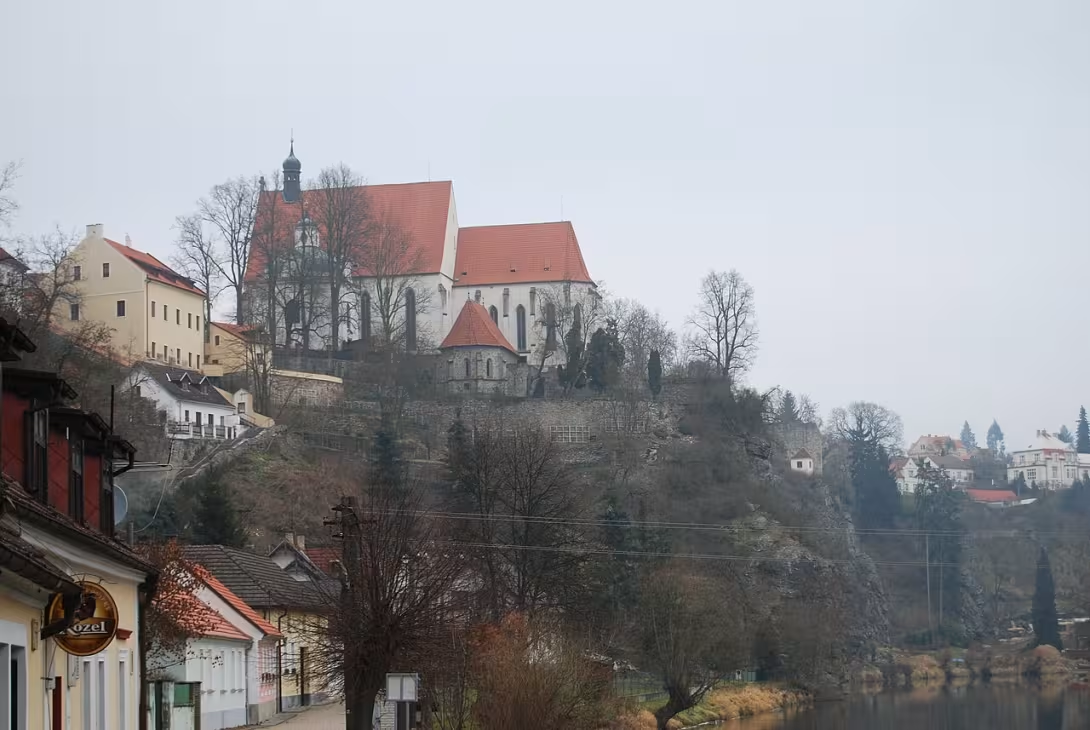
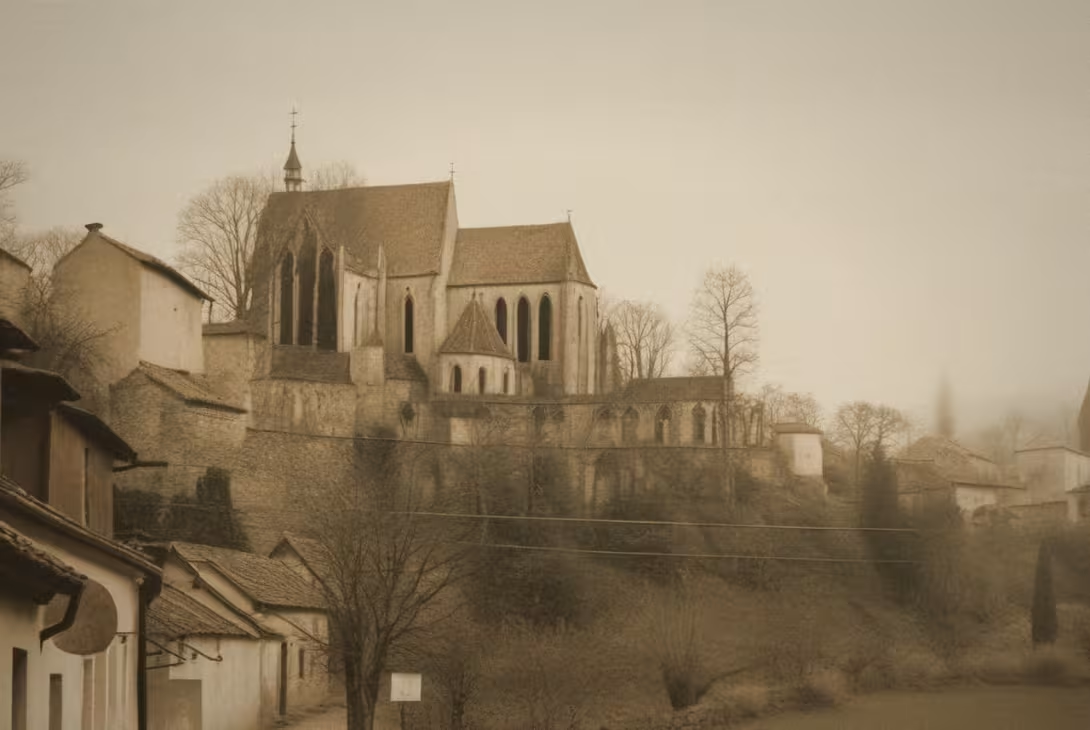
The historical appearance on the left is an AI-generated visualisation and serves as inspiration only.
Historical milestones
- Around 1350- 1400
- The basic stage of construction of the church, probably in a late Gothic style with elements of prehussite hall layout.
- 1500
- Completing the main double ship with a diamond vaults without ribs.
- 16. century (before 1550)
- Decoration of late gothic sprinkles with vegetative decoration, probably the work of Wendel Roskop.
- 1634
- The construction of baroque bark into the original Gothic space, which damaged the fresco of the Last Court.
Architectural development
The church was built as a late Gothic building with hall doubles and presbytery arches of Milevsky type. The main double ship was completed around 1500 with a combination of halo elements and sakson influences in the cellar vault. In the 17th century a Baroque crust was added to the church, which affected the interior. The presbytery is lower than the double boat and finished with a five-sided conclusion with high Gothic windows.
Historical events
- 1500 (approximately)
- The completion of the main double ship with a unique cellar vault.
- 1634
- Construction of baroque bark, which destroyed part of the original fresco.
- 17th Century
- Maintaining late Gothic sprinkles and parts of wall paintings.
Owners
Bishopric
Points of interest
- The church is part of a protected unit with a Franciscan monastery and is a late Gothic building with influences from Saxony.
- The main entrance to the church is from the west, while the presbytery is heading towards the exit with a deviation to the southeast.
- The 1634 Baroque bark destroyed some of the late Gothic frescoes, of which today only two small parts depicting the Last Judgment remain.
- The double-ship space is covered with a unique vaults (diamond) without ribs, which creates the penetration of rolled vaults.
Guide
This guide is narrated by a synthetic voice generated by artificial intelligence.
Show guide text
This text was created by artificial intelligence and has not been editorially reviewed. It may contain inaccuracies.
Welcome to the picturesque South Bohemian town of Bechyni. Right now you are standing right in front of one of the most important jewels of our Gothic architecture, the Church of the Assumption of the Virgin Mary, which forms an integral and proud part of the local Franciscan monastery. Look around you and try to feel the atmosphere of this place for a while. The main entrance to this shrine is located right in front of you from the west side, while the presbytery is heading east with a slight deviation to the southeast. When you stand in front of this late Gothic temple, whose walls contain strong influences from Saxony, history will breathe down on you deep into the past.
Let us go back a few hundred years in time to understand how this magnificent building was created. The basic phase of construction dates back to around 13 hundred fifty to 14 hundred. Even then, the basic shape of the church began to be drawn, which carried the elements of the former prehusite hall layout. However, building development continued and reached its magnificent appearance in around fifteen hundred when the main double ship was completed. Around this time, during the sixteenth century before the year fifteen hundred and fifty, a beautiful late gothic sprinkler decorated with a rich vegetable decoration, whose authorship is attributed to the important builder Wendel Roskop, who probably participated in the form of a monument in other directions.
Now pay attention to the architecture itself, especially if you have the opportunity to look inside. The greatest architectural secret and the greatest pride of this church is above you. It's an absolutely unique cellar or diamond vault in the main twin ship. When you look up, you see a arch that is completely free of ribs and creates an unrepeatable game of light and shadow on many tiny geometric flat fasets. This vault is a masterpiece of late Gothic construction and combines traditional hall elements with inspiration brought from Saxony.
However, every historical building has traces of changes and sometimes unfortunately losses that later centuries have brought. In the seventeenth century, namely in the year sixteen hundred and thirty-four, there was a significant design of the interior. A new baroque crust was built into the originally pure Gothic space. Although it itself represents an example of the art at the time, its construction has unfortunately hit the old decoration hard. The new construction destroyed part of the original late Gothic fresco. Today, we are left with only rare fragments, among which there were once outstanding remnants of a large painting depicting the Last Judgment. We can only guess how spectacular the overall painting must have been before the baroque intervention changed it forever.
Although the names of specific historical personalities associated with everyday life in this church often remain covered in secrets, the builders and artists themselves speak for them. The above mentioned Wendel Roskopf left his indelible trail in the form of a beautiful sprinkler. In addition, the whole area of the Franciscan monastery with this church is still a protected whole with traces of benedictine or rather Franciscan peaceful contemplation and spiritual legacy of the ancestors.
I believe that this place has reached you with its atmosphere, a combination of late-Gothic grandeur with baroque intervention and, above all, breathtaking diamond vaults. When you leave, be sure to take another look at the entire facade and let the silence of this South Bohemian shrine pass. Thank you for listening to this recording, and I wish you a wonderful rest of your stay in Bechynia. Goodbye.
Tips for visitors
{'text': 'Best time to visit the Church of the Assumption of the Virgin Mary is in the morning or in the afternoon when there is pleasant light in the interior and fewer visitors. Thanks to this you can enjoy the unique cellar vault and the atmosphere of the place without disturbing crowd. In the summer months it is advisable to avoid the noon hours when the church is often crowded.'}
{'text': 'The church is accessible by car and public transport. In the vicinity of the church it is possible to find a parking lot, but it is recommended to come as close as possible because some places may be limited. If you arrive by bus or train, the stops are close to the city Bechyně, from where you can walk. Find out the current connection and traffic options in the traffic search engine.'}
{'text': 'When visiting the church, wear comfortable clothes and shoes because you are moving on stone floors in the interior. In the winter months it is advisable to wear warmer clothes because it can be cold in the church. Next, prepare your laptop or mobile phone to take notes or photos. If you want to examine the church in more detail, you can also take a small visitor guide, which you will find on the site.'}
{'text': 'Photography is allowed in the church, but care must be taken to respect other visitors and not illuminate the exhibits with strong light. The best places for photography are mainly capital ships with diamond vaults and side chapel, where there is a pleasant light and the details are well photographed. It is suitable to photograph in natural light, for example in the morning or afternoon sun, which creates pleasant shadows and lighting.'}
{'text': 'Several interesting places are worth visiting around the church. In the church area there is a Franciscan monastery, which is of the same age and historical significance. Approximately one kilometer from the church is the Bechyňská Chateau, which offers a tour of the historical interior and surrounding gardens. For natural enthusiasts there is an interesting nature reservation Bechyně, located approximately three kilometres from the church and offers beautiful walks of nature.'}
{'text': For families with children a visit to the church is suitable because children can be impressed by its historical appearance and unique architecture. It is also possible to find quiet places in the church area where children can relax and see the details. It is recommended that you visit the Franciscan monastery with the children, where the children can be intrigued by their monastic life and historical objects. For a longer stay it is advisable to visit the Natural Reservation Bechyně, where children can observe local flora and fauna. '}
Frequently asked questions
Is Kostel Nanebevzetí Panny Marie v Bechyni open to the public?
Yes, the church is open to the public. The tour is possible during the opening hours.
How do I get to the place by car / public transport?
The nearest public transport stop is Bechyně, the square. The car can be parked in the vicinity of the church or in the parking lot near the river.
How much is the entrance fee and is it paid on the spot?
The church entrance is free.
Is the tour suitable for children and seniors?
Yes, a church tour is also suitable for families with children and seniors. The church has wide stairs, but there are also available alternatives.
How long does the tour take?
The church tour takes approximately 30 minutes.
What are the opening times and booking is required?
The church is open daily from 9: 00 to 18: 00. Reservation is not required, but during the season it is recommended to order in advance.
What's interesting in the immediate vicinity?
In the vicinity of the church you will find the historical centre Bechyně with many monuments and museums. The distance from the church to the historical centre is approximately 5 minutes' walk.
For kids
Imagine going back to the past in the Middle Ages! Instead of cars and computers, you'll find strollers and ceramic pottery rings. At that time there was a beautiful church of the Assumption of the Virgin Mary in Bechynia.
It was like entering another world where people prayed and lived by the legal rules. The church was built on the site of an older church and its construction began in the middle of the 14th century. During that time the church became an important monument to medieval architecture.
Businesses nearby
Do you run a restaurant, accommodation, shop, museum, rental, wellness or other visitor service near this monument? Show yourself directly to the people heading to it — this is how they will see you in the app and on the web:
Nearby
{'memories': [{\ 'nazen': 'Franciscan monastery in Bechyni', 'type': 'monastery', 'distance': 'on the church grounds'}, 'nature reservation Bechyně', 'type': 'nature reservation', 'nature reservation': 'distance': 'distance': 'distance': 'distance': 'church located in the historical centre of Bechyně': 'nature reservation', 'proximity' to the river Lukovice. '}
Accommodation nearby
Themed route
I propose a thematic tour of historical and natural attractions in Bechyn and its surroundings.
1.Kostel Nanebevzetí Panny Marie v Bechyni Type: church Why is it worth a visit: This main destination is located in the historical center of Bechyně, surrounded by the urban development and proximity of the river Lužka. It offers a unique atmosphere of ancient sacral architecture.
2. Franciscan monastery in Becyni Type: monastery Why is it worth a visit: It is located right in the church area. You can admire the peaceful atmosphere and historical building modifications associated with the spiritual life of the region.
3. Type: lock Why is it worth a visit: it lies approximately one kilometer from the church. It draws attention to its majestic position over the river and rich history associated with important noble families.
4. Natural Reservations Bechyně Type: nature reserve Why is it worth visiting: It is located approximately three kilometers from the starting point. It provides an ideal opportunity to walk through the virgin South Bohemian nature and explore the local ecosystem.
Seasonal recommendations
The spring awakes Bechyně and the surrounding landscape gets fresh green color. Light is soft and pleasant in this period, which ideally highlights the details of sacral architecture. I recommend a visit to the morning hours, where the air is the cleanest and the surroundings are the quietest. Clothes should be laminated, because morning cold can be surprising even on a sunny day.
In the summer months the atmosphere around the monument is very lively and the sun illuminates the facade. Due to the increased number of visitors in the main summer season, it is best to arrive early in the morning to enjoy peace and avoid the greatest heat. Ideal is to choose light and breathable clothes and not forget drinking mode while walking around.
Autumn brings a melancholy and spiritual mood to Bechyně, underlined by the colours of decaying leaves and morning fog. The golden light of autumn creates interesting shadows and deep contrasts on the walls of the church. The most appropriate afternoon time for the tour is when the sun shines low above the horizon. Prepare stronger shoes and warmer clothing in case of sudden cooling.
Zimą makes the church very majestic and peaceful in the landscape, especially if everything is covered with snow. A short day and cold weather means fewer people, which makes it possible to concentrate the context in silence. It is necessary to count on shorter opening times and come in sufficiently warm clothes. The best place to visit is around noon, when the light is most stable.
Visualizations and artistic views


The visualisations are generated by artificial intelligence and serve as inspiration.
Photos from the area
Real photos taken near the monument

Zdroj a licence jsou uvedeny u každého snímku.
View from the area
This animation was generated by artificial intelligence from a real photograph of the surroundings. The motion and details are not real footage of the location.
Atmosphere of the place
This atmospheric visualisation of the place and period was generated by artificial intelligence. It is not real footage of the location.
Tips from visitors
No tips yet. Be the first!
Log in and add your tip.
Sources and literature
Fotografie: Richenza / CC BY-SA 3.0, rozlišení zvýšeno umělou inteligencí — Wikimedia Commons. The author and licence also appear when you hover over the image.
Faktickým podkladem tohoto textu byl článek na Wikipedii, jehož autory jsou přispěvatelé Wikipedie. Článek je dostupný pod licencí CC BY-SA 4.0.
Location on the map


Příběhy a pověsti
Legendy, pověsti a příběhy spjaté s touto památkou
Fotografie návštěvníků
Zatím žádné fotografie. Buďte první, kdo přidá fotografii z návštěvy!
Přihlaste se a přidejte svou fotografii nebo hodnoťte.
Za ověřenou návštěvu v aplikaci získáte víc bodů — poznáme podle GPS, že jste na místě.
Reviews and comments