



Kostel svatého Matěje v Bechyni Church
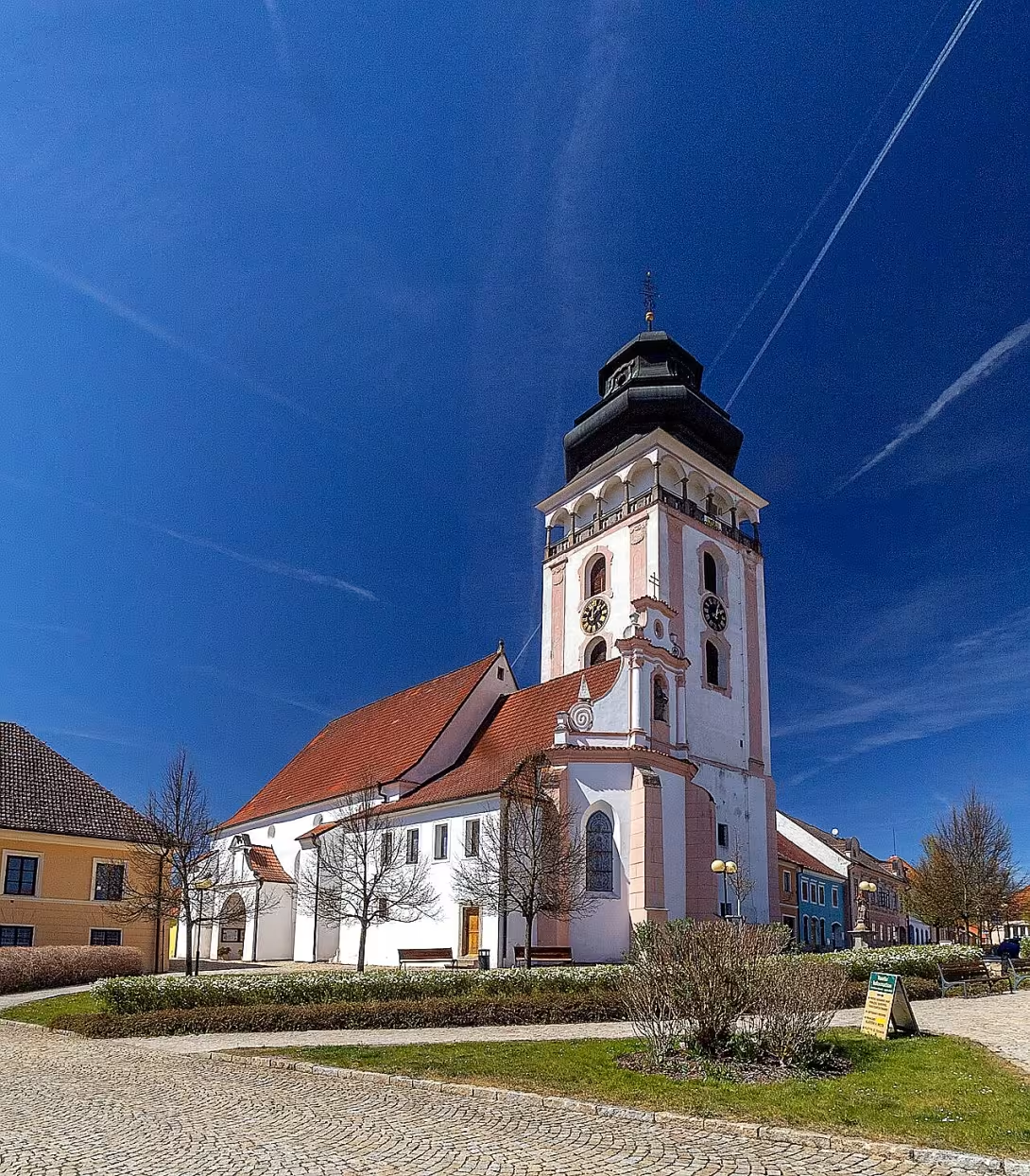
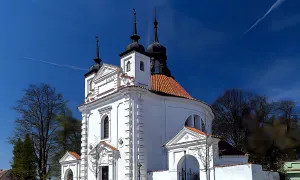
The church of St. Matthew stands on the square in Bechyni and is part of the town monument zone announced in 1990. It's a dean's church registered in the Central List of Real Cultural Monuments. Its high tower with a characteristic Renaissance appearance forms a visual dominance of the city.
The place where the church now stands has a rich history that goes deep into the past. Archaeological findings from 2011, obtained during the reconstruction of the square, indicate settlement in prehistoric times. Among these findings was ceramics, the oven from the first century BC and the water tank. In the country, traces of a Latin burial site were also uncovered. From the Middle Ages, it was possible to document the consequences of a great fire, which apparently hit the city in Hussite times, approximately the 1920s.
The original church was built in late Gothic style either at the end of the 13th or at the beginning of the 14th century, probably on the site of an older building. It took the form of an atrial double boat with a five-sided presbytery, to which careful elements were attached, a prism tower on the north side and a rectangular storey oratory on the south side.
From 1613 to 1615 the church underwent extensive reconstruction. The builder Adam ze Šternberka, owner of Bechynia Manor, shared the funding with President Ondrej Holushický, and the builder Jan Schütz from České Budějovice managed the construction works. From this period comes new vaults, priesthood and bark. At the same time, a five-story tower connected to the northeast corner of the church was added. On the top floor, there was a heralded residence, which was used until the 20th century.
Further changes were made to the church in 1740, when on the presbytery towards the square there grew a plastic decorated shield with a niche for the statue of St. Matthew. In the subsequent period from 1741 to 1743, the building was supplemented by Baroque onion-shaped dancing covered with sheet metal. In the 19th century new additions were added to the north and west sides of the church.
The inside of the church hides valuable objects and works of art. The net arch rests on the ribs of an unusual pear profile. In the western part of the ship, there is a Renaissance crust carried by six Tuscan columns. The tin baptism with reliefs dates back to 1555. A significant part is the painting of "Adoration of Kings," which is reported as the work of Flemish painter Cornelis de Vose from 1620 to 1630. The inner device consists mainly of baroque objects: the main altar with tabernacle and angel figures, side altars, statues and pulpit decorated with evangelist figures.
The dominating of the exterior remains the prism tower, which is decorated by corner pilasters and the top developed gallery with arcades. The tower is made available to the public during the summer season. In front of the church is a terraced statue of St. John Nepomuk from around 1780, which became an example of the Bechy pottery tradition and was moved to today's place only in 1938.
Then and now
Drag the slider to compare how the landmark may have looked when it was built with the view today.
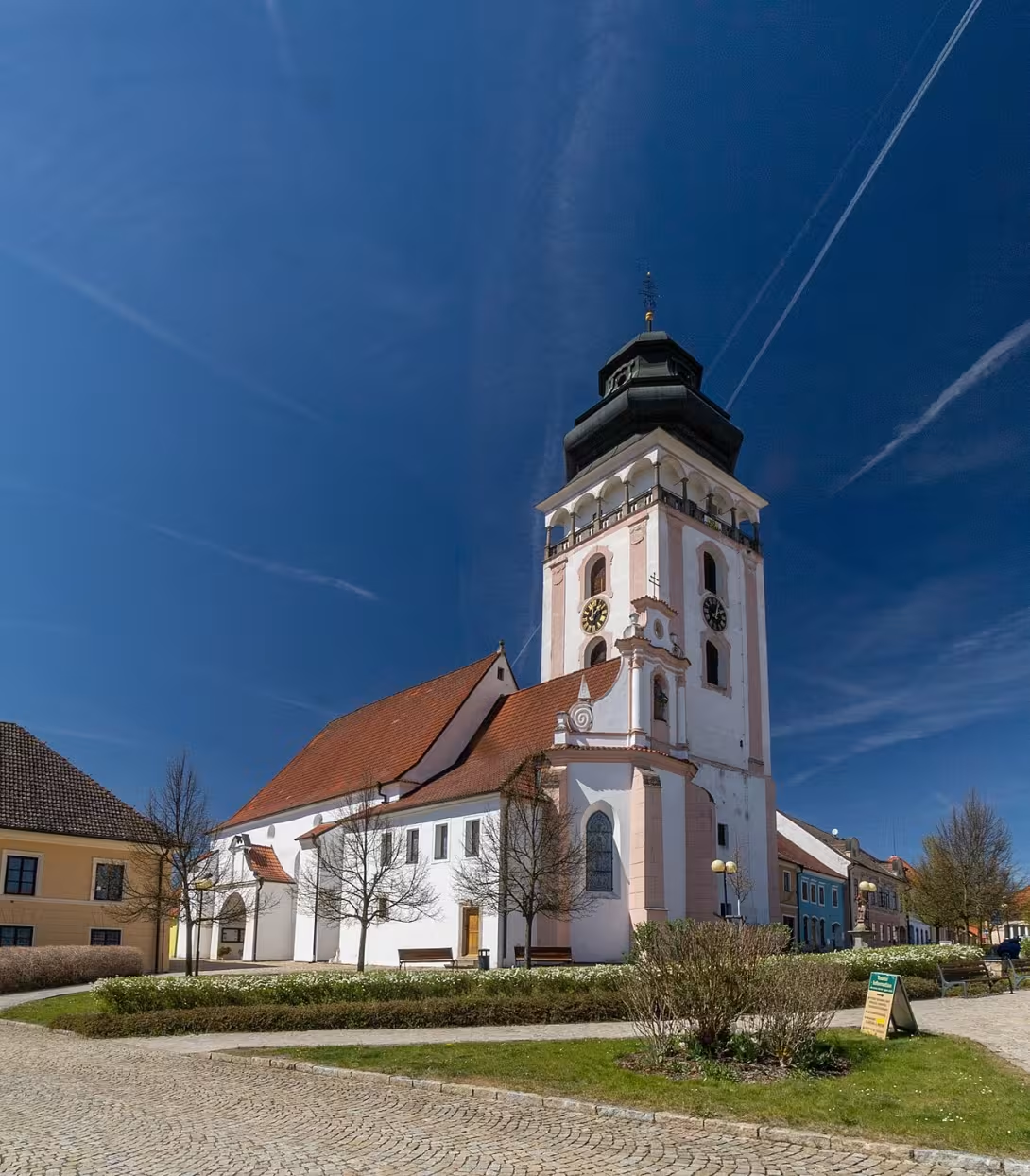

The historical appearance on the left is an AI-generated visualisation and serves as inspiration only.
Historical milestones
- 1st Century B.C.
- Archaeological findings (ceramics, furnaces, Latin burial ground) during reconstruction of the square
- 20 15th century
- Traces of a great fire from Hussite times, documented archaeologically
- 1613-1615
- Renaissance reconstruction with tower and priestry construction
- 1740
- Decoration of presbytery shield and addition of onion fighting
Architectural development
The church was created as a late Gothic building with two ships and presbytery. In the 17th century the Renaissance tower and the sacristy were added, in the 18th century there was a Baroque reconstruction of the interior and exterior. In the 19th century, ports were built on the north and west side. Materials include stone, wood and tin elements.
Historical events
- zlom 13th and 14th century
- The establishment of the original Gothic church in the place of the older settlement
- 1613-1615
- Renaissance reconstruction financed by Adam from Šternberk, including the construction of a prism tower
- 1740-1743
- Baroque treatment with shield decoration and addition of onion fighting
Owners
Farnost Bechyně, municipality Bechyně
Points of interest
- St. Matthew's Church is part of the town monument zone, announced in 1990.
- During the reconstruction of the square in 2011, archaeological remains from prehistoric times were found, including ceramics, furnaces from the 1st century BC and the Latin burial ground.
- In Hussite times, around the 1920s, the city was hit by a great fire, the consequences of which were documented.
- The church tower contains the upper floor of the hermitage, which served until the 20th century.
- The tower is open to the public during the summer season.
Guide
This guide is narrated by a synthetic voice generated by artificial intelligence.
Show guide text
This text was created by artificial intelligence and has not been editorially reviewed. It may contain inaccuracies.
The Church of Saint Matthew is a Roman Catholic deanery church located in the town square in Bechyni. It is part of the town's heritage conservation area, and its tall prismatic tower is the dominant feature of the entire square. The church faces the square with its presbytery.
The surrounding area has been settled since prehistoric times. During the reconstruction of the square in two thousand eleven, pottery was found, as well as a kiln from the first century before our era, a water reservoir, and a Celtic cemetery. Archaeologists also discovered traces of a major fire that apparently struck the town in the twenties of the fifteenth century, during the Hussite period.
The original Gothic church was built at the end of the thirteenth or the beginning of the fourteenth century, probably on the site of an older structure. The first major reconstruction took place between sixteen thirteen and sixteen fifteen. It was financed in large part by the owner of the Bechyni estate, Adam ze Šternberka, together with the captain Ondřej Holušický. The work was carried out by the builder Jan Schütz z Českých Budějovic. The barrel vault, the choir, the choir loft, and the five-storey tower all date from that period. A town crier lived in one of the tower's upper storeys, right up until the twentieth century.
In seventeen forty, an ornately decorated gable with a niche was erected above the presbytery facing the square. Inside it stands a wooden statue of Saint Matthew from the same period. Between seventeen forty-one and seventeen forty-three, the tower received a Baroque onion dome covered with sheet metal. Beneath it is a gallery with arcades on columns.
The church is vaulted with a net vault on ribs. In the western part of the nave stands a Renaissance gallery on six Tuscan columns. In the sacristy dating from around sixteen thirteen is a clay relief of the Virgin Mary from the end of the sixteenth century. The oldest piece of furnishing is a tin baptismal font with reliefs from fifteen fifty-five. Valuable is a painting of the Adoration of the Magi from between sixteen twenty and sixteen thirty. It is probably the work of the Flemish painter Cornelis de Vos, and was previously wrongly attributed to Peter Brandl. Most of the altars and statues date from the Baroque reconstruction around seventeen forty. These include the main altar and side altars of the Holy Family, Saint Catherine, Saint Bernard, and the Virgin Mary with a painting of the Black Madonna. The pulpit is decorated with statues of the evangelists.
In front of the church stands a terracotta statue of Saint John of Nepomuk, probably from around seventeen eighty. It is an example of the Bechyni pottery tradition. Originally it stood in front of the inn Na Růžku and was moved to the church in nineteen thirty-eight.
Tips for visitors
The best time to visit St. Matthew's church is in the morning after opening or in the afternoon after the 15th hour. In these times it is calmer in the church and you can see the interior without crowds. In summer it is also convenient to visit the church during a sunny afternoon when the light attracts the Renaissance tower and Gothic elements of the facade.
It is recommended to arrive by car because public transport to the city is not very frequent.
When visiting the church, wear comfortable clothes and shoes because the tour of the interior involves walking on stone floors. Next, prepare your camera or mobile phone, but don't forget the battery or charger. The use of lightning is often restricted in the church, so look at the best places in advance.
The best places for photography are especially the Renaissance tower with its distinctive prisms and gothic windows on the south side of the church. The ideal light for photography is in the morning or late afternoon, when light creates soft shadows and illuminates the facade details. In the interior it is worth capturing Gothic vaults and Baroque altar.
In the vicinity of St. Matthew's Church is worth visiting the City Monument Zone Bechyně, which includes the historical core of the city with the church as a dominant. Another interesting thing is Bechynsko Chateau, which is located about a mile from the centre. For families with children it is advisable to visit also the local museum or walk the picturesque streets with historic houses.
For families with children it is advisable to visit the church as part of a guided tour to explain the history and attractions of the monument. Children can also view the surrounding square and look for details on the facade of the church. There is also a possibility to visit the chateau of Becyne where children can explore the ruins and imagine what the medieval fortress looked like.
Frequently asked questions
Can the monument be visited?
Religious buildings are usually open mainly during services; at other times a visit is normally arranged with the parish or the operator. We have not verified specific times.
Where is the monument?
Location: nám. T. G. Masaryka 144, Bechyně, Jihočeský kraj. The map on this page shows the exact spot.
Why is the monument protected?
It is listed in the Central List of Cultural Monuments of the Czech Republic as a cultural monument (register no. 16055/3-4699).
For kids
Imagine going back to the past in the Middle Ages, the city of Bechyně. It was a small village with the church of St. Matthew, which stood in the middle of forests and fields.
How did it look here? Who lived here? What happened here? There was no music festival on those old walls of the church. But there were many people who went to church for worship and prayers. They were villagers with shy eyes and dressed women who went to weddings.
Businesses nearby
Do you run a restaurant, accommodation, shop, museum, rental, wellness or other visitor service near this monument? Show yourself directly to the people heading to it — this is how they will see you in the app and on the web:
Nearby
- Declared 1990, includes the historical core of the city with the church as a dominant.
- A ruin of the chateau at a distance of about 1 km, originally medieval fortress.
- 19th century railway station, part of historical infrastructure.
Accommodation nearby
Themed route
1. City Monument Zone Bechyně * Type: Historical Center * The beginning of the route in the heart of the city, where it is intertwined by narrow streets with preserved houses from the 18th and 19th centuries. The dominant is the church of St. Matthew, whose Gothic architecture and Baroque adaptations reflect centuries of local history.
2. St. Matthew's Church * Type: Sacral landmark * The most important monument of Bechyně, built in the 14th century, with later reconstruction. The interior keeps valuable gothic frescos and baroque facilities that are worth watching.
3. Bechy Chateau * Type: Ruins * There is a medieval fortress within a mile of the church, whose remains offer a view of the past. The romantic atmosphere of the ruins attracts walks around.
4. Station Bechyně * Type: Historical construction * The railway station from the 19th century, which is part of the preserved infrastructure, is interesting. Its architecture and technical details reflect the period of industrial development.
* The route is closed, visiting all points is possible on foot. *
Seasonal recommendations
Spring During the spring awakening, the church of St. Matthew in Bechynia offers a unique atmosphere where its Gothic windows are projected into a light that changes with the movement of the sun. The corrugated field around the church is gradually coloured with greenery, while the cold of winter is still floating in its interior, but the fragrance of wet soil and blooming spring herbs gradually retreats. The sound background is also specific - bird singing is mixed with the sound of stone walls that sound different in spring wind than in other seasons. It is recommended to visit in March or April when the church is still relatively calm, but nature around it offers the first flowering trees and green meadows. The clothes are suitable layered - the morning and evening are cold, while at noon the sun can be pleasant. The best time is early in the morning when light falls into the church so that it emphasizes its architectural details, or late in the afternoon, when it is reflected at sunset in the windows and creates a game of shadows.
Summer In the summer months, the church of St. Matthew will be transformed into a place where human activity meets the calm of the historical environment. Warm sunlight illuminates its facade and creates sharp shadows that highlight gothic niche and relief. The surrounding area of the church, especially the surrounding vineyards and meadows, is green and full of life in the summer, but in the main summer season (July and August) there are many visitors in the interior and on the surrounding roads, especially families with children. It is recommended to come early in the morning to avoid crowds, or in late afternoon hours, when heat becomes pleasant and the church receives a quieter atmosphere. Suitable is light but decent clothes that protect against the sun - hat and light scarf can be useful. In the summer months the church is open longer, but in hot days it is good to take water, because the air can be dry in the stone interior.
Autumn Autumn brings a unique atmosphere to Bechyně and St. Matthew's Church, where golden and red colors of surrounding forests and fields are reflected in the church windows and create a light game in the interior that resembles medieval stained glass. Colder air and short days change sounds - echo steps in the church sound deeper, while outside there is rustling of leaves and distant sounds from surrounding villages. In September and October the church is calmer than in the summer, but in November, especially around St. Catherine's Day, more pilgrims can be visited. It is recommended to visit in September or early October when the weather is still pleasant and nature offers a rich variety of colors. Suitable is warm but not too heavy clothing - morning and evening is cold, while it can be sunny at noon. The best time is the afternoon when the sun shines into the church so that it creates warm shades and creates a pleasant atmosphere for the tour.
Winter The winter visit to St. Matthew's Church is an experience where its Gothic architecture is projected into silver light, which penetrates narrow windows and creates a mysterious atmosphere in the interior. The surrounding area of the church is covered with snow, which gives the whole place peace and fairytale, while the interior keeps a pleasant temperature that contrasts with freezing outdoor air. At advent time and during Christmas holidays the church can be visited by more believers, but outside these periods it is very quiet. A visit is recommended in December, when the church may seem even more majestic thanks to the snow coat of surrounding trees and fields. It is suitable for warm but comfortable clothes - layered sweaters, warm shoes and scarf, because it is cold outside, but the interior can be pleasant. The best time is this afternoon, when the sunset is reflected in the windows and creates a magical atmosphere in the church. Opening times are shorter in winter, so it is good to check in advance whether the church is accessible.
Visualizations and artistic views


The visualisations are generated by artificial intelligence and serve as inspiration.
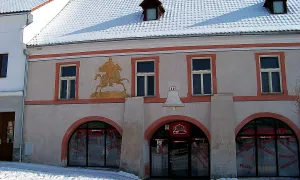
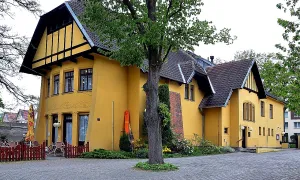
Photos from the area
Real photos taken near the monument

Zdroj a licence jsou uvedeny u každého snímku.
Atmosphere of the place
This atmospheric visualisation of the place and period was generated by artificial intelligence. It is not real footage of the location.
Tips from visitors
No tips yet. Be the first!
Log in and add your tip.
Sources and literature
Photos: Michal Ritter / CC BY-SA 3.0 — Wikimedia Commons. The author and licence also appear when you hover over the image.
Faktickým podkladem tohoto textu byl článek na Wikipedii, jehož autory jsou přispěvatelé Wikipedie. Článek je dostupný pod licencí CC BY-SA 4.0.
Location on the map

Příběhy a pověsti
Legendy, pověsti a příběhy spjaté s touto památkou
Fotografie návštěvníků
Zatím žádné fotografie. Buďte první, kdo přidá fotografii z návštěvy!
Log in a přidejte svou fotografii nebo hodnoťte.
Za ověřenou návštěvu v aplikaci získáte víc bodů — poznáme podle GPS, že jste na místě.
Reviews and comments