






Jurkovičova vila Building
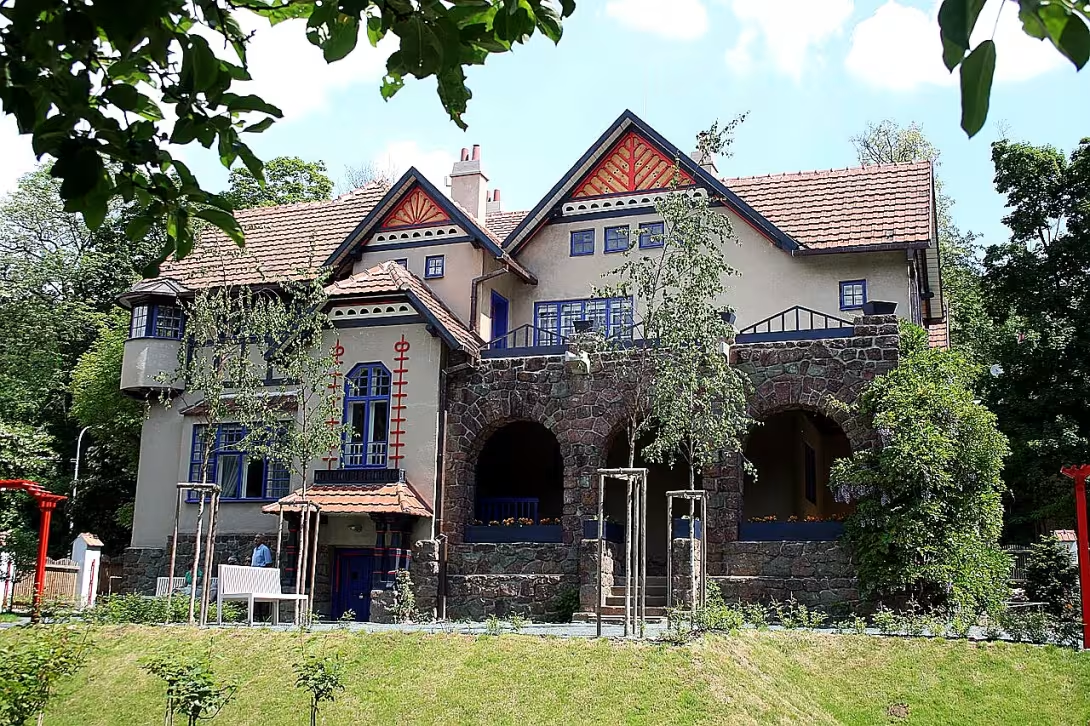
Jurkovičova vila in Brno-Žabovřešky is one of the most important examples of Art Nouveau architecture in the Czech Republic and among rare buildings included in the international catalogue Iconic Houses. This construction, which the architect Dušan Jurkovič built in 1906 on the edge of the Wilson Forest in Brno, combines Central European folk traditions, Vienna Art Nouveau and British Modern. Its basis is the concept of a rural house - cottage - with a central staircase hall, which Jurkovic modified to connect the common areas on the first floor with private rooms on the ground floor. Today it serves as a study centre of modern architecture, managed by the Moravian Gallery in Brno, and offers visitors not only original interiors, but also a restored garden, which proves Jurkovic's care for details and compliance with nature.
The villa is related to the personality of her author, Dusan Samo Jurkovic, one of the most important Czech architects and artists at the turn of the 19th and 20th centuries. He chose a quiet Žabovřesky for the construction, then a rural area on the outskirts of Brno, where it was adjacent to the imperial shooting range and the Svratka river was flowing nearby. Jurkovic bought a long plot of land at the beginning of which he had the villa built, while the rest of the land was put up for sale. His choice of place reflected not only the love for nature, but also the desire for privacy and inspiration in the surroundings - at that time there was an atmosphere of peace, ideal for creative work. The villa was established during the period when new architectural directions were sought in Europe, which combined modern aesthetics with national and folk motives. Jurkovic was inspired by the work of Viennese architect Josef Olbrich, especially by his villa in Darmstadt, and thus created a construction that was a modern expression at the time of its creation.
Architecturally, the villa is interesting with its solution, which combines British cottage elements with Art Nouveau elements. The basic layout is based on the central staircase hall, which connects the ground floor - where private rooms were located - with the first floor where Jurkovic placed his studio and social area for guests. This concept was unusual at the time, since most villas had common areas on the ground floor. Jurkovičova vila thus represents an original approach that reflects its concept of architecture as an artistic whole. The facade is decorated with typical Art Nouveau elements - stylized motifs, plastics and details related to folk architecture. The interiors are equally carefully thought out, with an emphasis on functionality and aesthetics, and they have preserved elements of original furniture and decoration.
After completion in 1906, the villa became a subject of public interest before its owner moved in. On 26 August of the same year, the Exhibition of Architecture and the Art Industry took place here, which was then a modern way of promoting architecture. This trend followed the villa colony in Darmstadt, where the houses were presented as a single exhibit. Jurkovičova vila gained immediate prestige and became a model for other buildings. But already in 1919 Jurkovic sold it, and in the following decades the owners took turns. The last private owner of the villa was handed over to the Moravian Gallery in Brno on 30 June 2006, which started its new stage. After extensive reconstruction, which took place between 2009 and 2011, the villa was restored to its original form while being adapted for the purposes of the study centre. The reconstruction was carefully documented and won an Honorary Recognition in the Grand Prix Architects competition in 2011.
Today, Jurkovičova vila is open to the public as a study centre of modern architecture with an exhibition dedicated to Dushan Jurkovic. Visitors can explore a restored staircase hall, a salon with samples of furniture files and other rooms where information about Jurkovic's life and work are located. The garden, carefully reconstructed according to period plans and photos, is another important part of the whole. It is divided into two parts - the top with the original entrance parterre, where there was a vegetable garden and a children's playground, and western with a ornamental and fruity garden. The most interesting elements include the square area bounded by four birch white trees, which optically follow the roshara of tree roses, or pergols and trelays, which give the garden a rhythmic character. The villa is not only an architectural but also a landscape piece, which shows Jurkovic's attention to details and compliance with the surroundings.
Jurkovičova vila is worth visiting not only for its architectural and historical values, but also because it represents a living example of how modern architecture can connect with national traditions and the natural environment. Its current use as a study centre shows that monuments can serve not only as a reminder of the past, but also as a source of inspiration for current and future generations of architects and visitors. For lovers of the history of architecture, Art Nouveau or life and the creation of Dusan Jurkovic, this villa is a unique opportunity to see what modern architecture looked like in the early 20th century and how personal and cultural experiences of its author reflected in it.
Then and now
Drag the slider to compare how the landmark may have looked when it was built with the view today.
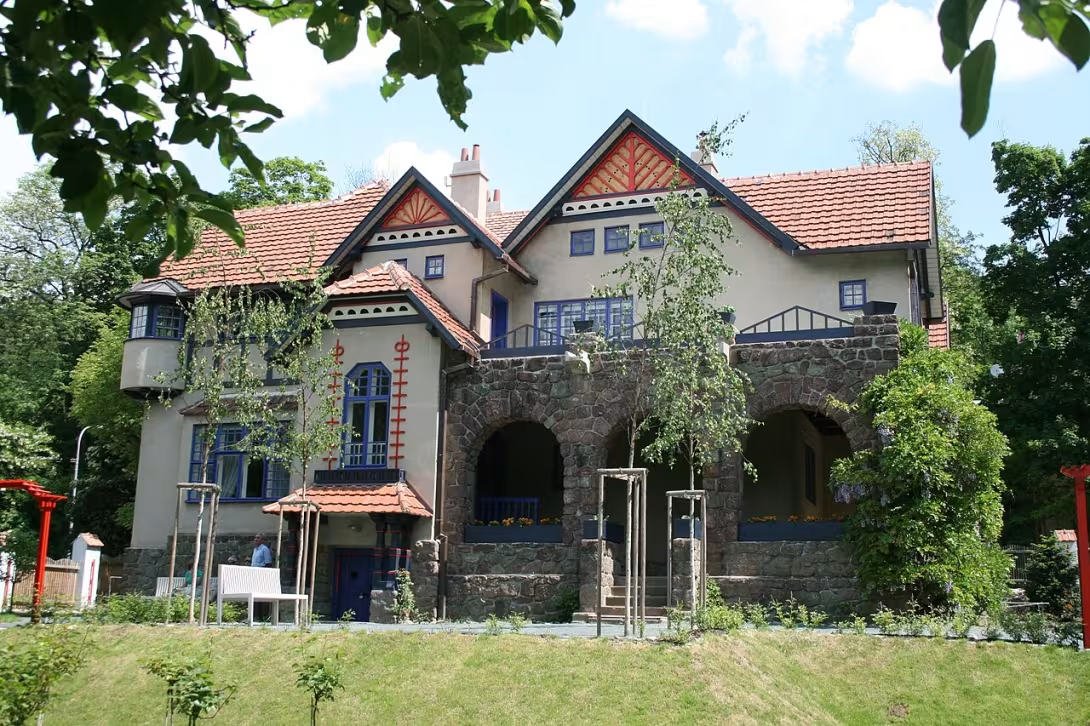
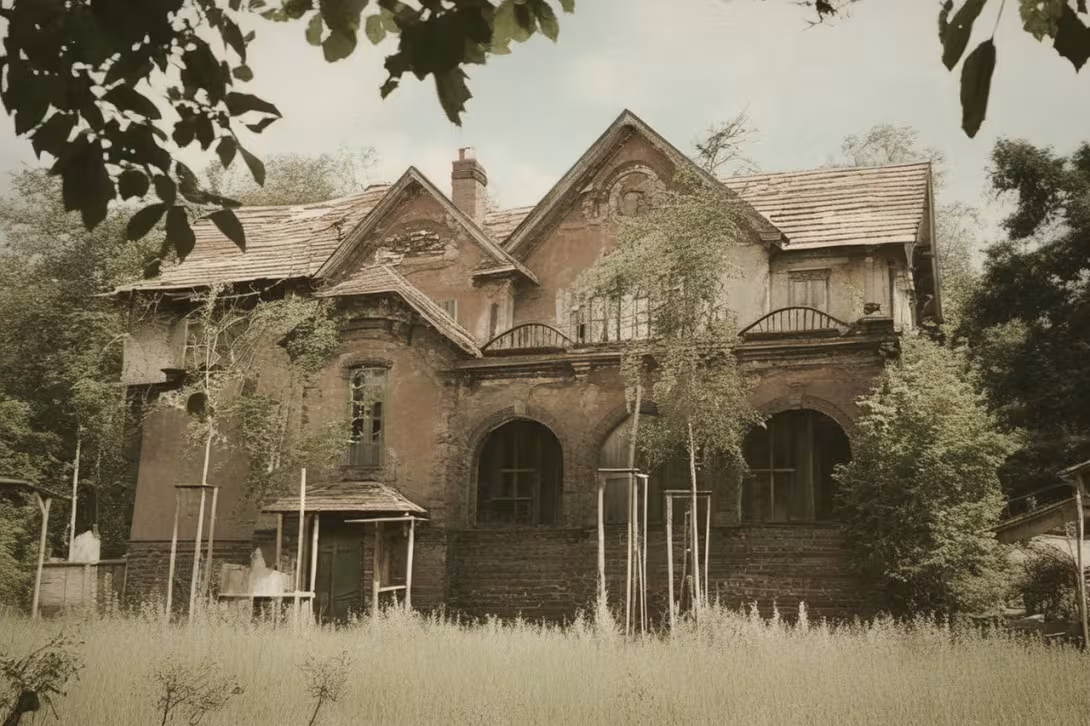
The historical appearance on the left is an AI-generated visualisation and serves as inspiration only.
Historical milestones
- 1906
- completion of construction and festive opening
- 1919
- sale of villa Dusan Jurkovic
- 2006
- takeover of the Moravian Gallery in Brno
- 2011
- completion of reconstruction and opening for visitors
Architectural development
The basic concept of the house is based on British Cottage type with central staircase hall. The original layout separated the social area and the studio on the first floor from the private bedrooms on the ground floor. The reconstruction took place in 2009- 2011, which brought the building closer to its original form.
Historical events
26 August 1906: festive opening of the villa associated with the Exhibition of Architecture and the Art Industry; 1 April 2011: opening for the public after extensive reconstruction.
Owners
Dušan Jurkovič (until 1919), then several owners in the interwar period, since 30 June 2006 Moravian Gallery in Brno.
Points of interest
- Villa is one of the few Czech buildings included in the international list of Iconic Houses and is among the most important examples of Art Nouveau style in the country.
- Dušan Jurkovič connected in the villa of Central European folk traditions, Vienna Art Nouveau and British Modern, creating an unusual arrangement with the central stairway hall connecting privacy on the ground floor and social areas on the floor.
- The construction was built in a quiet area of Žabovřská, then still rural part of Brno, where Jurkovic sought inspiration and privacy for his creative work.
- Villa hosted a public exhibition of architecture in 1906, which was a modern way of presenting the construction and brought it immediate prestige.
- Interiors and facades are richly decorated with Art Nouveau elements and folk motifs, while some original furniture and decoration are preserved.
Guide
Show guide text
This text was created by artificial intelligence and has not been editorially reviewed. It may contain inaccuracies.
Welcome, distinguished visitors. Stop for a moment, take a breath and fully perceive the place you're standing right now. You are in Brno Žabovřešky and in front of you there is a building that is much more than just an ordinary house. It is Jurkovičova vila, one of the rarest jewels of Brno architecture and the place where time stopped to tell us the story of courage, creativity and searching for its own identity. If you look at her now, you might see something unusual in her, something that didn't quite fit into the urban environment at the time, and yet she seems perfectly natural here.
Let's go back more than a hundred years together. It's nine hundred and six. It was this year that the construction was completed and opened ceremoniously. Its creator was Dušan Jurkovič, a man who brought incredible sensitivity and deep respect to traditions into architecture. The villa wasn't just a project, it was a personal vision. Jurkovic here wanted to create a space that would connect his inner world, his roots and his view of modern times. At that time, architecture was at a fascinating point of break. Old styles were no longer enough and new ones were just born. It was in this tension that this villa was created.
Now pay attention to the appearance of the building itself. Look at her facade and see the overall atmosphere she radiates. What you see before you is the unique synthesis of three very different worlds. The first is Central European folk culture. Jurkovic loved tradition, craft and simplicity of rural construction, which is reflected in the overall sound of the villa. The second element is the Viennese Art Nouveau, which was the highlight of elegance and modern taste at that time. The Art Nouveau brought organic shapes and efforts to achieve overall harmony into architecture. And the third, perhaps the most surprising element, is the principles of British modernity. It brought a rational approach and functionality to the building.
When you look at the villa, try to imagine how brave the architect must have had when he combined these three seemingly incompatible directions into one whole. It wasn't just a question of style, it was a question of philosophy. Jurkovic believed that modern man must not forget his roots, but must also walk forward. Notice how these influences intersect. It's not just random elements, it's a premeditated system. Even if you stand outside now, you can feel that the building has its center, its heart, around which everything else is arranged. This unusual arrangement with the central point is one of the most significant features of this building.
The names of prominent personalities are associated with this place. Besides Dusan Jurkovic himself, Josef Maria Olbrich is often mentioned in connection with this architecture. There are traces of intellectual dialogue among the best creators of their time who together sought a way to define modern housing and space. The villa was home to Jurkovic, a place where new ideas were born.
But the history of the villa is full of breakthroughs. After nearly 13 years, in the year one thousand nine hundred nineteen, Dušan Jurkovič decided to sell the villa. With this step ended one chapter and began another, much less predictable. The building has survived decades of change, political upheaval and oblivion, but its value has never disappeared. It would be a terrible loss if such a jewel were lost in time. That is why the rescue came in two thousand six, when the Moravian Gallery in Brno took over the villa. This was the key moment that ensured that the construction would come into the hands of experts who knew how to handle it. There was a difficult reconstruction that lasted several years. In the year two thousand eleven, the villa was finally reopened to the public in full glory as you see it today.
Now I want to impress you with one fact that gives this villa world dimensions. You may think it's just a beautiful local monument, but the truth is much more fascinating. Jurkovičova vila is one of the few Czech buildings that have been included in the international catalogue of important buildings, which brings together extraordinary works of world architects. This means that this building in Žabovřešky is recognized as a world work that stands in line with the most important architectural effects of the planet. It is proof that a local genius who draws from his roots can achieve universality and admiration anywhere in the world.
Now if you look at the building again, think of it as a bridge. It is a bridge between the countryside and the city, between tradition and modern, between Brno and the rest of the world. It's a place that teaches us that true modernity does not mean erasing the past, but its creative transformation. Nowadays, the villa is no longer a private home, but a modern architecture study centre. It's a place to study, to inspire and understand how space affects our feelings.
Now let's slowly finish this introductory part. In front of you stands an open door to a world full of details and architectural secrets. I ask you now to enter, to sow your spaces and try to feel the breathing in them. Note how light falls into the rooms, how space opens and closes, and how the incredible synthesis of the styles we talked about manifests itself in every corner. Let your intuition guide you and take your time.
Thank you for accompanying me on this first introduction to Jurkovic's villa. I wish you an inspirational tour, and I hope this house has charmed you as it has charmed the generations before you. Enjoy your stay in this special place. Goodbye.
Tips for visitors
For the best visual experience we recommend a visit in the morning, when natural light best highlights Art Nouveau details of the building.
You can reach the monument by car or public transport; Please check the current connection in the search engine.
For photography are the best places with soft light that underscore architecture from 1906. Bring comfortable shoes for possible walks.
The Wilson Forest and the Svratka River are nearby, offering a pleasant environment for fresh air. This neighborhood is ideal for families with children looking for peace in nature.
Frequently asked questions
Can the monument be visited?
Some buildings of this kind are open for guided tours, others serve another purpose or are privately owned. We have not verified whether and when this monument is open – please ask the operator.
What are the opening hours and admission?
We have not verified the opening hours or admission. Current information is published by the operator.
Where is the monument?
Location: Žabovřesky, Jihomoravský kraj. The map on this page shows the exact spot.
Why is the monument protected?
It is listed in the Central List of Cultural Monuments of the Czech Republic as a cultural monument (register no. 1000148666).
Businesses nearby
Do you run a restaurant, accommodation, shop, museum, rental, wellness or other visitor service near this monument? Show yourself directly to the people heading to it — this is how they will see you in the app and on the web:
Events nearby


Zdroj akcí: otevřená data měst a obcí ČR (Národní katalog otevřených dat) a kalendář akcí Národního památkového ústavu.
Nearby
Vila se nachází na úpatí Wilsonova lesa v blízkosti řeky Svratka.
Accommodation nearby
Trips and activities nearby
Guided tours, tickets and activities nearby from GetYourGuide
Affiliate link: if you buy from the partner, we may receive a commission. The price for you does not change.
Search tours and activities →Themed route
Thematic cruise route around Jurkovic's villa
1.Jurkovičova vila
Type: Villa
Why is it worth a visit: This architectural pearl located at the foot of Wilson's forest is the work of Slovak architect Dusan Jurkovic. Its unique design and history make it a fascinating place for lovers of architecture and culture.
2. Wilson Forest
Type: Forest
Why is it worth a visit: Located right next to the villa and offers beautiful walkways for walking in peace. It is an ideal place to relax and enjoy the views of the surrounding countryside, especially if you are looking for an escape from urban life.
3. The River Svratka
Type: River
Why is worth a visit: This river is closest to the villas and offers opportunities for various activities on water such as swimming or fishing. It is also a beautiful place for picnics with family or friends, where you can enjoy quiet moments along the shore.
4. Jurkovic Chapel
Type: Park courtyard
Why it is worth a visit: The villa's reservoir is a beautiful place for walks and relaxation. Its green areas and a quiet environment offer ideal conditions to relax after a tour of the villa itself.
5. Exposure in Jurkovic's villa
Type: Exhibition
Why is worth a visit: The exhibition within the villa offers a view of the life and work of Dusan Jurkovic. It is a great opportunity to explore historical contexts and artistic elements that make this construction unique.
This route offers a combination of cultural and natural experiences, making it ideal for a day trip.
Seasonal recommendations
Spring: In the spring season Jurkovičova vila is presented in the light of green nature, when flowering shrubs and trees revive the surrounding landscape. The sunny morning is accompanied by a mild temperature that is ideal for walking around the villa. The atmosphere is calm and friendly, allowing you to enjoy the views of the rebuilding garden without excessive crowd pressure. It is recommended to visit in the morning when the sun is the most distinctive and illuminates architectural elements of the villa in a special way. Clothes should be mild, with the possibility to add a warm jacket or plaid for a cooler morning.
Summer: During the summer season Jurkovičova vila is a popular destination because of its beautiful park and gardens that are in full bloom. Sun temperature attracts many visitors, so it is advisable to visit early morning or later in the day to avoid large crowds. Clothes should be light and light, with protective sunglasses and UV cream. The atmosphere is full of life, with birds and flowers in bloom, which gives the visit a romantic attraction.
Autumn: In autumn the gardens of Jurkovic's villa of color charm are acquired, when leaves of shiny colours and changing light create unique views. Less visitors allow for a quieter walk and use of sitting on garden benches under trees that are no longer covered with leaves. It is advisable to visit at noon when the sun is still strong enough for lighting, but the temperature is not too hot. Clothes should be medium, with the possibility of adding a warm jacket or plaid to a cooler afternoon.
Winter: In winter, Jurkovičova vila offers a peaceful and quiet space where landscape lighting is a special emphasis. While some parts of the park may be inaccessible due to snow, the villa itself and its surroundings offer views of the winter landscape. If you visit it during this period, it is advisable to come in the middle hours of the day when sunlight is best for photography. Clothes should be warm and protective, with a tie, jacket and a cup against cold and possible snow conditions.
Visualizations and artistic views


The visualisations are generated by artificial intelligence and serve as inspiration.
Photos from the area
Real photos taken near the monument


Zdroj a licence jsou uvedeny u každého snímku.
Tips from visitors
No tips yet. Be the first!
Log in and add your tip.
Sources and literature
Photos: Martin Strachoň / CC BY-SA 3.0 — Wikimedia Commons. The author and licence also appear when you hover over the image.
Faktickým podkladem tohoto textu byl článek na Wikipedii, jehož autory jsou přispěvatelé Wikipedie. Článek je dostupný pod licencí CC BY-SA 4.0.
Location on the map


Příběhy a pověsti
Legendy, pověsti a příběhy spjaté s touto památkou
Fotografie návštěvníků
Zatím žádné fotografie. Buďte první, kdo přidá fotografii z návštěvy!
Log in a přidejte svou fotografii nebo hodnoťte.
Za ověřenou návštěvu v aplikaci získáte víc bodů — poznáme podle GPS, že jste na místě.
Reviews and comments