



Kaplička svatého Jana Nepomuckého Niche chapel
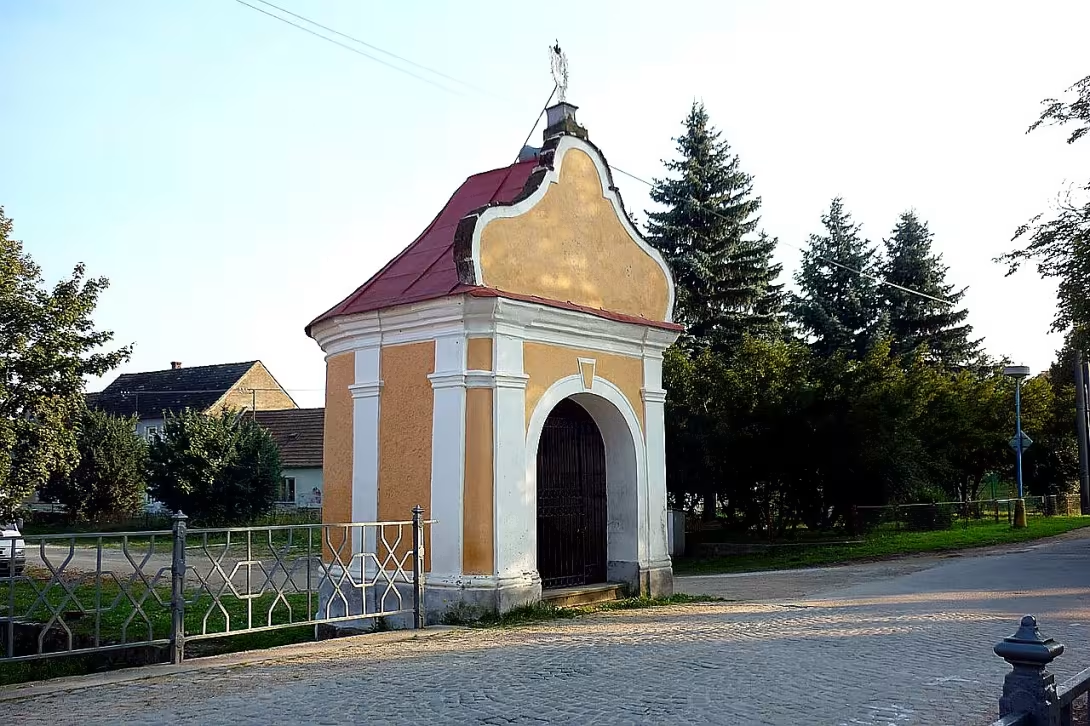
Kaplička svatého Jana Nepomuckého in the village Slavonice is a baroque niche chapel located on the bridge through Slavonic brook. It is an important representative of small wall sacral architecture, which has become famous for its valuable equipment and preserved by original interior fresco.
This building represents an architectural peak of baroque style in Czech countries, which extends until the beginning of the 19th century. The wall-mounted hall chapel has a square plan with a semi-circular finish. The entrance portal is glazed with a semicircle and lined with a white press band with an highlighted jewel. The edges of the building are arched, while the walls are divided by pilasters with Roman heads growing from the plinth. The roof orbiting profiled ledge separates the main mass of the object above which is a shield with rounded wings and protected by ceramic fittings. The whole chapel is covered by a saddle roof covered with metal, the top of which is decorated by the figure of the crowned Virgin Mary.
The interior is richly equipped with painting decoration. The walls are divided horizontally into plinth, colored fields with medallions and ledge. The vertical breakdown consists of six ionic columns with purple marble sticks and heads decorated with simple volutes in ochre tone. The green background of the fields contains oval medallions with ocular frame, stylized volutes and rokaj. The retreat ledge closes the space with an illusion of purple marble. The vault is depicted as a view into the open sky in green color, above the statue of St. John Nepomuk there are pink clouds with angels and a symbol of the eye of God with an eight-pointed star and a spreading halo.
The paintings in the medallions tell the legend of St. John Nepomuk. The first scene on the east wall depicts the confession of Queen Johanna Bavarian, the wife of King Wenceslas IV, in bright shades. The second scene shows King Wenceslas IV, who seeks to learn the content of confession from St. John; The king is in a reddish-green dress with a dark brown curtain hanging over him. The west wall shows torture, where there are two understanding men with torches at John's stretch on the rack. The last, fragmental scene at the entrance depicts the overthrow of the holy body from the Charles Bridge to the Vltava, which are recognizable heads and spades of the guard.
This chapel on the street Station No. 191 remains a valuable testament to religious architecture and painting at the turn of centuries, which makes it important for every Slavonic visitor.
Historical milestones
- Confession of Queen Johanna Bavarian St. John of Nepomuk.
- Trying to get information from John Nepomuk about the confession of the Queen.
- The torture and death of St. John Nepomuk.
Architectural development
The chapel is an example of Baroque architecture with decorated frescoes in the interior which depict key moments from the life of St. John Nepomuk. The walls are broken down by pilasters and the ledge heads contribute to her aesthetic impression.
Historical events
- Confession of Queen Johanna Bavarian St. John of Nepomuk.
- Trying to get information from John Nepomuk about the confession of the Queen.
- The torture and death of St. John Nepomuk.
Points of interest
- Kaplička svatého Jana Nepomuckého is a Baroque niche chapel located on the bridge through Slavonic stream. - It is an important representative of small wall sacral architecture, which has become famous for its valuable equipment and preserved by its original interior fresco. - This building represents the architectural peak of baroque style in Czech countries, which extends until the beginning of the 19th century. - The interior is richly equipped with painting decoration with medals that tell the legend of St. John Nepomukki. The paintings depict scenes as confessions of Queen Johanna of Bavaria and the torture of St. John.
Guide
Show guide text
This text was created by artificial intelligence and has not been editorially reviewed. It may contain inaccuracies.
Welcome to this silent witness in history who has now welcomed you with his humble size. Stop for a moment, take a breath and feel the atmosphere of this place. You are standing in front of the chapel of St. John Nepomuk, which stands at the bridge over Slavonic brook here in Slavonice. It's a place where the daily journey through the water connects to the spiritual dimension. The first impression that radiates from this building is a sense of peace and stability, even if it is a very small object. Look at her carefully. It is a so-called niche chapel, which means that its space is not closed like in a common church, but it is rather a deep space established in a construction that encourages the bystander to pray or think.
Let us now look at how this building was created and in what context it stands. This chapel is a representative of the Baroque era, a time when faith manifested itself in rich shapes and deep emotions. Although we do not know the names of the particular architects who designed and built it, it is clear that they were skilled masters of their craft. The chapel was placed right here, on the bridge over the stream, because Saint Jan Nepomucký is traditionally associated with water and bridges. At that time such sacral architecture was very common in the landscape, serving as a spiritual beacon for travelers and locals. This particular building is an important representative of small wall sacral architecture that has survived in our region for centuries and still reminds us of ancient values.
Now pay attention to the architecture itself and the details you see right in front of you. Note that the chapel has a square plan, which gives it a feeling of strength and balance. The most significant element to look at now is the semi-circular portal. This arch forms an entrance gate to the sacred space and is a typical element that leads from the outside to the inner sanctuary. The whole building is walled, making it a permanent element of the landscape that resists time and weather. Even though the chapel is small, its proportions are carefully thought out to act harmoniously in relation to the surrounding bridge and flowing stream.
Now, when we think about who this chapel is dedicated to, we come to one of the most fascinating stories of Czech history. Saint Jan Nepomucký, whose name you hear here, was not only a religious figure, but a man who found himself at the heart of power struggle and personal drama. The key personalities of this story are Jan Nepomucký, královna Johanna Bavorská and King Wenceslas 4th. Imagine the tension that must have been in the royal court at the time.
Queen Johanna Bavorská was looking for a spiritual shelter and support that she found just outside of Jan Nepomuk. John was her confessor, the man she trusted with her deepest secrets, fears and hopes. Confession is a sacred secret in the Christian tradition that must not be divulged under any circumstances. But this is where the tragic conflict begins. King Wenceslas, the fourth, driven by jealousy and mistrust, tried to force John to reveal the contents of the Queen's confession. The king wanted to know what his wife was telling him in secret, and John became the target of his wrath.
But Jan Nepomucký remained adamant. His faith in the duty of silence was stronger than the fear of royal wrath. He refused to divulge the word of Queen Johanna, thereby becoming a symbol of integrity and loyalty to his profession. But this persistence had a price. King Wenceslas the fourth did not kidnap such an abomination and John was sentenced to torture and death. His life ended tragically when he was thrown from the Charles Bridge to the Vltava. That is why today we see the chapel dedicated to Saint Jan at bridges and streams like this one here in Slavonice. The water thus symbolizes both his death and his cleansing and subsequent recognition as a saint.
Now, I'd like to invite you to look inside the chapel. If you notice her walls, you'll see something very valuable. The chapel is famous for its historic frescoes. These paintings are not just ornaments, but they serve as an open book for those who could not read. The frescoes depict the legends of Jan Nepomukki that we were just telling each other. Take a look at the depiction of Queen Johanna's confession, the depiction of the pressure of King Wenceslas and finally the scene of his torture. These original interior paintings are in remarkable condition and represent valuable equipment that makes this small building a real jewel. Follow the lines and figures on the walls, perceive the emotions that the painter put in them, and imagine how these images affected people hundreds of years ago.
You may be wondering why this chapel is so important, even though it's so small. The secret is that it represents a perfect combination of architecture, art and a deep human story. It is a place where the power of the King meets the humility of the Holy One and where the silence of the walled walls mingles with the shading of the Slavonic creek. It's fascinating to think how many people have passed through here in centuries, how many have stopped at this portal to ask for protection or to remember the courage of a man who refused to betray the truth. This chapel is not just a building, it is a monument to human dignity.
Now that you have learned of the fate of St. John and looked at the details of this Baroque building, I suggest you stay here for a while. Try to perceive the contrast between the strength of the stone and the fluid under the bridge. It's a symbolism that accompanies St. John Nepomuk all over the world.
Let's slowly say goodbye to this beautiful chapel. I hope her story helped you better understand the spirit of Slavonic and that you found some peace in this small building. We now invite you to explore this beautiful city again. Continue your journey, discover other hidden corners and be accompanied by the history that is here in every stone. Thank you for your attention and I wish you a pleasant continued journey.
Tips for visitors
The best time to visit is early morning or late afternoon when there are fewer visitors and light is soft, which underlines the atmosphere of the chapel.
Take comfortable shoes, umbrella or raincoat, water bottle and smaller backpack. Respect the sacral nature of the site and avoid noisy behaviour.
For photography, the best angles from the bridge to the semi-circular portal are. The noon sun illuminates the portal while the evening golden hour gives the scene warm tones and interesting shadows.
There is no other monument in the immediate vicinity, but you can walk through the historic Slavonic centre, which is just a few minutes' walk from the chapel and offers picturesque streets and traditional architecture.
Frequently asked questions
Can the monument be visited?
This is a structure in a public space that can usually be seen from outside free of charge. We have not verified that this particular one is freely accessible.
Where is the monument?
Location: Slavonice. The map on this page shows the exact spot.
Why is the monument protected?
It is listed in the Central List of Cultural Monuments of the Czech Republic as a cultural monument (register no. 1000158748).
Businesses nearby
Do you run a restaurant, accommodation, shop, museum, rental, wellness or other visitor service near this monument? Show yourself directly to the people heading to it — this is how they will see you in the app and on the web:
Nearby
🏰 Historic sites (88)
- 9. květen 1945 0.0 km
- Rudoarmějec 0.0 km
- kámen znovuotevření hranic 1.4 km
- Muzeum samorostů 1.6 km
- památník odsunu 1.6 km
- Museum Humanum Fratres 2.0 km
- Ehemaliger Gutshof aus Hoyos-Sprinzenstein‘schem Besitz 2.0 km
- Muzeum čs. opevnění 1935-1938 2.1 km +420606124829 web
- zboř. zámek Maříž 2.6 km
- železné opony 3.7 km
- Léštnice 3.7 km
- Bobovec 4.1 km
- zaniklá obec Pfaffenschlag 4.1 km
- sv. Jan Nepomucký 4.6 km
- sv. Florian 4.7 km
- sv. Josef 4.8 km
- Schloss Gilgenberg 5.1 km
- Památní kámen 5.3 km
- Šmelcovna 5.5 km
- Pomník konce 2. světové války 6.0 km
🍽️ Restaurants and dining (72)
- U nás doma 0.1 km
- Kafe & Hrnky 0.1 km Náměstí míru 465 web
- Kavárna Atomika 0.1 km Horní náměstí 532
- Spolkový dům 0.1 km web
- Besídka 0.2 km
- Apetito 0.2 km
- Kebab Slavonice 0.2 km
- Stop Cafe 0.2 km
- Alfa 0.2 km
- Ceramic Art&Salad (Bistro Maříž) 0.2 km Náměstí míru 451 +420 608 387 056 web
- bufet 0.2 km
- Hotel Hubert 0.3 km +420 601 528 31 web
- Na Kuželně 0.5 km
- Casa angelina 2.0 km
- Restaurace Maříž 2.8 km web
- Sauteich 5.7 km web
- Gasthof-Pension Boden 6.2 km
- Gasthaus 6.7 km
- Adria 7.1 km
- Adria II 7.2 km
🏨 Accommodation (43)
- Arkáda 0.1 km náměstí Míru 466 web
- Apartmány Pod Věží 0.1 km Horní náměstí
- Besídka 0.2 km
- Alfa 0.2 km
- Dům u Růže 0.2 km
- Rodinny Penzion 0.3 km Svatopluka Čecha 84 +420 736 454 289 web
- Penzion Bejčkův mlýn 2.0 km +420 384 493 181 web
- Oáza Maříž 2.8 km
- Selský dvůr 4.8 km
- Letni Den 6.5 km web
- Zughotel Waldkirchen 6.8 km +43 670 500 66 77 web
- Apartmány u Zdendy 7.1 km web
- Adria II 7.2 km
- Adria II 7.2 km
- Mlýn u splavu 7.4 km web
- Cyklocamp 7.5 km +420 739 667 575 web
- Cyklocamp 7.6 km +420 739 667 575 web
- U Kamenného stolu 7.8 km web
- Chalupa Modletice 7.9 km web
- Pension a restaurace RUDOLEC 8.2 km
🚲 Rentals and sport (5)
- U čápa 0.3 km
- Robert's Radservice 6.8 km
- lanový park 7.4 km
- Jägerrunde Dobersberg 8.7 km web
- Cyklo-sport Petr Kunkal 11.0 km Křížovnická 70/I
🥾 Hiking and nature (164)
- bašta 0.3 km
- Strážný kopec 1.4 km
- Šibeník 1.4 km
- Bruckberg 2.2 km
- Šibeniční vrch 2.6 km
- vodní vpusť 2.9 km
- Steinberg 3.3 km
- Pod trojmezím 4.1 km
- U hranic 4.4 km
- Hoher Stein 4.7 km
- Čihadlo 4.8 km
- Buchberg 4.9 km
- Scheibenkogel 4.9 km
- Čtrnáctka 4.9 km
- Stříbrný vrch 5.2 km
- Uhliště 5.4 km
- skalní útvary 5.5 km
- Graselova sluj 5.5 km
- železárny (ruiny) 5.5 km
- Schillerův kámen 5.6 km
Accommodation nearby
Trips and activities nearby
Guided tours, tickets and activities nearby from GetYourGuide
Affiliate link: if you buy from the partner, we may receive a commission. The price for you does not change.
Search tours and activities →Themed route
1. External area of the chapel - Environment. Allows you to view the overall design and location of the construction in the field. 2. The niche of St. John of Nepomuk - Sanctuary. The main part of the monument with a picture of the saint, which is intended for quiet reflection. 3. The immediate area of the chapel - Environment. A place for a short rest and observing the surrounding area in close proximity to the chapel.
Seasonal recommendations
Spring: In the spring period, the chapel of St. John Nepomuk is lit by sunlight, which highlights its historical architecture. Flowers around the surrounding roads begin to bloom and bring a moving scent. It is advisable to go early in the morning when the temperature is moderate and the crowd is less. It is recommended to wear clothes on variable weather because the spring wind can be cold.
Summer: In summer, the chapel is surrounded by thick greenery and flowering bushes, creating a pleasant atmosphere. Sun rays shine on her walls, which can sometimes be too fiery. The best time to visit is in the morning or late afternoon to avoid heat and crowds. It is recommended to wear light clothes, sunglasses and plenty of drinking water.
Autumn: In autumn months the chapel is surrounded by colorful leaves that bring a beautiful and melancholy atmosphere. The sun quickly hides behind the clouds, creating breathtaking light effects. It is advisable for a visit to choose a bright day when weather can be variable. It is recommended to wear warm clothes and perhaps an umbrella on any rain.
Winter: In winter, the chapel is lit by cold lights that highlight its ancient architecture. The surrounding area can be covered with snow, which creates an idyllic and peaceful environment. The visit is best for a sunny day when the temperature rises slightly above the zero limit. It is recommended to wear very warm clothes, clips and protective gloves.
Visualizations and artistic views

The visualisations are generated by artificial intelligence and serve as inspiration.
Photos from the area
Real photos taken near the monument

Zdroj a licence jsou uvedeny u každého snímku.
Tips from visitors
No tips yet. Be the first!
Log in and add your tip.
Sources and literature
Photos: Fojsinek / CC BY-SA 4.0 — Wikimedia Commons. The author and licence also appear when you hover over the image.
Faktickým podkladem tohoto textu byl článek na Wikipedii, jehož autory jsou přispěvatelé Wikipedie. Článek je dostupný pod licencí CC BY-SA 4.0.
Location on the map

Příběhy a pověsti
Legendy, pověsti a příběhy spjaté s touto památkou

Fotografie návštěvníků
Zatím žádné fotografie. Buďte první, kdo přidá fotografii z návštěvy!
Log in a přidejte svou fotografii nebo hodnoťte.
Za ověřenou návštěvu v aplikaci získáte víc bodů — poznáme podle GPS, že jste na místě.
Reviews and comments