



Karlštejn Castle
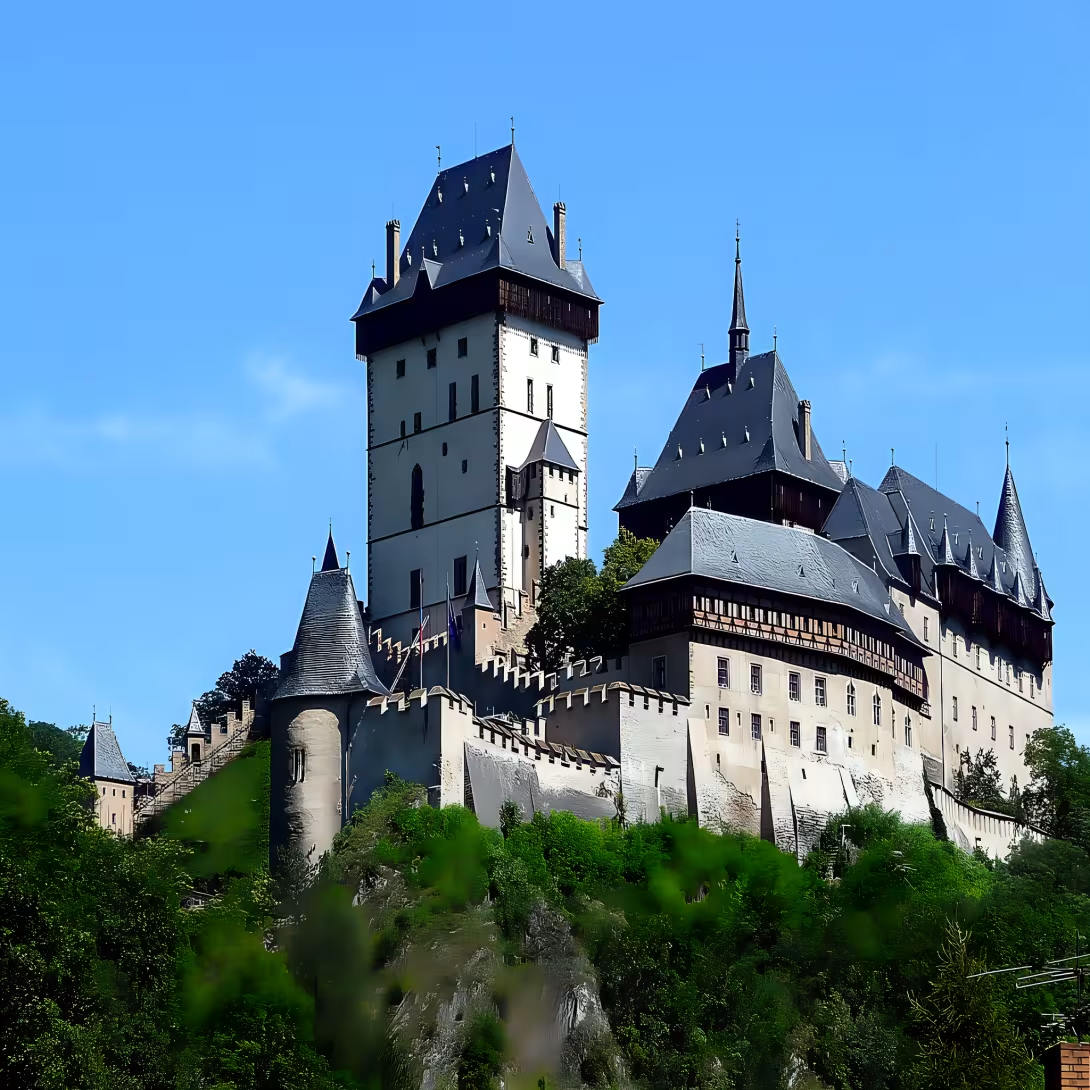
The castle Karlštejn is located in the cadastral area of Budňany in the middle of the Czech Karst, 13 kilometers east of Berouna and 30 kilometers from Prague. Since 1962 it has the status of a national cultural monument and is owned by the Czech Republic, managed by the National Heritage Institute.
Karlštejn was founded around 1348 as a private representative of the Czech and Roman King Charles IV. The then plans were virtually unequivocal - mansions without special pretensions. However, the development changed radically in the autumn of 1355, when Charles returned from this time already as established Roman emperor from his coronation trip. The victorious monarch decided to transform the castle completely and use it as a royal jeweler - an ingeniously guarded repository of Reich crown jewels and collection of holy remains. The Czech Crown Jewels, still stored in St. Vitus Cathedral in Prague, moved to Karlštejn for the first time at the beginning of the 15th century at the command of Václav IV. But due to political difficulties later devout in the 15th century, Zikmund had all insignia evacuated from the territory of the Czech Kingdom for fear of Hussite storms. Only after the end of the Hussite wars, in 1436, the Czech royal jewels were returned to the castle together with the documented crown archive. Here they remained with minor interruptions until 1619.
The most valuable premises of the castle consist of several chapels of excellent Gothic artistic decoration. The Chapel of Saint Catherine and the Church of the Assumption of the Virgin Mary in the Mariánska Tower together with the Chapel of the Holy Cross in the Great Tower are украPreparation of fresco paintings and incubated belts which represent the peak of the late medieval artistic craft. The leading masters of Czech Gothic painting participated in their decoration. The fresco cycles of the украketing staircase in the staircase annex of the Great Tower are also particularly remarkable. The chapel of the Holy Cross then contains a set of 129 Gothic plate paintings decorating its walls - a unique collection that does not have the world's equivalent range and provenance.
The castle has been open to the public since 1905, and it is one of the longest accessible sights of the Czech Republic. Today it is also one of the most visited castles in the country. The guides shall conduct the visitors through three defined circuits; during the year the castle hosts a number of cultural events - concerts, theatre performances and exhibitions. The Karlštejn Cultural Summer, the Royal Parade and the Karlštejn vintage are traditionally held here. The castle also offers premises for wedding ceremonies. / p >
Then and now
Drag the slider to compare how the landmark may have looked when it was built with the view today.
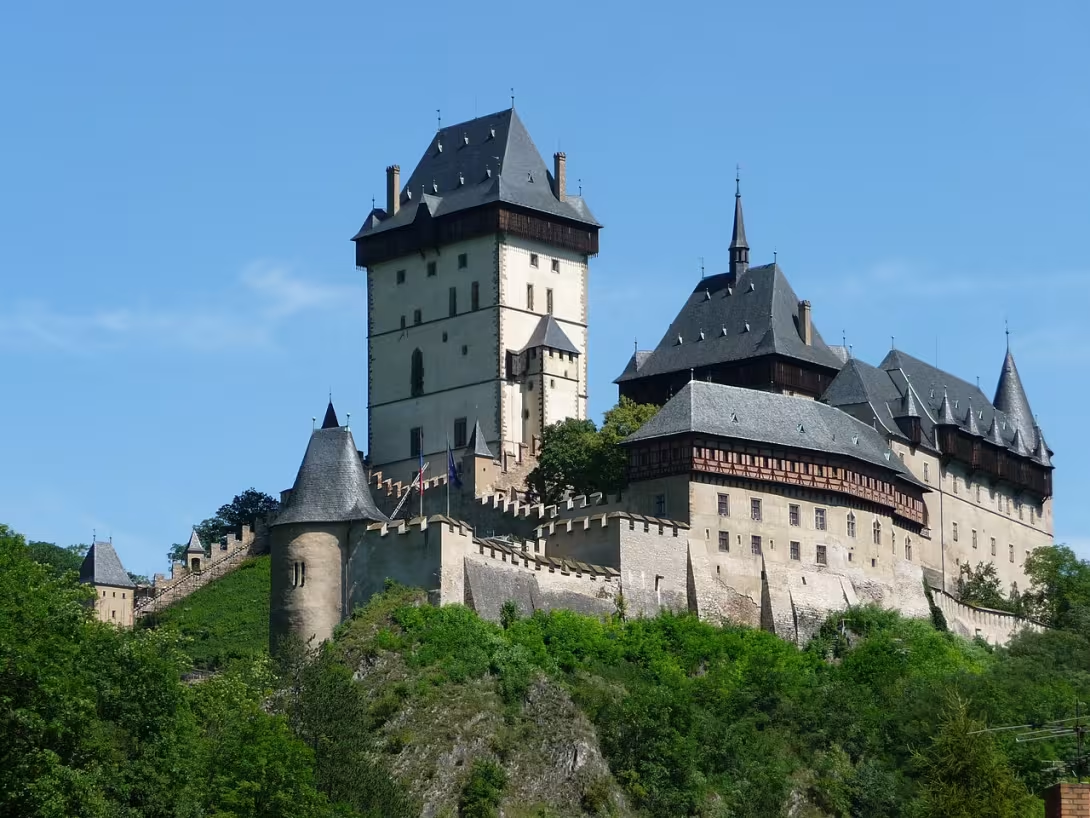
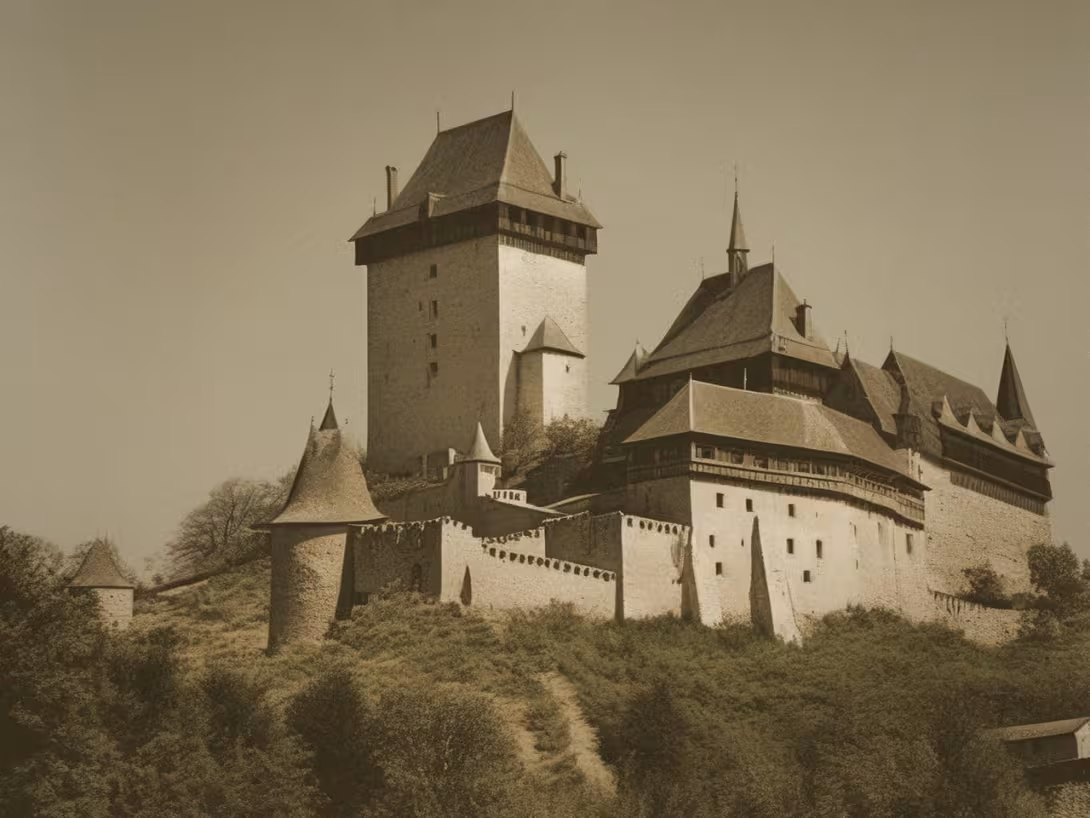
The historical appearance on the left is an AI-generated visualisation and serves as inspiration only.
Historical milestones
- 1348
- The castle Karlštejn was founded as a private representative residence of Charles IV.
- 1905
- The castle was opened to the public, which makes it one of the longest accessible monuments in the Czech Republic.
- 1962
- Karlštejn was declared a national cultural monument.
Architectural development
The castle was founded in the middle of the 14th century in Gothic style as a fortress with representative and sacral spaces. At the end of the 19th century, under the leadership of Josef Mocker, he was subjected to extensive regotization. Among the most valuable preserved parts are the chapel of St. Catherine, the Church of the Assumption of the Virgin Mary and the chapel of the Holy Cross with unique wall decoration and a set of plate paintings.
Historical events
1348 foundation of Charles IV Castle, 1355 change of purpose to the Royal Jewel, 1905 beginning of continuous public access
Owners
Czech Republic
Points of interest
- Castle Karlštejn was founded around 1348 as a private representative residence of the Czech and Roman King Charles IV. - In the autumn of 1355, Karel decided to transform the castle into a royal gem for the imperial crown jewels and a collection of holy remains. - Czech crown jewels first moved from Prague to Karlštejn in the early 1920s at the command of Václav IV. - The Chapel of St. Catherine, the Church of the Assumption of the Virgin Mary in the Mariánska Tower and the Chapel of the Holy Cross in the Great Tower are equipped with fresco paintings and incubated belts at the top of the late medieval artistic craft. - The castle has been open to the public continuously since 1905, which makes it one of the longest accessible monuments of the Czech Republic.
Guide
This guide is narrated by a synthetic voice generated by artificial intelligence.
Show guide text
This text was created by artificial intelligence and has not been editorially reviewed. It may contain inaccuracies.
Karlštejn is located in central Bohemia, thirteen kilometers east of Beroun and thirty kilometers southwest of Prague's city center. The castle stands in the middle of the protected landscape area Český kras. It belongs to the Czech Republic and is managed by the National Heritage Institute. It has been continuously open to the public since 1905, making it one of the longest-accessible monuments in the Czech Republic. Since 1962, it has been a national cultural monument.
The castle was founded around 1348 by Charles the Fourth, then King of Bohemia and Rome, and later Emperor. Originally, it was intended to serve as his private representative residence. In the autumn of 1355, Charles returned from Italy, where he had been crowned Emperor, and changed the purpose of the unfinished castle. Karlštejn was to become the royal treasury. It was intended to be a cleverly protected repository of the imperial coronation jewels and a collection of holy relics, guarded both militarily and spiritually.
The Czech coronation jewels were long kept in the Cathedral of Saint Vitus in Prague. They were first transported to Karlštejn only briefly by Charles's son Wenceslaus the Fourth at the beginning of the twenties of the fifteenth century. Soon after, King Sigismund, fearing the Hussites, had them removed from the Czech kingdom, along with the imperial jewels. After the end of the Hussite Wars, in 1436, only the Czech royal jewels returned to the castle, along with the crown archives of documents. With brief interruptions, they remained there until 1619.
The most valuable spaces in the castle are three sacred places. In the Marian Tower there is the Chapel of Saint Catherine and the Church of the Assumption of the Virgin Mary, in the Great Tower the Chapel of the Holy Cross. Leading masters of Czech Gothic painting worked on their decoration. The walls of all three spaces are covered with frescoes and bands inlaid with precious stones. The decoration is extraordinarily well preserved and testifies to the advanced art of the late Middle Ages. Also remarkable are the fresco cycles in the staircase annex of the Great Tower.
The Chapel of the Holy Cross is a true unique treasure. Its walls are adorned with a collection of 129 Gothic paintings painted on panels. Nothing of this scope exists anywhere else in the world.
Karlštejn is among the most visited castles in the Czech Republic. Concerts, theatrical performances and exhibitions are also held here. Regular events include the Karlštejn Cultural Summer, the Royal Procession, and the traditional Karlštejn Wine Harvest Festival.
Tips for visitors
To visit the Gothic castle Karlštejn we recommend to choose the morning clock to avoid the largest crowds of tourists and enjoy the peaceful atmosphere of this place associated with the Czech and Roman King Charles IV. Parking is available in the Podvrár, from where a slightly rising journey leads the municipalities of Budňany directly to the castle; use a car or public transport for your journey, the current connection of which is checked in the local search engine. For your trip, bring comfortable shoes suitable for walking uphill and stone castle patio, drinking water and clothes corresponding to current weather. For photography lovers, the best morning light offers views of the castle from the surrounding slopes of the protected landscape area Český kras. In the immediate vicinity within 30 minutes of the castle you can discover natural attractions, a riveted landscape around Berouna and picturesque scenery along the river Berouna. Families with children will appreciate a modest walk through the picturesque village leading to the castle and the opportunity to explore nature in the surrounding protected landscape area.
Frequently asked questions
Can the monument be visited?
Yes. We verified the opening hours or admission on the official website (19. 9. 2026); you will find them in the visitor information on this page. Please double-check with the operator before you travel.
What are the opening hours and admission?
Details verified on the official website (19. 9. 2026) are listed in the visitor information on this page. Official website: https://www.hrad-karlstejn.cz/
Where is the monument?
Location: č.p. 172, Karlštejn, Středočeský kraj. The map on this page shows the exact spot.
Why is the monument protected?
It is listed in the Central List of Cultural Monuments of the Czech Republic as a national cultural monument (register no. 116).
For kids
Imagine it's 1350. You are the guardian of the high tower of castle Karlštejn and your mission is to guard the greatest treasure in the entire empire. Inside the small chapel, behind eight locked doors, lies the crowns, scepters and remains of the saints - the most precious thing the Roman Emperor Karel IV. owned.
Businesses nearby
Do you run a restaurant, accommodation, shop, museum, rental, wellness or other visitor service near this monument? Show yourself directly to the people heading to it — this is how they will see you in the app and on the web:
Natáčelo se zde
- Noc na Karlštejně (1974) film
Zdroj: Wikidata (vlastnost „místo natáčení“) · Všechna filmová místa
Z magazínu

Events nearby

Zdroj akcí: otevřená data měst a obcí ČR (Národní katalog otevřených dat) a kalendář akcí Národního památkového ústavu.
Nearby
The castle is situated in the middle of the protected landscape area of Český kras, which offers natural attractions and artisanal landscape in the surroundings of Berouna and the river Berounka.
Accommodation nearby
Trips and activities nearby
Guided tours, tickets and activities nearby from GetYourGuide
Affiliate link: if you buy from the partner, we may receive a commission. The price for you does not change.
Search tours and activities →Themed route
Village Karlštejn Type: Villages Why it is worth a visit: This picturesque underground village is located in the valley Berounky and serves as a starting point for trips to surrounding nature. It offers a range of stylish pubs and shops for tourists.
River Berounka Type: Water flow Why is it worth a visit: The river flows through a picturesque valley in the foothills of the castle and creates meanders lined with rocky slopes. Its shores provide a quiet environment for nature walks.
Protected Landscape Area Český kras Type: Natural area Why is it worth a visit: The vast natural area with its arched landscape surrounds the whole site and is characterised by limestone rocks. It offers unique scenery and forest paths for hiking.
Ambient Berouna Type: Region Why is it worth a visit: The wider surroundings of the city of Beroun follow the river valley and form a natural framework for trips to the wavy landscape of central Bohemia. It's an area with a rich natural structure.
Castle Karlštejn Type: Castle Why is it worth a visit: The main destination of the trip is the Gothic castle founded by the Czech king and Roman emperor Karl IV. It stands on the rock edge above the village and hides the precious historical halls and the chapel of the Holy Cross.
Seasonal recommendations
The spring moons turn the surrounding forests into an oasis of awakening nature, where the walls under the castle bloom with wild herbs and the trees fall into a fine green veil. Sun rays create soft, warm light on the Gothic towers ideal for photography without a sharp herpes covering the landscape. In this period there is a quieter atmosphere, which is disrupted only by the singing of birds in deep valley Beroun. From the point of view of practical advice, you will appreciate the less onslaught of tourists, so you will enjoy the tour of the interiors without tiring crowds. The weather is changing, so don't forget to pack a waterproof jacket and solid shoes suitable for climbing wet historic tiles. The best time to visit is the morning hours, when the morning fog slowly retreats and opens a clear view of the region.
During the summer season the whole area comes to life and offers the longest opening hours that allow you to enjoy long sun days. The intense noon sun irradiates the white exit walls and throws sharp shadows into the castle trenches, while the dense surrounding forests provide welcome shade and relief from heat. The atmosphere is lively and cosmopolitan, full of excitement and energy. The disadvantage is the massive crowds of visitors, which is why it is absolutely necessary to get up and arrive at the checkouts first thing in the morning before the arrival of large tour buses. Put on light, breathable clothes, but don't forget the headgear and adequate supply of drinking water, because climbing up a steep hill from the underground takes a while to work on hot days. You better book a tour of the Great Palace over the Internet in advance to shorten waiting times in queues.
The autumn landscape of Křivoklátska is transformed into a colorful palette of shades of yellow, red and brown, which gives the castle an extremely romantic and melancholic character. The low sun creates dramatic side lighting and often morning fog looms over the river, which covers the entire valley into a mysterious veil. Tourism is fading, creating perfect conditions for quiet wandering and perception of the historical spirit of the place. Due to colder wounds and windy weather on the raised sharpness, it is worth wearing layered clothes, a warm hoodie and a quality wind-proof jacket. The best time for a trip is around noon, when thermometers show the most favourable values and sunlight at least partially warms. Follow the current operating hours, which are beginning to shorten as the year approaches.
Winter season breathes the castle with fairy-tale silence and nobility, especially when the surrounding forests and roof towers cover a layer of fresh snow. Early dimming and cold blue light underline the harsh beauty of the medieval fortress and silence in the courtyard speaks for everything. Use the advent time for peaceful walks, where there are hardly any crowds and the whole monument seems very intimate. Winter clothes including hat, gloves, scarves and fixed shoes with anti-slip sole are essential because the slope to the castle can freeze. Opening hours are limited to weekends or selected days, so check the current mode in advance. The best time to arrive is around noon, when daylight reaches its maximum and temperatures are most favourable.
Visualizations and artistic views


The visualisations are generated by artificial intelligence and serve as inspiration.
Photos from the area
Real photos taken near the monument


Zdroj a licence jsou uvedeny u každého snímku.
View from the area
This animation was generated by artificial intelligence from a real photograph of the surroundings. The motion and details are not real footage of the location.
Atmosphere of the place
This atmospheric visualisation of the place and period was generated by artificial intelligence. It is not real footage of the location.
Tips from visitors
No tips yet. Be the first!
Log in and add your tip.
Sources and literature
Photos: Jürgen Regel, Marian… / CC BY 3.0, rozlišení zvýšeno umělou inteligencí — Wikimedia Commons. The author and licence also appear when you hover over the image.
Faktickým podkladem tohoto textu byl článek na Wikipedii, jehož autory jsou přispěvatelé Wikipedie. Článek je dostupný pod licencí CC BY-SA 4.0.
Location on the map





Příběhy a pověsti
Legendy, pověsti a příběhy spjaté s touto památkou
Fotografie návštěvníků
Zatím žádné fotografie. Buďte první, kdo přidá fotografii z návštěvy!
Log in a přidejte svou fotografii nebo hodnoťte.
Za ověřenou návštěvu v aplikaci získáte víc bodů — poznáme podle GPS, že jste na místě.
Reviews and comments