






Karoliny Světlé 21 Villa
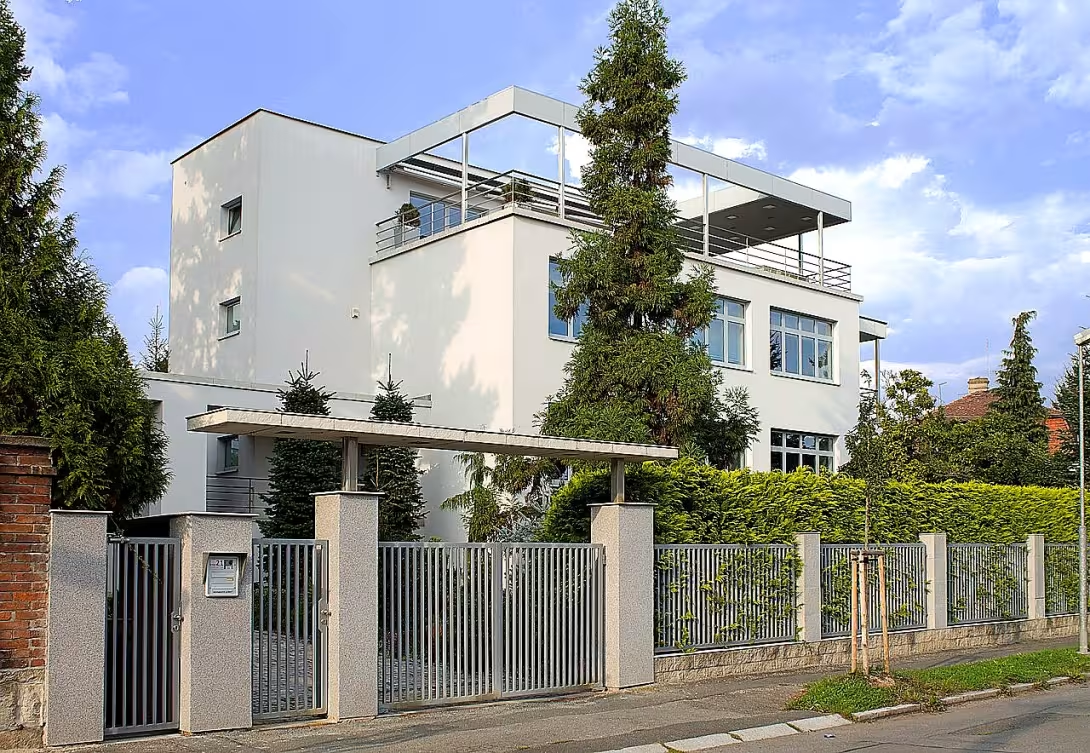
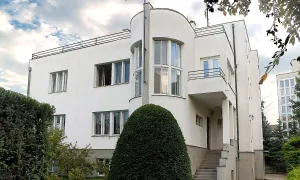
The villa at Karoliny Světlé 21 in Lběbín is the first functionalist villa in Pilsen. It was built in 1928 for the entrepreneur A.J. Rohrer, who ran a large-scale sausage company. The construction became a model of modern housing and was presented in professional publications and exhibitions. Today, it is protected as a cultural monument, even though later reconstruction has compromised it.
It was created when functionalism developed in Czechoslovakia in response to the need for rational and functional housing. Rohrer entrusted the architect Josef Špalk ml. who carried out the construction with Franz Vachta. It was completed in February 1928. Later it was extended with garage (1930), greenhouse and balcony above garden entrance (1933). The garden originally contained an octave gazebo and a swimming pool, but it lost its original function.
Architecturally, the villa is strictly functionalist. The utility part is located in the basement where the landlord's apartment was, while the owner's apartment was decomposed on the above floors. In the 1960s to 1970s, the original garden was partially lost when the northern part stopped another family villa. In 1994, the building was declared a cultural monument, but in 2005 a reconstruction took place, ignoring the original solution.
The villa has become a model of modern living and the interesting thing is that it is the first functionalist building in Pilsen. This makes it an important document for the development of Czech architecture in the first half of the 20th century. Today, the original garden elements are only traces, while the villa is waiting to return to its original form.
Accessible to the public, but after the non-professional reconstruction of 2005, it requires measures to restore its historical form. Although protected as a cultural monument, its value is threatened by inadequate care. For lovers of functionalism and architecture in the first half of the 20th century, it represents a valuable example of modern housing that should be preserved for future generations.
Visiting this villa means seeing a unique piece of Pilsen history that proves how architecture adapted to the needs of modern times. Despite the changes, its importance for the development of Czech architecture remains untouchable.
Historical milestones
- 1928
- Start of construction as the first functionalist villa in Pilsen
- 1930
- Complete garage and add greenhouse
- 1994
- Declaration by cultural monument
Architectural development
Originally a simple functionalist villa with a utility part in the basement and the owner's apartment on the above floors. In the 1930s, it was extended to include a garage, greenhouse and balcony. In the 1960s, the northern part of the garden was built by another house. The reconstruction took place in 2005, which did not respect the original architectural solution.
Historical events
- 1928
- The beginning of the building of the villa according to the project of Josef Špalka ml.
- 1930
- Completion of garage construction and glasshouse construction
- 1933
- Delivery of balcony above garden entrance
- 1994
- Declaration of the Villa by cultural monument
Owners
- 1928-1930 +
- 1999-2005
- since 2005
Points of interest
The first functionalist villa in Pilsen, built in 1928.
- It was designed for the entrepreneur A.J. Rohrer, who ran a large-scale sausage company.
- In the garden there was originally an eight-sided gazebo and a pool which later lost its original purpose.
- In the 1960s to 1970s, part of the original garden was built by another villa.
- Although protected as a cultural monument, it underwent an unprofessional reconstruction in 2005 that compromised the original form.
Guide
Show guide text
This text was created by artificial intelligence and has not been editorially reviewed. It may contain inaccuracies.
Welcome to this extraordinary building - the villa of Jan Rohrer in Plzeň Lběbín. You are standing in front of one of the most interesting examples of modern architecture in Pilsen, which has signed up for our regions as the first of its kind. In front of you is a simple but highly functional structure, which, in the year of its inception - in the year 24th - was a revolution. It was not just an ordinary house, but a manifestation of a new time when architecture began to relax from old, decorated forms and focused on the purity of lines, practicality and connection with nature. Look around you - do you see how modest this villa has been, but with certainty it has imprinted the surrounding environment? Her face is simple, but she doesn't miss the expression. Around it is a garden which used to belong to the whole as an integral part.
Let's go back over 100 years. In nineteen hundred twenty-eight, this building began to be the first functionalist villa in our territory. Its order was the entrepreneur Antonín Josef Rohrer, a man who had made his way in making sausages and was one of the major entrepreneurs of the time. For him, architect Josef Spalek Jr. designed a housing, which should not only be a home, but also an example of what a modern dwelling should look like. The villa had two parts - on the ground floor there was an apartment for the landlord, while the above floor was intended for the owner himself. The construction was completed in the 1930s, when the garage and greenhouse added to it, which added its utility function.
Now pay attention to what you're seeing. In front of you stands the facade, which is typical of functionalist architecture - clean lines, the absence of unnecessary decorated elements, but also the emphasis on proportions and harmony. The construction is simple, but it lacks character. There was a garden around it, which was not only a place for rest, but also a place where small architectural elements were located, such as an octave gazebo or pool. These elements may not be visible today, but imagine how people have spent time here in the past, how sunlight was reflected here from water levels and how guests would meet in the gazebo.
The key character of this place is of course its architect - Josef Spalek, younger. His name is associated with many important buildings in our region, but this villa is one of those that prove the direction in which architecture was headed. Spasek was inspired by the ideas of modern housing, which was meant to be not only beautiful but also practical. Jan Rohrer's villa became not only a home, but also a demonstration of what the future should look like.
And now something that might surprise you. This villa was not only about architecture, but also about the life that took place here. In the 1960s and 1970s, she went through some changes that affected her original form. Some elements, like the octave gazebo or the pool, have lost their original purpose and are no longer so visible today. But you can still imagine how voices used to sound here, how it was hosted here and how this villa became a part of the lives of its people.
There is not only a monument before you, but also a story. The story of how architecture changed, how people learned to live in a new spirit and how the fate of the people who lived in this villa intertwined. It's a place that can take you back to the past, but it can also inspire you to see what modern living looks like today.
Before leaving, look again at the facade of this villa. Notice how simplicity and functionality combine here, how architecture becomes a part of nature and how every detail was thought through here. This villa is not only a monument, but also a memory of the time when our landscape began to change and modern ideas began to influence everyday life.
Thank you for taking the time to visit this place. We hope you are interested not only in its architecture, but also in the stories that took place here. If you are interested in learning more, you can look in the archives or visit other sights nearby that can show you how our city has evolved. May this villa please you and inspire you to explore our beautiful places. Goodbye!
Tips for visitors
The best time to visit the villa is in spring or autumn, when the weather is pleasant outside and the garden is full of green. In summer it may be hot and in winter the garden may be frozen or covered with snow, which limits the tour of the outdoor parts. The villa is typical of its functionalist style, so it is ideal to visit it on a sunny day when its clean lines and modern design are better reflected.
Pleasant weather allows you to fully view the garden with historical elements such as gazebo, and enjoy the atmosphere of the villa from the outside.
Transportation to the villa is possible both by car and public transport. Parking is probably possible in the nearby area, but it is recommended to check the current options on the official site of the monument. If you arrive by bus or tram, the stops are within range, but you can find the exact connection in the map search engine. The villa is located in a quiet district of Lběbín, which is close to the centre of Pilsen.
It is well accessible from different parts of the city, whether by car or public transport.
When visiting, wear comfortable shoes because the garden can be uneven and some parts are covered with grass or stone. If you want to take photos, take with you a lens with higher resolution, because detailed photos of functionalist architecture and gardens require quality optics. Also remember the sunglasses and sunscreen if you are going to stay out for longer.
The comfort and proper equipment will improve the experience of the tour and allow you to better capture the beauty of the villa and its surroundings.
The best places for photography are around the gazebo and pool in the garden, where it combines historical character with modern elements. Sunlight hits best on the facade of the villa from the west, so the perfect time for pictures is afternoon. If you want to capture interiors, please inform yourself in advance of the possibilities of shooting inside, as some spaces may be limited.
The garden offers interesting contrasts and historical elements that are ideal for quality photos.
In the vicinity of the Villa in Lběbíno there is Plzeň, a city with rich history and modern functionalist buildings. The historical centre with the Cathedral and the square of the Republic is worth a visit, which is about 30 minutes away from the villa. You can also visit the Technical Museum of Pilsen, which is specialized in technology and industry, or walk around with functionalist architecture that is typical for Pilsen.
Pilsen offers a varied mixture of historical and modern monuments that will complement the visit to the villa.
For families with children the villas and its garden are interesting thanks to the possibility of exploring historical elements such as gazebo, and staying outside. Children can play in the part of the garden which is not completely renovated or see surrounding functionalist buildings. It is also recommended to visit nearby parks or playgrounds where children can relax and have fun. When visiting the sights, avoid the top hours when the site is most visited.
The garden and surroundings offer plenty of space for children and interesting elements that will impress them.
Businesses nearby
Do you run a restaurant, accommodation, shop, museum, rental, wellness or other visitor service near this monument? Show yourself directly to the people heading to it — this is how they will see you in the app and on the web:
Nearby
- Blízko centra města, v čtvrti Lochotín, s dostupností veřejné dopravy a okolními funkcionalistickými stavbami.
- Částečně zachovaná zahrada s historickými prvky, jako byl altán a bazén, ale s moderními zástavbami.
Accommodation nearby
Trips and activities nearby
Guided tours, tickets and activities nearby from GetYourGuide
Affiliate link: if you buy from the partner, we may receive a commission. The price for you does not change.
Search tours and activities →Themed route
1. Villa Karoliny Světlé 21 Memorial-protected villa - A unique example of functionalist architecture from the 1930s connecting the artistic and social history of Pilsen. Interesting is the interior and partially preserved garden with historical elements.
2. Garden by the villa Historic garden with modern elements - Combines the original gazebo and pool with newer development, offers a quiet place to relax and explore the past. Ideal for a short walk between trees and architectural details.
3. Funktionalist buildings in Lamběin Architectural monuments from the interwar period - The surrounding houses and buildings in the neighbourhood of the villa show a typical Plzeň functionalist building. Suitable for lovers of modern architecture and photography.
4. National building at the intersection of the villa An example of functionalist urban development - Typical for the period of the first republic, with clean lines and a simple facade. It shows what everyday architecture in Pilsen looked like in the past.
5. Public transport stop at the villa Traffic Node with good accessibility - A suitable place to connect to the city centre or surrounding parts of Pilsen. Ideal for visitors arriving by bus or tram.
Seasonal recommendations
Spring The Villa Karolina Light in the spring months offers a unique atmosphere of transformation. When the snow melts and the trees dress up in green leaves, the surroundings of the house gain a calm, almost intimate mood. The morning sun shines through bright branches and creates a game of light on historical facades. Nature around is still undamaged tourists - the park and surrounding gardens are ideal for walking without crowds. Practically, it is best to visit a monument in March or April when temperatures allow comfortable walking, but there is no summer rush and queues. It is recommended to dress layered - spring weather is unstable, and the morning or evening can be cold. Opening hours are standard at this time, but it is recommended to check the current information as some monuments extend the opening hours until the summer season.
Summer In the summer months, the villa becomes the center of a vibrant, but sometimes a busy atmosphere. The sun shines long and strong, creating sharp shadows on the historical details of the house and gives the interior bright, contrast lighting. The area is full of green, but also of visitors - especially in July and August, when it is the busiest period. It is recommended to arrive early in the morning before nine o'clock to avoid crowds and long fronts. Suitable is light, but the sun's clothing, hat and sunglasses, because the shadows are surrounded by limited amounts. The opening hours may be extended during the summer months, but some exposures may be closed in the morning due to the temperature.
Autumn Autumn brings peace and color to the surroundings of the villa. Trees are dyed in shades of yellow, orange and red, creating a picturesque background for photos and walks. The sun shines lower, which changes the lighting of the sights to warmer and softer, and the evenings are longer. The atmosphere is calmer than in summer, but still pleasant - ideal for those who seek harmony between nature and history. It is recommended to visit a monument in September or October when temperatures are mild and the rain is not yet so frequent. Clothes should be warm, but not too rough - autumn weather changes rapidly. Opening hours are standard at this time, but some tours can be completed earlier because of shorter days.
Winter Winter visit to Karolina Svlé is an experience for those who love peace and historic atmosphere without tourism. The snow covers the roofs and surroundings, which gives the memory a fabulous look, while the sun, when it comes out, illuminates the facade with fine, cold light. Inner spaces are often heated, which creates a pleasant contrast to a freezing outdoor environment. It is recommended to come in December or January when the most snow and shortest days, but also the least visitors. Clothes should be warm, layered and waterproof - winter weather in this area is usually variable. Opening hours are shortened in winter, often only in the morning, and some parts of the monument can be closed due to technical or safety reasons.
Visualizations and artistic views

The visualisations are generated by artificial intelligence and serve as inspiration.
Photos from the area
Real photos taken near the monument


Zdroj a licence jsou uvedeny u každého snímku.
Tips from visitors
No tips yet. Be the first!
Log in and add your tip.
Sources and literature
Photos: Ing. Ladislav Coufal / CC BY-SA 4.0 — Wikimedia Commons. The author and licence also appear when you hover over the image.
Faktickým podkladem tohoto textu byl článek na Wikipedii, jehož autory jsou přispěvatelé Wikipedie. Článek je dostupný pod licencí CC BY-SA 4.0.
Location on the map
Příběhy a pověsti
Legendy, pověsti a příběhy spjaté s touto památkou
Fotografie návštěvníků
Zatím žádné fotografie. Buďte první, kdo přidá fotografii z návštěvy!
Přihlaste se a přidejte svou fotografii nebo hodnoťte.
Za ověřenou návštěvu v aplikaci získáte víc bodů — poznáme podle GPS, že jste na místě.
Reviews and comments