



Kašna Parnas Fountain
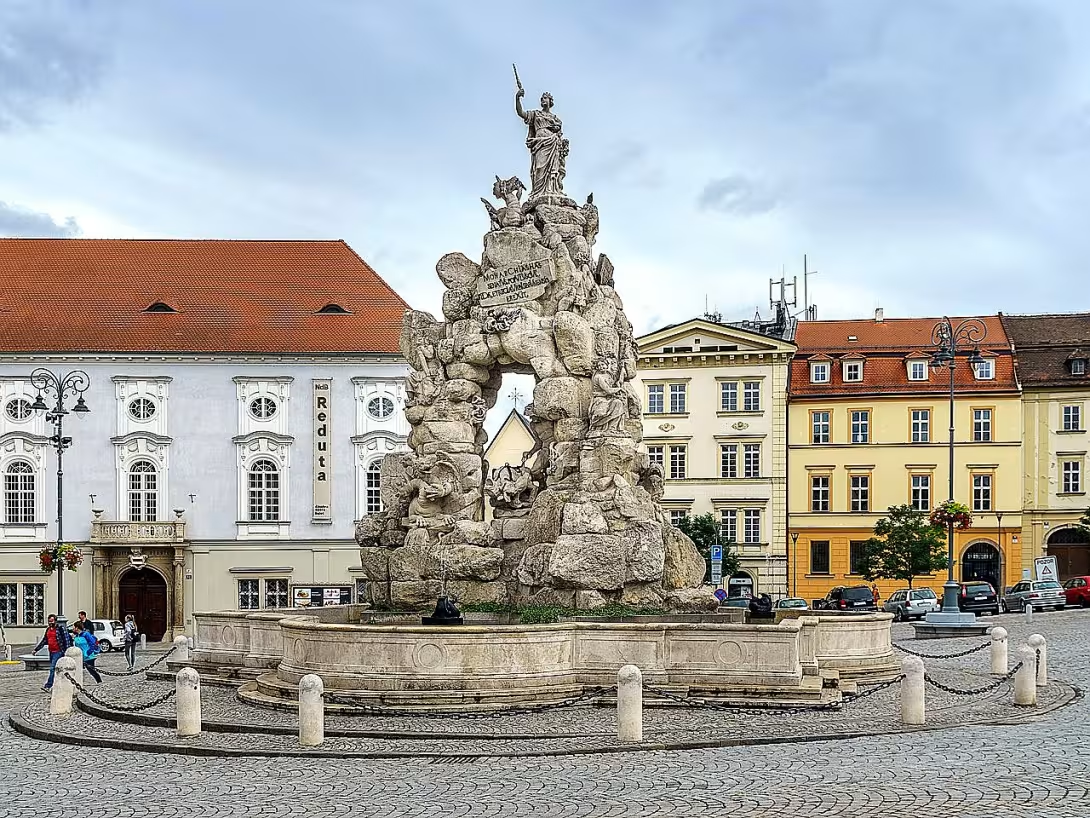
Kašna Parnas is a Baroque monument situated in the middle of the Green Market in Brno. It was built in 1690-1696 according to the design of Viennese architect Johann Bernhard Fischer from Erlach. This building is protected as a cultural monument of the Czech Republic. It represents one of the peaks of the Baroque sculpture in Brno and stands out with its iconographic programme and architectural rendering, inspired by the Roman fountain of four rivers.
The Brno City Council decided to build a new fountain in August 1690. The Renaissance fountain from 1597 no longer met the needs of the then Upper Square. The project was developed by Johann Bernhard Fischer z Erlachu; two of its original designs were preserved in the Vienna Albertina Gallery and in Zagreb. The resulting form of the work differs from them by a larger three-sided rock cliff, as the city's leaders have done. The building was organized by Councilman Johann Ignaz Dechau. The stonemason Wolfgang Steinböck, sculptor Tobias Kracker and other craftsmen, such as Bernard Höger and Antonín Riga, participated in the realization.
The architectural core consists of a high rock from a Krinoid limestone with a cave open to three sides. Inside the cave is a statue of Herakl dressed in the skin of a Nemean lion, which holds a club and chain with a three-headed dog, Kerber. On top of the rock stood the allegory of Europe, symbolizing the Holy Roman Empire. The figure was wielding a scepter in the right hand and standing over an overpowered dragon. On the sides of the rock there are three seated female figures representing the ancient empire: Greece, Babylon and Persia. Each one holds a scepter and is accompanied by specific attributes such as a quiver with arrows, winged lion or bear. The floor plan of the tank has the shape of a six-pointed star and the space around the monument defines fifteen stone columns of connected chains.
The name Parnas was created by mistake when students of the Brno Jesuit college began to consider female sculptures as muses based on the Parnas mountains. The history of the object is linked to repeated vandalism and theft; the first written report on the theft of parts of the decoration dates back to 1808. There have been many modifications over the centuries. At the end of the 19th century the original tank was replaced, the stone gargoyles in the form of dolphins replaced cast iron and the original gilded scepter replaced copper, later imitation stone. Under the fountain there is a system of brick stacks, which in the past served to supply water from the water tower on Petrova and to drain waste water.
In 2024, it was decided to make a replica of the statue of Europe of artificial stone because the original was in bad condition. In February 2025 he was transferred to the premises of the Brno Town Hall. On this occasion, they deposited a time capsule with ten objects, including period coins, medals and plaque. At the same time as the statue was restored, the fountain was renovated and its new lighting was installed in November 2024.
Kašna Parnas is an important proof of Baroque culture and technical maturity of its time. A visit to the Green Market offers a unique opportunity to see this sculpture work in its authentic historical environment.
Then and now
Drag the slider to compare how the landmark may have looked when it was built with the view today.
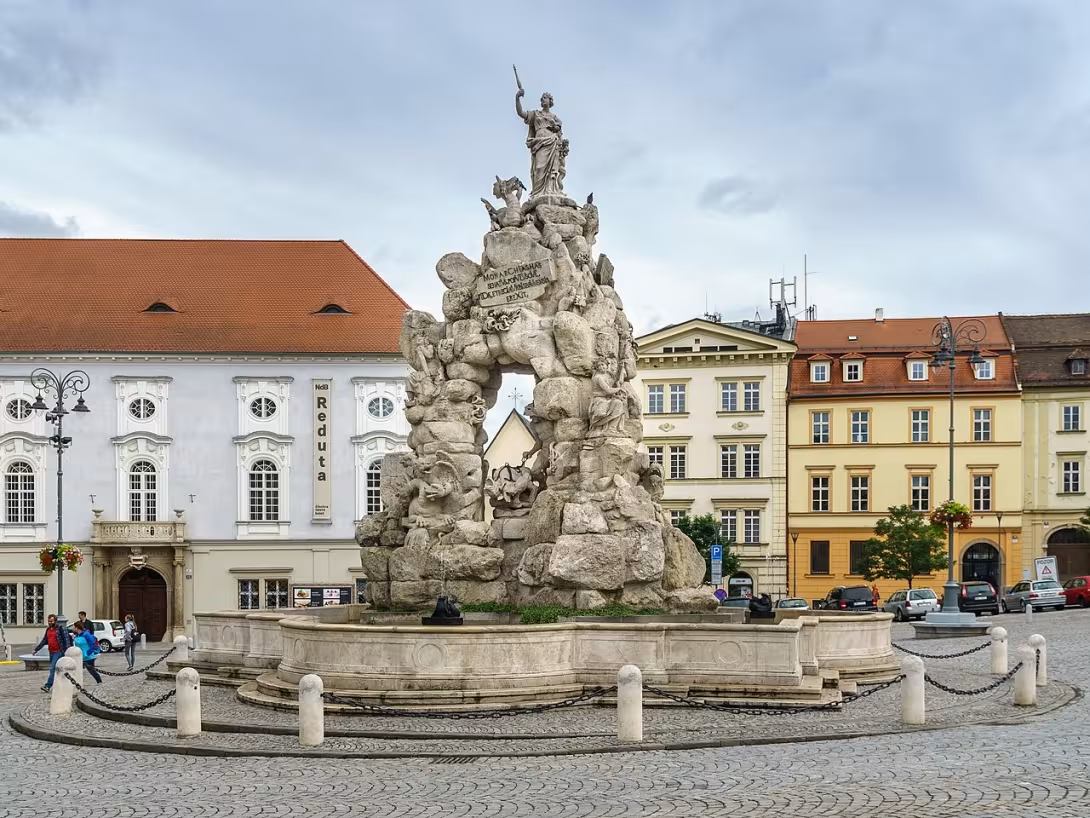
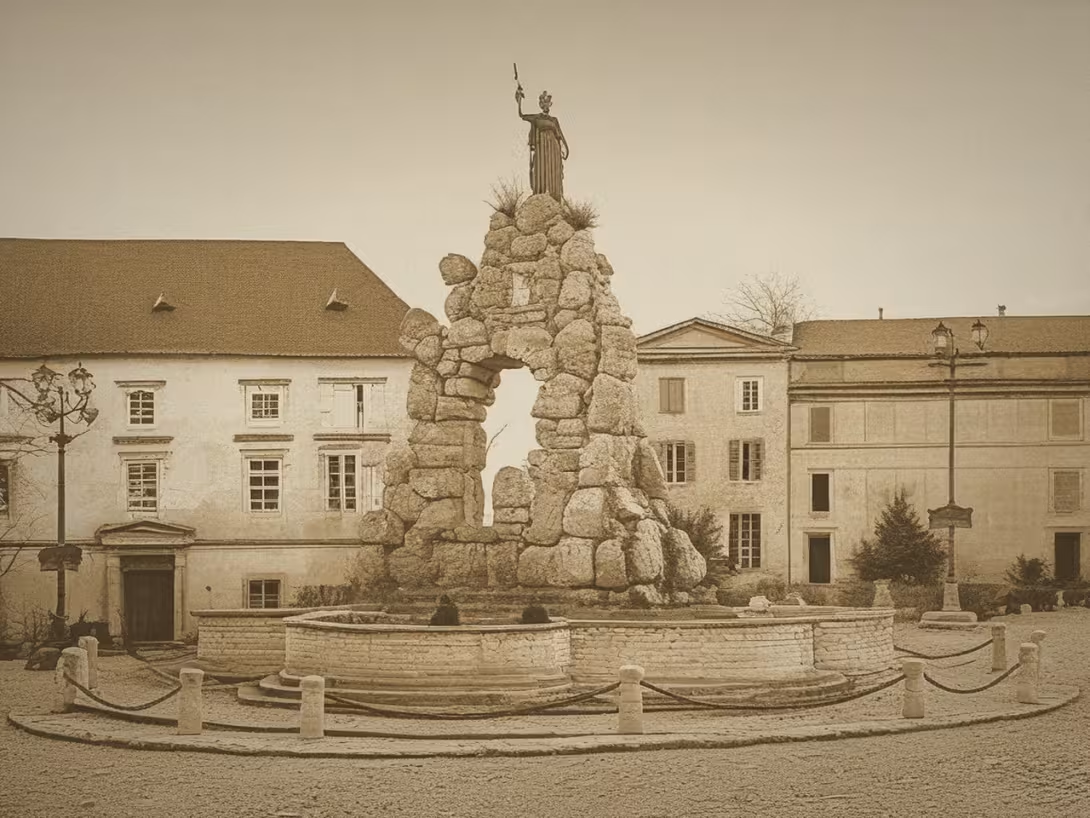
The historical appearance on the left is an AI-generated visualisation and serves as inspiration only.
Historical milestones
- 1690
- The Brno Magistrate decided to replace the unsatisfactory fountain with a new construction.
- 1696
- Finishing the construction of the Parnas fountain.
- 1808
- The first written theft on the porridge.
- 2014
- During reconstruction of the square found remains of older circular fountain.
Architectural development
The fountain was built from a crinoid limestone on a floor plan of a six-pointed star. The original tank was completely replaced at the end of the 19th century. Later there was exchange of stone gargoyles in the form of dolphins for cast iron and the original gilded scepter was replaced by copper and later imitation stone.
Historical events
1690: Decision of the Brno City Council on the construction of a new fountain. 1696: Completion of fountain construction. 2014: Found remains of older circular fountain during reconstruction of the square.
Points of interest
- The fountain was created between 16 and 16 hundred and ninety-six according to the design of the Viennese architect. Its form is different from the original proposals due to the demand of city officials for a larger rock cliff. The name Parnas was created by mistake because the Jesuit college students considered female statues to be muses from the Greek mountains. - Inside the cave of limestone is a statue of Herakla, which holds a chain with a three-headed dog. - Under the fountain there is a system of brick stacks that used to be used for water supply from the water tower and for draining waste water. - In February in the year two thousand twenty-five, a time capsule with ten objects, such as coins, medals and plaques, was placed under the statue of Europe.
Guide
Show guide text
This text was created by artificial intelligence and has not been editorially reviewed. It may contain inaccuracies.
Welcome to the heart of Brno. Right now, in the midst of the busy Green Market, where traders, visitors and residents of the city have been colliding for centuries, they stopped at one of the most important baroque treasures you can see here. In front of your eyes is a monumental waterwork that has dominated this space for over three centuries and gives it an unmistakable character. Before we begin to uncover its secrets, let you just enjoy for a moment the feeling that your gaze will stop at this rocky beauty and let yourself be swallowed by the atmosphere of a place where history in every paid drop of water intertwined with the present.
The view will probably immediately draw you to the unusual, massive form that appears in the middle of the square. What you see is not just a simple stone or a simple water container. The core of this whole building is made up of an artificial rock, which acts so naturally that you could view it as part of the original terrain, as if nature had carved it itself. But it is the work of human art and genius. Notice her texture and her rough surfaces breaking in the light of day. This rock is carved from a Krinoid limestone, which gives it the right weight and feeling of eternity. Now, if you look more closely inside her, you'll see that this rock is not just the face, but it has its hidden parts. There's a cave in her body. Right there, in that shadow and in that quiet corner, is a statue of Herakl. It's a fascinating moment when you look into the bowels of a rock and you see a figure there as if he were the guardian of this water world.
Around this rock masses are then placed other sculptures that give the whole part depth and meaning. Look at them - they're statues of women who aren't just an ornament. Each carries its own symbolic meaning. They're allegorical figures that represent the ancient empire. It's like stopping a time when human ambition, power, and history of entire civilizations are bound to a still rock and water movement. This baroque style, which is full of drama and motion, now encourages you not to just let yourself look, but also to perceive the feeling of grandeur that this building creates.
To understand why this fountain is standing right here and why it's so special, we have to go back deep into the past by the end of the seventeenth century. Let's move together in time to the year sixteen hundred and ninety. That's when the Brno Magistrate came to the decision that the existing water work was no longer sufficient and required something much more dignified, something that would correspond to the rising city. The decision was bold and ambitious. The whole construction process then lasted several years and was completed in sixteen hundred ninety-six. This whole building was built according to the design of one of the greatest artists of his time, a Viennese architect named Johann Bernhard Fischer z Erlachu. His vision was so strong that even though it changed later, it still remains the foundation of the whole work.
It is very interesting, however, that the resemblance you are seeing is different from the original plans of the architect. This happened because of the direct intervention and demand of city officials. The townspeople didn't just want any rock, they wanted something more, something more distinctive. They demanded that the rock reef be stronger and stronger. And so it happened that the resulting work took the unmistakable, dramatic form you're seeing right now. Many people were then involved in the implementation of this great work, whose names you may not know today, but who breathed life into it and helped to materialise it. Names like Johann Ignaz Dechau, Tobias Kracker, Wolfgang Steinböck, Bernard Höger or Antonín Riga appear in history. These were the people who participated in making this baroque dream a reality.
But now I'm going to tell you something you may not know that gives this place a little human, unexpected dimension. Do you know why this porridge is called Parnas? The name was not created within the framework of some magnificent artistic intention of an architect. The whole thing was created by a simple mistake. Students from a nearby Jesuit college began to think that this fountain resembles Parnas, a mountain from Greek mythology. This name, thanks to their spoken language at the anchor in people's memory and over time, has become an official sign. It's a beautiful reminder of how history and human error create their own legends.
But the history of this fountain is not just about the beauty and error of students. It's also history of losses and new discoveries that reveal what's hidden beneath the surface. The first theft was recorded on the porridge as early as the year of the eighth of the century. Imagine the anxiety at that time when something of this valuable and important work was lost. But on the other hand, history also brings us happy news. In the year two thousand fourteen, in the extensive reconstruction of the entire square, it became clear to us that beneath the surface you are walking on, there are even more secrets. Because the archaeologists found the remains of an even older, circular fountain that stood here earlier. This discovery reminds us that we are standing on layers of time that are constantly overlapping.
Now that you know the story of this rocky beauty, its origin and the little secrets it carries within it, I suggest you just keep walking. Let yourself be drifted by the atmosphere of the Green Market and see how history in every stone and in every paid drop of water intertwined with your presence. Thank you for a moment at this monument and I wish you a beautiful rest of the day to explore the other corners of our city.
Tips for visitors
The best time to visit is in the morning on the working days when markets take place on the Zelné market. You will experience the authentic atmosphere of the city and the lively excitement that belongs historically to the fountain.
The location is located in a pedestrian zone in the city centre. We recommend you take advantage of public transport and get off at stops in the nearby area, from where you can walk to the monument.
The morning light is ideal for photography, which will nicely draw details of Baroque statues. You can get the best footage from a slight angle or a level of tiles to capture the entire composition of the fountain with the surrounding historical houses.
In the surroundings we recommend visiting the Column of the Holy Trinity, the Theatre Reduta, the Cathedral Petrov or to walk to Denis orchards, where there is a beautiful view. All these places are available for a short walk.
For families with children, the visit is ideal as part of a walk downtown. Children can observe sculptures on porridge, which represent figures from Greek myths, and then look at stalls on the market.
Frequently asked questions
Can the monument be visited?
This is a structure in a public space that can usually be seen from outside free of charge. We have not verified that this particular one is freely accessible.
Where is the monument?
Location: Brno-město, Jihomoravský kraj. The map on this page shows the exact spot.
Why is the monument protected?
It is listed in the Central List of Cultural Monuments of the Czech Republic as a cultural monument (register no. 1000160826).
Businesses nearby
Do you run a restaurant, accommodation, shop, museum, rental, wellness or other visitor service near this monument? Show yourself directly to the people heading to it — this is how they will see you in the app and on the web:
Events nearby


Zdroj akcí: otevřená data měst a obcí ČR (Národní katalog otevřených dat) a kalendář akcí Národního památkového ústavu.
Nearby
Sloup Nejsvětěstí Trojice, Divadlo Reduta, Petrov, Denisovy sady.
Accommodation nearby
Trips and activities nearby
Guided tours, tickets and activities nearby from GetYourGuide
Affiliate link: if you buy from the partner, we may receive a commission. The price for you does not change.
Search tours and activities →Themed route
Thematic cruise route from Brno
1.Kašna Parnas
Type: Historical fountain
Why it is worth a visit: Kašna Parnas is located in the Moravian Eagle Square and is a key part of the historical centre of Brno. Its architecture reflects a Baroque style that still fascinates visitors with its beauty and history.
2. Column of the Holy Trinity
Type: Historical column
Why is worth a visit: This column is one of the most famous symbols of Brno, located in Freedom Square. Its important sculpture and historical motifs attract the attention of travelers and locals.
3. Reduta Theatre
Type: Theatre hall
Why is worth a visit: Reduta Theatre is one of the oldest theatre buildings in Europe, known for its rich program and historical architecture. It's a place where you can make touching cultural experiences.
4. Petrov
Type: Historical church
Why is it worth a visit: The Church of St. Peter and Paul, known as Petrov, is an icon of Brno with an important Baroque architecture. Its views from the church tower offer unique views of the city.
5. Denis sets
Type: City parks
Why is worth a visit: Denis sets are a quiet green haven in the centre of Brno, offering beautiful walks and opportunities to relax. The park is famous for its historical sculptures and charming architecture.
This route will guide you through the key historical and cultural sites of Brno, offering rich experiences for every visitor.
Seasonal recommendations
Spring: In the spring period Kašna Parnas in Brno is lit by sunlight, giving its architectural elements a special shine. Flowers around the fountain begin to bloom and add freshness and colour to the atmosphere. It is advisable to visit this historical object in the early afternoons when the temperature is pleasant and the crowds are less. It is recommended to wear light clothes with a blanket for possible weather twists.
Summer: In the summer Kašna Parnas in Brno receives an atmosphere full of life, when the surrounding green area is popular for afternoon relaxation. Sunshine illuminates the fountain and its architecture in the best colours. It is advisable to visit it early in the morning to avoid heat and crowds that may later be on top. The dosage of the sun feeder and UV protection are key.
Autumn: In autumn Kašna Parnas in Brno becomes melancholy but comfortable atmosphere. Sun rays are getting shorter and the temperature is dropping, which means fewer crowds. Leaves on trees begin to wither and add colour to the region. Visit her at noon to enjoy the warm sun rays, but don't forget the light blanket because it can be cold.
Winter: In winter Kašna Parnas in Brno gets a quiet and quiet atmosphere. Less people visit this historical object, which allows a personal search without interference. The sunlight can illuminate the snow carpet around the fountain, creating a miraculous effect. Visit her at noon to enjoy maximum sunlight and do not forget warm clothes and protection from cold.
Visualizations and artistic views


The visualisations are generated by artificial intelligence and serve as inspiration.
Photos from the area
Real photos taken near the monument

Zdroj a licence jsou uvedeny u každého snímku.
Tips from visitors
No tips yet. Be the first!
Log in and add your tip.
Sources and literature
Photos: Radler59 (talk) / CC BY-SA 4.0 — Wikimedia Commons. The author and licence also appear when you hover over the image.
Faktickým podkladem tohoto textu byl článek na Wikipedii, jehož autory jsou přispěvatelé Wikipedie. Článek je dostupný pod licencí CC BY-SA 4.0.
Location on the map
Příběhy a pověsti
Legendy, pověsti a příběhy spjaté s touto památkou
Fotografie návštěvníků
Zatím žádné fotografie. Buďte první, kdo přidá fotografii z návštěvy!
Log in a přidejte svou fotografii nebo hodnoťte.
Za ověřenou návštěvu v aplikaci získáte víc bodů — poznáme podle GPS, že jste na místě.
Reviews and comments