



Katzelsdorfská myslivna Hunting lodge
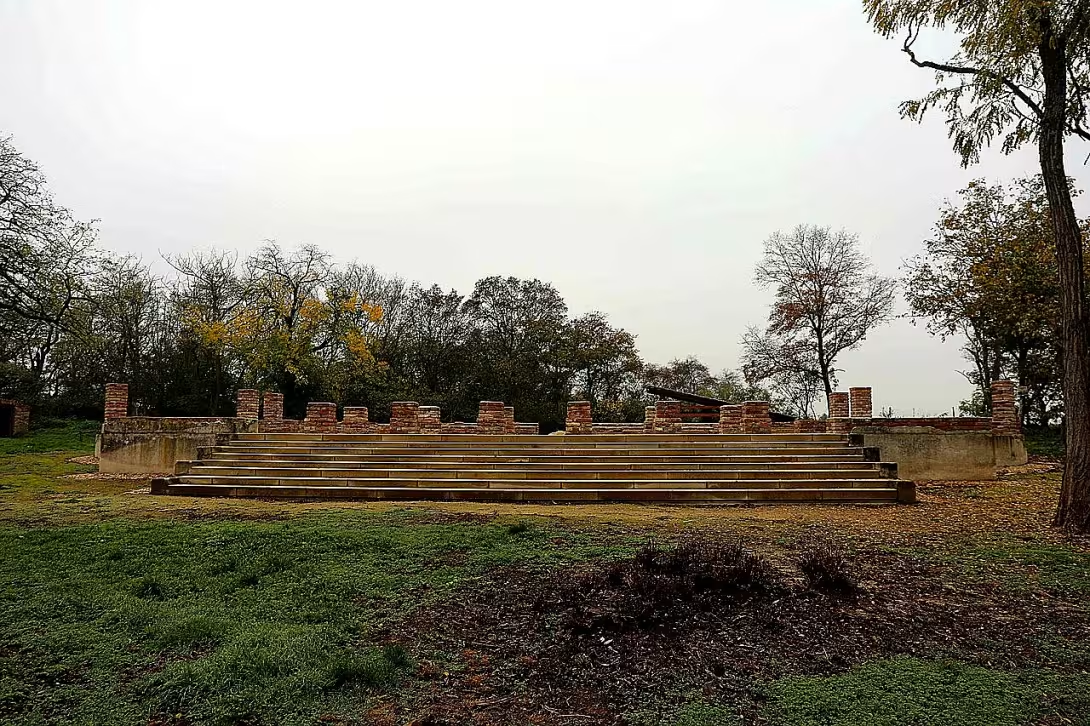
Katzelsdorfská myslivna, also known as the Kachisdorf Hunting House, is a hunting castle located in the village of Valtice and belongs to the Lednico-Valtice complex. The building was built in the early 19th century and is protected as a cultural monument of the Czech Republic. Its historical importance is that it served as a hunting centre for the House of Liechtenstein, which underlines its architectural and cultural value.
The castle was built in 1817-1819 according to the plans of the Prince building director Josef Kornhäusel, followed by Franz Engel. The architecture is classicist with later modifications and consists of two parts: a grove house and a hunting castle. The main element of the interior was the Hunting Hall, closed wall in the west and pillars internally. In the north and south, these pillars separated semi-circular spaces running out.
The ownership changed: from 1817 to 1907 it belonged to the Liechtenstein family, after World War II the property was confiscated and transferred to the Czechoslovak state. In 1956 it burned down and was not restored, which led to its gradual decay.
Key events in history include repairs in 1843-1844 and renovations in 1905-1907 under John II of Liechtenstein, when the reliefs of Josef Klieber were restored and new hunting motifs of Ludwig Wilhelm Stürmer were placed.
Today the remains of the hunting grounds are freely accessible. A revitalisation was launched in May 2020, which included deforestation and removal of rubble. Since 10 July 2021 the complex has been protected as a cultural monument of the Czech Republic. The revitalization included information elements that enable visitors to compare the current state with the original form of the castle.
Katzelsdorfská myslivna is today an interesting historical monument that attracts visitors with its rich past and architectural features. Its revitalization allows new generations to recognize important chapters of Czech history and appreciate the cultural heritage of the Lednice-Valtice region. Visiting this object is an opportunity to explore not only the architectural style of the 19th century, but also the history of the Liechtenstein family and their influence on the region.
Then and now
Drag the slider to compare how the landmark may have looked when it was built with the view today.
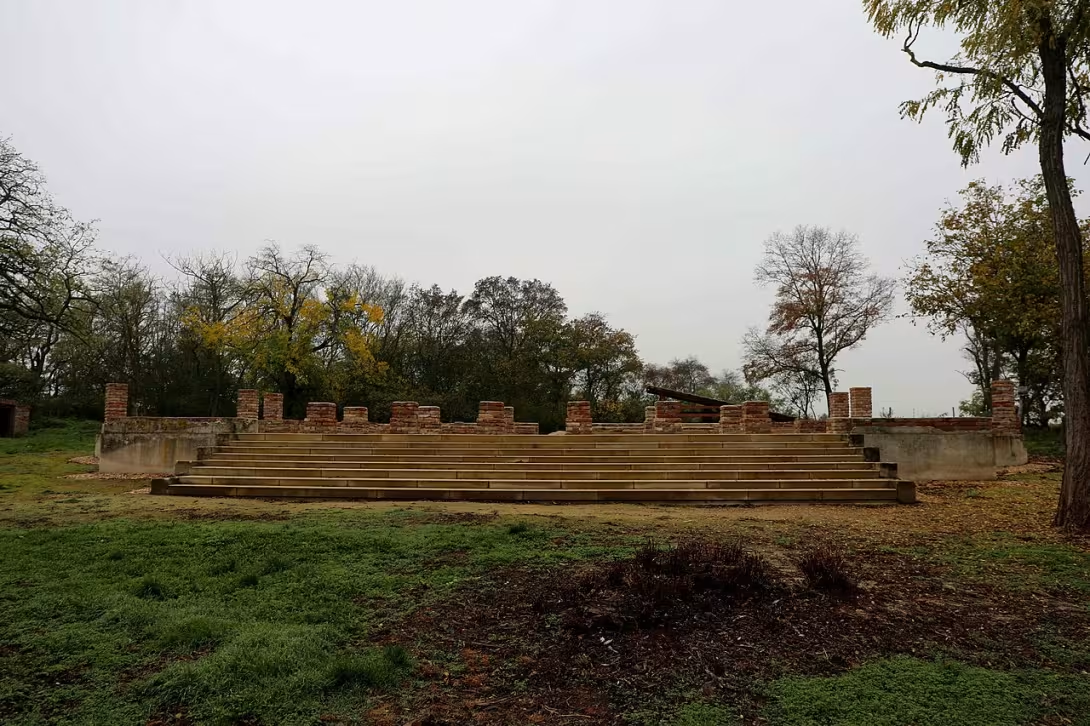

The historical appearance on the left is an AI-generated visualisation and serves as inspiration only.
Historical milestones
- 1817-1819
- Construction of hunting castle according to plans of Josef Kornhäusel
- 1843-1844
- Implementation of construction repairs
- 1905- 1907
- Renovation for Prince John II of Liechtenstein
- about 1945
- Confiscation of assets and transfer to the Czechoslovak State
- 1956
- The building fire and its subsequent decontamination
- 2021
- Entry of the site into the list of cultural monuments
Architectural development
The castle was built in a classical style with subsequent repairs, which included replacement of roof shingles and installation of reliefs. After the fire in 1956, further restaurant works were not carried out.
Historical events
- 1843-1844
- First significant repair of the castle.
- 1905- 1907
- Renovation and installation of relief from sculptor Ludwig Wilhelm Stürmera.
Owners
- 1817-1907
- after 1945
Points of interest
- Katzelsdorfská myslivna is a hunting castle built in the early 19th century. - The object served as a hunting centre for the family of Liechtenstein and is protected as a cultural monument of the Czech Republic. - The castle was built in 1817-1819 according to plans by Josef Kornhäusel and Franz Engel, with classical architecture. - The ownership of the chateau changed: from 1817 to 1907 it belonged to the Liechtenstein family, then it was the property of the Czechoslovak state after World War II. - Key events include repairs in 1843-1844 and renovation in 1905- 1907, when the reliefs of Josef Klieber were restored.
Guide
Show guide text
This text was created by artificial intelligence and has not been editorially reviewed. It may contain inaccuracies.
Welcome to the heart of the vast and beautiful territory that surrounds you. You're standing right in front of Katzelsdorf's hunting ground, a place that carries deep calm and exciting stories of the ancient past. You're looking at this object, try to stop rushing for a moment and feel the atmosphere that exists here. This hunting lodge is not only a separate building, but it is an essential part of the whole wider complex that connects nature to human art and history. Feel how this building floats in the landscape, how it fits into the surrounding environment, and how it reminds of the era when the proximity of forests and fields was crucial to the life of the nobles.
Now let's go back in time together to understand why this place was created. Imagine the early nineteenth century. The world was changing back then, but the traditions of the great families remained a fixed anchor. It was during this period, between a thousand eight hundred seventeen and a thousand eight hundred nineteen, that this hunting ground was built as an important point for the House of Liechtenstein. It wasn't just an ordinary rest building, it was a strategic hunting center. For the House of Liechtenstein, which held enormous power in the region and owned large-scale land, the hunting ground was a place where entertainment, social life and the management of their large-scale assets were united. This object was designed to reflect their position and elegance.
Now pay attention to the very form of the construction you have in front of you. While time is changing relentlessly, in the details you can perceive here, there is still a spirit of a certain era. This building was created according to the plans of two very important architects of its time. They are called Josef Kornhäusel and Franz Engel. Their cooperation led to the creation of a work that bears the features of Classicism. So when you look at the shapes and the overall balance of this object, you perceive this style. Classicism is characterized by calm, order and harmonious action. There are no unnecessary ornaments, but rather an effort for balance and temperate beauty, which is intended to be noble, but also naturally in the environment where it is located. Looking at the building, you can realize how architects worked with space and how they tried to make the building act as a natural complement to the landscape, not as an alien element.
The history of this place is not only full of peace, but also of the period of repair and renewal. Did you know, for example, that shortly after its creation, between a thousand and eight hundred forty-three and a thousand eight hundred forty-four, it was necessary to make repairs on the construction site? This shows how important it was to the owner and how they cared for this object. Later, in the turn of the century, namely, between a thousand and nine hundred and five and a thousand and nine hundred and seven, she went through an important renovation. It was under the reign of Prince John the second of Liechtenstein. It was during his reign that this object became once again a shining point within the entire estate.
Speaking of Liechtenstein, we need to remember how deeply this family was connected to the entire region. Characters like John first or Prince John second are not just names in textbooks, but they were real personalities that shaped the face of this place. Their decisions, their needs and their lifestyles directly affected the way this hunting game looks and how it was used. It's a fascinating idea that you're facing something that was directly influenced by the ambitions and tastes of the then nobles.
However, history is not always the way of ascension and fame. There are times when things get very difficult. Around the year a thousand and nine hundred forty-five had a fundamental change, when the property was confiscated and transferred to the hands of the then state. That meant the end of an era. It followed a period that was very difficult for this object. In a thousand and nine hundred and fifty-six, the building was hit by a fire, which was a great test for this historic object. This tragic phenomenon followed a period of decaying. A building that once served as a centre of noble life became a forgotten part of the landscape. It was a sad chapter where it seemed that this piece of history could die forever in the dust of time.
But history often has the ability to surprise and bring hope. Even after years of neglect, this place has become important again. In the year one thousand and two thousand twenty-one, this whole complex was included in the list of cultural monuments of the Czech Republic. This step is extremely important because it means that the state and society recognise the value of this place and its protection is now a priority. It is proof that even after difficult years the legacy of the ancestors can be revalued and protected for future generations.
If you're interested in anything else, think about how many people have stopped here over the centuries. How many hunting satellites were waiting here for a signal, how many guests shared their stories in the evenings and how many architects tried to preserve this beauty. Katzelsdorfská myslivna is witnessing changes in political systems, changes in ownership rights and technological progress, and yet it still stands here as a silent observer of everything that is going on.
Now I want to invite you to continue your walk through this beautiful territory. Let the atmosphere of the surroundings drift, observe how light changes on the walls of buildings and how nature intersects with architecture. Every step can lead you to other interesting places that are part of this magnificent whole. Thank you for stopping by and paying attention to this historic monument. We wish you a beautiful and inspiring journey further.
Tips for visitors
The best time to visit Katzelsdorf's hunting grounds is in spring and autumn months when nature is the most beautiful and light is ideal for photography. This period offers quiet moments without a large number of tourists.
For those travelling by public transport, it is possible to use the connection to Valtic and to leave on foot or by bike.
When visiting take with you suitable clothes according to the weather, shoes for walking on the lawn and perhaps even warm clothes during winter. Photographers should bring their equipment because there are some interesting perspectives for capturing the ruins.
Photographs of Katzelsdorf's hunting grounds offer the best results in the morning and evening, when light is soft. Also remember to try views from the surrounding terrain for panoramic images.
In the vicinity of Katzelsdorf's hunting grounds there is a Lednico-Valtice area which is ideal for a visit within one holiday. The historical buildings and natural parks are interesting, which is also suitable for families with children.
Frequently asked questions
Can the monument be visited?
This is a ruin. Such sites are often freely accessible, but some can only be visited with a guide or are closed for safety reasons. We have not verified the current situation – take care and respect any restrictions.
Where is the monument?
Location: Valtice. The map on this page shows the exact spot.
Why is the monument protected?
It is listed in the Central List of Cultural Monuments of the Czech Republic as a cultural monument (register no. 2000008132_0001).
Businesses nearby
Do you run a restaurant, accommodation, shop, museum, rental, wellness or other visitor service near this monument? Show yourself directly to the people heading to it — this is how they will see you in the app and on the web:
Events nearby


Zdroj akcí: otevřená data měst a obcí ČR (Národní katalog otevřených dat) a kalendář akcí Národního památkového ústavu.
Nearby
Zámeček se nachází mezi Valticemi a obcí Katzelsdorf, což je součást Lednicko-valtického areálu. Tento region je známý svou historickou architekturou a přírodními krásami.
Accommodation nearby
Themed route
1. Valtice (municipality) - Starting point. The site is part of a historic region. 2. Katzelsdorfská myslivna (hunting lodge) - The main destination of the trip. He's worth a visit because of his architecture. 3. Katzelsdorf (municipality) - Final stop. The village is located in beautiful nature.
Seasonal recommendations
Spring - In the first half of the year, there is a fine fog surrounding Katzelsdorf's hunting grounds, which in the morning creates a mysterious atmosphere and highlights old stone remains. The air is fresh, the trees are beginning to burst and the first flowers appear around. It is recommended to wear layered clothes that can be easily added or removed and have firm waterproof shoes because after the rain the terrain can be slippery. It is best to arrive early in the morning or late in the afternoon when visitors are less numerous and the light is softer.
Summer - In the summer months, the sun falls on a ruin in full bloom, creating a contrast between clearly lit stones and shadows along the surrounding lips and crows. Warm days bring a lot of insects and green grass to the landscape. Practically it is advisable to wear a hat, sunglasses and use sunscreen, add plenty of fluids and choose fixed shoes with good suspension. The best time is early morning when the sun is not too sharp and the crowds are still small.
Autumn - The autumn season covers the hunting grounds in golden shades of leaves that rustle under their feet and create nostalgic whispers. The colder air and the occasional fog supply the ruin with melancholy tones, while the sun's rays in the late afternoon illuminate the stone remains and underline their texture. It is recommended to wear a warm sweater, fixed shoes and possibly a light coat because the weather can quickly go from sunny to rainy. It is ideal to visit the place after the afternoon rain when the leaves are redder and the crowds are smaller.
Winter - In the winter, silence spreads around the hunting grounds, which only interrupts the rustling of snow below the steps. White coverage highlights the structure of old walls and creates a cool but magical scenery. Due to low temperatures and possible ice, it is necessary to wear a warm jacket, hat, gloves and shoes with anti-slip soles. The most suitable is to arrive around noon, when the sun lights up the most snowy stones, and choose a day with clear sky to minimise the risk of slippery parts.
Visualizations and artistic views


The visualisations are generated by artificial intelligence and serve as inspiration.
Tips from visitors
No tips yet. Be the first!
Log in and add your tip.
Sources and literature
Photos: Petr Gabriel Photo / CC BY-SA 4.0 — Wikimedia Commons. The author and licence also appear when you hover over the image.
Faktickým podkladem tohoto textu byl článek na Wikipedii, jehož autory jsou přispěvatelé Wikipedie. Článek je dostupný pod licencí CC BY-SA 4.0.
Location on the map




Příběhy a pověsti
Legendy, pověsti a příběhy spjaté s touto památkou

Fotografie návštěvníků
Zatím žádné fotografie. Buďte první, kdo přidá fotografii z návštěvy!
Log in a přidejte svou fotografii nebo hodnoťte.
Za ověřenou návštěvu v aplikaci získáte víc bodů — poznáme podle GPS, že jste na místě.
Reviews and comments