



Korunovační kříž The camera
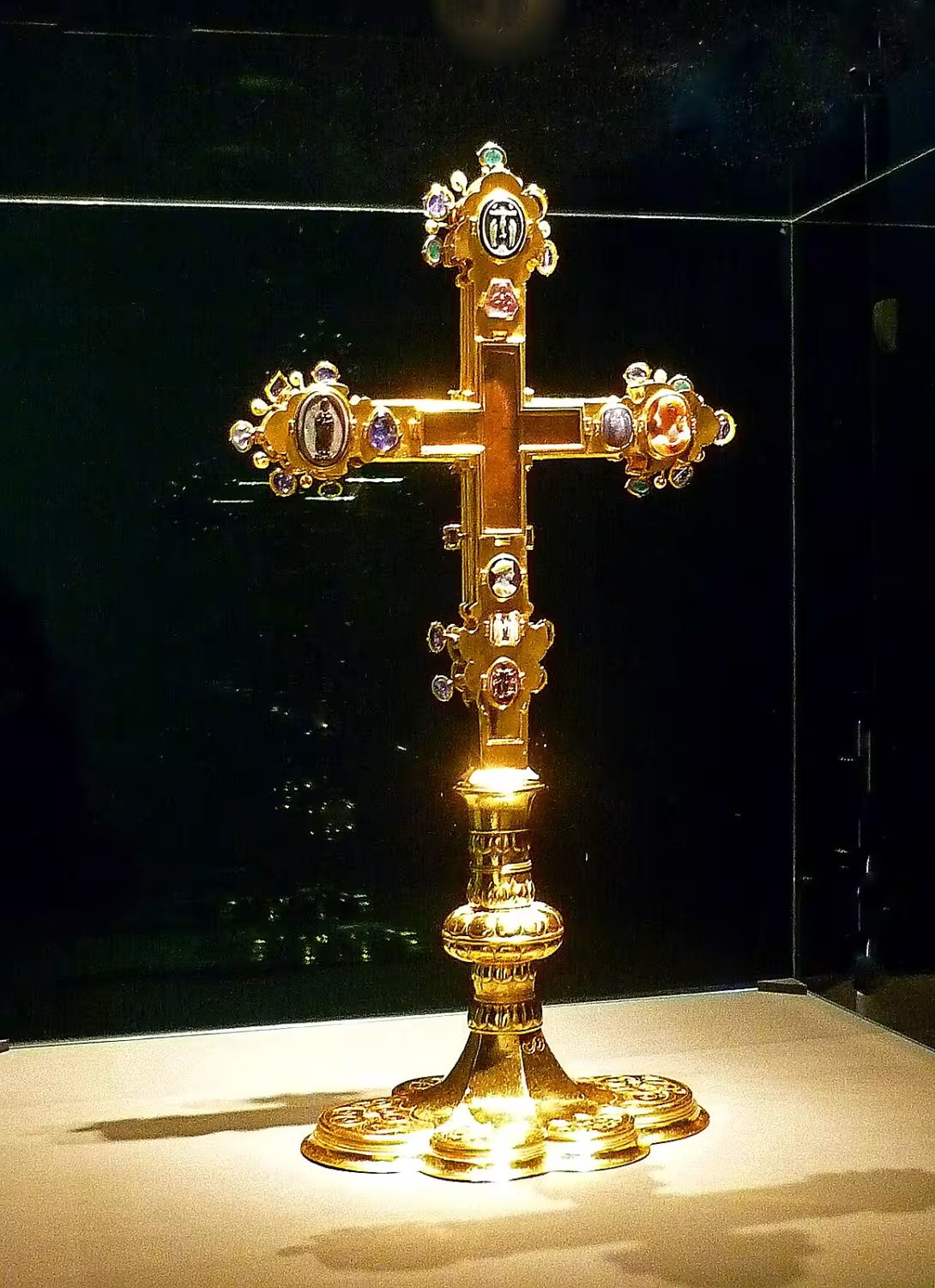
Korunovační kříž, also known as The Golden Cross or formerly as the Earth Cross of the Czech Kingdom is one of the most valuable objects of the Holy Treasure. The owner is the Metropolitan chapter at St. Vitus in Prague. Although it is exhibited together with the Czech crown jewels and it is used in the coronation mass, it was not originally intended for them - it was part of Karlstejn treasure, where all these treasures were permanently stored.
It is a relic in the shape of a Latin cross, which the craftsman made out of wood slaughtered with gold sheet. Its dimensions are 62.5 centimetres in height and 41.5 centimetres in width, with a thickness of 5 centimetres. The surface is richly decorated with gems - sapphires, aquamarines and rubies - as well as Roman and Byzantine gems and pearls. Due to the contents, the cross forms an interlock, a box for the holiest relic. The central part is two splinters from the Wood of the Holy Cross, identified as Lebanese cedar and protected by crystal plates in crossing. In individual compartments, covered by miniature doors with gems, parts of the artifacts associated with Christ's suffering were stored: pieces from the square nail of Christ's cross, from the fungus which Christ received, from the crown of thorns, from the rope used in the whipping, and from the sink in which Christ washed the feet of the apostles. The cross also contains the remains of saints - a particle from the finger of St. John the Baptist, the remains of St. Pankran and St. Anne.
The cross was ordered by the Czech King and the Roman Emperor Karel IV. as a vessel for the most precious relic of the Czech Kingdom, called Arma Christi. According to the historian Josef Cibulka, it was built around 1354, but Karel Otavský considers that it was only in the sixties or seventies of the 14th century because it was not shown in the Karlstejn remains. It was not created for Charles's Czech coronation because it was created later.
The cross belonged originally to the Charles Treasure and did not belong to the Holy Treasure as could be expected. By 1620 it was stored in the chapel of the Holy Cross in Karlstejn together with all Czech crown jewels, under the supervision of two purcrabs. In 1645 he was transferred from Karlštejn to Prague and incorporated into the Svatovitský Treasure, which he remains part of today. During the Hussite wars, the cross suffered damage - it was stolen from the original golden foot with a heel. The new leg was completed in 1523 in the early Renaissance style.
Although the cross is called the coronation and is exhibited with crown jewels, it was not directly intended for the coronation liturgy itself. It was used only exceptionally - specifically during the coronation mass of Austrian emperor Ferdinand I. Habsburg Czech king in 1836. Another liturgical use dates back to 2020, when Cardinal Dominik Duka used it during the grand ceremony at St. Vitus Cathedral. This unexpected deployment was linked to the coronavirus crisis that affected the way Big Friday celebrated. In March 2024 the cross was transported to Dresden, where it was lent for an exhibition called Fragments of Memory.
Then and now
Drag the slider to compare how the landmark may have looked when it was built with the view today.
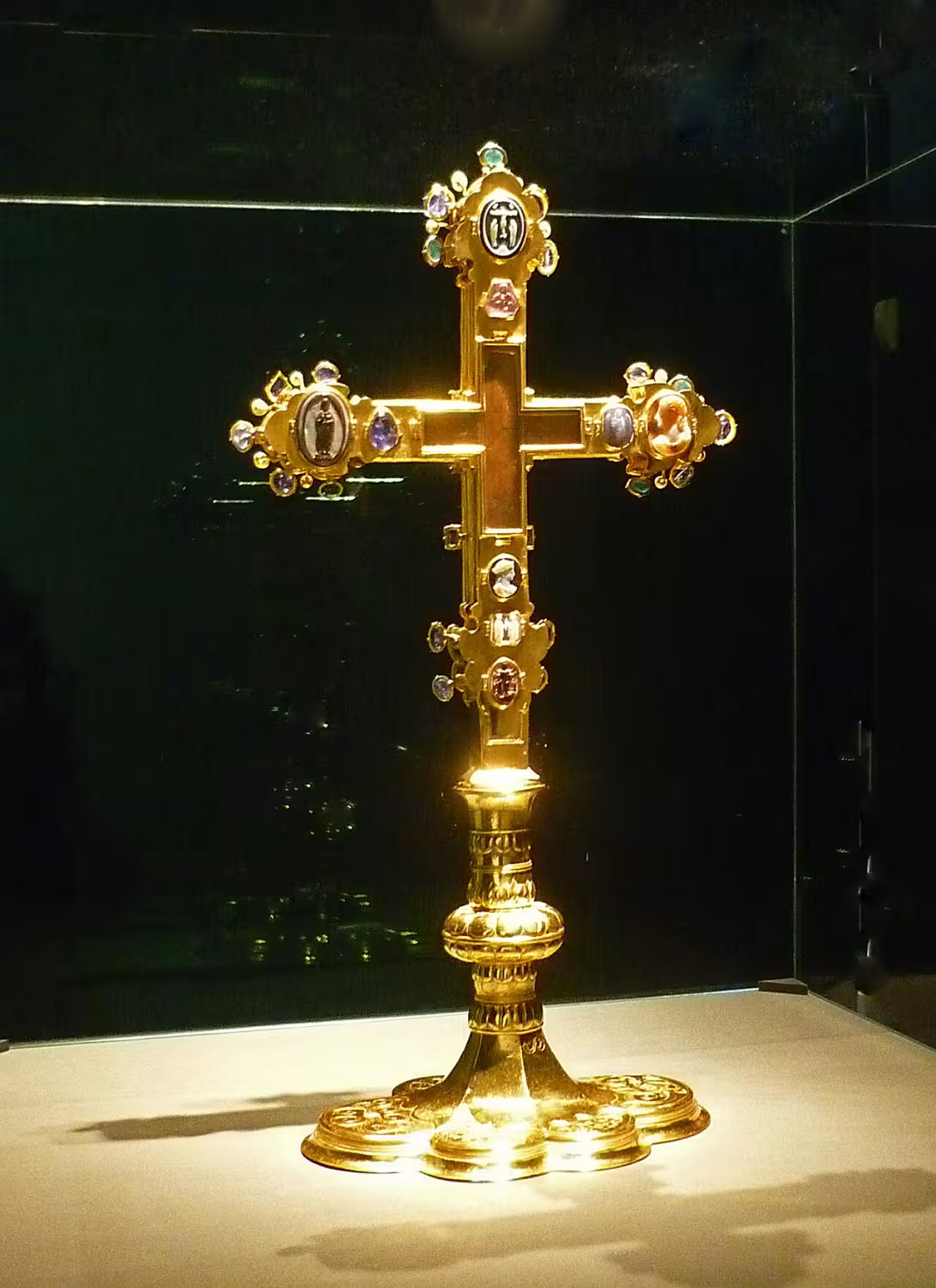
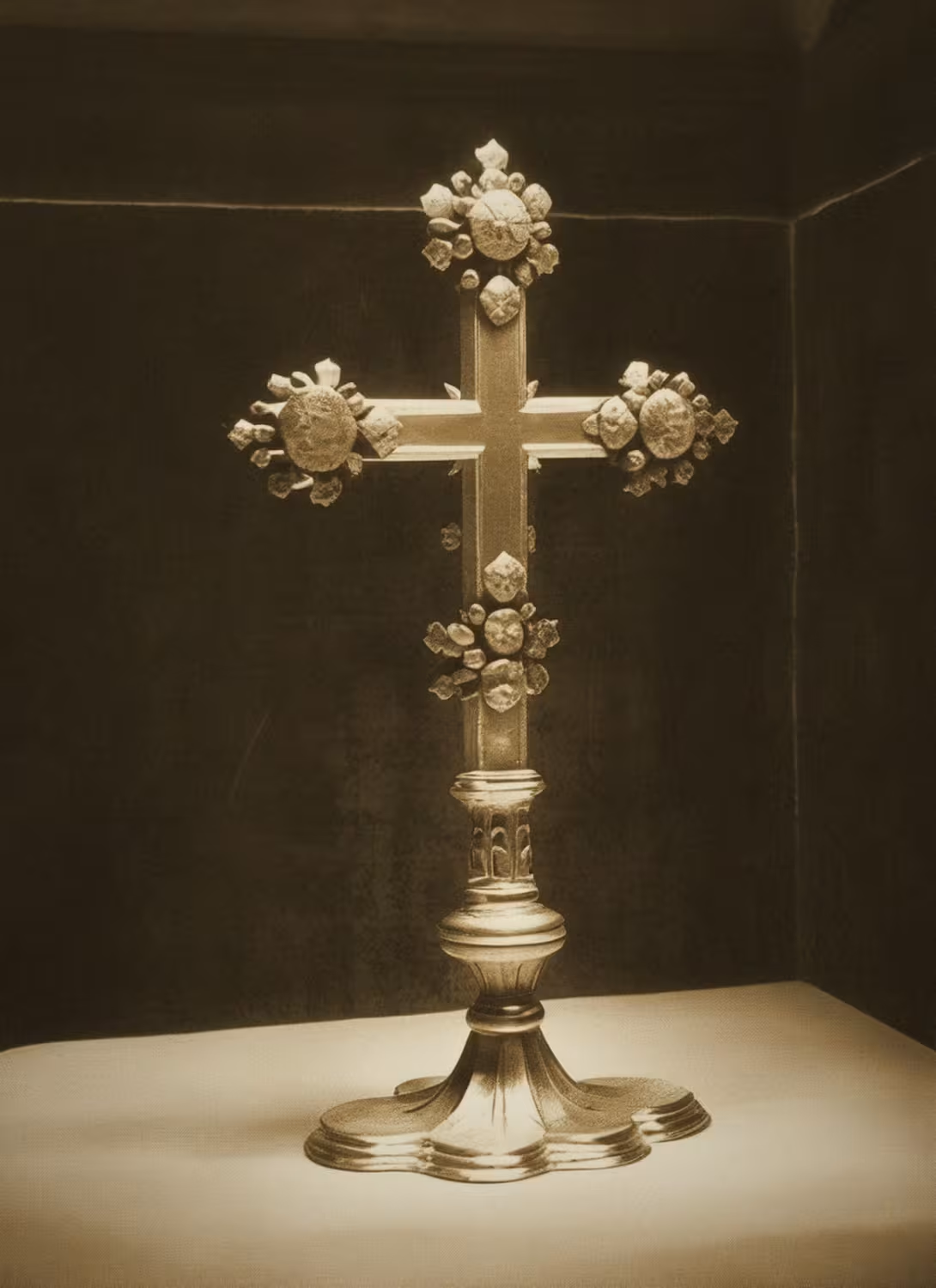
The historical appearance on the left is an AI-generated visualisation and serves as inspiration only.
Historical milestones
- 1354 (approximately)
- Making the cross as a reliquary for Karlstejn Treasure, containing parts of the Wood of the Holy Cross and the remains of the saints.
- 1523
- Completing the new leg of the cross in the early Renaissance style after the loss of the original.
- 1645
- Transfer from Karlštejn to Prague and connection to the Holy Treasure.
- 2024
- Loan to Dresden for the exhibition Fragments of Memory.
Architectural development
The cross is made in the style of late goth, with elements of the early Renaissance after the completion of the leg in 1523. The original golden leg was destroyed during the Hussite Wars. Materials include wood, gold sheets, gems, pearls and Byzantine gems. The internal structure contains compartments with relics covered by miniature doors.
Historical events
- 1354 (approximately)
- The creation of the cross to order Karl IV as a reliquary for the most valuable sanctuary of the Czech Kingdom.
- 1645
- Transfer from Karlstejn to Prague and connection to the Svatětský Treasure.
- 1836
- Last used during the coronation mass of Austrian emperor Ferdinand I. Habsburg Czech king.
- 20
- Use in the grand ceremony at St. Vitus Cathedral due to the coronavirus crisis.
Owners
since 1354 _ about – Metropolitan chapter at St. Vitus in Prague (more precisely as part of the Charles Treasure); from _ 1645 – Metropolitan chapter at St. Vitus in Prague (moved to St. Vitus Treasure).
Points of interest
- The cross was originally part of Karlstejn Treasure and only in 1645 was it transported to Prague and integrated into the Svatovit Treasure.
- Although it is called coronation, it was not intended for ordinary coronation mass, but it was used only exceptionally, last in 2020 during the grand-Friday ceremony.
- The cross contains two splinters from the Wood of the Holy Cross protected by crystal plates and other relics associated with Christ's suffering.
- In 1523 a new leg in the early Renaissance style was added after the loss of the original gold leg during Hussite wars.
- In March 2024 the cross was lent for an exhibition in Dresden called * Fragments of Memory *.
Guide
Show guide text
This text was created by artificial intelligence and has not been editorially reviewed. It may contain inaccuracies.
Welcome to one of the most valuable medieval relics of Czech history - the Crown Cross, also known as the Golden Lone Cross. You are faced with a gem that carried not only the wealth of artistic work, but also the deep faith and power of Czech kings. This cross, made of beaten gold plate in the shape of a Latin cross, shines jewels, pearls and gems that give it irresistible shine. Although it is called coronation, it was not intended for ordinary coronation ceremonies, but it served as the most important sanctuary of the Czech kingdom - as a reliquary for the part of the Holy Cross Wood and the remains of the saints.
Let's look together at his history, which goes back to the 14th century. The cross was made in approximately 1354 as part of the Karlstejn treasure, which Karel IV. had gathered in his castle. His task was to preserve the most valuable relics - fragments of the true cross on which Jesus Christ was crucified, and the remains of the saints. These holy remains were not only a spiritual foundation for the medieval monarch, but also a symbol of God's grace and legitimacy of his government. The cross carried not only gold shine but also invisible power to protect the Czech Kingdom.
Now pay attention to its shape and details. In front of you is a Latin cross whose shoulders are covered with gold metal, which shines like the sun. On its surface is reflected light of precious stones - rubies, sapphires and pearls, which were carefully placed in the golden ground. These stones are not only an ornament, but also symbols - each of them had its meaning, from protection from danger to the reminder of celestial glory. Look carefully at its structure: the cross has two shoulders, which converge into one, and originally also had a leg which was lost. It was later replaced by a new one, made in the early Renaissance style in 1523, which proves that even after centuries this gem remained in care and was restored to serve other generations.
The key character associated with this cross is, of course, Karel IV., which had not only created it, but also built the castle Karlstejn, where it was originally intended to be kept. Karel IV. was not only a powerful emperor, but also a deeply religious man who believed that relics were not only spiritual, but also political. For him, this cross was not only a sanctuary, but also a tool to strengthen his rule and ensure peace in the country. Although the cross was later, in 1645, transported to Prague and integrated into the Svatovite Treasure, its original meaning as part of the Karlovy Vary Treasure remains untouchable.
Now let's look at one of the most interesting mysteries associated with this cross. Although it is called coronation, it was not intended for ordinary coronation mass. He was too valuable and holy to be used often. Only exceptionally, in the most important moments, was it exposed or used. The last time this happened was in 2020, during the grand-Friday ceremony, when it was handed over to the Archbishop. This fact adds even greater secrets to the cross - as if its true power lies in the fact that it has been kept secret and admired rarely.
Now imagine what the fate of this cross was. It was originally hidden in the depths of Karlstejn, where it was intended to protect the Czech Kingdom from danger. After centuries he was transferred to Prague, where he became part of the Svatovite Treasure, one of the most valuable collections of medieval Christian art. And until 2024 it was lent to Dresden, where it became part of the exhibition Fragments of Memory which presented its history and artistic value to the wider world.
So before you stands not only an artistic gem, but also a symbol of faith, power and history. A cross that carried not only gold and jewels, but also part of the memory of the Czech Kingdom itself. If you have a moment, look again at its shine, the way it reflects light, and try to imagine what a medieval workshop was like where it was created. What were the hands that held him and what prayers accompanied him.
Thank you for taking the time to look at this special subject. If you want to learn more about its history or other gems that are found in this collection, do not hesitate to ask. May this golden cross inspire you with its shine and mystery. Goodbye.
Tips for visitors
Best time to visit the Crown Cross is in the morning, ideally in the first half of the day. There are fewer visitors at the time and you can see this valuable memory in peace. In addition, there is a pleasant light in the morning, which draws the shine of the golden plate and the gems on the cross.
It is recommended to use public transport where possible. The location is well accessible, the current connection and routes can be found in the traffic search engine.
When visiting, wear comfortable clothes and shoes as the tour may include a short walk. It is also important to take a small towel or cloth to avoid scratching the surface of the cross when touched. If you are interested in photography, prepare a small lamp or mobile light for detailed photos.
The best places for photography are near the display case. It is recommended to photograph in natural light from the window to capture the shine of gems and gold sheet. Avoid direct sunlight, which could cause glare
There are other interesting places around the monument worth visiting. In 30 minutes you can visit other historical monuments and cultural events in the region. However, specific activities in the area depend on the current program and need to be informed on site or on official website.
If you are visiting a memorial with children, prepare for them short and interesting information about the history of the Crown Cross. For example, you can explain to them what relics are stored in the cross and why it was created. Children can also try to draw their own cross or to make a simple camera from paper.
Frequently asked questions
Can the monument be visited?
We have not verified whether this monument is accessible. Please ask the owner or operator, or the local municipal office.
Why is the monument protected?
It is listed in the Central List of Cultural Monuments of the Czech Republic as a national cultural monument. It is protected as part of a larger listed ensemble.
Businesses nearby
Do you run a restaurant, accommodation, shop, museum, rental, wellness or other visitor service near this monument? Show yourself directly to the people heading to it — this is how they will see you in the app and on the web:
Nearby
Korunovační kříž is exhibited together with Czech crown jewels in the Svatovit Treasure in Prague Castle. This complex of buildings and monuments itself is an important historical monument and attracts visitors from all over the world. The St. Vitus Cathedral is also nearby, which is another important symbol of Czech history and architecture.
Accommodation nearby
Themed route
Thematic cruise route: Korunovační kříž (interchange)
1. Korunovační kříž (Audiovisual) - Type: Historical landmark - Why it is worth a visit: This monument is one of the oldest and most valuable sacral monuments in the Czech Republic. Korunovační kříž, located on the top of Karlstejn Castle, symbolizes the sanctity and history of the Czech crown.
2. Chapel of the Virgin Mary Snow - Type: Religious monument - Why it is worth a visit: The chapel is the oldest sacral object of the castle and served as a temple for Czech crown jewels. It is a place with a rich history that excels architectural beauty and spiritual atmosphere.
3. St George's Chapel - Type: Religious monument - Why is it worth visiting: This chapel is the oldest sacral object in the castle and served as a burial ground of Czech kings. It is famous for its historical reliefs and architectural structure, which attracts many visitors.
4. St. Anne's Chapel - Type: Religious monument - Why it is worth a visit: The chapel is one of the oldest sacral objects in the castle and served as a temple for Czech crown jewels. It is famous for its historical reliefs and architectural structure, which attracts many visitors.
5. Chapel of the Virgin Mary Snow (courtyard) - Type: Historical courtyard - Why is it worth a visit: The basin in front of the chapel is an ideal place to relax and enjoy the beauty of the castle. Here you can appreciate the panoramic view of the surrounding landscapes and notice the historical details that give the courtyard a unique atmosphere.
This route offers travelers the opportunity to explore not only Korunovační kříž itself, but also other historical and spiritual monuments of Karlstejn Castle.
Seasonal recommendations
Spring During the spring, when nature awakens to life and the sun begins to shine for a long time, Korunovační kříž gains its mystical atmosphere. The light penetrates the glass stained glass windows and creates a game of color reflections that highlight the gold and blue details of the cross. The surrounding area of the sights, often surrounded by greenery, brings a calm and meditative mood, ideal for reflection. It is recommended to visit the memory in the morning when there are fewer visitors and the light is softer. Suitable is light but warm clothes because spring weather can be variable - from sunny days to sudden rain.
Summer In the summer months, when the sun stands high in the sky, Korunovační kříž shines in sharp daylight, highlighting its sculpture details and gold gilding. The warm weather attracts more visitors, so it is advisable to come early in the morning or late in the afternoon to avoid crowds. In the main summer season the surrounding area of the monument is lively, but also offers pleasant walks along nearby gardens or park paths. Light, breathable clothes and comfortable shoes are recommended, because temperatures can be high and the visit can be associated with longer stays outside.
Autumn Autumn brings golden and red shades of leaves to the surroundings of the Crown Cross, creating contrast with blue and gold color of the camera. Mild but bright daylight highlights the details of the cross, while cooler air gives a visit a calm and serious atmosphere. There are fewer tourists in this period than in the summer, but the visit pays off in the morning when the light is the most beautiful. Warmer clothes are recommended because evenings can be cool, and comfortable shoes for possible walks on uneven terrain.
Winter In winter months, when the sun shines lower in the sky, Korunovační kříž receives a mysterious and serious atmosphere. Light penetrates glass surfaces of the camera and creates fine reflections that are projected into the snow landscape. In advent time, when the surroundings are often decorated with shining Christmas decorations, the monument seems even more noble. It is suitable for warm, but not too thick, clothes to keep the mobility off, and comfortable shoes on any frozen pavement.
Visualizations and artistic views


The visualisations are generated by artificial intelligence and serve as inspiration.
Tips from visitors
No tips yet. Be the first!
Log in and add your tip.
Sources and literature
Photos: SchiDD / CC BY-SA 4.0 — Wikimedia Commons. The author and licence also appear when you hover over the image.
Faktickým podkladem tohoto textu byl článek na Wikipedii, jehož autory jsou přispěvatelé Wikipedie. Článek je dostupný pod licencí CC BY-SA 4.0.
Příběhy a pověsti
Legendy, pověsti a příběhy spjaté s touto památkou
Fotografie návštěvníků
Zatím žádné fotografie. Buďte první, kdo přidá fotografii z návštěvy!
Log in a přidejte svou fotografii nebo hodnoťte.
Za ověřenou návštěvu v aplikaci získáte víc bodů — poznáme podle GPS, že jste na místě.
Reviews and comments