






Kostel Nanebevzetí Panny Marie (Černošice) Church
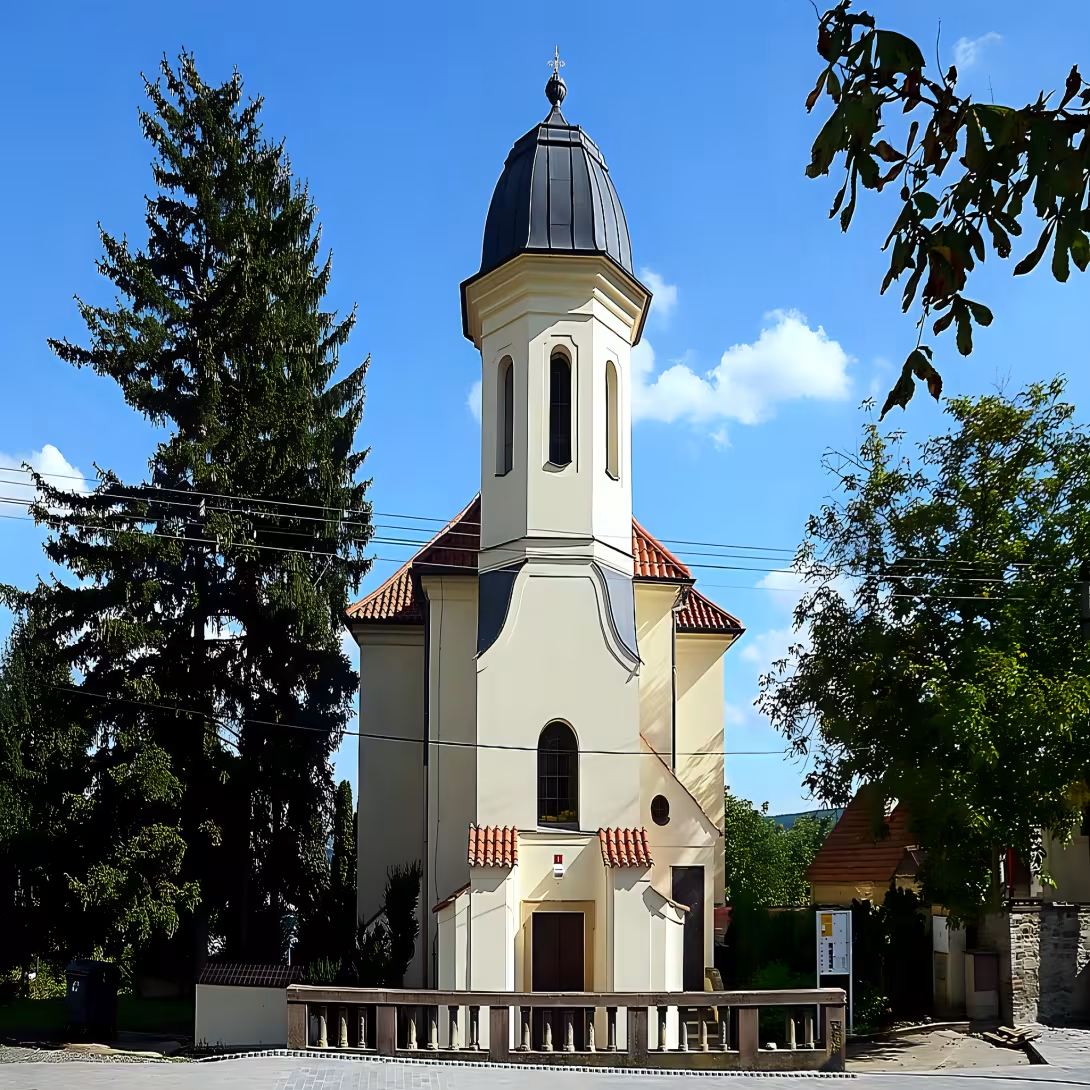
The oldest mention of the church dates back to 1352, when the Papal tithe paid. However, its foundation is older - it is assumed that it was made thanks to the efforts of the tankers from the Bizlav monastery. The monastery gained its possession here when it was at the end of the thirteenth century donated to the chinacy of Václav II, who entrusted the individual monasteries of the rooms around the lower Berounka, including the Upper Chernošice and adjacent villages. The construction was changing over the centuries. Today's form was created after extensive construction modifications in 1774, funded by local miller Jiří Kotáška.
In the recent past, the church has undergone a major renewal. After 2012 the roof, roof and facade were repaired. A complex reconstruction of the interior took place between 2011 and 2012, where a Baroque fresco depicting souls in purgatory was discovered and restored on the wall behind the cross. At the same time he received a new mobility - marble sacrifice table, ambon and baptizer created by sculptor Petr Váňa.
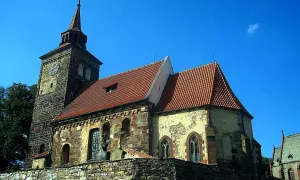
It is an architectural structure with entry in the west front. An interesting thing is the tower, which appears to be four-sided on the ground floor and on the floor passes into the shape of the eight-sided Baroque style. There are three bells. The oldest is St. Rosalie from 1700, which, twenty years after its foundation, faded and built again, the other two bells, named Mary and Václav, were donated in memory of the liberation in 1945 by Dean Adolf Pitha.
The inside of the church is equipped with gradually acquiring artifacts. The main altar from 1713 is decorated with a Baroque painting of the Assumption of the Virgin Mary in a colorful, gilded frame. Among the side altars there is a Renaissance painting of the Virgin Mary with St. Anne, who watches Jesus on his lap, and a baroque cross supplemented with statues of the Virgin Mary the Painful and St. John the Evangelist. In the fiftieth year of the twentieth century, local members of the families of Bočková and Paris donated to the church the stained glass windows which were produced by the Prague workshop V. Stanek and V. Šebek.
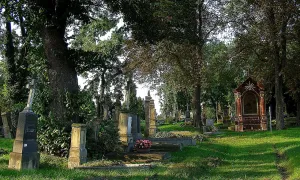
Around the church there is a cemetery of 0.27 hectares. The obvious gem consists of two tombs of the mighty Clan family, which owned a nearby farmhouse and a local hotel. This place of eternal peace will be visited by those who want to remember the personalities associated with Černošicemi - here lies painter František Šutty, who lived from 1898 to 1950, also Czechoslovak doctor and professor Zdeněk Frankenstein. The second cemetery of Chernošic is allegedly located southeast of the centre of Lower Mokropsy in Pod Krishovkou.
The church is still a parish gemeinde - regular services are held here, which makes it not only a museum artifact, but a living place for the community to meet. The visitor will find evidence of the centuries-old development of Czech religion, art and local identity.
Then and now
Drag the slider to compare how the landmark may have looked when it was built with the view today.
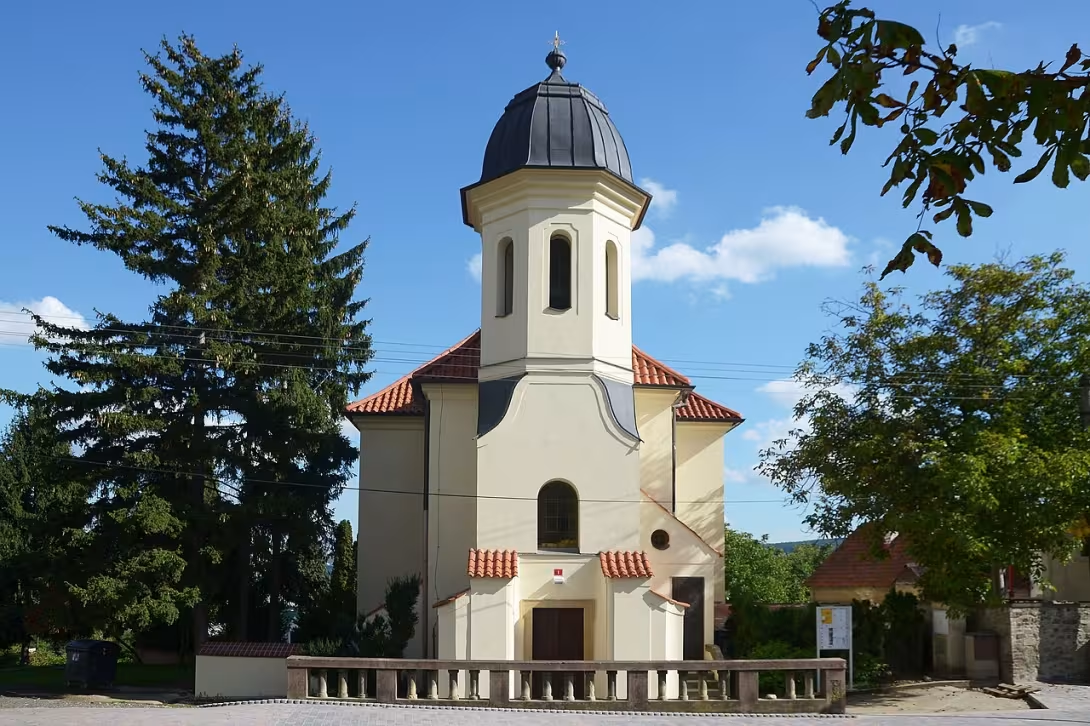

The historical appearance on the left is an AI-generated visualisation and serves as inspiration only.
Historical milestones
- 1352
- First written mention of the church in connection with the Pope's tithe.
- 1713
- Production of the main altar with the picture of the Assumption of the Virgin Mary.
- 1949
- The dedication of two bells (Marie and Václav) in memory of liberation in 1945.
- 2012
- Reconstruction of the interior and discovery of Baroque fresco on the wall behind the cross.
Architectural development
Originally a Gothic church was gradually modified in Baroque style, especially in the early 18th century. In the 21st century, reconstruction of the roof, facade and interior took place, including the discovery and restoration of Baroque fresco on the wall behind the cross. The main ship is supplemented by a prism tower with polygonal termination.
Historical events
- 1352
- The first written mention of the church, when the Papal tithes were paid.
- 1774
- Last significant Baroque reconstruction financed by miller Jiří Kotáška.
- 1965
- Listed on the list of cultural monuments of the Czech Republic.
Owners
parish
municipality
Points of interest
- The church was founded probably by tankers from the Wasslav monastery, which won the land thanks to the gifts of Václav II in the late 13th century.
- In 1774 the church underwent extensive modifications, financed by local miller Jiří Kotáška.
- The Baroque fresco on the wall behind the cross depicting the soul in purgatory was restored during the reconstruction of the interior in 2011-2012.
- There are three bells in the church tower, the oldest of which dates back to 1700 (St. Rosalie) and two others were donated by Dean Adolf Pitch after liberation in 1945.
Guide
This guide is narrated by a synthetic voice generated by artificial intelligence.
Show guide text
This text was created by artificial intelligence and has not been editorially reviewed. It may contain inaccuracies.
Welcome to the Blackies. Right now, you're standing in front of the Church of the Assumption of the Virgin Mary and you have headphones on, so let's imagine together the place you're looking at. Raise your eyes and let the general impression of this building take place for a while. In front of you there is a one-ship sacral building, whose silhouette is complemented by a distinctive Baroque tower and an Orthodox end of the priesthood. When you look at the facade and surrounding walls, you see a calm and firm atmosphere of places that remember centuries of human destinies, prayers and transformations. Feel the antiquities of the walls ahead of you and let them transfer you in time to the times long past.
Let us now look at how this church was formed and what its historical context is. The original core of this building is Gothic and dates back to the 14th century. The first written mention of this church dates back to 135,552, in connection with the payment of the Pope's tithe. According to historical sources, the church was probably founded by the tankers from the Weaponry monastery. The arms monastery won the land thanks to generous gifts from King Wenceslas the Second in the early 13th century. At that time, the monks formed a landscape and laid the foundations of spiritual life throughout the area.
When you look carefully at the construction, you will notice that it bears traces of various building development stages. At the beginning of the eighteenth century the church underwent a radical Baroque reconstruction during which it gained its present form. Later, in 17 hundred and seventy-four, further extensive adjustments followed. The local miller Jiří Kotáška financed these at the time, which shows how deeply the church was linked to the life of local inhabitants and farms. During the eighteenth century, namely in seventeen hundred thirteen, the main altar was also made with a valuable picture of the Assumption of the Virgin Mary, which became the spiritual heart of the whole space.
Now try focusing on the architectural details that you have right in front of you. Although you might expect a purely gothic character, the result of centuries of modifications is a fascinating mix of styles. You are standing in front of a single-boat shrine dominated by a Baroque tower. Although we cannot look inside at the moment, it is worth noting that the interior contains rare baroque and Renaissance artistic elements such as historical altars and ancient stained glass. All of these details together form a harmonious whole that speaks of craftsmanship and taste of people in the past centuries.
A number of interesting stories and moments from a more modern history relate to this place. A very powerful story took place in nineteen hundred forty-nine. At that time two new bells were given to the church, which were named Mary and Václav. These bells were taken as a living landmark of liberation in nineteen hundred forty-five, to commemorate the end of the difficult years of war with their voice and the joy of freedom. The people of Chernošic have thus indicated that the church represents not only the place of faith but also a symbol of hope and national identity.
One of the biggest surprises, however, was published only recently. During the total reconstruction of the interior in the years twenty-one to twenty-two, the restorer made a stunning discovery. On the wall right behind the cross was unexpectedly revealed and then restored ancient Baroque fresco. This hidden treasure has waited for centuries under layers of paint before being brought back into the light of the world. The personalities of craftsmen, priests, miller Kotak or anonymous builders from the fourteenth century have taken up time, but their work stands here and speaks to us without words.
I hope this walk was interesting for you through history and architecture. When you have time, try to get around, perceive the genius loci of this sanctuary and think about all the generations that have walked the same country as you are now. Thank you for your attention, and I bid you farewell and wish you a wonderful rest of the day on your next discovery of Chernošice. Goodbye.
Tips for visitors
{'paragraph': 'The best time to visit the Church of the Assumption of the Virgin Mary is in the summer months, especially in June or September. At that time the weather is pleasant and the sun lights up the interior so that the Baroque paintings and statues can be well looked at. In winter, the church offers a quiet atmosphere without crowds of tourists, ideal for meditation or photography without interference.'}
{'paragraph': 'The church is available by car, it is recommended to park in a public parking lot in the centre of Chernošice, located just a few minutes walk from the entrance. For visitors by public transport is the most suitable stop in the centre of the village, from where it is about ten minutes walk to the church. The current connection and departure times can be found in the transport search engine.'}
{'paragraph': 'When visiting, wear comfortable clothes and shoes as the church and its surroundings are partly outdoor and include a small corridor leading to the cemetery. For photography, prepare a lens with a larger visual field to fit into the frame detailed elements such as baroque cassette ceiling or gothic portals. Also remember the mobile charger, as the interior has limited access to electrical outlets.'}
{'paragraph': 'The most beautiful photos can be taken in the morning or afternoon light, when the sun rays illuminate the limestone columns and stained glass. The most interesting places for the shot are the main altar with the image of the Assumption of the Virgin Mary, the baroque cassette ceiling and the entrance portal with gothic elements. In the interior it is permitted to photograph without lightning, outside in the cemetery or in the surrounding area without limitation.'}
{'paragraph': 'In the vicinity of the church is worth a visit to the Weaponry monastery, which is located about ten kilometers from Chernošice. This Cisteriac monastery is one of the most important medieval complexes in Bohemia and its monastery church is also a beautiful Baroque monument. For families with children there is an interesting cemetery Dolní Mokropse, where there are historic tombs and stone tombstones that can fascinate children with their appearance.'}
{'paragraph': For families with children it is advisable to visit the church in the morning when it is quiet and the children can see the interior without interference. Children will probably be interested in gothic elements such as small windows with stained glass or baroque statues on the altar. In the Lower Mokropse cemetery, children can look for the oldest tombstones and talk about the history of Chernošice. For children older then it may be interesting to compare the Gothic church with the Baroque monastery in Basslav. '}
For kids
Imagine going back to the past, until Černošice wasn't as big and big as it is today. Imagine you're a little knight or a knight who just entered a wonderful Gothic village.
The church of the Assumption of the Virgin Mary stood long before Černošice became a village. It was built in the 14th century and its construction is like a locker full of secrets and adventure. Who lived here? They were monks from a nearby monastery who went to church to pray for their brothers and sisters. What happened here? There have been many weddings and funerals.
Businesses nearby
Do you run a restaurant, accommodation, shop, museum, rental, wellness or other visitor service near this monument? Show yourself directly to the people heading to it — this is how they will see you in the app and on the web:
Events nearby
Zdroj akcí: otevřená data měst a obcí ČR (Národní katalog otevřených dat) a kalendář akcí Národního památkového ústavu.
Nearby
- The Cistercian monastery, which probably initiated the formation of the church in Chernošice.
- The second Negro cemetery with the historical tomb of the Klan family.
- Natural flow that affected the development of the village and its cultural environment.
Accommodation nearby
Trips and activities nearby
Guided tours, tickets and activities nearby from GetYourGuide
Affiliate link: if you buy from the partner, we may receive a commission. The price for you does not change.
Search tours and activities →Themed route
Design of a thematic cruise route in the footsteps of history and nature around Chernošice:
1.Kostel Nanebevzetí Panny Marie (Černošice) Type: church Why is it worth a visit: The main destination of our journey, which was probably initiated by the nearby Cistercian monastery. It offers a peaceful atmosphere and a demonstration of sacral architecture.
2. Lower Mokropse Type: cemetery Why is it worth a visit: The second Negro cemetery is located approximately one kilometer from the main destination. Here you can admire the historical tomb of the Klan family.
3. Berounka Type: River Why is it worth a visit: Natural flow about three kilometers from the church. It offers a pleasant environment for relaxing and walking along the water level.
4. Weapons monastery Type: monastery Why is it worth a visit: A significant Cistercian monastery that lies about ten kilometers from Chernošice. Historically related to the creation of a black church and closing our trip.
Seasonal recommendations
Spring In the spring months the Church of the Assumption of the Virgin Mary in Chernošice is dressed in bright tones, when its stone walls are reflected in blooming trees and young grass. Specific here is a quiet lighting, when the sun lights up in the morning and creates fine, moving shadows in the corridors. Nature around the church offers the first flowers of spring plants and bird singing, which gives the visit a feeling of freshness and renewal. It is recommended to visit the church in March or April when the air is pleasantly warm but still unwet. Practical advice includes the choice of clothes according to variable weather - light jackets or raincoats are enough, but it is always good to have an umbrella at hand. The best time is early morning when the church is calm and you can enjoy its architecture without disturbing crowds that appear on weekends.
Summer In the summer months the church acts as an oasis of peace in the middle of the green, where its shadows offer relief from sunlight. There is a long daylight that highlights the details of the facade and creates a light and shadow game on the inside walls. The surrounding nature is lush - tall trees and flowering bushes provide a sense of escape from the urban rush. In the main summer season, however, it is necessary to expect a higher interest for tourists, especially on weekends. It is recommended to visit the church early in the morning or late in the afternoon when the heat is pleasant and the crowds are smaller. Clothes should be easy, but with the possibility of covering the shoulders when entering a cooler interior. It is also advisable to have water with you during the summer months, especially during longer tours of the area.
Autumn Autumn brings golden leaves to Chernošice and a calm atmosphere where the church looks like a fairy tale. Specific here is a soft, scattered light, which creates fine shades of stained glass and gives the interior a warm, intimate mood. The surrounding forests and meadows turn into a mosaic of red, yellow and brown tones, creating a picturesque background for photographs. At this time, the church is often visited by locals looking for peace and inspiration. It is recommended to visit it in September or October, when the weather is stable, but the air is still inoperative. Clothes should be laminated - warm sweaters and light jackets are enough, but in November it is advisable to add scarves or gloves. The best time is the afternoon when the sun shines directly into the church and creates interesting light effects on the altar.
Winter Winter visit to the Church of the Assumption of the Virgin Mary is an experience for lovers of peace and mystery. The specific here is a cold, blue light that emphasizes silver shades of stone and creates magical reflections on the stained glass. The surrounding landscape is covered with snow, which gives the church a sense of isolation and escape from the everyday rush. In advent time there is also a special atmosphere where the church becomes a place of meditation and reminder. It is recommended to visit it in December when the air is clean and opening times longer than in the winter months. Clothes should be warm and comfortable - thick jackets, gloves and warm shoes are essential. The best time is the afternoon when the church is lit with artificial light and there is a sense of cosy. In winter it is also advisable to monitor the current opening times, which may vary according to the weather.
Visualizations and artistic views


The visualisations are generated by artificial intelligence and serve as inspiration.
Photos from the area
Real photos taken near the monument


Zdroj a licence jsou uvedeny u každého snímku.
Atmosphere of the place
This atmospheric visualisation of the place and period was generated by artificial intelligence. It is not real footage of the location.
Tips from visitors
No tips yet. Be the first!
Log in and add your tip.
Sources and literature
Fotografie: RcorpCZ / CC BY-SA 3.0, rozlišení zvýšeno umělou inteligencí — Wikimedia Commons. The author and licence also appear when you hover over the image.
Faktickým podkladem tohoto textu byl článek na Wikipedii, jehož autory jsou přispěvatelé Wikipedie. Článek je dostupný pod licencí CC BY-SA 4.0.
Location on the map

Příběhy a pověsti
Legendy, pověsti a příběhy spjaté s touto památkou
Fotografie návštěvníků
Zatím žádné fotografie. Buďte první, kdo přidá fotografii z návštěvy!
Přihlaste se a přidejte svou fotografii nebo hodnoťte.
Za ověřenou návštěvu v aplikaci získáte víc bodů — poznáme podle GPS, že jste na místě.
Reviews and comments