



Kostel Nanebevzetí Panny Marie (Grunta) Church
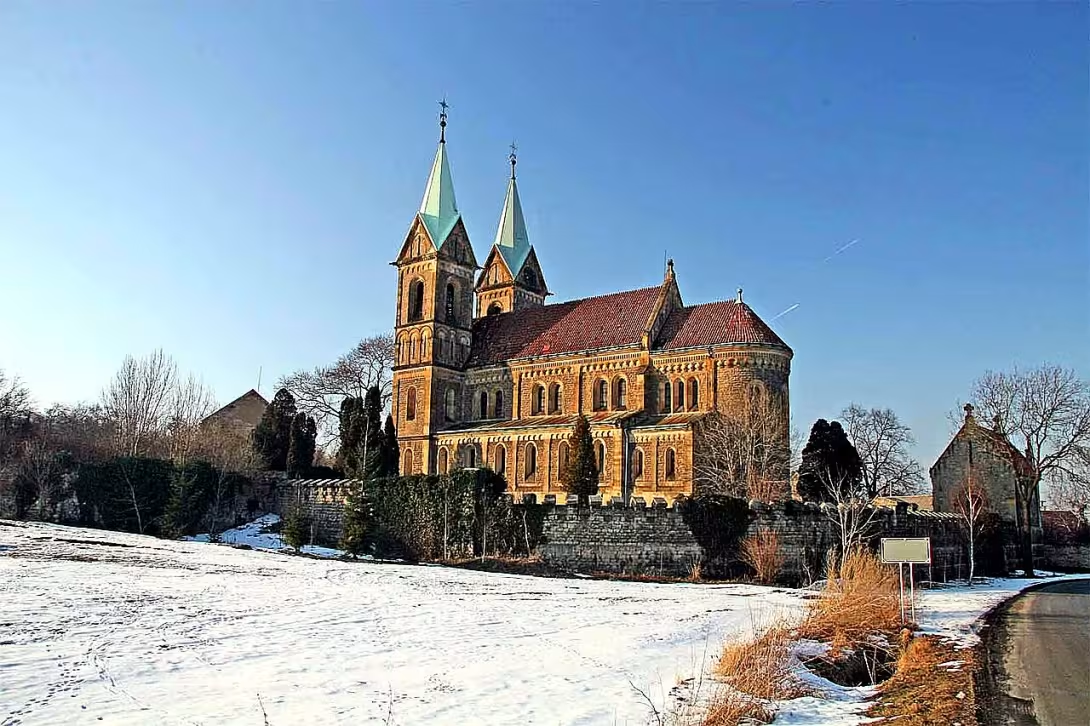
The Church of the Assumption of the Virgin Mary in Grunta is an important architectural monument located in the Středočeský kraj region of the Czech Republic. Constructed between 1905 and 1908, this neoromantic-secessionist church reflects early 20th-century architectural trends within the Austro-Hungarian Empire. Its historical and cultural significance is highlighted by its designation as a cultural monument in 1987 and its status as a filial church of the archdeaconry in Kutná Hora after the local parish dissolved in 2007.
The site's history dates back to at least 1305, with evidence of an earlier church reconstructed between 1367 and 1398 by miners from nearby Kutná Hora. By 1814, due to deterioration, only its tower and spiral staircase remained. A new building replaced it in 1817 but was demolished in 1905 for the current structure. This marked a pivotal moment in Grunta's architectural history, reflecting broader cultural shifts towards modernism.
Architecturally, the Church of the Assumption is a robust three-nave basilica with twin western towers, designed by Rudolf Vomáčka and constructed under Jan Sklenář’s supervision. It exemplifies neoromantic style with secessionist elements, evident in interior decorations by František Urban and his wife. This artistic choice aligns with the broader European trend towards modernism during the early 20th century. Notably, its furnishings are entirely in the secessionist-neoromanesque style, enhancing its unique aesthetic appeal.
Ownership and administration of the church have evolved over time. Despite local myths suggesting otherwise, it was funded entirely by the church’s own resources, not by external patrons like Jan Kubelík, a notable figure in Czech music history. Interestingly, Antonín Zápotocký, who later became a communist president, worked as an apprentice stonemason on this site, adding historical intrigue.
Key events include its listing as a cultural monument in 1987 and its transition to filial church status in 2007. These milestones underscore its enduring importance within the local community and beyond. The church underwent significant restoration in 2024, ensuring its preservation for future generations.
Today, the Church of the Assumption stands at Grunta's southern edge, surrounded by a cemetery enclosed with walls featuring neogothic battlements and a neoromanesque mortuary chapel. Its accessibility and historical significance make it an attractive destination for visitors interested in architectural history and cultural heritage. The church’s unique blend of styles and storied past offer a compelling glimpse into the region’s rich history, inviting exploration and appreciation from all who visit.
Then and now
Drag the slider to compare how the landmark may have looked when it was built with the view today.
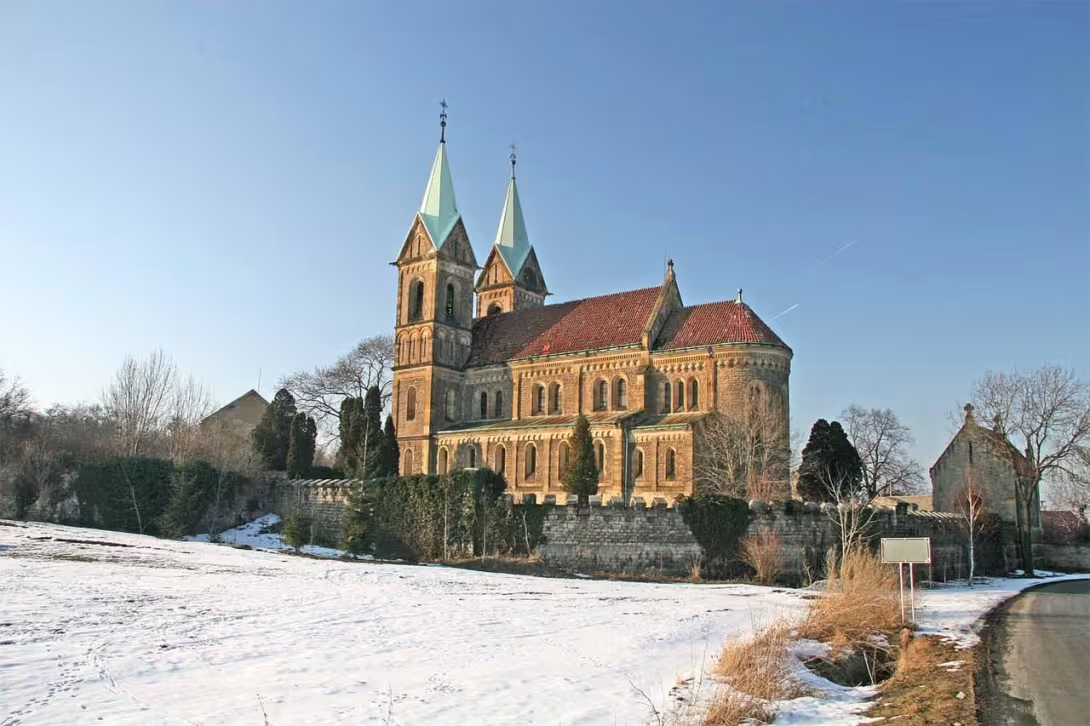

The historical appearance on the left is an AI-generated visualisation and serves as inspiration only.
Historical milestones
- 1305
- First mention of a church on the site.
- 1367-1398
- Reconstruction of an older church by miners from Kutná Hora.
- 1814
- Only the tower and spiral staircase remained due to decline.
- 1817
- A new church was built, which was later demolished.
- 1905-1908
- Construction of the current Neo-Romantic-Secessionist church.
- 1987
- Registered as a cultural monument.
- 2007
- Became a filial church of the archdeaconry in Kutná Hora.
Architectural development
The current church was constructed between 1905 and 1908, replacing an earlier structure that had been demolished. The design is neoromantic with secessionist elements, featuring a three-nave basilica with twin western towers. Notable for its interior decorations by František Urban and his wife, the church's furnishings are entirely in the secessionist-neoromanesque style.
Historical events
- 1987
- The church was listed as a cultural monument.
- 2007
- It became a filial church of the archdeaconry in Kutná Hora after local parish dissolution.
Points of interest
- Despite local myths suggesting external patronage, the Church of the Assumption was funded entirely by its own resources, with no financial support from notable figures like Jan Kubelík.
- Antonín Zápotocký, who later became a communist president of Czechoslovakia, worked as an apprentice stonemason at Grunta during his youth, adding a layer of historical intrigue to the site.
- The church's neoromantic-secessionist style reflects broader European architectural trends towards modernism in the early 20th century, making it a unique example of this stylistic transition within the region.
- Before its current form, the site housed an earlier church reconstructed between 1367 and 1398 by miners from nearby Kutná Hora, linking its history to the area's mining heritage.
- In 2024, the Church of the Assumption underwent significant restoration efforts, ensuring its preservation for future generations while maintaining its architectural integrity.
Guide
This guide is narrated by a synthetic voice generated by artificial intelligence.
Show guide text
This text was created by artificial intelligence and has not been editorially reviewed. It may contain inaccuracies.
Welcome to the Church of the Assumption of the Virgin Mary in Grunta, a remarkable testament to architectural evolution and historical resilience. As you stand here, take a moment to absorb the grandeur before you—a robust three-nave basilica with twin western towers that rise majestically against the sky. This structure is not just a building; it's a narrative woven through time.
The story of this church begins in 1305 when the first mention of a sacred site was recorded here, hinting at its longstanding spiritual significance. Over the centuries, this place has seen transformations reflective of both devotion and necessity. Between 1367 and 1398, miners from Kutná Hora undertook significant reconstruction efforts on an older church that once stood here, showcasing early community involvement in maintaining this sacred space.
As time marched on, by 1814, only the tower and spiral staircase remained—a silent witness to the passage of years. This led to a new chapter in 1817 when another church was constructed, though it too would eventually be dismantled. The current neoromantic-secessionist masterpiece you see today emerged from 1905 to 1908, designed by Rudolf Vomáčka and brought to life under the supervision of Jan Sklenář. This structure replaced its predecessor due to deteriorating conditions, yet it stands as a testament to both architectural innovation and historical continuity.
As we delve into the architecture, notice how the twin towers command attention, their design reflecting the neoromantic-secessionist style that characterizes this church. The basilica's layout invites you to explore its depth and breadth, encouraging a journey through space that mirrors a spiritual quest.
The history of this place is intertwined with notable figures like Antonín Zápotocký, who worked as an apprentice stonemason here before rising to become the communist president of Czechoslovakia. His early days in Grunta are a poignant reminder of how places can shape destinies.
Amidst the myths and legends that often surround such historical sites, one intriguing fact stands out: despite local tales suggesting otherwise, this church was funded entirely by its own resources, with no financial support from renowned figures like Jan Kubelík. This independence in funding is a testament to the community's dedication and pride.
As we conclude our exploration, I invite you to linger a little longer, to let your imagination wander through the corridors of history that this church embodies. Whether it's pondering the lives touched by its walls or simply enjoying the serene atmosphere it exudes, there's much to discover here in Grunta.
Thank you for joining me on this journey through time and architecture. May your visit inspire a deeper appreciation for the stories etched into the very stones of this magnificent church.
Tips for visitors
The best time to visit the Church of the Assumption of the Virgin Mary in Grunta is during late spring or early autumn, when the weather is pleasant for outdoor exploration. This period offers mild temperatures and beautiful natural lighting that enhances the architectural details of the church. Additionally, visiting outside peak tourist seasons ensures a more tranquil experience, allowing visitors to appreciate the serene atmosphere of the surrounding cemetery and rolling hills.
For those preferring public transport, it's advisable to check current routes as they may vary; however, local buses typically serve the area.
When visiting the Church of the Assumption of the Virgin Mary, it is recommended to bring comfortable walking shoes, especially if you plan to explore the surrounding hills or walk around the cemetery. A camera or smartphone for photography is also advisable, as well as weather-appropriate clothing depending on the season. Sunscreen and a hat are useful during sunny days, while an umbrella or raincoat might be necessary in unpredictable spring or autumn weather.
For photography enthusiasts, the best spots to capture the church include its exterior façade, which showcases neoromantic-secessionist architectural elements beautifully illuminated by morning light. The surrounding hills provide a picturesque backdrop that enhances the church's silhouette during sunset hours. Inside, natural lighting through stained glass windows creates stunning visual effects worth capturing.
Nearby attractions within 30 minutes include other historical sites and natural landscapes characteristic of the Central Bohemian Region. Visitors can explore local rolling hills for hiking or simply enjoy a leisurely walk to appreciate the scenic views. Families with children might also find it enjoyable to visit nearby playgrounds or picnic areas, making it an ideal spot for a day out in nature.
Frequently asked questions
Can the monument be visited?
Religious buildings are usually open mainly during services; at other times a visit is normally arranged with the parish or the operator. We have not verified specific times.
Where is the monument?
Location: Grunta, Středočeský kraj. The map on this page shows the exact spot.
Why is the monument protected?
It is listed in the Central List of Cultural Monuments of the Czech Republic as a cultural monument (register no. 47047/2-3450).
Businesses nearby
Do you run a restaurant, accommodation, shop, museum, rental, wellness or other visitor service near this monument? Show yourself directly to the people heading to it — this is how they will see you in the app and on the web:
Nearby
The church is located at the southern edge of Grunta, surrounded by a cemetery enclosed with walls. Nearby natural features include rolling hills typical of the Central Bohemian Region.
Accommodation nearby
Trips and activities nearby
Guided tours, tickets and activities nearby from GetYourGuide
Affiliate link: if you buy from the partner, we may receive a commission. The price for you does not change.
Search tours and activities →Themed route
Tematická výletní trasa: Kostel Nanebevzetí Panny Marie (Grunta)
1. Kostel Nanebevzetí Panny Marie (Grunta) - Typ: Historický kostel - Proč stojí za návštěvu: Tento kostel je kulturním a historickým srdcem obce Grunta. Jeho architektura odráží bohatou minulost regionu, nabízejíc návštěvníkům pohled na duchovní život zdejších obyvatel po staletí.
2. Hřbitov u kostela - Typ: Hřbitov - Proč stojí za návštěvu: Ohraničený zeďkou hřbitov je klidným místem, kde se můžete ponořit do reflexe a uctít památku předchozích generací. Jeho umístění vedle kostela dodává cestě historickou hloubku.
3. Kolovraty na jih od kostela - Typ: Přírodní útvar - Proč stojí za návštěvu: Tyto kolovrate jsou příkladem typických krajinářských rysů Středočeského kraje. Jsou ideálním místem pro krátký procházku, která nabízí pohledy na rozlehlé lesní oblasti a údolní krajinu.
4. Lesní chodníky kolem Grunty - Typ: Chodníky - Proč stojí za návštěvu: Procházka po tyto chodníky nabízí možnost prozkoumat přírodní krásy okolní oblasti. Jsou to ideální cesty pro relaxaci a užívání si klidu, který zde vládne.
5. Obecní nádvoří v Gruntě - Typ: Nádvoří - Proč stojí za návštěvu: Toto místo slouží jako centrum komunitního života v obci. Je ideálním místem pro zastavení, aby se podívali na místní architekturu a možná i setkali s některými z místních obyvatel.
Tato trasa nabízí kombinaci kulturního poznání a přírodního užitku, což umožňuje návštěvníkům plně prozkoumat krásu a historii obce Grunta.
Seasonal recommendations
Spring: Visiting the Church of the Assumption of the Virgin Mary during spring offers a picturesque experience as nature awakens around Grunta. The blooming flowers and lush greenery create an enchanting backdrop for exploring this historic site, with dappled sunlight filtering through budding trees enhancing its serene atmosphere. This season is ideal for photography enthusiasts looking to capture vibrant colors against the church's architectural beauty. Visitors should dress in layers as temperatures can be mild but unpredictable, allowing for a comfortable exploration of both indoor and outdoor areas.
Summer: Summer at the Church of the Assumption of the Virgin Mary is marked by long daylight hours and warm weather, making it perfect for leisurely visits. The vibrant greenery surrounding Grunta provides a lush setting that complements the church's historic charm. However, this season also attracts larger crowds, particularly during peak tourist times in late July and August. To avoid the busiest periods, consider visiting early in the morning or later in the afternoon. Comfortable walking shoes and light clothing are recommended to navigate both the interior of the church and its scenic surroundings.
Autumn: Autumn brings a stunning transformation to Grunta with vibrant foliage creating a breathtaking panorama around the Church of the Assumption of the Virgin Mary. The golden hues and crisp air make it an ideal time for those who appreciate nature's beauty, offering a tranquil atmosphere less crowded than in summer months. As temperatures begin to drop, visitors should wear warmer clothing and consider bringing a light jacket or sweater. This season provides a unique opportunity to experience the church in a serene setting, with fewer tourists allowing for more intimate exploration.
Winter: The Church of the Assumption of the Virgin Mary takes on a magical quality during winter, as snow blankets Grunta, creating a picturesque scene that enhances its historic allure. The soft lighting from street lamps reflecting off the snow can create an enchanting atmosphere perfect for photography or quiet reflection. Visitors should dress warmly, including hats and gloves, to fully enjoy their visit during the winter months.
Visualizations and artistic views


The visualisations are generated by artificial intelligence and serve as inspiration.
Tips from visitors
No tips yet. Be the first!
Log in and add your tip.
Sources and literature
Photos: Zp at Czech Wikipedia / CC BY-SA 3.0 — Wikimedia Commons. The author and licence also appear when you hover over the image.
Faktickým podkladem tohoto textu byl článek na Wikipedii, jehož autory jsou přispěvatelé Wikipedie. Článek je dostupný pod licencí CC BY-SA 4.0.
Location on the map





Příběhy a pověsti
Legendy, pověsti a příběhy spjaté s touto památkou
Fotografie návštěvníků
Zatím žádné fotografie. Buďte první, kdo přidá fotografii z návštěvy!
Log in a přidejte svou fotografii nebo hodnoťte.
Za ověřenou návštěvu v aplikaci získáte víc bodů — poznáme podle GPS, že jste na místě.
Reviews and comments