



Kostel Nejsvětějšího Srdce Ježíšova ve Vejprtech Church
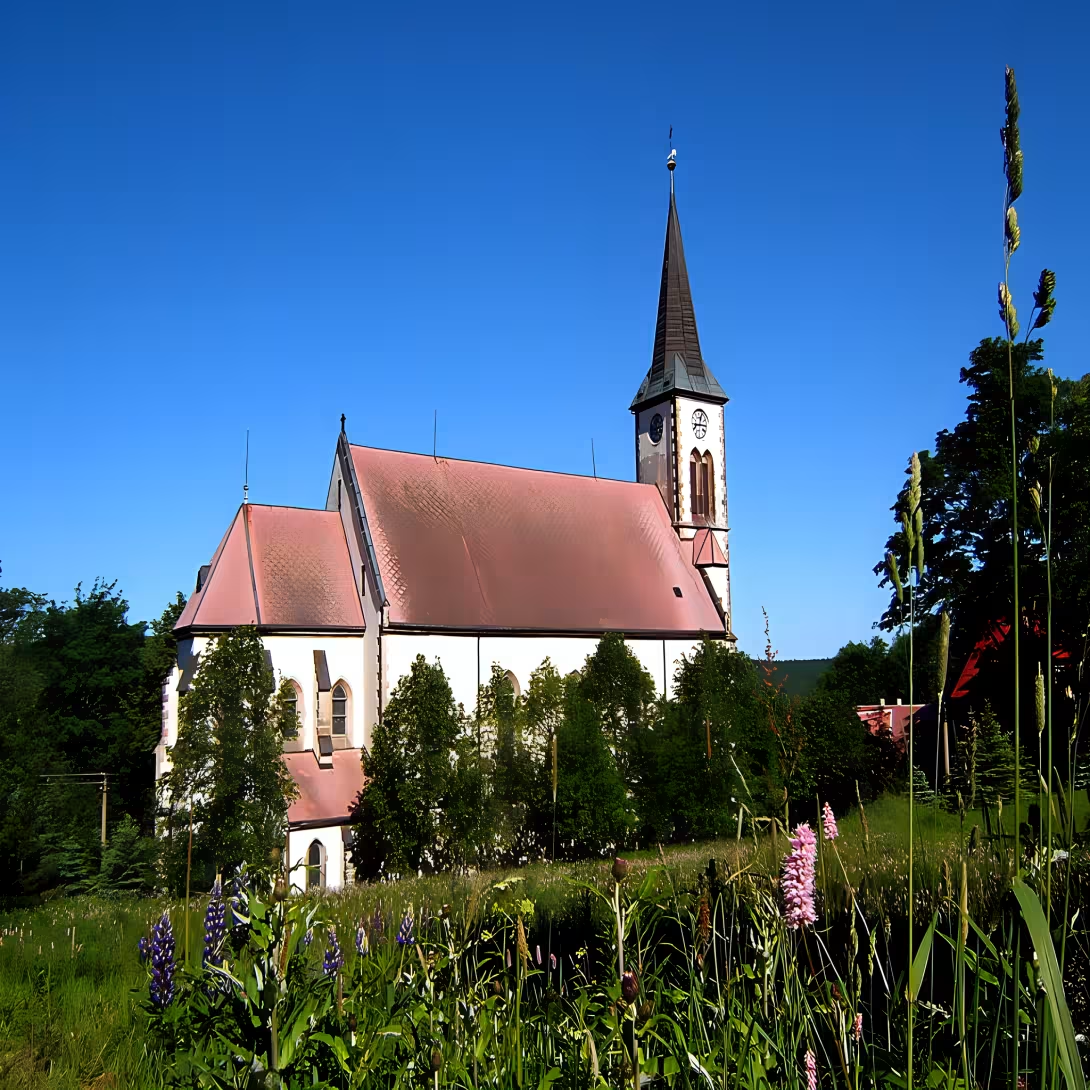
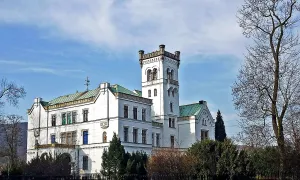
Kostel Nejsvětějšího Srdce Ježíšova ve Vejprtech is an exemplary piece of neo-Gothic architecture from the turn of the nineteenth and twentieth centuries. It stands in the southern part of the town in Nové Zákány and its proportions emit elegance typical of the quality of its times.
Long preparation preceded the construction project itself. In 1870, citizens of the New Call of the Clave founded a church building. Twenty-five years later, on July 28, 1895, the cornerstone was laid on a solemn occasion. The construction lasted about four years and was completed around 1899. The building material, with the permission of Count Buquoy, was broken on the top of the Keeper (originally called Hohenstein Berg) southeast of the settlement.
The building has a ship 25 meters long and 10 meters high. The tower rises in the axis of the north facade to a height of 47 metres and far visibly dominates the surrounding landscape. The interior has been enriched with selected elements from Central Europe. The main altar in the neo-gothic style was created by the Rifesser workshop from South Tyrol. The other elements were gradually increasing - in 1900 the Marian altar, in 1901 the pulpit, in 1910 the second side altar for the cross road. The bells were made in Vienna, an organ with 14 registers was supplied by Neusser from Nové Jicin.
The cross road with 14 stops is particularly remarkable. He had it carved in South Tyrol by Viennese priest Johann Grill at the request of the local native Cardinal Theodore Innitzer, Archbishop of Vienna. The plastic file was preserved even during the communist totalitarianism, only labels with the names of the sponsors were lost.
A major recovery came with the fall of communism. In 1990, German native citizens from Vejprtek took the initiative. The original windows from 1896 were damaged during the totalitarian period and were re-finished in 1999-1997 according to the original designs. New safety glass protects color glass from further damage. In the stained glass, names of both original and new sponsors appeared. During the reconstruction, the cross-road sculptures were also removed and repaired according to the photographic documentation. The total reconstruction was completed in 1997.
Then and now
Drag the slider to compare how the landmark may have looked when it was built with the view today.
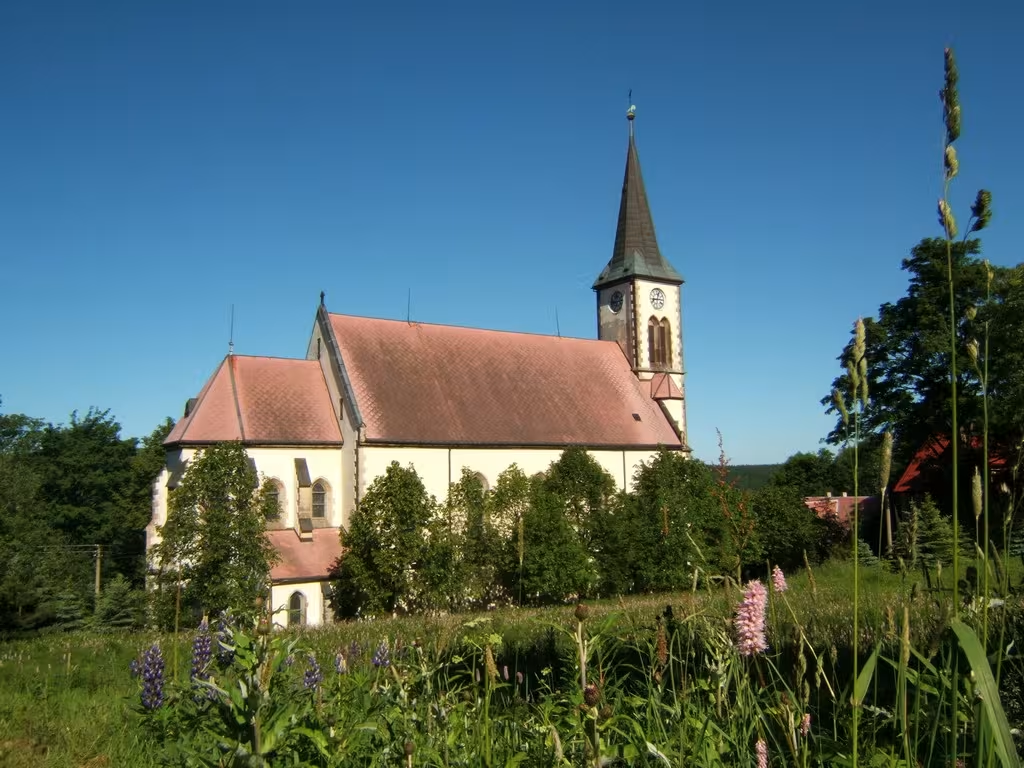
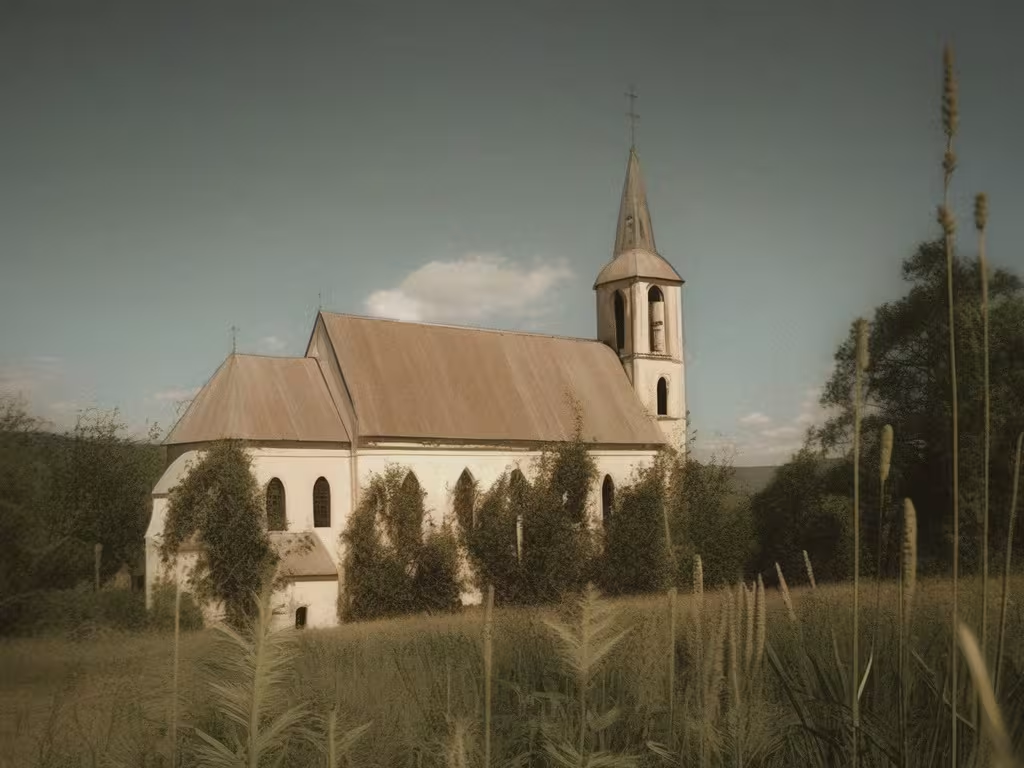
The historical appearance on the left is an AI-generated visualisation and serves as inspiration only.
Historical milestones
- 1870
- Establishing a church building association
- 1895
- Laying of the church base stone
- 1896
- Input of original windows
- 1991
- Start of the stained glass reconstruction
- 1997
- Completion of church reconstruction
Architectural development
The church was built in a neo-gothic style in 1895-1899. The stone for construction came from a quarry on top of the Keeper. The interior was gradually supplemented: in 1900 Marian altar, in 1901 pulpit and in 1910 second side altar. The screens from 1896 were damaged in the communist era and restored according to the original designs in 1999-1997. The church is built of stone and has a characteristic tower in the axis of the northern facade.
Historical events
- 1870
- Foundation of the Society for the construction of a church by citizens of the New Call
- 1895
- Laying of the church base stone
- 1997
- Completion of the extensive reconstruction of the church, financed by the German native collection
Points of interest
- The church was built in a neo-gothic style at the turn of the 19th and 20th centuries as a result of a long preparation which began in 1870.
- The construction lasted approximately four years and was completed around 1899, the base stone being laid on 28 July 1895.
- The church tower reaches 47 metres high and dominates the surrounding countryside due to its visibility from far away.
- The interior of the church contains a cross road with fourteen stops, carved by Viennese vicar Johann Grill at the request of Cardinal Theodore Innitzer.
- During the communist era, the stained glass was damaged and the cross-road sculptures survived, only the names of the sponsors were lost.
Guide
This guide is narrated by a synthetic voice generated by artificial intelligence.
Show guide text
This text was created by artificial intelligence and has not been editorially reviewed. It may contain inaccuracies.
The Church of the Sacred Heart of Jesus is a Roman Catholic church in Vejprtec in the Chomutov district. It was built at the end of the nineteenth century in the southern part of the city, an area called Nové Zvolání.
Its story began in 1870, when several citizens of Nové Zvolání founded an association for the construction of the church. Thanks to its efforts, the cornerstone was laid on July twenty-eighth, 1895, and four years later the building was complete. The stone was quarried, with the permission of Count Buquoy, on top of Strážce, formerly called Hohenstein Berg, southeast of the settlement.
The furnishings of the church were created in various workshops. The bells were made in Vienna. The main altar in Neo-Gothic style was made by the firm Rifesser in South Tyrol, and the organ with fourteen stops was supplied by the firm Neusser from Nový Jičín. The interior was then gradually enhanced. In 1900, a Marian altar was added, in 1901 a pulpit, and in 1910 a second side altar, called the Crucifix altar.
The stained-glass windows have had a special fate. The originals dated from 1896, but during the period of communist rule, they were damaged by thrown stones. Between 1991 and 1997, they were therefore recreated according to the original designs. On the windows, the names of the original donors as well as donors from the time of restoration appeared. They are now protected from further damage by security glass.
The fourteen stations of the Cross were commissioned, carved and created in South Tyrol by the Viennese priest Johann Grill. He did so at the request of a local native, Theodore Cardinal Innitzer, who was the archbishop of Vienna. The collection survived the period of totalitarianism in the twentieth century without damage, with only the plaques bearing the names of sponsors missing. During the restoration, the sculptures were removed and the plaques were completed with copies according to photographic documentation.
The repair of the entire church was made possible by a collection that was initiated in 1990 by German natives. The repair was completed in 1997.
The Neo-Gothic structure has a nave twenty-five meters long and ten meters high. Along the axis of the northern façade rises a tower forty-seven meters high.
Tips for visitors
The best time to visit the Church of the Holy Heart of Jesus in Vejprty is in the morning or after lunch when there is a pleasant light in the interior and fewer visitors. In the winter months the indoor temperature is pleasant, while in the summer months it is advisable to visit the church early in the morning or in the evening to avoid the heat outside. The church is a typical neo-gothic building that comes out in full beauty in the sunlight, especially when it illuminates stained glass and stone details. It is also convenient to visit the church during services that offer a unique experience of the atmosphere of the place.
The church is available by car for which several parking lots are available in the vicinity. It is recommended to park in a public parking lot in the middle of the village Vejprty, which is just a few minutes walk from the church. If you arrive by public transport, the stop is in the centre of the village, from where the church is easily accessible by foot. The current connection and transport schedules are always good to check in the traffic search engine before the journey.
When visiting the church, take on comfortable clothes and shoes, as you move on stone floors in the interior. It is also convenient to take a small umbrella or raincoat because the church does not always have an ideal microclimate. If you are planning to photograph, remember to take a camera or mobile phone with a high-quality lens. For the best results it is advisable to also have a battery or charger with you because the church is often photographed and the batteries are quickly exhausted.
Photography in the church is permitted, but care must be taken to respect other visitors and do not touch historical elements. The best places for photographs are stained glass, stone details and interior paintings, which are best lit in natural light. For the most beautiful pictures is the perfect time in the morning or in the evening, when light hits oblique and creates interesting shadows. In the interior it is advisable to photograph with natural light to preserve the authentic color and atmosphere.
In the vicinity of Vejprt, which is at most 30 minutes' drive away, it is worth visiting in particular the Highlands of the Keeper, where the stone was broken for the construction of the church. This historical local element is only five kilometres south-east of the village. Another interesting thing is the city of Chomutov, which is about 15 kilometres away and offers rich history and cultural monuments. Both of these places are easily accessible by car and offer additional possibilities for exploring and exploring the region.
For families with children a visit to the Church of the Holy Heart of Jesus is an interesting combination of historical knowledge and entertainment. Children can see the tall tower, which is fascinating for them, and also see small details in the interior such as statues or paintings. It is also possible to play on the playground in the vicinity of the church or to see the surrounding nature. It is also interesting for children to learn about the history of the place where the stone was broken for building the church, which may be an interesting story for their imagination.
Frequently asked questions
Is Kostel Nejsvětějšího Srdce Ježíšova ve Vejprtech open to the public?
Yes, the church is open to the public. The opening hours are 9:00 to 5:00.
How do I get to the place by car / public transport?
The church is located in the center of Vejprtek, so it is possible to get there by foot or by car. Parking is available outside the church.
How much is the entrance fee and is it paid on the spot?
Payment is made directly at the entrance.
Is the tour suitable for children and seniors?
Yes, a church tour is also suitable for families with children. There are several places where children can safely play and explore.
How long does the tour take?
The church tour takes approximately 30 minutes. If you want to look around, you can spend another hour or two.
What are the opening times and booking is required?
The church is open to the public from 9:00 to 17:00. Reservation is not necessary, but if you want to visit the church with a guide, you must make a reservation in advance.
What's interesting in the immediate vicinity?
In the immediate vicinity of the church there are several historical buildings and monuments. There is also a park nearby where you can relax and explore the local flora.
For kids
Imagine going back 131 years, until there was still a young church of the Holy Heart of Jesus in Vejprty. The town was a small rural town back then, where people who lived from the country lived and cultivated it.
The church looked like a little white violin between the surrounding fields. The inner spaces were simple and simple, but full of songs and prayers. People used to gather here to pray and stick together. The church was their home, where they gathered to be whole.
Businesses nearby
Do you run a restaurant, accommodation, shop, museum, rental, wellness or other visitor service near this monument? Show yourself directly to the people heading to it — this is how they will see you in the app and on the web:
Nearby
- The place where Count Buquoye's permission broke the stone for church construction is located southeast of Vejprt.
- A nearby town with a rich history that is about 15 km from Vejprt.
Accommodation nearby
Trips and activities nearby
Guided tours, tickets and activities nearby from GetYourGuide
Affiliate link: if you buy from the partner, we may receive a commission. The price for you does not change.
Search tours and activities →Themed route
Thematic cruise route: Vejprty and its historical roots
1.Kostel Nejsvětějšího Srdce Ježíšova ve Vejprtech * Type: Baroque sacral structure * The main monument of the village, built in the 18th century. He is famous for his rich interior with cuts and frescoes that reflect the baroque artistic tradition. It's interesting to see his history associated with Count Buquoy.
2. Top Guardian (Hohenstein Berg) * Type: Archaeological site * Approximately 5 km from Vejprt is the place where the stone was broken for the construction of the church. It's proof of old construction traditions and connections to local history. The beautiful view of the surrounding landscape gives the visit additional value.
3.Chomutov * Type: Historical city * About 15 km from Vejprt lies a city with a rich past, mainly due to silver mining and industrial development. Visiting is a historical centre with monuments such as the Church of St. Nicholas or the City Fortress. Local museums offer interesting information about the region.
Seasonal recommendations
Spring: In the spring season, Kostel Nejsvětějšího Srdce Ježíšova ve Vejprtech boasts a vibrant flowering surrounding nature that creates a beautiful and fresh atmosphere. Sunshine days increase the attractiveness of visitors who enjoy cold periods in the morning or evening. At this time, it is recommended to visit the church on the early Saturday afternoon to avoid initial doses of tourists. It is advisable to wear a light hat and a warm jacket for a cooler morning or evening.
Summer: For years, Kostel Nejsvětějšího Srdce Ježíšova ve Vejprtech is a popular destination where visitors are released in the presence of green meadows and forests. Sunshine days make families and tourists more attractive. This season it is recommended to visit the church quickly to escape the largest crowd that often comes at noon. It is advisable to wear short clothes and protective sunglasses.
Autumn: Autumn in Vejprtech offers unforgettable experiences where the woods are painted in golden and red shades, creating a beautiful atmosphere around the Holy Heart Church. Sunshine days are still present, but cooler evenings require more warm clothes. Visit the church on Sunday afternoon when there are fewer people than during working days. It is advisable to wear a warm jacket and a short coat.
Winter: Winter visit to the Church of the Holy Heart offers a unique experience where the church lights up and becomes the center of attention in a cool atmosphere. Freezing days can be overcome by warm clothing and moisture protection. This season it is recommended to visit the church in the morning when there are usually fewer people. It is advisable to wear warm clothes, including pairs of shoes and moisture protection.
Visualizations and artistic views


The visualisations are generated by artificial intelligence and serve as inspiration.
Photos from the area
Real photos taken near the monument


Zdroj a licence jsou uvedeny u každého snímku.
Tips from visitors
No tips yet. Be the first!
Log in and add your tip.
Sources and literature
Photos: Rafael Brix / CC BY-SA 3.0, rozlišení zvýšeno umělou inteligencí — Wikimedia Commons. The author and licence also appear when you hover over the image.
Faktickým podkladem tohoto textu byl článek na Wikipedii, jehož autory jsou přispěvatelé Wikipedie. Článek je dostupný pod licencí CC BY-SA 4.0.
Location on the map

Příběhy a pověsti
Legendy, pověsti a příběhy spjaté s touto památkou
Fotografie návštěvníků
Zatím žádné fotografie. Buďte první, kdo přidá fotografii z návštěvy!
Log in a přidejte svou fotografii nebo hodnoťte.
Za ověřenou návštěvu v aplikaci získáte víc bodů — poznáme podle GPS, že jste na místě.
Reviews and comments