






Kostel Panny Marie Pomocné (Bruntál) Church
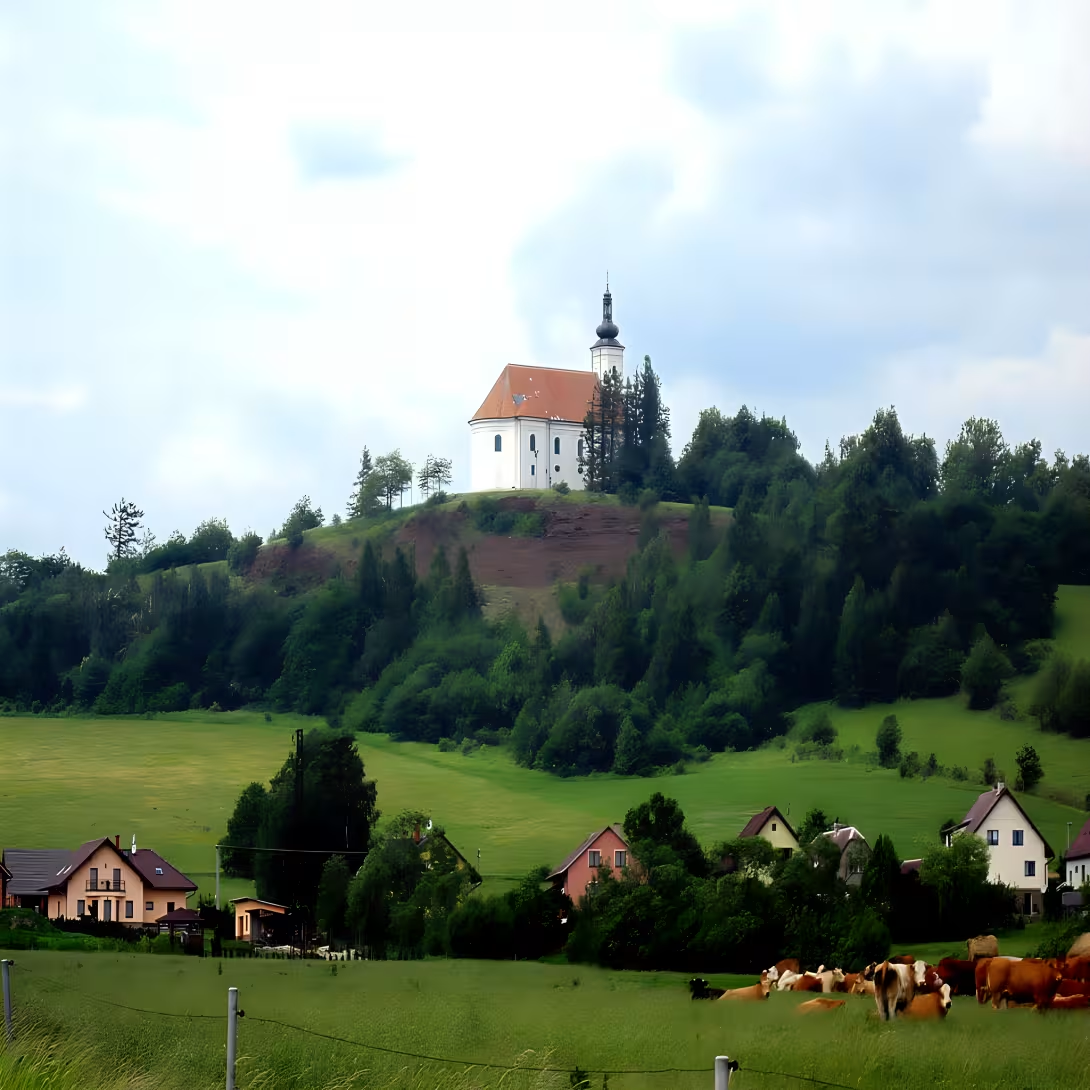
The Church of the Virgin Mary The Auxiliary stands on the Coal Hill, about two kilometres southwest of Bruntál. It is a baroque one-ship building with an elliptical presbytery and became one of the most important pilgrimage sites in North Moravia.
The beginning of this pilgrimage site dates back to the time of the Thirty Years' War. According to tradition, the governor of the North Moravian manor promised the Order of German Knights August Osvald z Lichtenštejna that if he could defend the chateau of Sovanec against the Swedes, he would build a chapel on the Coal Hill. Although the Swedes of the Soviet Union eventually conquered in 1642, Colonel Liechtenstein fulfilled its promise. From 1653 to 1655 a wooden chapel with a copy of the painting of the Virgin Mary was built on the hill by Lucas Cranach. Soon it became a popular destination for pilgrims, and in 1724 a hermit was built.
Since the beginning of the 18th century, a significantly larger building has been considered with a growing number of believers. The new church was founded between 1755 and 1758 on the initiative of the order governor Bedřich Filip of Wildenstein. The construction was financed primarily by the Order of German Knights. The project was commissioned by the Krnov builder Georg Friedrich Gans, who was the author of the church at the Krnov. The construction was completed in 1758 and the church was consecrated in 1762. Shortly afterwards, from 1766 to 1770, a four-row lime alley was planted leading from Bruntál. The pilgrims could also accommodate the buildings accompanying the church - vicarage built during the construction of the church and the inn established in 1770.
The tower of the church with onion dancing has become a distinct dominant landscape. However, lightning was repeatedly threatened, which led in 1863, under the government of the Grand Commissar of the Archduke Maximilian d'Este, to extensive reconstruction. That's when the church got the shale roof and lightning rod. The Lip Alley was later extended to the centre of Bruntál (1885 to 1889) and a cross road was created.
The 20th century was very cruel for the campus. In particular, since the Soviet military crew was based in Bruntál in 1968, there has been devastation. In the 1960s, vicarage and tavern buildings were demolished, the church interior was looted. Total reconstruction started in 1990. The interior was equipped with organ, new church benches (copies from the parish church of Bruntal) and marble sacrifice table. The state invested 4.5 million crowns through the district office. In October 1993, the church was reconsecrated by the Archbishop of Olomouc, John Graubner. The cross road was restored at the beginning of the 21st century and exterior lighting was opened in 2004.
Today, the church takes place only occasionally, especially at the time of the pilgrimage on the feast of the Virgin Mary in August and September and 9 October on the anniversary of the reconsecration. Visitors can admire it especially from the outside - the tower still belongs to the most remarkable landscape orientation points Bruntálska.
Then and now
Drag the slider to compare how the landmark may have looked when it was built with the view today.
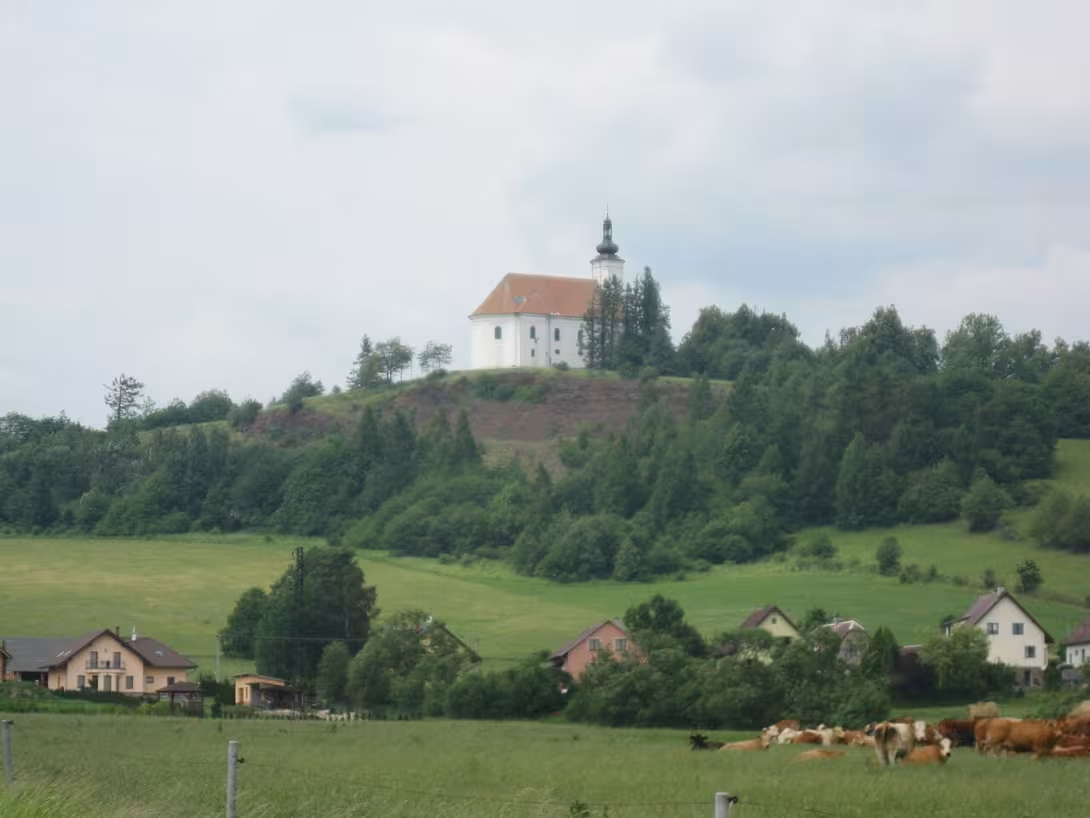

The historical appearance on the left is an AI-generated visualisation and serves as inspiration only.
Historical milestones
- 1653-1655
- The position of the original wooden chapel on the site of the present church as fulfilling the promise of Governor Augustus Osvald of Liechtenstein.
- 1755-1758
- Construction of the Baroque church according to the project by George Friedrich Gansa.
- 1766-1770
- The drop of a four-row lime alley from Bruntál to the church.
- 1958
- Writing the church into a list of cultural monuments.
- 1993
- Reconsecration of the church after reconstruction.
Architectural development
The church was built in 1755- 1758 on the site of an older wooden chapel from 1653- 1655. The single-boat construction with an elliptical presbytery and tower above the northern facade is a typical baroque work. There were modifications in the 19th century, such as covering the shale roof and installation of lightning rod. In the 20th century, the interior was looted, but in the 1990s, a large reconstruction took place, including the renewal of mobility and exterior lighting.
Historical events
- 1642
- Swedish conquest of the castle Sovinec during the 30-year war, which led to the establishment of the original wooden chapel on Coal Hill.
- 1758
- Completion of the Baroque church according to the project by George Friedrich Gansa.
- 1968-1989
- Devastation of the church and its premises, including the destruction of vicarage and inn.
- 1993
- Reconsecration of the church by the Archbishop of Olomouc, John Graubner, after reconstruction.
Points of interest
- The Church of the Virgin Mary the Aspilist was founded as a pilgrimage place on the Mountain of Coal already during the 30-year war, when a wooden chapel was built here after the promise of Governor Augustus Osvald of Liechtenstein.
- From 1755 to 1758 a baroque single-boat church was built with an elliptical presbytery, financed by the Order of German Knights.
- The church is dominated by the landscape thanks to its tower with onion beating, which was equipped with lightning rod after repeated lightning strikes in 1863.
- Lip alley manager from Bruntál was planted between 1766 and 1770 and later extended to the city centre (1885-1889).
- The church was reconstructed after the communist era in the 1990s, when it was equipped with new organas and marble sacrifice table.
Guide
This guide is narrated by a synthetic voice generated by artificial intelligence.
Show guide text
This text was created by artificial intelligence and has not been editorially reviewed. It may contain inaccuracies.
Welcome! You are standing in front of the Church of the Virgin Mary of the Auxiliary in Bruntál, one of the most important cultural monuments in North Moravia. Look up and you'll see an amazing structure with a high wreath and slender towers.
The church has an unknown origin, but its historical context is connected to the pilgrimage sites of northern Moravia. Now pay attention to the architecture of the church - observe its simple, gothic similarity and lean towers that seem literally to heaven.
The church was an important pilgrimage place in northern Moravia. Note that its inner spaces are full of works of art and ornaments. Many religious ceremonies and holidays were held in these areas.
Let's move on to interesting stories and personalities associated with the place. The Church of the Virgin Mary the Auxiliary was dedicated to this holy which was closely linked to the Christian tradition. Note that the church has many details that tell about his past.
Now let's stop for a moment and watch this beautiful building carefully. What interests you most? Is it architecture or art or something else?
Invitation to further explore and say goodbye - come back and look at the Church of the Virgin Mary Help for the second time. Come back if you want, and we'll be happy to welcome you back.
Tips for visitors
{'paragraph': 'The best time to visit the Church of Our Lady of Aids is in the summer months, especially in June and July, when the weather is pleasant and there are often cultural events or mass in nature. In these months there is also the most beautiful surrounding nature, as the Carbon Hill is full of greenery. In winter, the church offers a quiet atmosphere and the possibility to observe the surrounding landscape covered with snow, which is ideal for families with children who love winter trips.'}
{'paragraph': 'The church is easily accessible by car because it is located directly on the Carbon Hill, just minutes from the center of Bruntál. Parking is possible in the nearby parking lot near the church, which is usually large enough for a larger number of visitors. If you arrive by public transport, the stop is nearby, but the current connection is good to check in the traffic search engine before travelling. It is recommended to walk on foot because the path to the top is short and offers a nice view of the city.'}
{'paragraph': 'When visiting, take comfortable shoes because the path to the top is partly uneven and stone. It is also convenient to take a light raincoat or umbrella with you because the weather can change quickly. It is good for children to prepare some small activity such as rings or small toys to play around the church. Remember also enough water, especially in the summer months.'}
{'paragraph': 'The church offers several places that are ideal for photography. The best time for pictures is morning or evening when the sun creates soft shadows and illuminates the facade of the church. Especially beautiful are the photos from around the church, where a beautiful view of Bruntál and surrounding landscape is opened. The interior of the church is also interesting, especially its baroque decoration and elliptic presbytery. It is recommended to take pictures with respect to other visitors.'}
{'paragraph': 'A few interesting places are worth visiting in the vicinity of the church, which are at most 30 minutes away. For example, the Bruntál Four-row Lip Alley, which is historically protected and offers a peaceful walk between old trees. Another interesting thing is the castle Sovanec, whose ruin is located about five kilometres from the church and offers a fascinating view of history. For natural enthusiasts, the Carbon Hill itself is a height dominant which attracts walking trips and observations of the surrounding countryside.'}
{'paragraph': 'For families with children a visit to the Church of the Virgin Mary Help is a great opportunity to live together. Children can view the church as a small chateau building and talk about its history. There is enough space around the church for small trips and exploring nature. You can also play games to observe birds or collect stones. During the summer months, there are often events for children such as painting or workshops that are ideal for developing their creativity.'}
Frequently asked questions
Is Kostel Panny Marie Pomocné (Bruntál) open to the public?
Yes, the church is open to the public. The opening hours are 9: 00 to 5: 00.
How do I get to the place by car / public transport?
From Bruntál there is a four-row Lip Alley, which has as an important landscape protection element. Parking is possible near the church.
How much is the entrance fee and is it paid on the spot?
Payment is made directly inside the church.
Is the tour suitable for children and seniors?
Yes, a church tour is also suitable for families with children and seniors. The church has accessible staircases and flat areas that allow easy walking.
How long does the tour take?
The church tour takes approximately 30 minutes. But you can also listen to religious service or have fun in a nearby park.
What are the opening times and booking is required?
The church opening hours are from 9: 00 to 5: 00. Reservation is not necessary, but it is recommended for groups over 10 people.
What's interesting in the immediate vicinity?
In the immediate vicinity of the church there is a four-row lime alley, which has as an important landscape protection element. There are also other historical objects and cultural institutions in the area.
For kids
Imagine going back 276 years to a small village of Bruntál in North Moravia. Here stood the church of the Virgin Mary of the Helpers, which was like a royal chateau between trees and meadows. Who lived here? They were people who lived in harmony with nature, who took care of their kisses and pastures. They were people who loved the Virgin Mary and went looking for her with help.
Businesses nearby
Do you run a restaurant, accommodation, shop, museum, rental, wellness or other visitor service near this monument? Show yourself directly to the people heading to it — this is how they will see you in the app and on the web:
Nearby
From Bruntál there is a four-row Lip Alley, which has as an important landscape protection element.
Accommodation nearby
Themed route
Thematic cruise route from Bruntál
1.Kostel Panny Marie Pomocné (Bruntál) * Type: * religious monument This Baroque church is one of the most important sacral buildings in Bruntále. Its rich history and architecture make it an ideal beginning to explore local culture and history.
2. Four-row Lip Alley from Bruntál * Type: * monument protected natural element This relief alley, located near the city centre, is an ideal place to relax and walk. It's a beautiful place to relax after visiting the church.
3. Castle Sovinec (ruin) * Type: * historical castle Known for its dramatic position at the top of the hill, Castle Sovanec offers impressive views and fascinating history. It is an ideal place for those interested in medieval architecture and history.
4. Carbon Hill * Type: * height dominant This peak is part of the local region and offers views of the surrounding area. It is a great way to close your tour in Bruntále and enjoy the natural beauty of the region.
This route offers a combination of cultural and natural attractions that are ideal for a full day visit to Bruntále.
Seasonal recommendations
Spring During the spring, when Bruntál awakens from the winter sleep, the Church of the Virgin Mary Helpers becomes charming due to the changing light that penetrates through the stained glass and creates a game of colored glare on the stone walls. The surrounding area of the church is still quiet before the visitors fill up in the summer, and nature around it - with flourishing trees and green gardens - gives the place a fresh, almost intimate touch. It is also specific that in March and April the church is lit by the sun longer than in other times, which creates a pleasant atmosphere for walking around the historical centre. It is recommended to visit it in the morning when the air is clean and the church has not yet begun to attract more tourists. Clothes should be layered - spring weather often changes, and even when the sun welcomes, evenings can be cold. The ideal time is between 10: 00 and 12: 00, when the church is sufficiently lit, but the crowd is minimal.
Summer In the summer months, when the sun stands high and heat radiates from the stone walls of the church, the Virgin Mary becomes helpful in the monumental and dramatic effect. The church acts as a natural amphitheater during this period, whose interior is lit directly by sunlight, which penetrates through windows and creates living shadows on the altar and frescoes. The surrounding area is full of life - green trees, flowering shrubs and often outdoor concerts or cultural events in the surrounding area provide a cheerful atmosphere. It is recommended to arrive early in the morning, no later than 9 o'clock, to avoid crowds that accumulate in the main summer season especially in the afternoon. Clothes should be light, but in view of possible weather changes - in July and August there may also be short downpour. The best time to visit is in the morning when the church is calm and the light is ideal for shooting details.
Autumn Autumn brings a unique atmosphere to Bruntál and the Church of the Virgin Mary when golden and red shades of leaves are reflected in the windows of the church and create unusual, warm colors in the interior. Cooler air and short days give the place a nostalgic, almost fairy-tale feel, especially in October when nature prepares for winter. The church during this period acts as a cozy shelter from wind weather, and its interior, illuminated by artificial light, becomes mysterious. It is recommended to visit it in the afternoon, when the sun is still enough to illuminate the facade and create interesting reflections on the windows. Clothes should be warm, but not too massive - autumn days are variable, and even when the sun shines, evenings can be cold. The best time is between 14 and 16 hours when the church is well lit and there is peace outside.
Winter In winter, when the snow cover covers the roofs of the church and the surrounding area, the Virgin Mary gets help on a fairy tale spell. The white coat of winter emphasizes the historical details of the facade and creates contrast with dark stone walls, while the interior, illuminated by Christmas candlesticks or artificial light, acts as a cozy refuge from frost. In advent time, the church becomes part of the Christmas atmosphere, and although there are no traditional markets, its interior is often decorated with candlesticks and Christmas decorations. It is recommended to visit it in the morning, when the church is most calm and the light is still enough to illuminate the stained glass. Clothes should be warm, laminated and with respect to possible snow - shoes with good grip are necessary. The best time is between 11: 00 and 13: 00, when the church is sufficiently lit and there is still no evening darkness outside.
Visualizations and artistic views


The visualisations are generated by artificial intelligence and serve as inspiration.
Atmosphere of the place
This atmospheric visualisation of the place and period was generated by artificial intelligence. It is not real footage of the location.
Tips from visitors
No tips yet. Be the first!
Log in and add your tip.
Sources and literature
Fotografie: Lehotsky / CC BY-SA 3.0, rozlišení zvýšeno umělou inteligencí — Wikimedia Commons. The author and licence also appear when you hover over the image.
Faktickým podkladem tohoto textu byl článek na Wikipedii, jehož autory jsou přispěvatelé Wikipedie. Článek je dostupný pod licencí CC BY-SA 4.0.
Location on the map
Příběhy a pověsti
Legendy, pověsti a příběhy spjaté s touto památkou
Fotografie návštěvníků
Zatím žádné fotografie. Buďte první, kdo přidá fotografii z návštěvy!
Přihlaste se a přidejte svou fotografii nebo hodnoťte.
Za ověřenou návštěvu v aplikaci získáte víc bodů — poznáme podle GPS, že jste na místě.
Reviews and comments