



Kostel Stětí svatého Jana Křtitele (Libčeves) Church
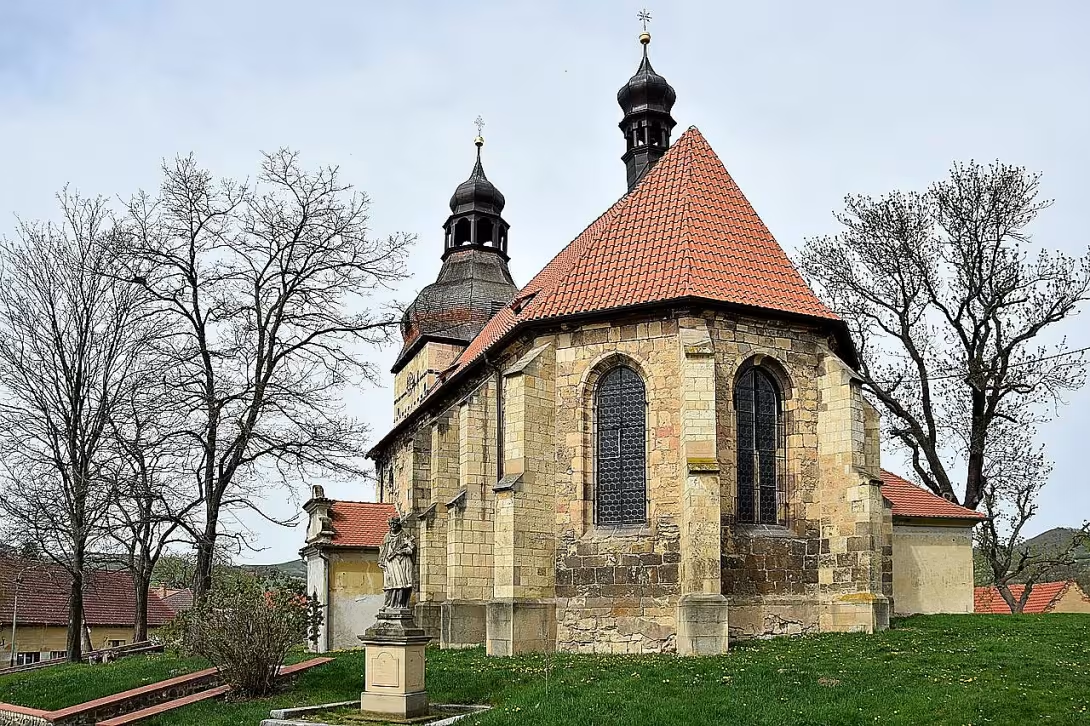
Church The wall of St. John the Baptist is a Roman Catholic parish church in Libčevsi in the district of Louny, which forms the architectural dominance of the village. It stands in the middle on a low surface and is one of the most important documents of secondary and late Romanesque architecture in Bohemia.
Although Libčeves is mentioned for the first time in writing already in 1295 and the church itself only fifty years later in 1352, the construction itself is significantly older. Dendrochronological analyses of the stakes of the staircase made of oak and pine wood dated back to the late 1930s. These findings coincide with the interpretations of the artist's historians who based their conclusions on the analysis of the composite elements of the construction. This Romanesque time includes a massive prism tower from an opuce with a vaulted vault on the ground floor and the first floor, as well as a tower connecting the western part of the ship with semi-circular windows. The original is also a southern portal with a characteristic crutch cross on the facade of the tower. The Gothic presbytery was added to the building later, the exact time of its creation is not always the same in literature - older sources place it before Hussite wars, while newer researchers such as Jaroslav Skopec suggest that it could have occurred only around the mid-15th century. At the turn of the 16th and 17th centuries, the south hall was added to the church, later in 1787 the present Baroque crust and in 1853 the sacristy.
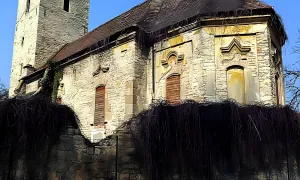
The building is a one-boat church with a gothic polygonal presbytery with graduated armrest. The façade of the ship ends with a characteristic arc wave. Two portals lead to the ship - Romanesque from the south and Gothic from the north. The presbytery vault with a broken victory arch separates from the ship, while the sacristy on the north side with the clove arch join it.
The church interior is richly equipped. The wall paintings from 1787 were created by the kadani painter Josef Sachs - they depict scenes from the life of St. John the Baptist, the baptism of Christ and the church father. It was golden around 1700 with the painting of the House of St. John the Baptist, supplemented by a smaller altar of St. Anne. From the second half of the 18th century also comes the stone baptist with rocaic ornament and pulpit with sculpture decoration. The author of the two-hander organ, which was built in 1773, was the Litomeric organist Johann Rusch. The church thus passes through the centuries of its stone memory - tombstones such as Václav Vřesovický from 1585 and Wolf Senfeld from 1575 commemorate his long history. / p >
Then and now
Drag the slider to compare how the landmark may have looked when it was built with the view today.
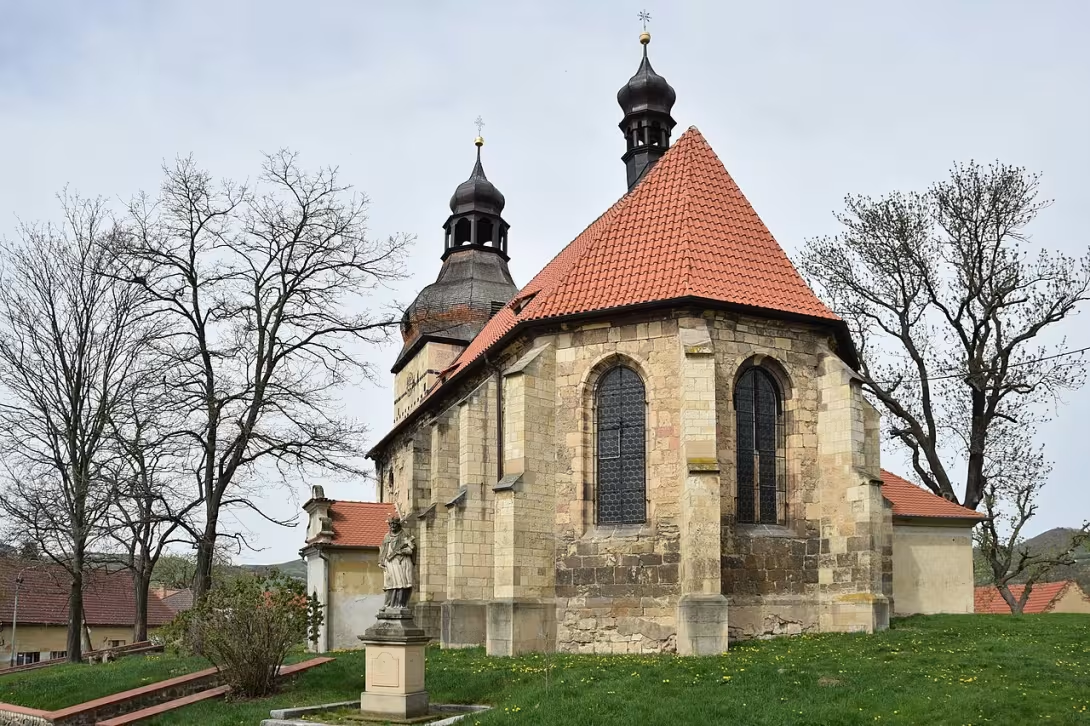

The historical appearance on the left is an AI-generated visualisation and serves as inspiration only.
Historical milestones
- End of the 1930's of the 13th century
- The origin of the original Romanesque part of the church (tower, boat, Romanesque portal) according to dendrochronological dating.
- Before Hussite Wars / Turn of the 1950s
- Gothic reconstruction of presbytery (according to historical sources, opinions differ).
- 1787
- Painting frescoes in the church interior.
- 1853
- Character status.
Architectural development
The church was built as a Romanesque building with a tower and part of the ship in the late 1930s. Around the turn of the 15th and 16th centuries, the presbytery was rebuilt in a Gothic style. In the 17th century the south hall was added and in the 18th century there were baroque modifications such as a crust and frescoes. In 1853 a sacristy was built. The materials include a sprain for the tower and basalt stones for the led cross on the facade.
Historical events
- 1295
- The first written mention of the village Libčeves, however the church already existed earlier.
- 1352
- The first written mention of the Church of St John the Baptist.
- 1585
- The design of the tombstone Václav Vřesovický, which is still part of the church.
- 1787
- Painting of the interior of the church with frescoes of Josef Sachs.
Points of interest
- The church is one of the most important proofs of middle and late Romanesque architecture in Bohemia.
- Dendrochronological analyses of wooden stakes of stairs from 1340-1349 confirm that the original building dates back to the late 1930s.
- The mighty prism tower from the plough with a full vault and half-circle windows is from the Romanesque era, as well as the western part of the ship and the southern portal with a crutches cross.
- A gothic presbytery with a polygonal conclusion was added either before the Hussite wars or around the mid-15th century, according to sources.
- The interior is decorated with wall paintings from 1787 by painter Josef Sachs, depicting scenes from the life of St. John the Baptist.
Guide
This guide is narrated by a synthetic voice generated by artificial intelligence.
Show guide text
This text was created by artificial intelligence and has not been editorially reviewed. It may contain inaccuracies.
The Church of the Beheading of Saint John the Baptist is a Roman Catholic parish church in Libčeves in the Louny region. It stands in the middle of the village on a low hill and is its landmark. Originally a Romanesque building, it ranks among the oldest preserved churches of its kind in Bohemia.
Libčeves first appears in written records in the year 1295, the church only in 1352. However, the building is much older. A dendrochronological analysis of oak and pine beams of the staircase dated it to the end of the 1230s. Art historians had already assumed the same time of origin earlier based on stylistic elements. From the Romanesque period comes a massive prismatic tower made of opoka stone in the western façade with barrel vaults on the ground floor and first floor. On the façade of the tower is an embedded crutch cross made of basalt stones. The Romanesque part also includes the western section of the nave with semicircular windows and the southern portal, now hidden behind a later added vestibule.
The original Romanesque choir was later replaced by a new Gothic one. When exactly it was created is uncertain. Earlier literature mostly places it before the Hussite wars. Jaroslav Skopec in his latest comprehensive work on the Louny region dates it to the turn of the 1450s and 1460s. The choir has a polygonal apse with stepped buttresses and a ribbed vault on corbels. It is separated from the nave by a pointed triumphal arch. At the turn of the sixteenth and seventeenth centuries, a southern vestibule with a comb vault was added, in 1787 a Baroque gallery on two pillars, and in 1853 a sacristy on the northern side.
The altar from around 1700 bears a painting of the Beheading of Saint John the Baptist. It is complemented by a smaller altar of Saint Anne. A stone baptismal font with rocaille ornament and a pulpit with a statue of the Good Shepherd date from the second quarter of the eighteenth century. A two-manual organ was built in 1773 by the Litoměřice organ builder Johann Rusch.
The interior is decorated with wall paintings by the Kadaň painter Josef Sachs from 1787. On the ceiling of the nave is the Beheading of Saint John the Baptist and his Sermon on the Desert. In the undercroft of the gallery is Christ Expelling the Money Changers from the Temple, and on the gallery balustrade are four Church Fathers. The vault of the choir is decorated with the Baptism of Christ, four Evangelists, and God the Father with angels.
The church also contains epitaphs of Wolf Senfeld from 1575, Václav Vřesovický from 1585, and the priest Bohuš from 1612. Other, mostly damaged epitaphs are set into the outer wall.
Tips for visitors
The best time to visit the Church of St John the Baptist is in the morning or early afternoon. In these times there are fewer visitors and you can see Romanesque architecture and detailed frescoes in peace. If you want to experience the magical atmosphere, visit the church at sunset, when light penetrates through window holes and illuminates the interior quite differently.
It is recommended to use public transport when arriving from larger cities such as Louny or Ústí nad Labem. The current connection and departure times can be found in the transport search engine. The village has well maintained roads, so car travel is smooth.
When visiting, wear comfortable shoes because the church and its surroundings are partially uneven and stone pavements can be slippery. The interior is cold, so bring a light sweater or sweater. Prepare a high-quality camera or smartphone with enough zoom to capture detailed frescoes and architecture.
Use natural light from window holes for quality images, especially in the morning or afternoon sun. The tower is an ideal place for panoramic images around Libčevsi.
In the vicinity of the church is worth a visit to the Church of St. Jacob the Greater in Louny, located about 15 kilometres from Libčevsi. Another interesting thing is Castle Libčeves, located in the village itself, but outside the church area. Both of these places offer other historical and cultural experiences.
For families with children, a visit to the Church of St John the Baptist is a great opportunity to learn history. Children can see the ancient frescos and hear the stories associated with the church. It is possible to play on local playgrounds or to see the surrounding nature. It is also recommended to visit the Church of St. Jacob the Greater in Louny, where interactive exhibitions are prepared for children.
Frequently asked questions
Can the monument be visited?
Religious buildings are usually open mainly during services; at other times a visit is normally arranged with the parish or the operator. We have not verified specific times.
Where is the monument?
Location: Libčeves, Ústecký kraj. The map on this page shows the exact spot.
Why is the monument protected?
It is listed in the Central List of Cultural Monuments of the Czech Republic as a cultural monument (register no. 43287/5-1222).
For kids
Imagine an ancient town where something always happens! You are standing on the top of a small hill in the middle of Libčeves and there in front of your eyes is the church of the Wall of St. John the Baptist. It's a strange place, like being thrown into the past in time, right in the early twelfth century. It was when people wore long dresses and built their houses out of bones and wood, but this church became one of the first temples in Bohemia!
Businesses nearby
Do you run a restaurant, accommodation, shop, museum, rental, wellness or other visitor service near this monument? Show yourself directly to the people heading to it — this is how they will see you in the app and on the web:
Accommodation nearby
Trips and activities nearby
Guided tours, tickets and activities nearby from GetYourGuide
Affiliate link: if you buy from the partner, we may receive a commission. The price for you does not change.
Search tours and activities →Themed route
Thematic cruise route: Gothic and Baroque beauty around Libčevsi
1.Kostel Stětí svatého Jana Křtitele (Libčeves) * Type: * Sacral monument, Gothic church with baroque adjustments. * Why visit? * Unique example of late Gothic architecture with preserved fresco and valuable mobility. Its quiet location in the middle of the village offers not only a spiritual atmosphere but also an opportunity to explore historical details such as stone sculptures or organ.
2. Castle Libčeves * Type: * Renaissance chateau with Baroque elements, today private. Why visit? Although it is inaccessible to the public, its impressive facade and surrounding park with memorable trees represent an important part of local history. The chateau was the seat of important noble families and its architecture shows the changes of the region from the Middle Ages to the Baroque period.
3. Church of St. Jacob the Greater (Louny) * Type: * Gothic parish church with remarkable tower and interior. * Why visit? * As a dominant sacral structure Louns combines Gothic roots with baroque modifications. Its height dominance over the city and richly decorated interior with altars and statues is worth stopping on the way back. It is convenient to combine a visit with a walk in the historic centre of Louns.
* Tip: * The route combines spiritual and cultural monuments with the possibility of short walks along the surrounding fields and forests near Libčevsi, where natural diversity can be observed between agricultural areas and forests. The distance between Libčevsi and Louny is approximately 15 kilometers, ideal for cycling or car expedition.
Seasonal recommendations
Spring Spring in Libčevsi brings church The wall of St. John the Baptist is a fine, bright light, which penetrates glass windows and illuminates the interior with a golden glare. The surroundings awaken to life - meadows flourish, forests green and the air smells of rain and young leaves. The atmosphere is calm, almost meditative, as if time has slowed down here. In this period the church is surrounded by flowering trees and fields that create a pleasant contrast with stone architecture. I recommend visiting the church early in the morning when the surrounding area is still quiet and the sun lights up the facade from one side, which creates impressive shadows. Light clothes are suitable, but prepare an umbrella too - spring weather is unpredictable. Avoid weekends when families often come here with children.
Summer In summer months church The wall of St. John the Baptist gains on magic thanks to long, golden afternoon sun rays that reflect on white plaster facades and create playful shadows on the pavement. The surrounding area is green, full of heat and the smell of grass, and the air is so light, it feels like it's breathing. The atmosphere is lively but at the same time calm - ideal for walking along the surrounding roads or sitting on a bench by the church. In the main summer season, groups of tourists often come here, so you better come before noon when there are most crowds. Light, airy clothes and sun protection - hat or sunglasses are suitable. Remember enough water because temperatures often exceed 20 degrees.
Autumn Autumn Libčeves is like a small picture of a fairy tale - the church is projected into the mirror of coloured leaves, which are lit up in the autumn sun. The light is softer, scattered, and the shadows are longer, which gives the place a mysterious atmosphere. The surrounding area is transformed into a sea of yellow, orange and red shades that contradict the stone stability of the church. The air is colder but still clean, and the smell of fallen leaves and needles brings a sense of peace. In this period the church is less visited so you can enjoy a visit in peace. Suitable is warmer clothes - sweater or sweater with long sleeves - and comfortable shoes for walking on wooded roads. The ideal time is morning or afternoon, when the sun lights the church from one side and creates charming shadows.
Winter Winter Libčeves is like from another world - church The wall of St. John the Baptist is projected into white snow, which surrounds its stone walls and creates a magical atmosphere. The light is thinner, reflected from snow and creates fine, silver reflections on the plaster. The surrounding area is quiet, as if time has stopped here, and the air smells of fresh snow and wood fire. Winter visit is ideal for those looking for peace and quiet. Hot clothes - jacket, scarf and gloves - and comfortable shoes, because the roads can be covered with snow. The church is shortened in winter, so you should check the current hours. The best time to visit is in the afternoon when the sun lights the church from one side and creates charming shadows on snow.
Visualizations and artistic views


The visualisations are generated by artificial intelligence and serve as inspiration.
Photos from the area
Real photos taken near the monument


Zdroj a licence jsou uvedeny u každého snímku.
Atmosphere of the place
This atmospheric visualisation of the place and period was generated by artificial intelligence. It is not real footage of the location.
Tips from visitors
No tips yet. Be the first!
Log in and add your tip.
Sources and literature
Photos: Petr Kinšt / CC BY-SA 4.0 — Wikimedia Commons. The author and licence also appear when you hover over the image.
Faktickým podkladem tohoto textu byl článek na Wikipedii, jehož autory jsou přispěvatelé Wikipedie. Článek je dostupný pod licencí CC BY-SA 4.0.
Location on the map


Příběhy a pověsti
Legendy, pověsti a příběhy spjaté s touto památkou
Fotografie návštěvníků
Zatím žádné fotografie. Buďte první, kdo přidá fotografii z návštěvy!
Log in a přidejte svou fotografii nebo hodnoťte.
Za ověřenou návštěvu v aplikaci získáte víc bodů — poznáme podle GPS, že jste na místě.
Reviews and comments