






Kostel svaté Anny (Město) Church
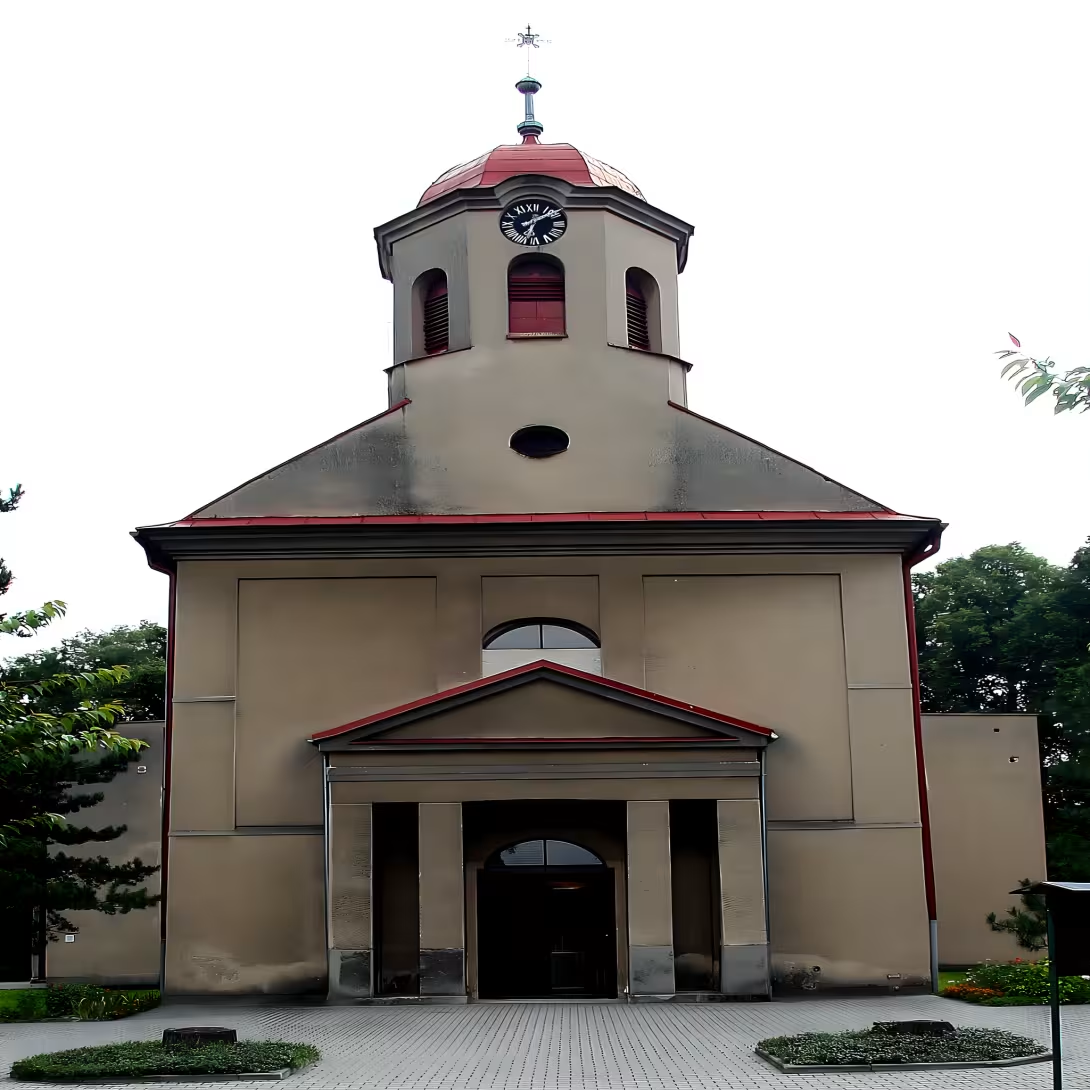
St. Anne's Church stands in Havířov as the main parish church and represents one of the central sacral buildings of this industrial region. Built in late Empire style, it became an essential part of urban space and landscape.
The church's construction is directly related to the fate of the land and the older pilgrims. Before today's building appeared, there were two wooden temples in this place - the church of St. Catherine and the church of St. Peter and Paul, whose first existence is commemorated in 1527. But these medieval buildings met tragedy: in 1823 they burned to the ground. A long way to replace them was through the village of Šumbark, which was aware of building a new church as an urgent need. The construction was carried out between 1841 and 1845 when a new temple was born, maintaining the tradition and spirit of previous buildings. Since 1964, the church has been legally protected as a cultural monument.
The emergence of Havířov brought with it new challenges. As the city developed and the number of believers grew, the capacity of the existing churches, especially St. Margaret's Parish Church in Bludovic and St. Anne's Filial Church, was insufficient. In 1968 and 1969, the possibility of building a new church was seriously considered. However, for financial reasons, this plan did not enter into force. Instead, a more pragmatic path was chosen - the extension of the existing church. The extension was made between 1970 and 1971, thus strengthening capacity without unnecessary costs.
The interior is dominated by a set of elements that indicate the quality of its processing. The main ship associated with the circle and confessional is adjacent to two side chapels and a priesthood. Three paintings, crosses and original windows have been preserved from the original facility. The key element became a stone mosaic with a large wooden cross and a brass inscription "I AM A ROUTE, TRUTH AND LIFE," made of marble. The altar, in fact, consists of three materials - marble, wood and brass. The side chapel features stained windows that give the interior a special atmosphere. There are two bells in the tower named Anna and Vojtěch.
The organ, installed in 1985 by the Krnov company Rieger-Kloss, is one of the most valuable equipment. Their playing table is placed sideways to the bark and the tool has electromagnets and electrical traction with a number of registers including the attractiveness of the Tercsept register.
In 2013 the church underwent extensive modernization. The extension from the 1970s has seen significant improvements - new social facilities, new offices, new heating, heating and new wiring have been built. Today the church regularly participates in the Night of the Churches project, which opens the temples of the public and brings their value and history closer. It is a place of deep faith, but also cultural heritage that deserves the attention of all those who are interested in the construction and history of the region.
Then and now
Drag the slider to compare how the landmark may have looked when it was built with the view today.
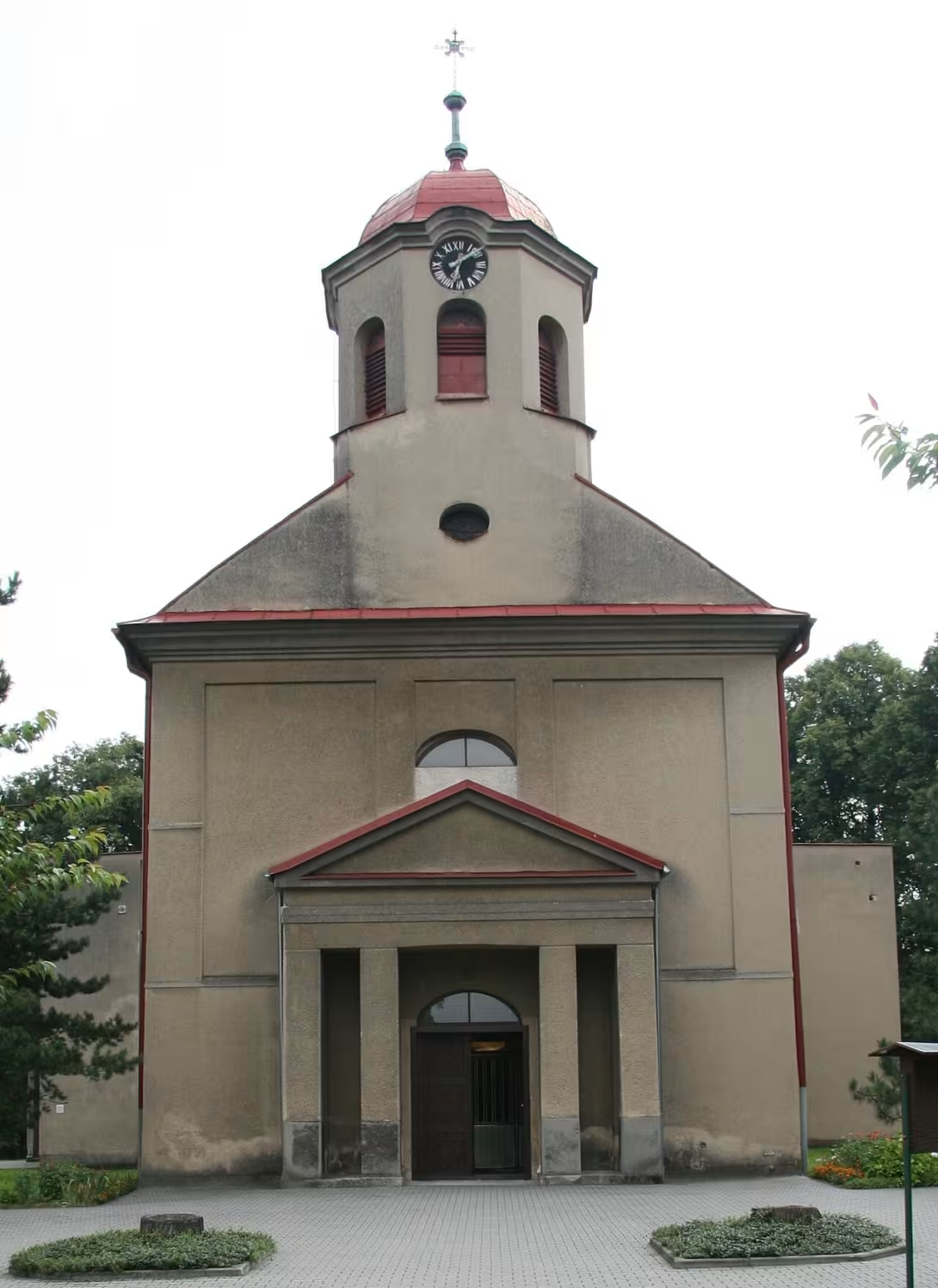

The historical appearance on the left is an AI-generated visualisation and serves as inspiration only.
Historical milestones
- 1841
- The beginning of the late Empire Church of St. Anne at the site of the destroyed wooden church.
- 1845
- The construction of St. Anne's church.
- 1964
- Writing the church into a list of cultural monuments.
- 1970
- Expansion of the church presbytery.
- 1985
- Installation of organ from Rieger-Kloss.
- 2013
- Modernization of the extension including heating and new heating.
Architectural development
The church was built in 1841- 1845 in late Empire style with a single-boat layout and a saddle roof. In 1970-1972 the presbytery was expanded while the original Empire architecture was preserved. The interior includes a stone mosaic with a cross, an altar of marble, wood and brass and stained windows in side chapel. The tower is equipped with two bells named Anna and Vojtěch.
Historical events
- 1527
- First written mention of the predecessor of the church - the wooden church of St. Catherine and St. Peter and Paul.
- 1823
- The destruction of the original wooden church by fire.
- 1964
- The inclusion of St. Anne's Church in the list of cultural monuments.
- 2013
- Modernization of the extension including heating, new heating and electrical installation.
Points of interest
- The church of St. Anne was built between 1841 and 1845 in the place where before stood two wooden churches - Saint Catherine and St. Peter and Paul, which burned down in 1823.
- Three original paintings, cross road paintings and original windows were preserved in the interior.
- The altar is composed of three materials: marble, wood and brass.
- There are two bells in the tower named Anna and Vojtěch.
- In 2013 the church underwent extensive modernization, with new social facilities, offices, heating, heating and wiring.
Guide
This guide is narrated by a synthetic voice generated by artificial intelligence.
Show guide text
This text was created by artificial intelligence and has not been editorially reviewed. It may contain inaccuracies.
Welcome. You're standing in front of one of the most important and shady places in this area, in front of St. Anne's Church. Before you go any further, stop for a moment and feel the atmosphere of this place. In front of you is a building that is not only a wall and a roof, but a living witness to human effort, tragedy and endurance. Look at her face and try to see the calm that exists here, even though the history of this place has been very stormy in the past.
To really understand what you're seeing right now, we need to go back deep into the past together, to a time when there were no stone walls, but wooden structures. Imagine 1823. It was a year that meant a huge test for the local community. There was a tragic event when two older wooden churches - St. Catherine's Church and St. Peter and Paul's Church burned down. It was an unimaginable loss for the people back then, the loss of their spiritual center and meeting place. But after this fire, they did not fall into despair. Instead, they started preparing for something new, more permanent and firmer.
This new chapter began to write its history in 1841. That's when the first stones were laid under the building you see before you. The construction of this church of St. Anne lasted several years and was completed in 1845. The whole process of construction was spent to reflect the period aesthetics and at the same time to offer a sense of stability, which was so lacking after the previous fire. This is how this impressive sacral building was born from the ashes of old wooden buildings.
Now pay attention to the architecture itself, which you are now seeing with your eyes. The church is built in late Empire style. This style is characterized by a certain nobility, but also by a certain thickness and purity of the line, which is intended to give the impression of order and harmony. If you look at the overall structure, you'll see it's a one-legged church. This means that the inner space is uniform, without complex side ships, which creates a sense of concentration and calm.
Notice the tower standing by the church. It is not a high, dominant tower that dominates the entire region, but it is low, harmoniously aligned with the whole building. It ends with a typical helmet, which gives the whole profile of the church its specific, historical appearance. Another important element you should observe is the presbytery. It's the part of the church that goes towards the exit, and it has a polygonal shape, a polygonal plan. This detail of architecture gives the building interesting geometry and playfulness in its lines.
But it is important to remember that this church, as you see now, is not a static image from the mid-nineteenth century. He evolved along with the people who inhabited him. In the 1970s, it was the presbytery that became an important extension in order to make better use of the space. And even in the latest history, specifically in 2013, the church has undergone modernization. For example, there has been a warm and installed new heating in the extension, which tells us that even this historical monument must be maintained to serve current generations and to be pleasant in its walls even in cold months.
When you decide to enter the interior, prepare to meet with the authenticity that has survived here for centuries. The inner space will surround you with silence and history that you can literally touch. Note the original elements in particular. In the interior there are still three original paintings, which are a rare ally to the construction time. Also look at the windows - they are the original windows that bring specific light into space, as people saw more than one hundred and seventy years ago. Another important element is the cross road, whose images are part of this spiritual space.
And if your senses hit the sound, it's probably the organ's fault. These were installed in the church in 1985 by Rieger-Kloss. They are a symbol of how even in modern times it takes care of the quality and tradition of musical accompaniment in this sacral space. And don't miss a look at the altar. It is fascinating with its material composition because it is composed of marble and other materials that give it nobility and dignity.
You may be interested in one thing that's not obvious at first glance, but that has a certain mystery in it. This church is located in a place where two different ages collide in time. Under your footsteps, beneath the floor of this stone church, there are traces of the two older wooden churches that once served the people here. It's like a layer of history where every new building carries a memory of what was before it. St. Anne's Church is not just a building, it's a palimpsest on which a new chapter was written after the tragedy of the fire.
This building was included in the list of cultural monuments in 1964, which confirms its immense value for our heritage. It is a place that has survived changes in political systems, technological revolution, and personal fates of many generations.
Now that you know the story of this place, I urge you to enter and experience the atmosphere of this space. Take a look at the details of the altar, see the light passing through the original windows and let yourself be carried away by the silence that exists here. Just let yourself stop for a moment and see the present of history. Thank you for spending this moment with us. We wish you a pleasant further part of your journey to discover the beauty and mystery of our region. Goodbye.
Tips for visitors
{'paragraph': 'The best time to visit St. Anne's church is during the morning hours after services where there is pleasant light and fewer crowds in the interior. If you are interested in a quiet atmosphere, avoid morning classes on working days when local believers often come here. In the summer months it is advisable to visit the church early in the morning or at the end of the afternoon, when the weather is pleasant outside and you can see the surrounding nature without overheating.'}
{'paragraph': 'Parking near the church can be found in public parking lots in the city centre. It is recommended to use public transport as there is a limited parking area around the church. The location is available by car and by public transport; the current connection and parking possibilities can be found in the traffic search engine. If you arrive by car, be careful to mark parking spaces and respect local rules.'}
{'paragraph': 'When visiting the church, wear comfortable clothes and shoes because it is a historic building with a stone base that can be cold. In the winter months it is advisable to wear warmer clothes because the interior can be cold. Do not miss a small guide to the church, which often offers local tourist information or parish office. If you are interested in history, you can bring a notebook to remember the attractions.'}
{'paragraph': 'Photography in the interior of the church is permitted, but it is necessary to take care to respect the worship and peace of the believers. The best places for photos are windows with Empire decorations, main altar and interior paintings. For quality images it is advisable to use natural light from windows, especially in the morning. In the exterior, it is worth capturing the church facade at sunset, when light creates interesting shadows and reflections.'}
{'paragraph': 'In the vicinity of St. Anne's church there are several interesting places worth visiting within 30 minutes' drive. The nature reserve of Strbske Pleso, which offers picturesque tourist routes and the possibility of nature observation, is approximately 5 kilometres away. The historical centre of Karviné, which is also about 5 kilometres away, is ideal for lovers of architecture and history, as here you will find old buildings and cultural monuments. It is interesting for families with children to visit local parks and playgrounds around the Havířov estate, where children can relax and have fun. '}
{'paragraph': 'For families with children, a visit to St. Anne's Church is particularly interesting because of its historical importance and the possibility to become acquainted with religious culture. The children can see the old paintings and statues and listen to the stories of St. Anne. In the vicinity of the church you can visit the local playground or parks where children can play and relax. It may be interesting for older children to find out more about the history of the church and its decoration, which can be an interesting activity for the whole family. It is also recommended to visit the church during some event or festivities that are often held here.'}
Frequently asked questions
Is Kostel svaté Anny (Město) open to the public?
Yes, the church is open to the public. The opening hours are 9: 00 to 5: 00.
How do I get to the place by car / public transport?
The car can be reached in the parking lot near the church. The public transport can use lines 1, 2 and 3 that stop in front of the church.
How much is the entrance fee and is it paid on the spot?
Payment is made directly at the entrance.
Is the tour suitable for children and seniors?
Yes, a church tour is suitable for all age groups. The church has accessible staircases and flat areas that allow easy walking.
How long does the tour take?
The church tour takes approximately 30-45 minutes. You can spend more time if you want to learn more about the history and architecture of the church.
What are the opening times and booking is required?
The church opening hours are from 9: 00 to 5: 00. Reservation is not necessary, but it is recommended for groups over 10 people.
What's interesting in the immediate vicinity?
In the immediate vicinity of the church there is a historical centre of the city with a number of other monuments and museums. There are also several restaurants and cafés where time can be spent.
For kids
Imagine going back 186 years and finding yourself in the heart of the city where St. Anne's Church is standing today. But it was different then. Město was much smaller, most of the houses were made of wooden construction and people lived in the valleys and hills.
It was like a game of heroes trying to survive in a difficult environment. People have done agriculture, trade, or craft. St. Anne's Church was the only place where people could come and pray for their families and homes.
Businesses nearby
Do you run a restaurant, accommodation, shop, museum, rental, wellness or other visitor service near this monument? Show yourself directly to the people heading to it — this is how they will see you in the app and on the web:
Events nearby
Zdroj akcí: otevřená data měst a obcí ČR (Národní katalog otevřených dat) a kalendář akcí Národního památkového ústavu.
Nearby
In the vicinity of the church there is an industrial zone and a settlement of Havířova, approximately 5 km from here there is a natural reserve of Strbske Pleso and the historical centre of Karviné.
Accommodation nearby
Themed route
1.Kostel svaté Anny (Město) * Memorial of sacral architecture * - A unique example of a late Baroque church with rich decoration, built in the 18th century. Its location in the middle of the village and its historical importance makes it central to the cultural heritage of the region.
2. Natural Reservations of Strbske Pleso * Natural reservation * - It lies about 5 km from the city and offers a picturesque mountain pond surrounded by beech forests. Ideal for short hiking, nature observation and rest in a quiet environment.
3. Historical Centre Karviné * City Monument Zone * - Located approximately 5 km from the City and represents an example of the industrial and cultural history of the region. It is dominated by St. Francis of Assisi and a number of period houses.
* (Recommended order: Church of St. Anne → Strbske Pleso → Karviné.) *
Seasonal recommendations
Spring In the spring months, the Church of Saint Anne in the City will turn into a quiet refuge, when its Gothic window lining begins to light up with soft sunlight and the shadows of trees around it create dancing patterns on stone walls. Nature is awakening - green shrubs and young leaves on the surrounding baits give the monument a fresh, almost mysterious touch. The air is light but still cold, and the inside of the church, heated by old stone walls, offers a pleasant contrast. It is recommended to visit it early in the morning when the church is almost abandoned and the light falls through the stained glass so that the colors of blue and red glow as in secret litany. Clothes should be layered - spring weather is variable, and even when the sun welcomes, evenings can be cold. Avoid visiting during the rainy season, when the paths to the monument can become muddy and the interior wet.
Summer In the main summer season, St. Anne's church becomes more lively, but also more difficult to visit. The sun rising in hot days illuminates its towers so that it seems as if gold dust is coming from them, while the afternoon heat creates sharp shadows on the stone facades. The surrounding area is green and full of life - visitors often stop on benches by the church to relax from walking through the city. In the interior, protected from the sun, there is a pleasant coldness, but the stained glass can be so clear that it is necessary to turn a blind eye when staying longer. It is recommended to come immediately after opening to avoid crowds that converge especially in the afternoon. Light, breathable clothes and sunglasses are essential, as well as a bottle of water - there is little shade around the church in the summer months. Evening visits are quieter, but some parts of the monument may already be closed.
Autumn Autumn brings a mysterious atmosphere to the city, which St. Anne's church emphasizes even more. When leaves in the surrounding trees turn into golden and red shades, the light that penetrates through the stained glass turns into warm, almost honey shades that create a magical, almost sacred impression in the interior. The air is clean and cold, and the church, surrounded by fallen leaves, acts as a guardian of the past. In advent time, when evenings become longer, candles light up inside and the church grows on intimacy. It is recommended to visit it in the afternoon, when the sun still illuminates the facade, but the crowds are smaller than in summer. Clothes should be warm but not too massive - autumn weather changes rapidly, and although the sun may be pleasant, evenings are cold. Go for a walk along the surrounding roads, where autumn colours are reflected in rainwater pools.
Winter The winter visit of St. Anne's church is like entering another world - the snow areas around the monument surround it like a white cloak, while the ice crusts on the windows create amazing, branched patterns. The sun, which stays lower in the sky in winter, illuminates the church so that its silhouette draws against the pale sky as a black contour in the snow. In the interior, where pleasant temperatures are maintained, visitors often stop at windows to watch snowflakes roll around. Opening times are shortened in winter, so it is good to know about the exact times in advance. It is recommended to visit the church in the afternoon when light becomes softer and shadows longer, which gives the monument even more peace. A warm but comfortable outfit is a necessity - frost and wind can be sudden, and even a short walk around the church requires sufficient protection. Evening visits are the most beautiful in winter, but some parts of the monument can already be closed.
Visualizations and artistic views


The visualisations are generated by artificial intelligence and serve as inspiration.
Photos from the area
Real photos taken near the monument


Zdroj a licence jsou uvedeny u každého snímku.
Atmosphere of the place
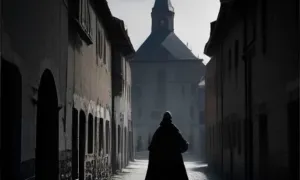
This atmospheric visualisation of the place and period was generated by artificial intelligence. It is not real footage of the location.
Tips from visitors
No tips yet. Be the first!
Log in and add your tip.
Sources and literature
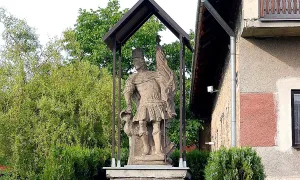
Fotografie: Michal Klajban / CC BY-SA 3.0, rozlišení zvýšeno umělou inteligencí — Wikimedia Commons. The author and licence also appear when you hover over the image.
Faktickým podkladem tohoto textu byl článek na Wikipedii, jehož autory jsou přispěvatelé Wikipedie. Článek je dostupný pod licencí CC BY-SA 4.0.
Location on the map
Příběhy a pověsti
Legendy, pověsti a příběhy spjaté s touto památkou
Fotografie návštěvníků
Zatím žádné fotografie. Buďte první, kdo přidá fotografii z návštěvy!
Přihlaste se a přidejte svou fotografii nebo hodnoťte.
Za ověřenou návštěvu v aplikaci získáte víc bodů — poznáme podle GPS, že jste na místě.
Reviews and comments