



Kostel svaté Ludmily (Litoměřice) Church
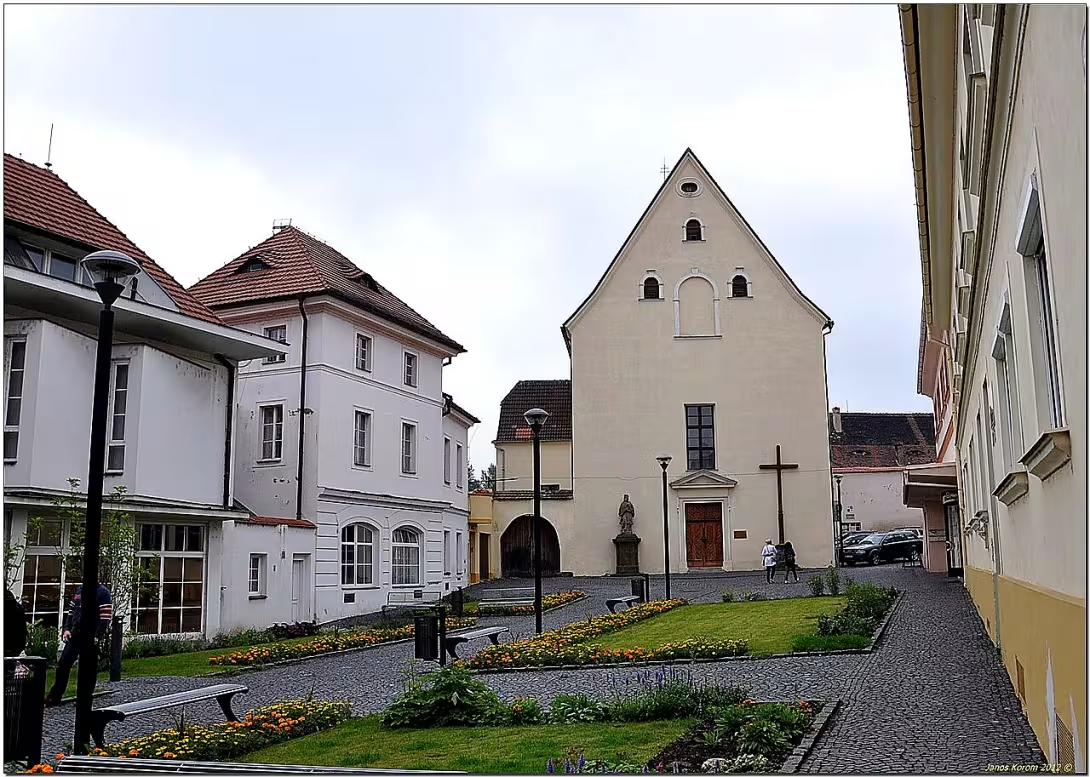
St. Ludmila's church is located on Capucín Square in Litoměřice as part of the former Capuchin monastery complex. It is a baroque building which was initiated and supported by Count František Arnošt Šlik, who died in 1675. The building of the church was accompanied by gradual internal furnishing around 1657 when altars and works of art were procured.
The architecture of the church corresponds to the spiritual ideal of capuchins and their preselection of moderation. It is a single boat of a simple shape with a narrower presbytery finished with a surface and lower chapel on the east side. The facade without the decorative rimsa passes directly into the steep triangle shield. The entrance consists of a rectangular portal with a triangular front. The vault of the ship is broken by sections, as well as the vault in the chapel of the Virgin Mary attached to the church on the east side.
The inside of the church shows rich decoration and art. The centre is the main altar in the form of a triumphant arch with columns and triangular shield, decorated with the image of the Death of Saint Ludmila painted probably between 1653 and 1655 by Tobias Peck. In the side fields, the visitor sees the paintings of St. Catherine and St. Barbara. On the sides of the triumphant arch stands two early Baroque altar: St. Anthony of Paduan from 1669 and St. Francis from Assisi erected already in 1651. Both are decorated with typical bolts and acanthus cuts, which were preserved in original form.
On the east side there are two altars of St. Joseph and Virgin Mary with rococo elements from the middle of the 18th century. The main donor crypt, Count František Arnošt Šlik, was located in the chapel of the Virgin Mary. The other altars are dedicated to the Immaculate Virgin Mary, Saint Margaret Alacoque and Saint Anne, decorated with statues and paintings from the 18th century. Tabernacle and adjacent walls come from the middle of the 18th century and reflect the rococo style.
A four-storey monastery with four wings is adjacent to the west side of the church around a closed courtyard with partial arcades. The construction corresponds to the typical availability of Capuchin monasteries: refectory and library in the east wing, cells of beacons mainly in the south wing, special sanitary facilities in the southeast corner. According to the rules at the time, the monastery space was not heated - it was only in the north wing intended for apparently sick brothers.
In front of the church is a statue of St. John Nepomuk from the period after 1729 and a mission cross from 1840. This building remains an important proof of the Baroque architecture of the Czech countries and the way of life of the Capuchin Order. / p >
Then and now
Drag the slider to compare how the landmark may have looked when it was built with the view today.
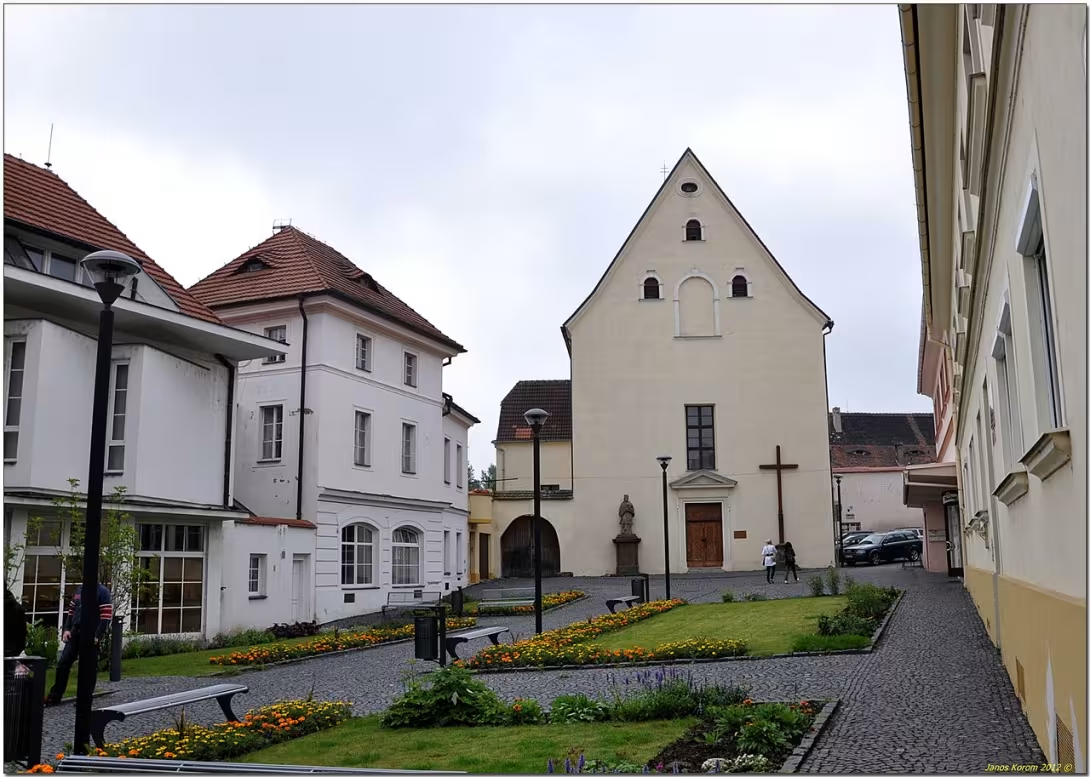

The historical appearance on the left is an AI-generated visualisation and serves as inspiration only.
Historical milestones
- 1653
- A title painting painted on the main altar by Tobias Pock.
- 1675
- Count František Arnešt Šlik's death.
Architectural development
The church is an early Baroque building with a simple longitudinal arrangement. The exterior has a triangular shield and a rectangular portal. The interior was arranged around 1657, with characteristic bolting motifs and a combination of black color and gilding. The following decades have added rococo elements.
Historical events
- 1653
- Painting the title painting on the main altar by Tobias Pock.
- 1675
- The death of Count František Arnošt Šlik, the chief donor of the church.
Owners
Parish Litoměřice
Points of interest
- The church was supported by Count František Arnošt Šlik whose crypt is located in the chapel of the Virgin Mary. - The main altar is decorated with the painting of the Death of Saint Ludmila, which was probably painted by Tobias Pock between 1653 and 1655. - The altar of St. Anthony of Padua and St. Francis of Assisi is preserved by original Bolts and Acantic carvings. - The adjoining monastery didn't burn under the rules, except for the north wing for sick brothers. - In front of the church is placed a statue of St. John Nepomuk from the period after 1729 and a mission cross from 1840.
Guide
This guide is narrated by a synthetic voice generated by artificial intelligence.
Show guide text
This text was created by artificial intelligence and has not been editorially reviewed. It may contain inaccuracies.
The Church of Saint Ludmila on Kapucínské náměstí in Litoměřice was once the convent church of the Capuchin convent. The construction of the convent was initiated and largely financed by Count František Arnošt Šlik, who died in 1675. Today the church is protected as a cultural monument.
It is an early Baroque building, very simple in design. It has a single longitudinal nave, a narrower presbytery with a flat end, and a lower chapel of the Virgin Mary on the eastern side. The façade transitions without a cornice straight into a steep triangular gable, and a rectangular portal is topped with a triangular pediment. The vaults of the nave and chapel are pierced with segments, apparently due to the work of a lay builder.
The interior furnishings were created alongside the completion of the building around 1657 and have survived to this day. Characteristic of them are vault motifs and the combination of black color with gilding. The main altar has the form of a three-axis triumphal arch with columns and a pediment. Its titular painting, the Death of Saint Ludmila, was painted presumably between 1653 and 1655 by Tobiáš Pock. In the side panels are images of Saint Catherine and Saint Barbara. The tabernacle and the wall with images of Saint Wenceslaus and Saint Vitus are Rococo, from the mid-eighteenth century.
On either side of the triumphal arch stand two facing altars. The altar of Saint Francis of Assisi with vault and acanthus carvings was erected as early as 1651, the altar of Saint Anthony of Padua dates from 1669. In the chapel of the Virgin Mary was the crypt of Count Šlik. On the altar there is a titular painting by the painter Klinger from 1781. Other altars are dominated by Rococo from the mid-eighteenth century, for example the altar of the Immaculate Virgin Mary with statues of Saint Francis Seraphinus and Saint Elisabeth of Thuringia.
In front of the church stands a statue of Saint John of Nepomuk from after 1729 and a mission cross from 1840.
The former convent adjoins the western side of the church. Its four-story wings enclose a closed courtyard, partially with arcades. In the southeastern corner stands a separate square object of sanitary facilities, such as other Capuchin convents also have. In the eastern wing was the refectory and above it the library. The monks had the most cells in the southern wing. The monastic rules did not permit heating, so heating was only provided in the northern wing, where there were probably rooms for sick monks.
Tips for visitors
For the best experience we recommend a visit in the morning, when the Baroque interior works most impressive thanks to the natural light. If you are looking for a quieter atmosphere, it is advisable to choose days outside the main tourist season.
You can easily reach the monument by car and public transport.
For photography it is ideal to use daylight when looking at the church from the square. Before entering, you can photograph the statue of St. John Nepomuk and the mission cross. There is also a monastery complex with four-story wings around the courtyard.
Families with children should take patience with them, given the sacral nature of the object. We recommend having small cash payments and drinking water.
Frequently asked questions
Can the monument be visited?
Religious buildings are usually open mainly during services; at other times a visit is normally arranged with the parish or the operator. We have not verified specific times.
Where is the monument?
Location: Litoměřice, Ústecký kraj. The map on this page shows the exact spot.
Why is the monument protected?
It is listed in the Central List of Cultural Monuments of the Czech Republic as a cultural monument. It is protected as part of a larger listed ensemble.
For kids
About 676 years ago, something very special began to be built in Litoměřice, which was like a magnificent jewel on the ground. It was the church of St. Ludmila, which today is so beautiful and impressive for all those who catch him looking.
When the newly built church was completed, it became the center of many interesting events. On his land lived Capuchin monks who prayed daily and prepared guests for various holidays. It was like a big house full of wisdom and secrets where a kid was told they were singing with angels.
Businesses nearby
Do you run a restaurant, accommodation, shop, museum, rental, wellness or other visitor service near this monument? Show yourself directly to the people heading to it — this is how they will see you in the app and on the web:
Events nearby

Zdroj akcí: otevřená data měst a obcí ČR (Národní katalog otevřených dat) a kalendář akcí Národního památkového ústavu.
Nearby
In front of the church is a statue of St. John Nepomuk from the period after 1729 and a mission cross from 1840.
Monastic complex with four-story wings around the courtyard.
Accommodation nearby
Trips and activities nearby
Guided tours, tickets and activities nearby from GetYourGuide
Affiliate link: if you buy from the partner, we may receive a commission. The price for you does not change.
Search tours and activities →Themed route
1. Statue of St. John Nepomuk and Mission Cross (Type: Statue and Monument). In front of the church you can see the Baroque statue and historical cross from 1840. 2. Church of St. Ludmila (Type: Church). The main destination of the trip, which is the center of the entire circuit. 3. Monastic complex (Type: Monasteries complex). Buildings with four-story wings around the courtyard are an interesting building.
Seasonal recommendations
In spring the church surrounds the awakening nature and soft light, which pleasantly highlights the details of the facade. The atmosphere is fresh and hopeful. We recommend wearing layered clothes because the weather is variable, and visit the memory in the morning when the surroundings are quiet.
The summer season brings sharp sun and rich colors that make the visit a visual experience. The city is full of life in high season. To avoid the biggest crowds and heat, it's best to come first thing in the morning. Don't forget light, breathable clothes and plenty of fluids.
Autumn is characterized by golden leaves and foggy wounds, which give the building a mysterious and melancholy mood. The light is finer and more golden in this period. It is practical to carry an umbrella or raincoat and plan the arrival for the late afternoon when the atmosphere is most calm.
In winter, the church is majestic, especially in advent time, when the holiday mood rules in the surroundings. The inner space offers refuge from frost and silence. It is necessary to choose very warm clothes and to check in advance the opening times which are usually shorter during this period.
Visualizations and artistic views


The visualisations are generated by artificial intelligence and serve as inspiration.
Photos from the area
Real photos taken near the monument

Zdroj a licence jsou uvedeny u každého snímku.
Atmosphere of the place
This atmospheric visualisation of the place and period was generated by artificial intelligence. It is not real footage of the location.
Tips from visitors
No tips yet. Be the first!
Log in and add your tip.
Sources and literature
Photos: János Korom Dr. from Wien, Austria / CC BY-SA 2.0 — Wikimedia Commons. The author and licence also appear when you hover over the image.
Faktickým podkladem tohoto textu byl článek na Wikipedii, jehož autory jsou přispěvatelé Wikipedie. Článek je dostupný pod licencí CC BY-SA 4.0.
Location on the map


Příběhy a pověsti
Legendy, pověsti a příběhy spjaté s touto památkou
Fotografie návštěvníků
Zatím žádné fotografie. Buďte první, kdo přidá fotografii z návštěvy!
Log in a přidejte svou fotografii nebo hodnoťte.
Za ověřenou návštěvu v aplikaci získáte víc bodů — poznáme podle GPS, že jste na místě.
Reviews and comments