



Kostel svatého Jakuba Staršího (Litoměřice) Church
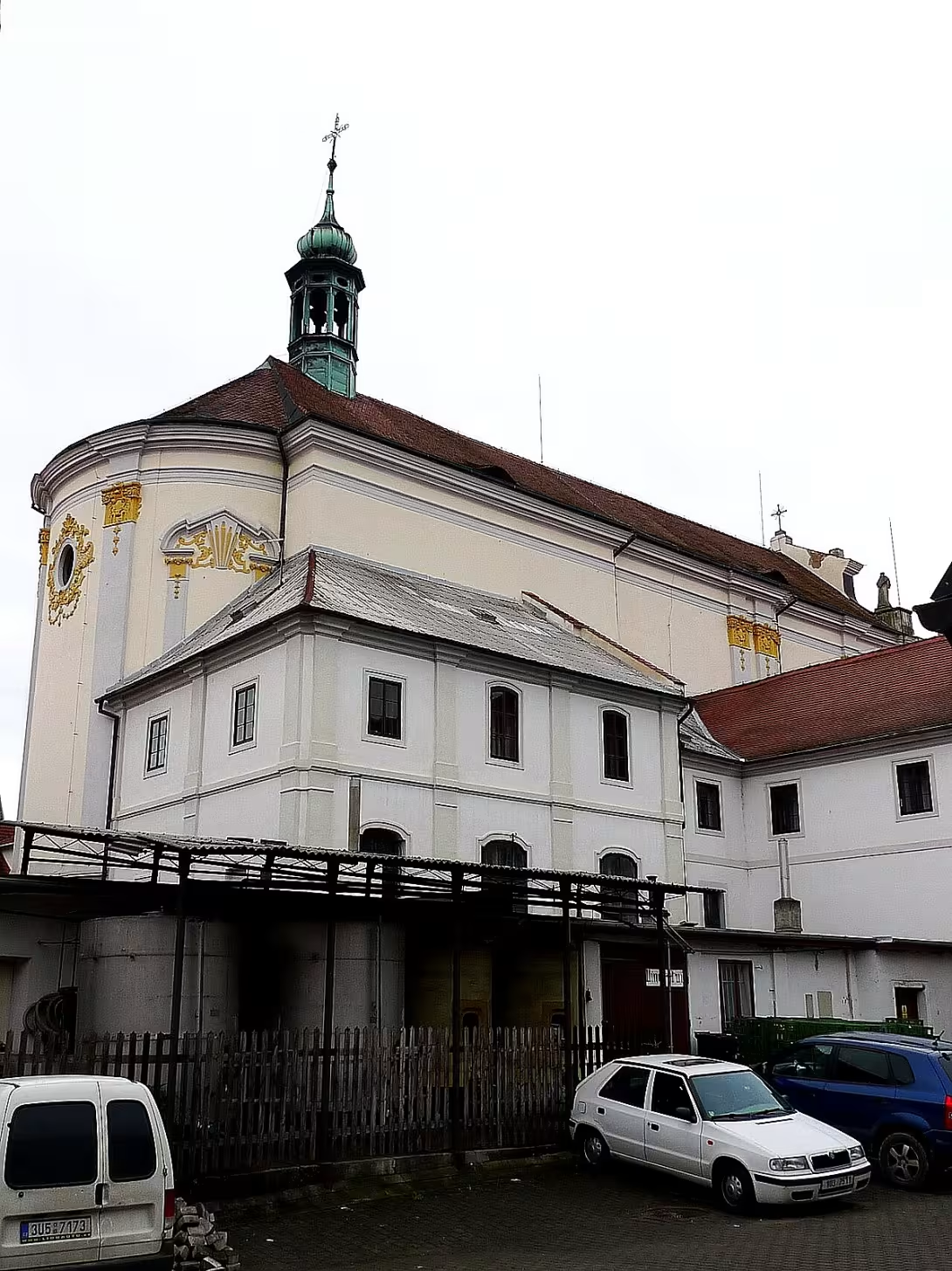
The church is located on Dominican Square and is protected as a cultural monument of the Czech Republic. For the first time, it was mentioned in 1233, when the oldest monastery in the city was mentioned by the medieval pilot Beneš Minority. The Prague Bishop Jan II. z Dražic founded it for the Franciscan-Minority who lived and served here. Conventional buildings were created together with the church and were part of the city fortification. The oldest form of construction is not known; It is only assumed that the church stoned originally in the south while the monastery buildings occupied the north.
At the end of the 14th century the church received rich support - around 1390 it was donated by Ješek Kamenický z Čakovic, which probably led to more advanced reconstruction. The Hussite Revolution of 1421 brought devastation. But the temple was restored after its completion. A worse fate awaited him during the Thirty Years' War - he was destroyed and for many years he was in ruins.
Rebirth occurred after the battle on White Mountain. The first post-white mountain reconstruction took place between 1662- 1667. But the monastery continued to fight the trials - in 1714 the devastating fire destroyed it. The following repairs have become more extensive. In 1715 the presbytery was almost finished and it was built on the main ship of the church. There was a contract with the architect, probably Octavius Broggie, who simplified the project in 1716. Today's late Baroque form of the church was gained in 1730-1740. The consecration took place on July 14, 1750, long after Broggie's death. In 1752 the ship was completed, and in 1758, when St. Anne's altar was set, the temple was finally closed - other equipment was installed until 1781.
Architecturally, it is a single-boat building with a demistered semi-circular apside, which is complemented by monastery buildings in the north. The facade without towers is two-stage, decorated with high stacks of pilaster bundles on the corners. The main rims are dedicated to the shield attachment with volute wings and the statue of St. James. The south side has an axis risalite with a triangular shield. The high pilasters and windows with three-piece enchantments highlight the late baroque and rokaja style.
In the interior the visitor is welcomed by the plaque and lunette vaults, which are separated belts on drawn pilaster bundles. The organ ring in the west has a wavy breast and protects the end of the presbytery in the form of a semicircle. The equipment deserves the attention of the Rococo altar of St. Vincent Ferrersky from the artificial marble (half of the 18th century) with the statues of St. Augustine and Bl. Henry Susa, and the altar of St. John Nepomuk and the pulpit from the end of the 18th century by the statue of St. James.
The Minorites served in the temple until 1877 when the Dominicans replaced them. After the 1950s Communist Action K, which abolished the men's monasteries, took over the administration of the church's lithomeric deanery, which managed it so far. The church remains a link between medieval piety, baroque glare and today's Catholic life in Litoměřice.
Then and now
Drag the slider to compare how the landmark may have looked when it was built with the view today.
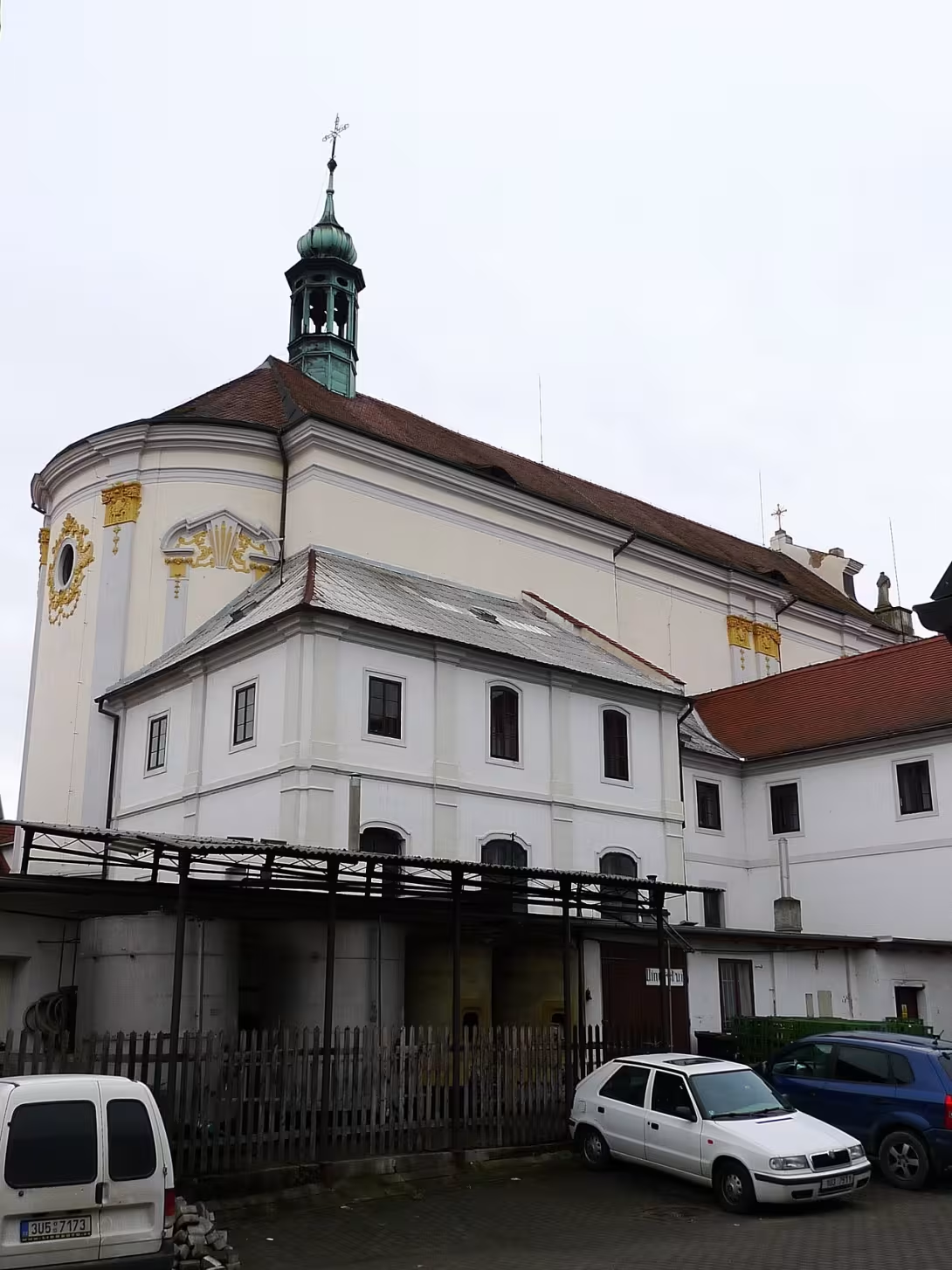

The historical appearance on the left is an AI-generated visualisation and serves as inspiration only.
Historical milestones
- 1233
- First mention in Beneš Minorita's planes.
- 1421
- Devastation of the object during the Hussite revolutions.
- 1750
- Church bloom after the builder's death.
- 1758
- The final completion of the building with the installation of St. Anne's altar.
Architectural development
The original Gothic building was gradually restored after destruction during the 30-year war. In the 18th century there was a major reconstruction into the late Baroque and rococo style, for which probably Octavio Broggi was responsible. The interior is characterized by flat and lunette vaults.
Historical events
1233 - first mention in the aeroplane; 1421 - devastation during the hussite revolutions; 1730-1740 - obtaining today's baroque form; 1758 - final completion of construction.
Owners
Minorites (since the 13th century), Dominicans (since 1877), Litoměřické deanery (since 1950).
Points of interest
- The church is situated on Dominican Square and is protected as a cultural monument of the Czech Republic. - Around 1390 he was given Ješek Kamenický z Čakovic. - During the Thirty Years' War, the temple was destroyed, and for years it was desolate in ruins. - Today's late Baroque form of the church was obtained in 1730-1740. The Minorites served in the temple until 1877 when the Dominicans replaced them.
Guide
This guide is narrated by a synthetic voice generated by artificial intelligence.
Show guide text
This text was created by artificial intelligence and has not been editorially reviewed. It may contain inaccuracies.
The Church of Saint James the Greater, also called the Elder, stands in Dominikánské náměstí in Litoměřice. It originally belonged to the Minorites and today is protected as a cultural monument.
It is first mentioned by the medieval chronicler Beneš Minorita in the year 1233 in an account of the oldest monastery in the city. The church was founded by Prague Bishop Jan the Second of Dražic for the Franciscan monks of the Minorite order. The monastery buildings and the church were built as part of the city's fortifications. What the original structure looked like is not known. Around the year 1390, the monastery was generously endowed by Ješek Kamenický from Čakovic and by that time at the latest a reconstruction took place. In the year 1421, during the Hussite Revolution, the building was destroyed and later restored. During the Thirty Years' War, the church was demolished and lay in ruins for a long time.
The first restoration came in the years 1662 to 1667. After a fire in 1714, the church was repaired to such an extent that it amounted to a major reconstruction. It acquired its present late Baroque appearance in the years 1730 to 1740 and is attributed to architect Octavius Broggio. It was consecrated on July 14, 1750, after the architect's death. The nave was completed in 1752 and the church was finally finished in 1758.
The church was cared for first by the Minorites, and from 1877 by the Dominicans. They had to leave in 1950 when the Communist regime dissolved the male monasteries. The spiritual administration was then taken over by the Litoměřice deanery.
The church is single-naved and longitudinal, ending with a semicircular apse. Former monastery buildings adjoin its northern side. The two-story façade has no towers. At the top is a gable with volute ornaments, scrolled decorations, and in a niche stands a statue of Saint James. The windows are decorated with stucco ornaments of late Baroque and Rococo style. Although the building is longitudinal, its floor plan clearly tends toward a centralized arrangement.
Inside are flat vaults called barrel vaults and lunette vaults. On the west side is an organ loft with a wavy balustrade.
The church's furnishings were created gradually until 1781. They include a Rococo altar of Saint Vincent Ferrer made of artificial marble with statues of Saint Augustine and the Blessed Henry Suso. Further, a Rococo altar of Saint John of Nepomuk with cherubs and ornaments. The pulpit made of artificial marble dates from the late eighteenth century and on its canopy stands a statue of Saint James.
Tips for visitors
The best time to visit the church of St. Jacob the Elder is from 9 a.m. to 5 p.m. Since this is a historical monument, we recommend that you visit it at a time when there are fewer people and you can better see the details of architecture.
Frequently asked questions
Can the monument be visited?
Religious buildings are usually open mainly during services; at other times a visit is normally arranged with the parish or the operator. We have not verified specific times.
Where is the monument?
Location: Litoměřice, Ústecký kraj. The map on this page shows the exact spot.
Why is the monument protected?
It is listed in the Central List of Cultural Monuments of the Czech Republic as a cultural monument. It is protected as part of a larger listed ensemble.
For kids
Imagine going back to the past, until Litoměřice was a small town with narrow streets and wooden houses. The church of St. Jacob the Elder stood at the Dominican Square and was a place where important events took place.
There lived monks from the Order of Minorites who were famous for their artistic abilities. It was those who created beautiful frescoes on the walls of the church that are now part of his historical memory. The monks also helped people in Need and were like families for the locals.
Businesses nearby
Do you run a restaurant, accommodation, shop, museum, rental, wellness or other visitor service near this monument? Show yourself directly to the people heading to it — this is how they will see you in the app and on the web:
Events nearby


Zdroj akcí: otevřená data měst a obcí ČR (Národní katalog otevřených dat) a kalendář akcí Národního památkového ústavu.
Nearby
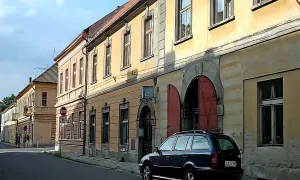
Dominican Square in Litomerice, city fortification.
Accommodation nearby
Trips and activities nearby
Guided tours, tickets and activities nearby from GetYourGuide
Affiliate link: if you buy from the partner, we may receive a commission. The price for you does not change.
Search tours and activities →Themed route
1. Dominican Square Type: City square Why to visit: It serves as an ideal introduction to the city tour and offers a view of its historical development.
2. Church of St. Jacob the Elder Type: Church Why to visit: The main destination of the route, which represents an important sacral monument.
3. Urban fortification Type: Historical construction Why to visit: Allows a walk in the historical context around the boundaries of the city.
Seasonal recommendations
In spring, the church is surrounded by awakening nature and fresh air. The soft spring light falls beautifully on the facade and in the interior the feeling of renewal reigns. We recommend wearing more layers of clothing because the weather is variable. It is best to visit the memory in the morning before the first groups of visitors are added.
In the summer months the temple offers a pleasant shelter from the heat, where the inner space acts cool and calm. The sun sharply highlights the details of architecture, which is ideal for photography. Due to the high season and larger crowds, come as early as possible in the morning. Don't forget light, breathable clothes and plenty of fluid.
Autumn brings golden colours of leaves and softer, fuller lighting to the surrounding church, which gives the place a nostalgic atmosphere. It's an ideal time for quiet contemplation with no rush. It's practical to carry a waterproof jacket or umbrella. Visit the memory rather in the afternoon, when the light is the most cénic.
In winter, the construction works monumentally against the grey sky, possibly in snowy robes. In advent time, there is a cosy and anticipating mood in the interior. It is necessary to choose very warm clothes and shoes. Pay attention to opening times that are shorter in this period.
Visualizations and artistic views


The visualisations are generated by artificial intelligence and serve as inspiration.
Photos from the area
Real photos taken near the monument


Zdroj a licence jsou uvedeny u každého snímku.
Atmosphere of the place
This atmospheric visualisation of the place and period was generated by artificial intelligence. It is not real footage of the location.
Tips from visitors
No tips yet. Be the first!
Log in and add your tip.
Sources and literature
Photos: H2k4 / CC BY-SA 3.0 — Wikimedia Commons. The author and licence also appear when you hover over the image.
Faktickým podkladem tohoto textu byl článek na Wikipedii, jehož autory jsou přispěvatelé Wikipedie. Článek je dostupný pod licencí CC BY-SA 4.0.
Location on the map


Příběhy a pověsti
Legendy, pověsti a příběhy spjaté s touto památkou
Fotografie návštěvníků
Zatím žádné fotografie. Buďte první, kdo přidá fotografii z návštěvy!
Log in a přidejte svou fotografii nebo hodnoťte.
Za ověřenou návštěvu v aplikaci získáte víc bodů — poznáme podle GPS, že jste na místě.
Reviews and comments