



Kostel svatého Benedikta (Pustiměř) Church
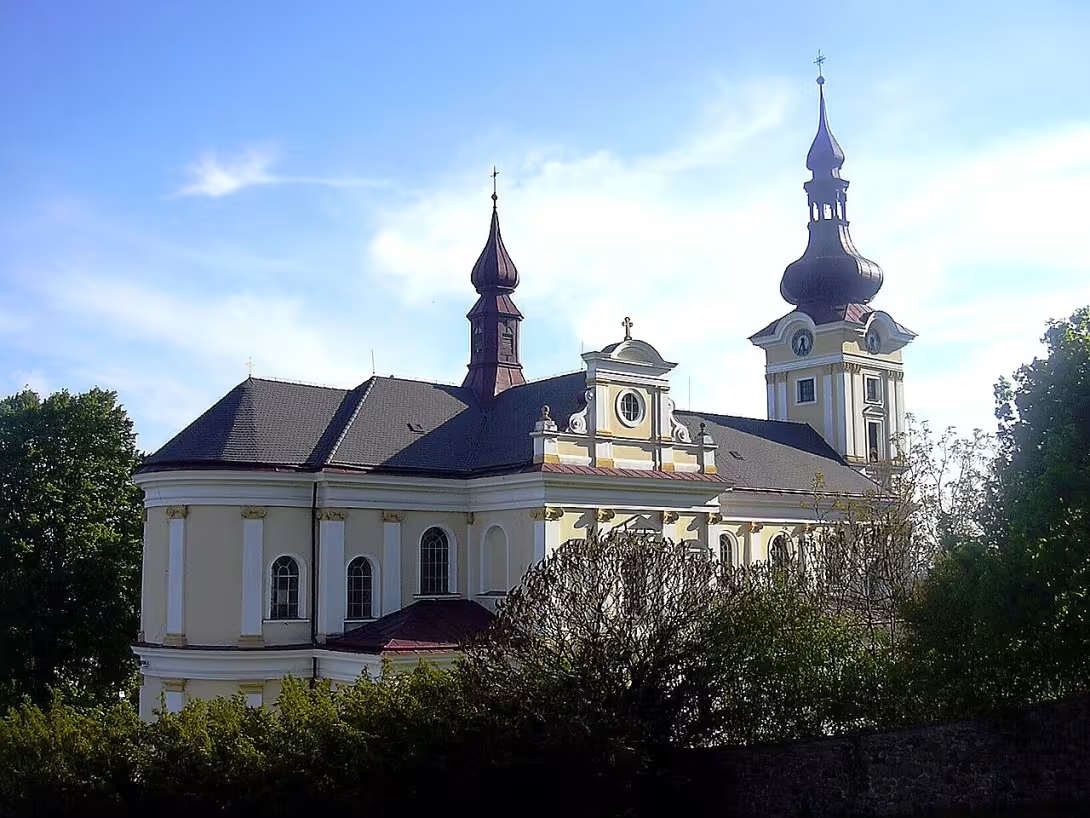
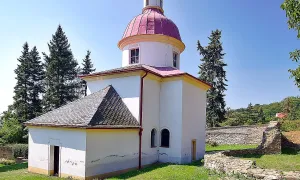
In the village of Pustiměř near the district town of Vyškov stands the Roman Catholic parish church of St. Benedict, which is part of the spiritual and building heritage of this area. The church was founded in the turn of the 19th and 20th centuries as an important project to restore local sacral architecture.
Construction of the new church started in February 1900 by demolition of the old temple. The whole project was under the patronage of the Archbishop of Olomouc, Prof. ThDr. Theodore Kohn and lasts less than two years. Construction work was intensively carried out, as demonstrated by the number of workers: up to 31 masons, 15 apprentices, 29 diaries and 18 manuals were involved daily in the construction. The construction material itself came from local sources - from a destimeter brick used approximately 773 415 bricks for the construction.
The new church was completed and handed over in July 1901. The ceremonial ceremony was then performed by his benediction on Sunday, July 24, 1901 by the Rajadean prelate Benedict Jan Karel Korčian. In this moment, the construction, which was of considerable importance to the local community, became a full-fledged protection for the spiritual life of memory.
For a long time, however, the interest in protecting this church was not in a hurry. It was only in 1996 that a request was made to the Ministry of Culture to include St. Benedict's Church as a cultural monument. However, recognition was only obtained after the intervention on 22 February 2001, which means that its historical and construction values were officially closed up for more than a century after it was erected.
Today, the church is one of the cultural monuments and represents a testimony of construction activity and community solidarity from the beginning of the last century. For visitors Pustiměře is an interesting stop where you can see the result of an ambitious construction project that has affected local social and spiritual life in its time.
Then and now
Drag the slider to compare how the landmark may have looked when it was built with the view today.
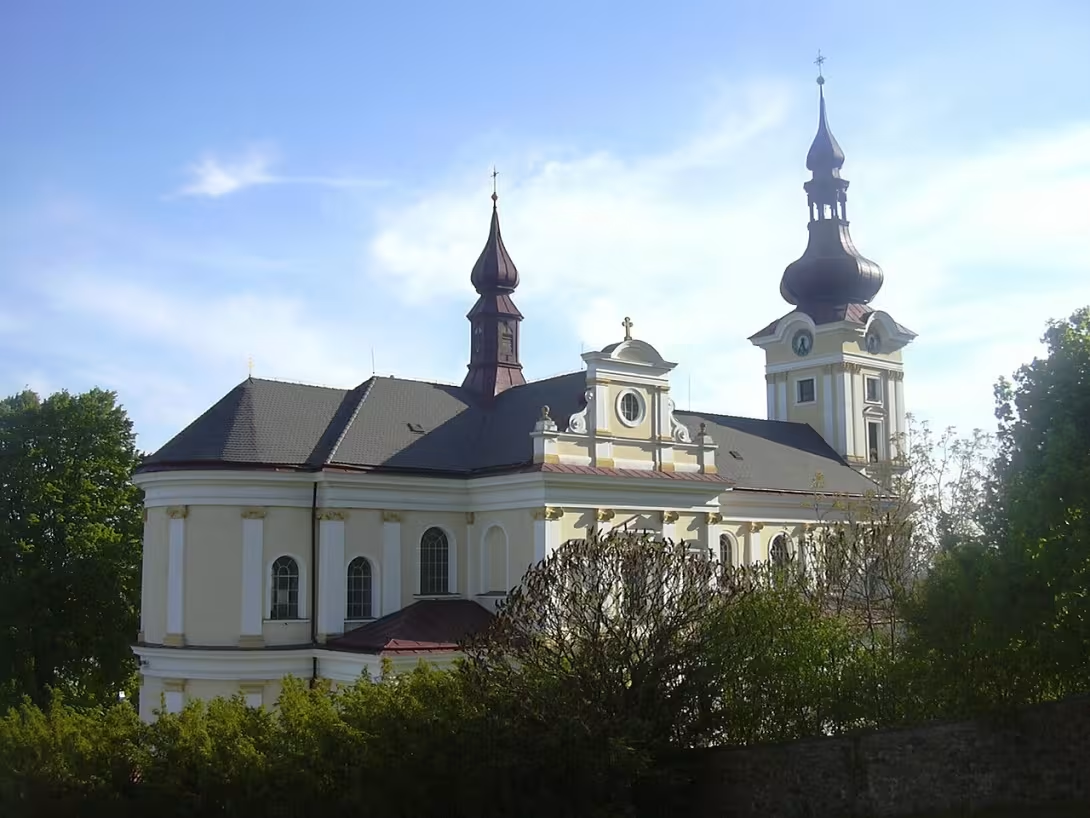
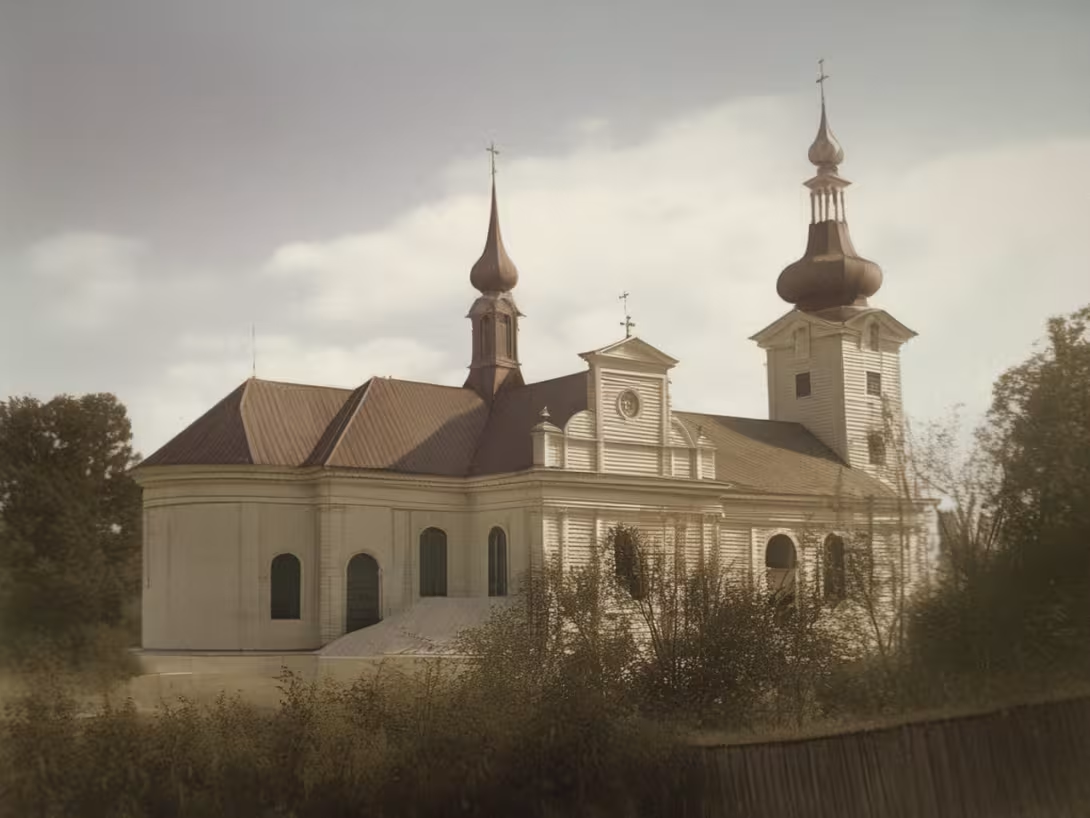
The historical appearance on the left is an AI-generated visualisation and serves as inspiration only.
Historical milestones
- 1900
- The opening of the construction by knocking down the older church under the patronage of the Archbishop of Olomouc, Theodore Kohn.
- 1901
- Completion of the construction and beneciency of the church on 24 July with the Radhrad prelate by Benedict Jan Karel Korčian.
- 1996
- Submission of a request to include the church as cultural monuments to the Ministry of Culture.
- 2001
- The church was declared a cultural monument after intervention.
Architectural development
The church was built as a one-ship building with a tower and sacristy. Local bricks (about 773 415 bricks) and brick structures were used. The appearance is influenced by historical tendencies with elements of the new Baroque. Original paintings and equipment from the construction period are preserved in the interior. No significant reconstructions are documented.
Historical events
- 1900
- Beginning of construction - demolishing the older church and starting construction of a new temple.
- 1901
- Completion of the construction and consecration of the church on 24 July with the Radhrad prelate by Benedict Jan Karel Korčian.
- 2001
- The church was declared a cultural monument after a long-term process which began with a request from 1996.
Owners
Roman Catholic Church
Points of interest
- St. Benedict's Church was built in 1900- 1901 as a substitute for an older temple, whose construction began in February 1900 by demolition of the previous building.
- The project was run by the Archbishop of Olomouc, Prof. ThDr. Theodor Kohn, and it was very fast - the whole building lasted less than two years.
- During construction, up to 31 masons, 15 apprentices, 29 diaries and 18 menus worked, and the material came from a local brick (773 415 bricks used).
- The church was festively consecrated on July 24, 1901 by the Brazilian prelate Benedict Jan Karl Korčian.
- Only in 2001, after more than a century of completion, the church was officially classified as cultural monuments after the intervention of the Ministry of Culture.
Guide
This guide is narrated by a synthetic voice generated by artificial intelligence.
Show guide text
This text was created by artificial intelligence and has not been editorially reviewed. It may contain inaccuracies.
The Roman Catholic parish Church of Saint Benedict stands in Pustiměř, not far from the district town of Vyškov. It is a building from the turn of the nineteenth and twentieth centuries and was built relatively quickly.
Work began in February of the year nineteen hundred with the demolition of the old church. The patronage over the construction was held by the Archbishop of Olomouc, Theodor Kohn. The new church was finished and handed over in July of the year nineteen hundred and one, so the construction took less than two years. On Sunday the twenty-fourth of July, it was blessed by the Rajhrad prelate Benedikt Jan Karel Korčian.
On the construction work was done daily in large numbers. There were up to thirty-one masons, fifteen apprentices, twenty-nine day laborers and eighteen day laborers who were women. The church is built from bricks from the local Pustiměř brickyard and approximately seven hundred seventy-three thousand four hundred fifteen of them were used.
In the year nineteen ninety-six, a request was sent to the Ministry of Culture for the church to be listed among cultural monuments. It was approved only after intervention, on the twenty-second of February, two thousand and one.
Tips for visitors
The best time to visit St. Benedict's church is during the morning hours after the Holy Mass or in the morning on Sunday. At these times, the inside of the church is lit with a pleasant light and there is a quiet environment that allows you to fully see the neo-Baroque decoration and historical elements. If you prefer fewer people, avoid morning classes on working days when the church is often visited by school groups.
It is recommended to use public transport if you come from larger cities. The current connection can be found in the traffic search engine. In the vicinity of the church it is possible to park in open spaces near the sacral area, which are usually available.
When visiting take on comfortable clothes and shoes as the church and its surroundings are often visited even in colder periods of the year. It is also important to take a small towel or towel, as some parts of the church may be wet. If you are planning a longer stay, bring water and a light snack.
Photography is permitted in St. Benedict's Church, but it is necessary to respect other visitors and not touch historical elements. The best places for photography are the main altar with neo-Baroque elements and windows with stained windows that are best lit in the morning or afternoon light. The outside facade of the church is also attractive especially at sunset.
In the vicinity of St. Benedict's church is worth visiting the chapel of Saint Anne, which is located nearby in the sacral area. Another interesting feature is the Pustiměř brick, which is an important industrial monument and offers the opportunity to learn the history of the local industry. For families with children it is advisable to visit also nearby natural areas such as forests and meadows around the village where children can move freely and discover nature.
For families with children, a visit to St. Benedict's church is interesting thanks to the possibility of viewing historical paintings and statues that children can take. There is also enough space in the church area for children to move freely and discover the surroundings. It is also recommended to visit the chapel of Saint Anne where children can see smaller but equally beautiful sacral structure.
Frequently asked questions
Can the monument be visited?
Religious buildings are usually open mainly during services; at other times a visit is normally arranged with the parish or the operator. We have not verified specific times.
Where is the monument?
Location: Pustiměř, Jihomoravský kraj. The map on this page shows the exact spot.
Why is the monument protected?
It is listed in the Central List of Cultural Monuments of the Czech Republic as a cultural monument (register no. 50806/7-8951).
For kids
Imagine going back 125 years, until the world was completely different. Only today would you go to a small village of Pustiměř and find St. Benedict's church there.
Is that what it looked like? Who lived here? What happened here? The inhabitants of Pustiměře lived through the fields, forests and rivers. They were people who fed on agriculture and livestock. And St. Benedict's Church was their place of prayer.
Businesses nearby
Do you run a restaurant, accommodation, shop, museum, rental, wellness or other visitor service near this monument? Show yourself directly to the people heading to it — this is how they will see you in the app and on the web:
Nearby
- St. Anne's Chapel is another sacral building in the complex, which complements the historical dominance of the village.
- The local brick shop supplied material for the construction of the church - over 773 thousand bricks.
- Natural park with rich flora and fauna, which forms a picturesque surroundings of Pustiměře.
Accommodation nearby
Trips and activities nearby
Guided tours, tickets and activities nearby from GetYourGuide
Affiliate link: if you buy from the partner, we may receive a commission. The price for you does not change.
Search tours and activities →Themed route
Thematic cruise route: Sacral and industrial heritage Pustiměře
1. Church of St. Benedict The dominance of the village is the Gothic-Renaissance church from the 15th century, which served as an opportunistic point of the monastery. Its rich decoration and historic frescoes reveal the rich past of the local monastery. In particular, visit the presbytery with a valentine vault and a tower overlooking the surrounding landscape.
2. St Anne's Chapel Near the church there is this small but important chapel, which complements the sacral area. Its simple architecture and quiet environment offers an opportunity to relax and reflect. The chapel is also associated with local legends and traditions.
3rd Pustiměř brick In the village there is a historical brick which delivered over 773 thousand bricks for the construction of St. Benedict's church. It is a rare example of an industrial monument that shows how local sources have influenced the creation of sacral structures. The walk through the brick will bring you closer to the brick production technique and their importance to regional history.
The route is designed to gradually explore both the sacral and industrial heritage Pustiměře. All targets are close to each other, so you can take the trip on foot in a few hours.
Seasonal recommendations
Spring: In the spring period, the Church of St. Benedict in Pustiměři can look at a green coup when trees and shrubs start to bloom. Sun rays penetrating through new leaves give the church a lively atmosphere. At this time it is recommended to visit in the morning when the temperature is pleasantly mild and the crowds are less. Wear light clothes with the possibility to add layers in winter because spring weather can change quickly.
Summer: The Church of St. Benedict in Pustiměři lit with long sunny days and warm air. In the main summer season there can be more visitors, especially on Sundays or free days, so it is advisable to visit early morning or later in the afternoon. Early arrival can help avoid the crowd and enjoy a quieter tour. Hot clothes, sunglasses and UV protection are essential.
Autumn: In autumn, the Church of St. Benedict offers in Pustiměři beautiful view of forests with colored leaves. The atmosphere is mild and calm, which is the perfect time to visit without fear of overcrowding. Clothes should be more layered because of falling temperatures. Visiting the church in the morning or Wednesday week can be ideal because it is usually calmer.
Winter: In winter with the Church of St. Benedict in Pustiměři can look at the covered snow or ice crust, which gives his architecture a romantic and mysterious character. Hot clothes, including leather shoes and cold protective equipment, are essential for a comfortable visit. Days without snow can be ideal for taking pictures of the church in a quiet atmosphere.
Visualizations and artistic views


The visualisations are generated by artificial intelligence and serve as inspiration.
Photos from the area
Real photos taken near the monument

Zdroj a licence jsou uvedeny u každého snímku.
Atmosphere of the place
This atmospheric visualisation of the place and period was generated by artificial intelligence. It is not real footage of the location.
Tips from visitors
No tips yet. Be the first!
Log in and add your tip.
Sources and literature
Photos: cs:User:Pernak1 / CC BY-SA 3.0 — Wikimedia Commons. The author and licence also appear when you hover over the image.
Faktickým podkladem tohoto textu byl článek na Wikipedii, jehož autory jsou přispěvatelé Wikipedie. Článek je dostupný pod licencí CC BY-SA 4.0.
Location on the map


Příběhy a pověsti
Legendy, pověsti a příběhy spjaté s touto památkou
Fotografie návštěvníků
Zatím žádné fotografie. Buďte první, kdo přidá fotografii z návštěvy!
Log in a přidejte svou fotografii nebo hodnoťte.
Za ověřenou návštěvu v aplikaci získáte víc bodů — poznáme podle GPS, že jste na místě.
Reviews and comments