






kostel svatého Jakuba Většího (Hodonice) Church
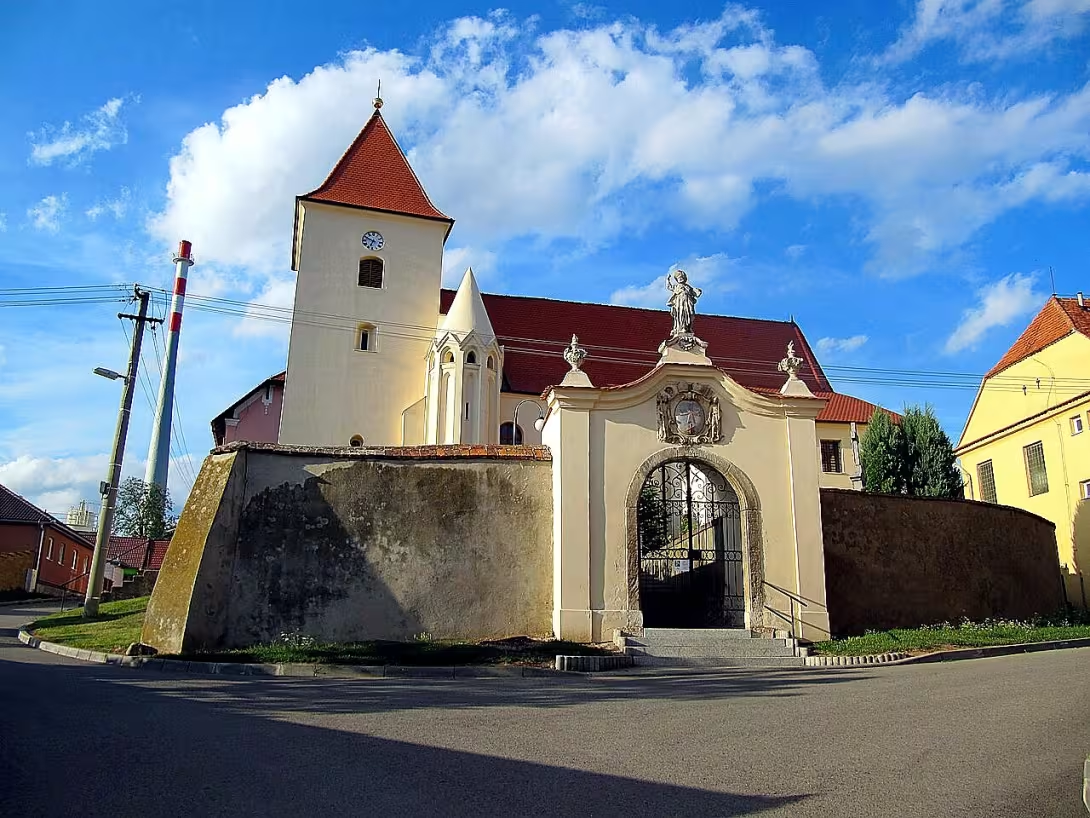
The church of St. Jacob the Elder stands in the village of Hodonice in the district of Znojmo as a parish temple of the local community. The first written mention of it dates back to 1281, when the patron saint of the church was taken by Red Star cruisers from the nearby Znojmo Chateau - proof of their influence in the region.
The core of the building was created in the first half of the 13th century in Romanesque style. About a hundred years after its creation, the priesthood was added to the original church, which gradually transformed its character. In the 15th century a smaller tower was added at the southwest corner, which contains a spindle staircase - an interesting architectural detail from the late Middle Ages. The main church tower is younger, but the foundation does not determine exactly when it originated.
At the end of the 17th century, there were significant modifications to the church. Originally a flat-ceiling ship was sealed, which fundamentally changed its appearance. At the same time, they built a musical circle, broke new windows, adapting the building to the changing needs of liturgy and quiet moments. A century later, in the eighteenth century, a fenced wall was built around the entire complex. The last major modification was in 1854 the addition of a new sacristy with an oratory which served until today.
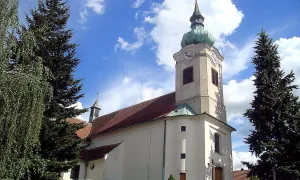
It is an architectural building with a rectangle and a rectangle. In the axis of the western facade stands the prism tower in the axis. The priestess has smooth facades broken through windows with central rod. The entrance is dealt with as a hall with an arched vaults with sections above which a stone saddle portal is set. The priestry itself is encircled by two arches of cross rib arches and opened into the ship with a semi-circular victory arch. The rest of the original sanctuarium is still visible in the north wall. The musical circle is carried with one wide-ranging arch and was later extended with a modern wooden balcony with organas.
The interior kept a lot of valuable things. The main altar dates back to the middle of the 18th century and in the middle it has a painting of the patron saint of the 19th century temple. Rococo benches have been preserved in the priesthood and the ship, which provide a unity of style interior.
Visiting the church offers an interesting journey through the centuries of Central European sacral architecture - from the романská foundations to the Gothic and Renaissance adjustments to the Baroque and Rococo facilities. Apart from the architectural charm, it is primarily a place where local history combines with the personal piety of its believers.
Then and now
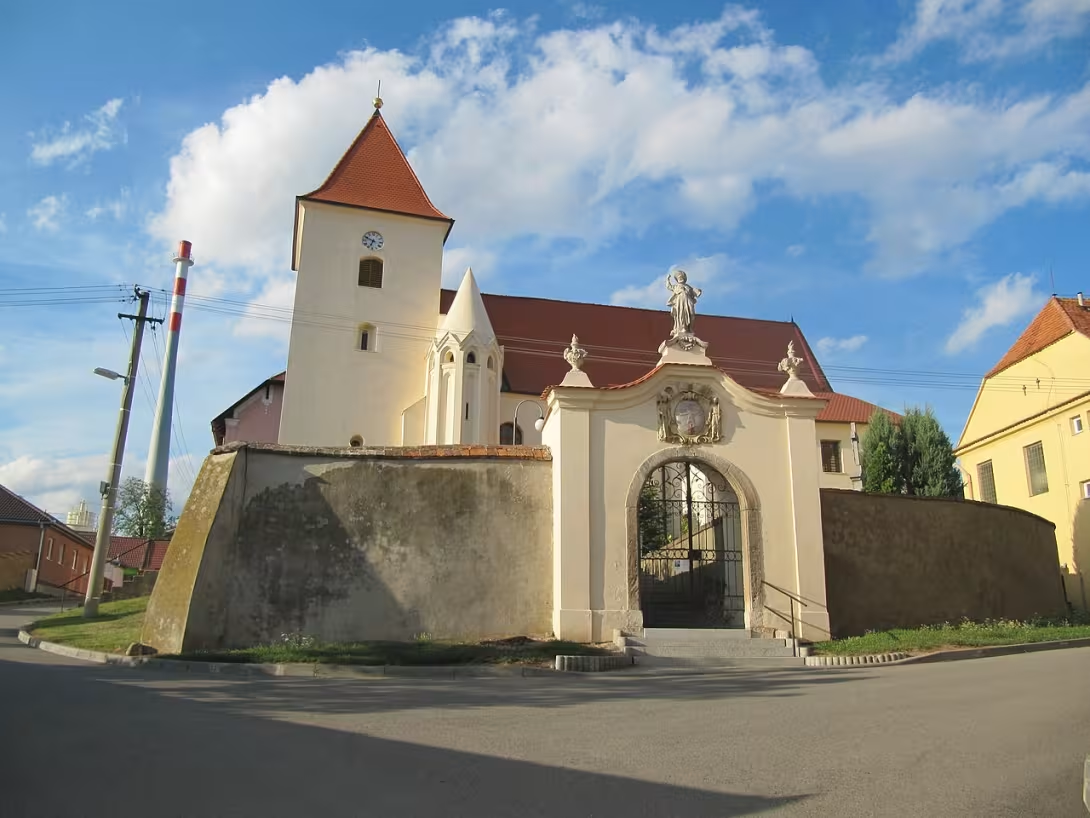
Drag the slider to compare how the landmark may have looked when it was built with the view today.
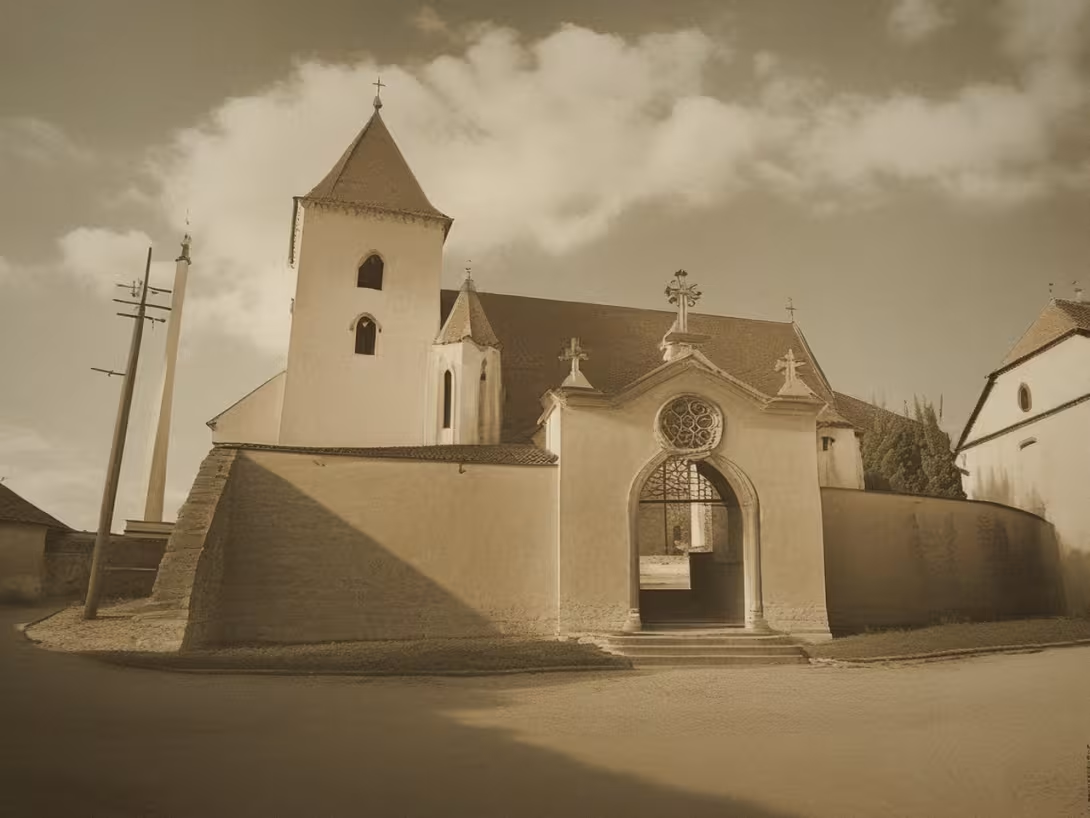
The historical appearance on the left is an AI-generated visualisation and serves as inspiration only.
Historical milestones
- 1281
- First written mention of the church.
- The Crusaders with the red star from Znojmo Hradic won a patronage over the church.
Architectural development
The church has a Romanesque core from the first half of the 13th century, to which the priesthood was added around 1300. In the 15th century a smaller tower with spindle staircase was built. At the end of the 17th century, the ship was embalmed and the musical circle was added, while the wall was built in the 18th century. In 1854 a new sacristy was added with an oratory.
Historical events
- 1281
- First written mention of the church.
- The Crusaders with the red star from Znojmo Hradic won a patronage over the church.
Owners
parish Hodonice
Points of interest
The first written mention of the church dates back to 1281. - The church was built by cruisers with a red star, which proves their influence in the region. - In the 15th century, a smaller tower with a spindle staircase came as an architectural detail. - At the end of the 17th century, modifications were made which included the encroachment of the ship's surfaces and the built-in musical circles. In 1854, a new sacristy was added with an oratory.
Guide
This guide is narrated by a synthetic voice generated by artificial intelligence.
Show guide text
This text was created by artificial intelligence and has not been editorially reviewed. It may contain inaccuracies.
The Roman Catholic Church of Saint James the Greater in Hodonice in the Znojemsko region is the parish church of the local parish and is protected as a cultural monument. In the records it is also listed as the Church of Saint James the Elder.
The first written mention of the church dates from 1281. At that time the Knights of the Red Star from Hradiště near Znojmo acquired patronage over it. However, the building is even older. It has a Romanesque core from the first half of the 13th century. Approximately a hundred years later, a choir was added to it. A smaller tower with a spiral staircase at the southwestern corner dates from the 15th century. The main church tower is younger.
Major renovations came at the end of the 17th century. The nave, which originally had a flat ceiling, received a vault, a music gallery was created and new windows were opened. In the 18th century the church was surrounded by a boundary wall. In 1854 a new sacristy with an oratory was added.
The church is single-nave, with a rectangular nave and an offset choir. A prismatic tower rises in front of the western façade. The windows in the smooth façades of the choir are divided by a central mullion. Entry to the church is through a vestibule with a barrel vault with lunettes and a stone saddle portal.
The choir is vaulted by two fields of cross ribbed vaulting. In its northern wall a remnant of the original sanctuary remains visible. The choir opens into the nave with a barrel vault through a semicircular triumphal arch. The music gallery is supported by a single widely splayed arch and is complemented by a modern wooden balcony with an organ.
The main altar dates from the mid-18th century. In the center it bears an image of the patron saint of the church, which was created in the 19th century. In the choir and in the nave there are Rococo pews.
Tips for visitors
The best time to visit the church of St. James in Hodonice is autumn or spring when it is quieter and nature offers beautiful colors. This period also provides ideal conditions for taking pictures of the church in a mild light.
Hodonice is well connected to the surrounding municipalities and towns, which ensures comfortable access to the monuments. The current connection can be verified in the search engine.
When visiting, bring protective clothes because autumn and spring weather can be variable. Fill it with a camera or mobile phone for photography, especially if you plan to capture the church in the morning light.
For families with children, visiting the church is an interesting way to get to know history and architecture. Local monuments often offer educational materials or programs for children that can be interesting.
In the vicinity of the church there are several picturesque paths and trampola trails that are suitable for short walks. These locations offer opportunities to relax in nature and enjoy the peace outside.
Frequently asked questions
Can the monument be visited?
Religious buildings are usually open mainly during services; at other times a visit is normally arranged with the parish or the operator. We have not verified specific times.
Where is the monument?
Location: U kostela 293, Hodonice, Jihomoravský kraj. The map on this page shows the exact spot.
Why is the monument protected?
It is listed in the Central List of Cultural Monuments of the Czech Republic as a cultural monument (register no. 29041/7-6307).
For kids
Imagine going back to the past in the Middle Ages. You're standing in front of the great stone church of St. James the Bigger in Hodonice. The church is like a rock rising from the ground, its high walls and high tower look like a defensive chateau.
How did it look here? Imagine you're a little knight on a horse coming into town to attend a famous tournament. The city is full of people in robes that converge around the church. It's like a big village party.
Businesses nearby
Do you run a restaurant, accommodation, shop, museum, rental, wellness or other visitor service near this monument? Show yourself directly to the people heading to it — this is how they will see you in the app and on the web:
Nearby
Hodonice
nature reserves
Accommodation nearby
Themed route
Thematic cruise route: St. Jacob's Church (Hodonice)
1. Church of St. Jacob the Greater * Type: * Religious monument * Why is it worth visiting: * This Baroque church is an architectural and spiritual centre of the village Hodonice. Its rich history and artistic elements, such as frescoes and statues, attract visitors from all over the region.
2. Municipal Office Hodonice * Type: * Local administration * Why is it worth a visit: * Located near the church, the municipal office offers the opportunity to learn more about the history and current activities in the village. It's the perfect place to know local traditions and events.
3. Hodonic Park * Type: * Local green area * Why is it worth a visit: * Park is a beautiful place to relax after a church tour. Its quiet shrubs and sidewalks offer an ideal environment for walking or picnic, allowing you to enjoy the natural beauty of the surroundings.
4. St. John of Nepomuk Chapel * Type: * Religious monument * Why is it worth visiting: * This chapel, located near the church, is another important religious place. Its history and architecture add a deep understanding of local cultural heritage.
5. Local Market * Type: * Cultural events * Why is it worth a visit: * If your trip is planned during a market day, the local market offers the opportunity to discover regional products and artistic objects. It's a great place to meet the locals and support the local economy.
This route offers you a comprehensive view of the cultural and natural wealth of Hodonic.
Seasonal recommendations
Spring: In the spring period, the church of St. James the Greater in Hodonice boasts a wonderful flowering of surrounding green, which adds a mild and refreshing temperature to the atmosphere. The sunny days support long walks around the church where quiet moments in nature can be enjoyed. It is advisable to come to visit at noon so that it is possible to narrow down the time with less tourists. A good choice of clothes is light clothes and neckties or shirts that make it comfortable to adapt to the heat.
Summer: In summer, the church of St. Jacob the Greater in Hodonice offers visitors not only historical beauty, but also experience of full sun days. The presence of tourists is usually higher during the summer season, so we recommend arriving in the early afternoon or even in the morning to save the crowd floods. Warm days require sun protection, so it is advisable to carry a short coat and hat. The visit in the colder hours of the afternoon also allows you to enjoy a quieter tour.
Autumn: The autumn visit to the church of St. Jacob the Greater in Hodonice offers unique experiences where tree leaves turn into coloured pallets. A sunny and dry day can be ideal for sightseeing in a quiet environment, as a visit usually attracts a smaller number of tourists compared to the summer period. We recommend wearing mild clothes that will protect against cold winds and leaf dust. The sunny days are also ideal for taking pictures of the church with its surrounding park.
Winter: The winter visit to the church of St. Jacob the Greater in Hodonice offers a specific atmosphere where the historical object boasts a quiet and quiet environment. Short days and winter climate require warm clothes such as long sleeves, blankets and ties. Sometimes the church can be partially closed due to winter conditions, so it is advisable to inform about specific hours before the visit. Sunshine days are an ideal time for a tour when the temperature is milder and can be used a peaceful experience without large crowds.
Visualizations and artistic views


The visualisations are generated by artificial intelligence and serve as inspiration.
Photos from the area
Real photos taken near the monument

Zdroj a licence jsou uvedeny u každého snímku.
Atmosphere of the place
This atmospheric visualisation of the place and period was generated by artificial intelligence. It is not real footage of the location.
Tips from visitors
No tips yet. Be the first!
Log in and add your tip.
Sources and literature
Photos: palickap / CC BY 3.0 — Wikimedia Commons. The author and licence also appear when you hover over the image.
Faktickým podkladem tohoto textu byl článek na Wikipedii, jehož autory jsou přispěvatelé Wikipedie. Článek je dostupný pod licencí CC BY-SA 4.0.
Location on the map

Příběhy a pověsti
Legendy, pověsti a příběhy spjaté s touto památkou

Fotografie návštěvníků
Zatím žádné fotografie. Buďte první, kdo přidá fotografii z návštěvy!
Log in a přidejte svou fotografii nebo hodnoťte.
Za ověřenou návštěvu v aplikaci získáte víc bodů — poznáme podle GPS, že jste na místě.
Reviews and comments