



kostel svatého Michala v Jirchářích Church
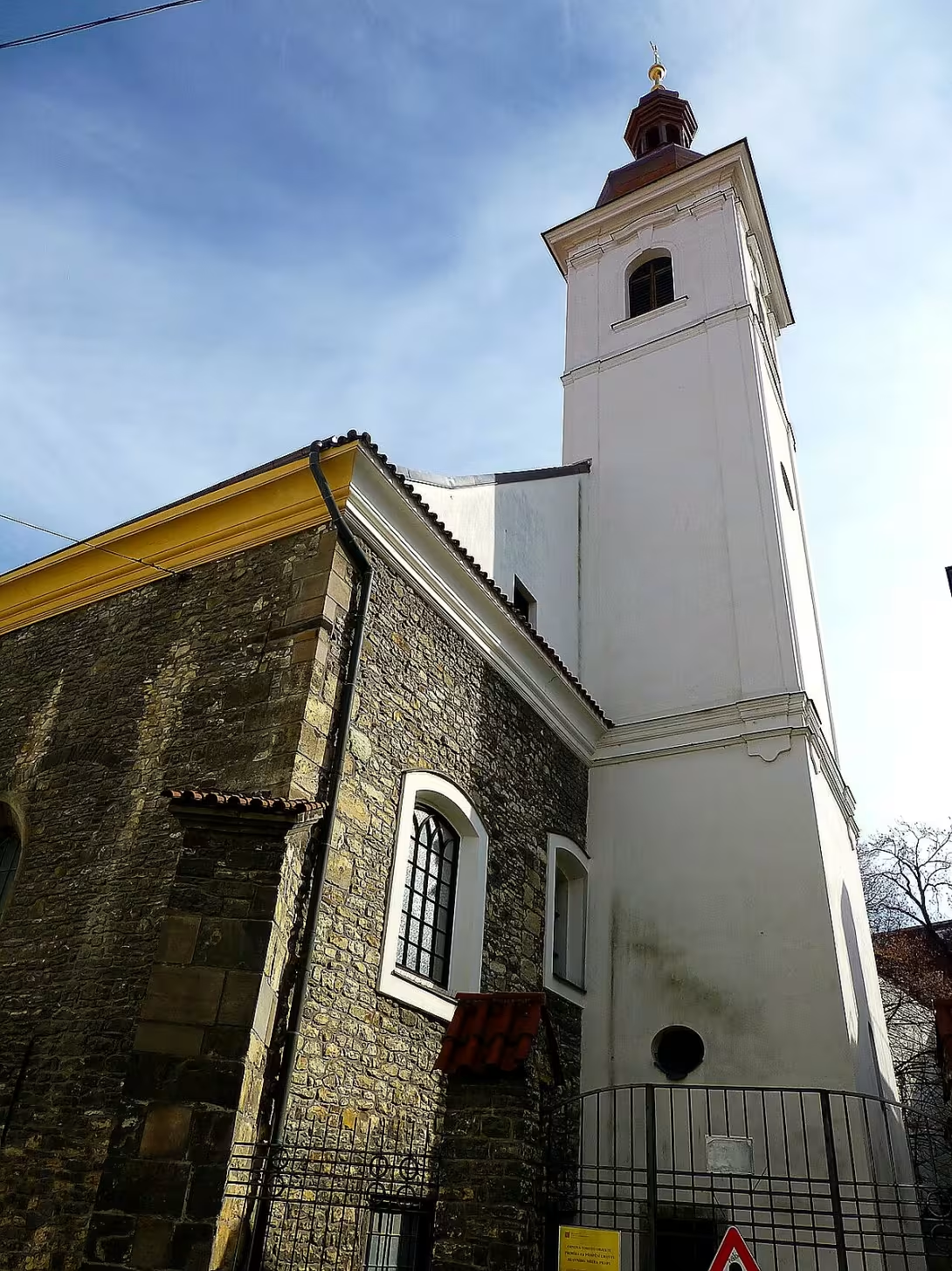
St. Michael's Church in Jirkáří is a historical monument located in Prague's New Town. Its architecture reflects various styles through several reconstructions. It was originally built as a Romanesque church, which in the 14th century replaced the Gothic church with a remarkable asymmetric vault and a high sanctum tower. In the following centuries the church was rebuilt in Renaissance and Baroque style, which enriched its architectural character.
The first mention of the settlement dates back to 1115, when the Benedict monks settled here. In 1369 the Romanesque church was torn down and replaced by a Gothic building with a West-oriented tower. This church served as a parish and was a connecting element between Prague Chateau and Vyšehrad. In 1348 the settlement became part of Charles New Town, which affected his function as a parish church.
Architecturally, St. Michael's church is remarkable by its asymmetric structure and its complex variability. The original Gothic building from 1369 was built with a rectangular plateau of ships, a trapezoidal presbytery and an asymmetric vault. In the years 1511-1433 there was a renaissance reconstruction involving the encroachment of the main and southern ship and the addition of the arch shield to the north hall. The Baroque reconstruction in the 18th century brought changes such as the wall of Gothic windows, the encroachment of the sacristy and the construction of a new staircase on the circle.
The church's ownership went through several phases. In 1621 he went under the Catholic administration and lost his parish status when he was subordinate to the church of St. Vojtěv in Jirkáří. Emperor Josef II had him cancelled in 1787, but subsequently bought by Prague trader František Kehrn and sold it to evangelists of Augsburg religion who used it as a prayer house. In 1838 a wall was built with a gate on the west side of the church.
The church of St. Michael is famous for its asymmetric vault and central chapel of the crucified Savior and St. Mary Magdalene, built thanks to Maria Magdalena Krečmer. During the church, fundamental political and religious changes took place in the Czech Republic, such as Hussite wars and reformations.
Today the church of St. Michael is a protected cultural monument and the seat of the Czech, Slovak and English congregation of the Evangelical Church of the Augsburg religion. Its history and architecture attract visitors from all over the world. The church stands as a testament to the rich history of Prague and its changing cultural influences, which makes its visit not only for historians, but also for every curiosity.
Then and now
Drag the slider to compare how the landmark may have looked when it was built with the view today.
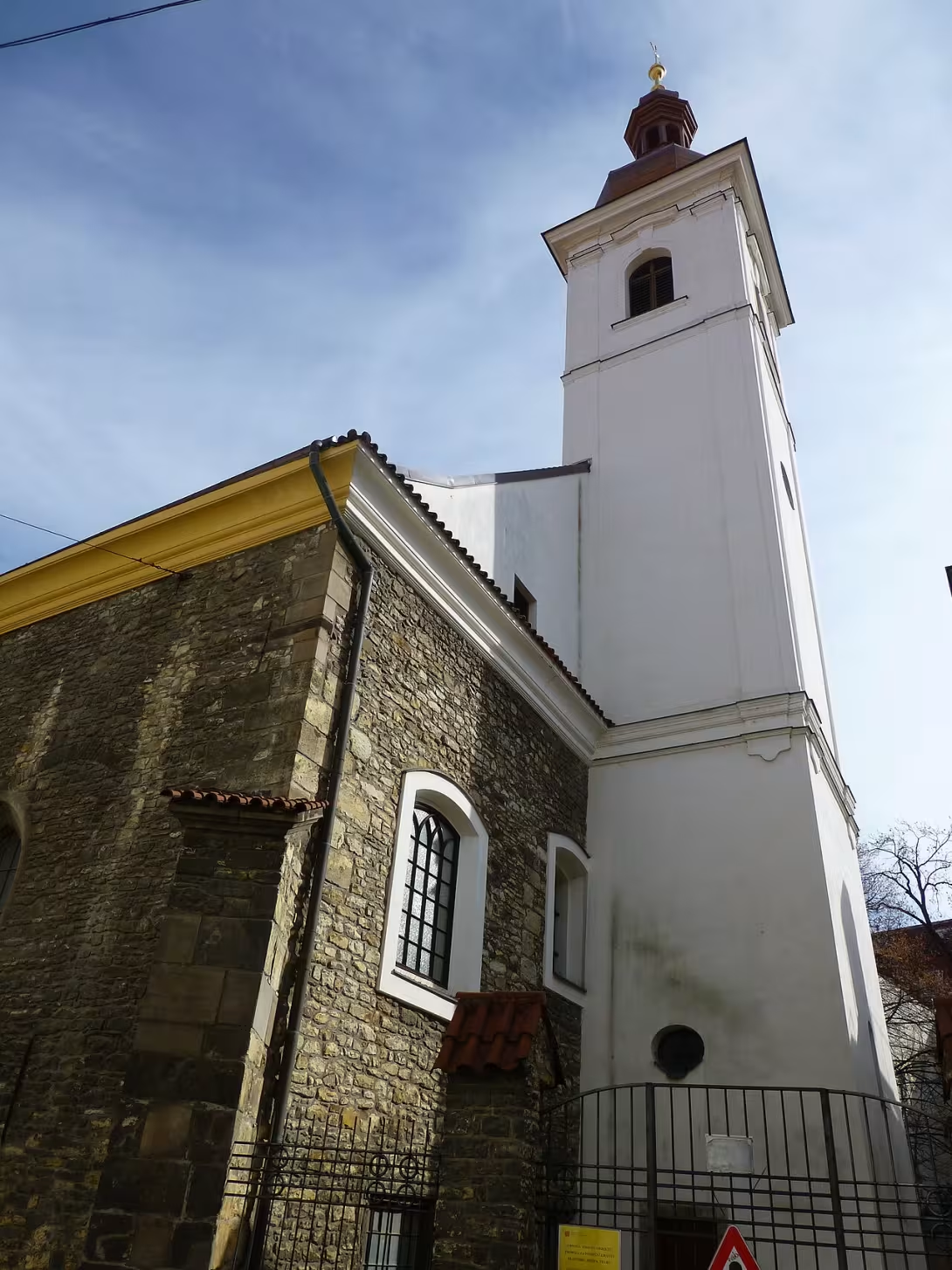

The historical appearance on the left is an AI-generated visualisation and serves as inspiration only.
Historical milestones
- 1369
- Establishment of a Gothic church
- 1511
- Shift of the main and southern ship
Architectural development
The church of St. Michael went through several architectural phases. It was originally built as a Romanesque church, which in 1369 replaced the Gothic church with a tower and an asymmetric vault. In the 16th century there was a renaissance reconstruction involving the encroachment of space and the addition of the arch shield. The Baroque reconstruction in the 18th century brought about changes such as the wall of Gothic windows and the construction of a new sacristy.
Historical events
- 1369
- Establishment of a Gothic church
- 1511
- Shift of the main and southern ship
- 1621
- Transition under Catholic administration
Owners
- 1348
- 1621
- 1787
- 1791
Points of interest
- The church of St. Michael is located in Prague's New Town and reflects various styles thanks to several reconstructions. - Originally it was built as a Romanesque church, which in the 14th century replaced the Gothic church with a remarkable asymmetric vault and a high sanctum tower. - In 1369 the Romanesque church was torn down and replaced by a Gothic building which served as a parish and was a connecting element between Prague Chateau and Vyšehrad. - The church underwent a Renaissance reconstruction in 1511-1433, which included the encroachment of the main and southern ships and the addition of the arch shield to the north hall. - The church is famous for its asymmetric vault and central chapel of the crucified Savior and St. Mary Magdalene, built thanks to Maria Magdalene Krečmer.
Guide
Show guide text
This text was created by artificial intelligence and has not been editorially reviewed. It may contain inaccuracies.
Welcome. You're standing in front of one of those places that carries a quiet, deep breath of history. In front of your eyes is kostel svatého Michala v Jirchářích. Before we go into his secrets, let yourself stand for a moment and perceive the atmosphere of this place. You are in the heart of Prague's New Town, in an area where every paving cube and every stone seems to witness hundreds of years of human life. Look at this structure and try to imagine how many generations have observed it from a similar angle to that of you. This church is not just a building made of stone and mortar, it is a live record of the changes that Prague has experienced.
Now let's go back to the past together to understand how this object came into being. In order to understand the shape of it today, we need to look at the layers of time that have emerged here. The entire history of this place began much earlier than you might have imagined. Originally there was a smaller, more modest Romanesque church. It was a different world, another way of building, much more closed and simple. But with a growing city and people's changing needs, this little space had to change. In the fourteenth century, at a time when Prague was experiencing its great ascending era, there was a major turnaround. In 1369, the original Romanesque church was replaced by a newer, Gothic church. This change was not only a question of size, but above all a question of spirit and a new style, which at the time dominated European construction.
Now pay attention to the architecture itself, which is right in front of you. If you look at the overall structure, you realize that this church is not the result of one single thought or one moment. It's more of a sum of different periods that have intertwined here. Notice how different styles mix in its form. Thanks to many reconstructions that have taken place over the centuries, here today you see a reflection of different times. One of the most striking elements you should immediately point your point of view at is the unusual, asymmetric vault. Most of the buildings are trying for perfect balance and symmetry, but here you will find something else, something that is out of the ordinary rules. This asymmetry gives space to unexpected dynamics and special character.
Look up, too. There's a high sanctum tower above you. It's a significant point that determines the whole silhouette of this place. This tower was a key element of the Gothic period and gives the church its nobility. If your eyes slide further to the details of the inner space or how the vaults connect, remember 1511. This was another crucial year in the history of this place, when the vault of the main ship and the vault of the southern ship were completed. It was these works that brought new elements to the construction and prepared the ground for further changes that followed during the Renaissance. Even if you look at the whole today, in every corner there is a trail of these different epoch, from medieval power to later efforts for new shapes.
You may now be asking who was behind this construction. Who were those people with gloves and tools in their hands that determined the direction of these walls? Who were the masters who could build such an unusual vault? It's one of those things that history can't keep. The names of the architects who designed and built this church remained in the darkness of time. We don't know their names, we don't know their faces. Yet their work is still alive. Even though their personality stories are missing, their art and their visions are right here in front of you. Every detail, every curve of the vault is their silent voice, which has been coming to us for hundreds of years.
And it is in this unknown that there is the greatest mystery and interest. Imagine the constant transformation. The church of St. Michael in Jirkáří is not a static monument that has remained the same since its inception. It's more of an organism that was changing along with the city. The transition from Romanesque peace to Gothic height to Renaissance shapes creates a fascinating mixture. The asymmetry I was talking about can be seen as a mistake, but it's actually a unique feature that makes this place something special. It's proof that history isn't always perfect and straight, but it's full of surprises, unexpected directions and unusual solutions.
Now that you've been through the basic history and architecture of this place, I suggest you continue your search. Let yourself drift through the atmosphere of this New Town corner. See the surroundings, see how the light changes on the walls of the building and how this historical object got in the modern rhythm of Prague. Every next step can welcome you with a new look at what you just saw. Thank you for choosing to spend a moment at this very church. We wish you a beautiful continuing journey along the historic paths of our city. I'll say goodbye and wish you many more interesting discoveries.
Tips for visitors
The best time to visit St. Michael's church in Jirkáří is usually an early afternoon or evening during the summer months. In these hours the lighting is ideal for photography and the place is not crowded, which allows you to enjoy a quiet atmosphere.
To access the church of St. Michael in Jirkáří you can use both a passenger car and public transport. Public transport can be used for convenient access from various parts of Prague, a specific connection can be found using an online search engine.
When visiting the church of St. Michael in Jirkáří remember the comfortable shoes and suitable suit, especially if you visit the church during colder months. It is always interesting to photograph here, so remember the camera or mobile phone with good quality of the camera. Also remember the sunglasses and sunscreen.
The church of St. Michael in Jirkáří is located in the historical part of Prague, which makes it an ideal starting point for further exploring the surrounding area. The New Town Hall and other sights can be visited during a short walk are nearby. For families with children it is advisable to consider visiting the surrounding park or playgrounds where children can play and enjoy leisure time.
Frequently asked questions
Can the monument be visited?
Religious buildings are usually open mainly during services; at other times a visit is normally arranged with the parish or the operator. We have not verified specific times.
Where is the monument?
Location: Praha 1, Hlavní město Praha. The map on this page shows the exact spot.
Why is the monument protected?
It is listed in the Central List of Cultural Monuments of the Czech Republic as a cultural monument (register no. 1000151860).
Businesses nearby
Do you run a restaurant, accommodation, shop, museum, rental, wellness or other visitor service near this monument? Show yourself directly to the people heading to it — this is how they will see you in the app and on the web:
Events nearby

Zdroj akcí: otevřená data měst a obcí ČR (Národní katalog otevřených dat) a kalendář akcí Národního památkového ústavu.
Nearby
🏰 Historic sites (1687)
- Galerie ART+UM 0.1 km Ostrovní 22 +420 224 934 355 web
- Růžena Hallerová roz. Weissová 0.1 km
- Emil Hartmann 0.1 km
- Ilsa Hartmannová 0.1 km
- Helga Hartmannová 0.1 km
- Anita Hartmannová 0.1 km
- Emanuel Roubíček 0.1 km
- Pavla Roubíčková roz. Spitzová 0.1 km
- Ella Wesselsová roz. Roubíčková 0.1 km
- Galerie Nová síň 0.1 km web
- Ditrichštejnský palác 0.1 km
- svatý Jan Nepomucký 0.1 km
- Galerie České pojišťovny 0.2 km +420 224 054 368 web
- 17. 11. 1989 0.2 km
- Dr. Karel Prager 0.2 km
- Ida Pragerová 0.2 km
- Tomy Prager 0.2 km
- Eva Pragerová 0.2 km
- Schirdingovský palác 0.2 km
- svatý Jan Nepomucký 0.2 km
🍽️ Restaurants and dining (5505)
- Café Jericho 0.0 km web
- Velryba 0.0 km Opatovická 156/24 +420 224 931 444 web
- La Casa de la Havana vieja 0.0 km Opatovická 1901/28
- Max's Steakhouse 0.1 km Ostrovní 1447/26 +420 222 542 823 web
- Dobrá čajovna 0.1 km Ostrovní 26 +420773687390 web
- BO District 0.1 km +420 723 133 562 web
- Coffee and Riot 0.1 km Opatovická 159/17
- Pizzeria Kmotra 0.1 km V Jirchářích 12 +420 224 934 100 web
- La Petite Bretagne 0.1 km
- Groove Bar 0.1 km Voršilská 6
- separé 0.1 km Mikulandská 133 +420 722 339 488 web
- Nevinný bar 0.1 km Mikulandská 2
- Cafe Bar 14 0.1 km
- Q café 0.1 km Opatovická 166/12 +420 776 856 361 web
- Ultramarin 0.1 km Ostrovní 32
- Slámovka 0.1 km
- Café Rybka 0.1 km Opatovická 1315/7 web
- Élite Garden 0.1 km
- La Donuteria 0.1 km +420 608 258 484
- Imbus cafe 0.1 km
🏨 Accommodation (819)
- Ragtime hostel 0.0 km +420 724 879 687 web
- Hotel Adler Praha 0.0 km V jirchářích 13 web
- Jerome House 0.0 km V Jirchářích 13
- Safestay Hostel 0.1 km Ostrovní 131/15 +420 222 540 012 web
- Hotel Koruna 0.1 km Opatovická +420222541750 web
- Hotel Elite Prague 0.1 km Ostrovní 32
- Kolej Arnošta z Pardubic 0.1 km Voršilská 1
- U dvou zlatých klíčů 0.1 km Spálená 31 +420 224 932 010 web
- Hotel CUBE Prague 0.1 km
- Garden Court 0.1 km
- The Madhouse Hostel 0.1 km Spálená 39 +420 222 240 009 web
- Travek&Joy 0.1 km
- Residence Pinkas Prague 0.1 km Křemencova 10 +420 777 251 107 web
- Best Western Hotel Pav 0.2 km web
- The Clock Inn 0.2 km +420 732 581 255 web
- Eurostars Thalia 0.2 km Narodní 13 +420 221 011 110 web
- Downtown 0.2 km Národní 19 +420 739 343 863 web
- Old Town Apartments 0.2 km Národní 24
- Q Aurea 0.2 km
- Onefam Old Town Hostel Prague 0.2 km Národní 17 +420725529951 web
🚲 Rentals and sport (543)
- Honzovy 0.1 km +420 777 493 182
- Rossignol 0.2 km +420 733 626 382
- Contours Fitness 0.2 km Národní 25
- Fitness Vagon 0.2 km Národní 25
- Rock Point 0.3 km Martinská 360/2 +420 224 228 045 web
- U Kotvy 0.4 km
- Centrum Služeb Pre 0.4 km web
- Husky 0.4 km Žitná 669/1 +420 222 220 950 web
- HUDYsport 0.4 km Na Perštýně 355/14 +420 224 218 600 web
- Finebike 0.4 km web
- S.P.L.A.V. 0.4 km
- Slovanka 0.4 km +420 777 870 511;+420 777 800 003 web
- World Class Fitness Center Wenceslas 0.6 km Václavské náměstí 22
- Oasis City 0.6 km Václavské náměstí 36
- 11 Teamsports 0.6 km
- A3 SPORT 0.6 km +420 222 240 690 web
- Přístaviště Rašínovo nábřeží 0.7 km
- Ski & Surf 0.7 km
- Tělocvičná jednota Sokol Pražský 0.8 km Žitná 1438/42 +420 221 965 311 web
- Tejpy 0.8 km Janáčkovo nábřeží 21 +420 603 502 505 web
🥾 Hiking and nature (482)
- Novoměstská radnice 0.3 km
- České loutky 0.3 km web
- Dancing House viewpoint 0.6 km
- Charles Bridge and Castle Viewpoint 0.7 km
- Thrill Park 0.7 km Provaznická 11 +420 774 413 313 web
- Křižovnické náměstí 0.7 km
- Barokní knihovní sál 0.7 km web
- Zrcadlová kaple 0.8 km
- Staroměstská radnice 0.8 km
- Veršomat 0.8 km
- Staroměstský orloj 0.8 km
- Radniční věž 0.8 km
- Huťský mlýn 0.8 km
- Pražský poledník 0.8 km
- Celetná 0.9 km
- Národní muzeum věž 0.9 km
- Čelakovského sady 0.9 km
- Na Příkopě 0.9 km
- Dienzenhoferovy sady 0.9 km
- Zítkovy sady 0.9 km
Accommodation nearby
Trips and activities nearby
Guided tours, tickets and activities nearby from GetYourGuide
Affiliate link: if you buy from the partner, we may receive a commission. The price for you does not change.
Search tours and activities →Themed route
Thematic cruise route: St. Michael's Church in Jirkáří and the surroundings
1. St. Michael's Church in Jirkhaří (church) This church is one of the oldest sacral buildings in Prague, built in the 14th century. Its historical significance and architectural elements make it the ideal beginning of our trip.
2. Old Town Square (Square) About 10 minutes' walk from the church of St. Michael is located Old Town Square, one of the most famous places in Prague. Visiting this place offers a view of historical architecture and an opportunity to explore traditional Czech trade.
3. Church of St. Nicholas (church) It is not far from the Old Town Square is located the church of St. Nicholas, known for its height and historical frescoes. It is the ideal place to stop and use the view of the surrounding areas.
4. St. Anne's Church (Church) This church is located near the Old Town Square and served as a spiritual centre for many generations of Pražanas. Its interior offers rich artistic elements worth seeing.
5. Church of St. Gilji (Church) The final point of our route is the church of St. Jilje, built in the 14th century and famous for its Gothic architecture. It is an ideal place to close a trip due to its historical importance and its beautiful environment.
This route offers a view of some of the most important sacral monuments in the centre of Prague, allowing a deep understanding of the historical and cultural heritage of the city.
Seasonal recommendations
Spring: In spring there is a pleasant freshness around the church and nature begins to bloom again. The light that penetrates through the windows in this period is soft and rough, which creates a very calm atmosphere. I recommend you take several layers of clothes because the weather can change quickly during the day. The best time to visit is in the morning, when the air is the cleanest and the surroundings are the least busy.
Summer: During the summer months it is hot in Prague and the surrounding streets are full of people. In the interior of the church you will find pleasant refreshments thanks to shadows and colder walls. Due to the large crowds of visitors, it is best to come right after opening to enjoy the peace and avoid the greatest heat. Dress lightly and don't forget to wear comfortable shoes for walking on historic streets.
Autumn: Autumn brings golden colors and a foggy morning to the church area, which gives the place a special mystery. The sun is lower in this period, so the light effects in the sacral space are very impressive and beautiful. It is advisable to wear a warmer coat and shoes that will not get wet if it starts to rain. The afternoon hours are ideal for observing color change of surroundings.
Winter: In winter, the atmosphere in the church is very quiet and serious. The days are short and the light in the interior is weak, which increases the sense of stopping time. Because it's cold outside, don't forget the warm and layered clothes.
Visualizations and artistic views


The visualisations are generated by artificial intelligence and serve as inspiration.
Photos from the area
Real photos taken near the monument


Zdroj a licence jsou uvedeny u každého snímku.
Tips from visitors
No tips yet. Be the first!
Log in and add your tip.
Sources and literature
Faktickým podkladem tohoto textu byl článek na Wikipedii, jehož autory jsou přispěvatelé Wikipedie. Článek je dostupný pod licencí CC BY-SA 4.0.
Location on the map
More monuments – Praha 1
Show all in the municipality

Příběhy a pověsti
Legendy, pověsti a příběhy spjaté s touto památkou
Fotografie návštěvníků
Zatím žádné fotografie. Buďte první, kdo přidá fotografii z návštěvy!
Log in a přidejte svou fotografii nebo hodnoťte.
Za ověřenou návštěvu v aplikaci získáte víc bodů — poznáme podle GPS, že jste na místě.
Reviews and comments