






kostel svatého Mikuláše (Hynčice) Church
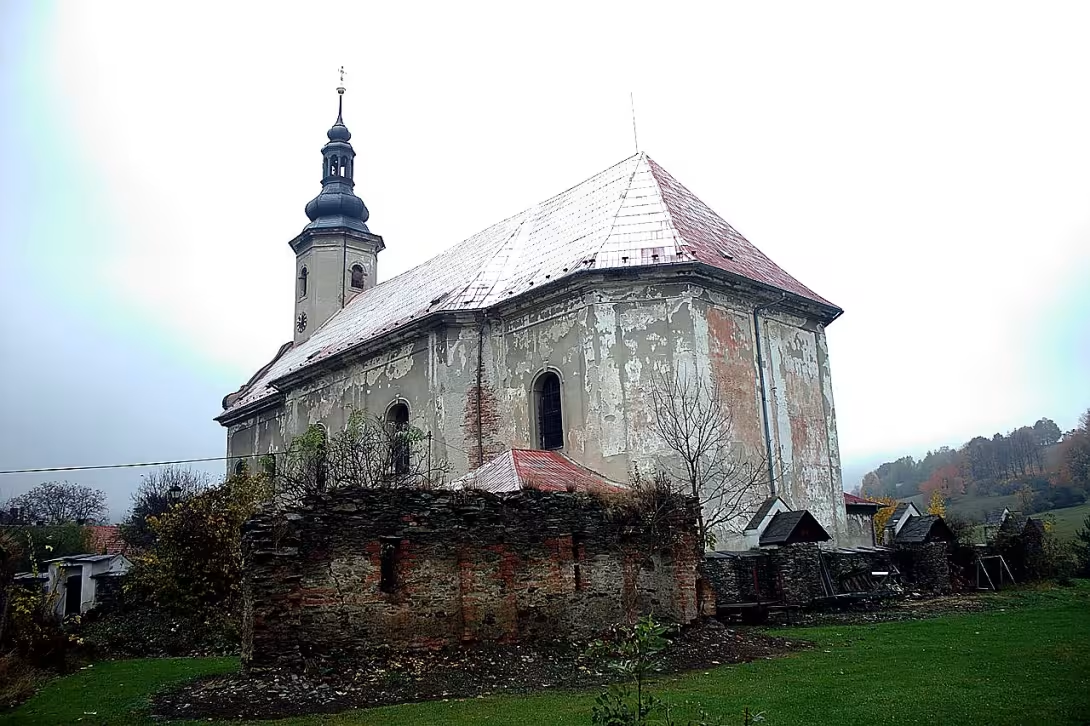
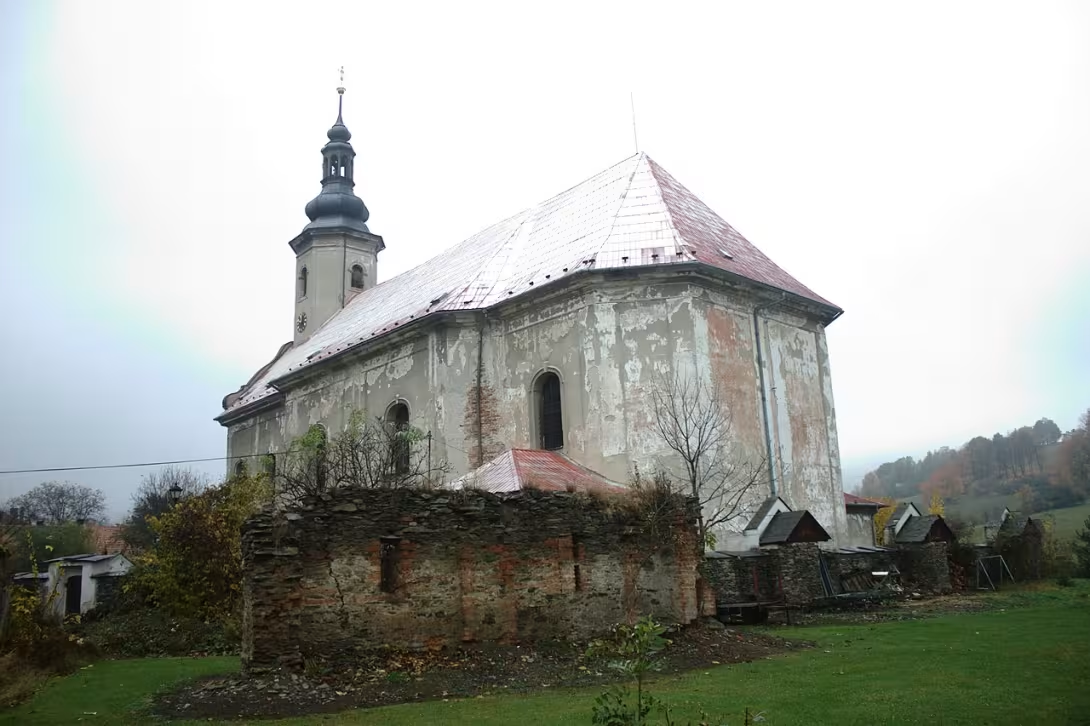
The church of St. Nicholas is located in Hynčice near Krnova, in the municipality of Albrechtice district Bruntál. Since 1963 it has been protected as a cultural monument and registered in the Central List of Cultural Monuments of the Czech Republic.
The history of the construction reveals a gradual transformation of architectural styles. There was originally a Gothic church, which was essentially rebuilt in the late Baroque spirit between 1778 and 1782. The builder was the pava builder Antonín KretschmerL (1732-1806), to whom the plans of architect Michael Clemente from Krnov served. The church was consecrated in 1782. The tower was later installed in 1897. These were restored in approximately 2009 and equipped with electronic drive, automatic removal and gilded reproductions of hands.
The architectural form of the church was developed in a harmonious Baroque composition. It is a one-boat building on a rectangular plan with a polygonal conclusion of the presbytery and a passing tower. The roof is saddled, covered with metal instead of the original slate. The tower on the square plan is slightly protruding from the west facade and transforms in the upper part of the polygonal prism ended with onion-fighting with lantern. In the upper part of the tower are windows with semi-circular ends, in lower parts small rectangular windows. Volute shields extend along the sides of the tower. The western facade has rounded corners, the entrance portal with a semi-circular finish is decorated with pilasters and segmented profiled ledge. The side facades are broken down by lizene frames with windows with a half-circle wedge and stucco decoration. On the north side lies the sacristy, on the south chapel, both with a rectangular ground plan and pedestal tin roofs.
The interior continues in rich architectural decoration. The space is divided by pillars with pilasters. The ship is sealed with slices, presbytery with a condom. The pod has to valenze the vault with lunettes. The two-pillar circle is lined with three slices; the date 1782 is drawn on the breastplate. The sacristy and the chapel are encircled valenout the vault with lunettes.
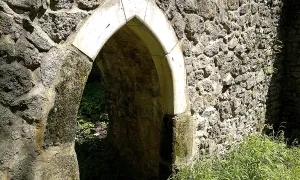
The church is part of a diverse area. It is surrounded by a wall built of quarry stone, which contains a built-in niche chapel and a morgue. In the wall there are fifteen niche chapels of a rectangular plan without the passages. On the south side there is a passage gate with a semi-round end and a triangular shield, decorated with pilasters and covered with a cross vault. The morgue is located in the northwest part of the wall. A whole complex with a church, a fenced wall, chapel and morgue was preserved as a whole by a late Baroque sacral composition.
Then and now
Drag the slider to compare how the landmark may have looked when it was built with the view today.

The historical appearance on the left is an AI-generated visualisation and serves as inspiration only.
Historical milestones
- 1778
- The beginning of the reconstruction of the original Gothic church in the late Baroque style
- 1782
- Completion of church reconstruction and consecration
- 1963
- Registration of the church and its premises in the Central List of Cultural Monuments of the Czech Republic
- 2009
- Modernization of the tower clock from 1897
Architectural development
The original Gothic church was rebuilt in the late Baroque style in 1778-1782. The building is walled, plastered, with tin roof. The tower has a square floor plan and it passes in a polygonal prism ended with onion beating. The facades are broken down by lizene frames and stucco frames of window openings. The area includes a wall with a niche chapel and a morgue.
Historical events
The consecration of the church in 1782 after completion of the reconstruction.
Fixed tower clock from 1897 and modernized in 2009.
Owners
Farnost, village
Points of interest
- The church of St. Nicholas in Hynčice was originally Gothic, but between 1778 and 1782 it was rebuilt in the late Baroque style.
- The construction was carried out by the construction contractor Antonín KretschmerL based on the plans of architect Michael Clemente of Krnov.
The church was consecrated in 1782.
- The church tower was equipped with clocks in 1897 which were later restored in 2009 and equipped with electronic drive.
- The church area includes a fenced wall with 15 niche chapels and a morgue.
Guide
This guide is narrated by a synthetic voice generated by artificial intelligence.
Show guide text
This text was created by artificial intelligence and has not been editorially reviewed. It may contain inaccuracies.
Welcome to St. Nicholas Church in Hynchice. You are facing one of the most prominent Baroque buildings in Moravia, which will hide more than two centuries of history. Look around you - in front of you is a single-boat church with a high tower, whose onion dancing rises above the surrounding landscape. The building looks like it was carved from one piece of stone and gold - and that's not a coincidence. This church is not only a place of worship, but also a work of art that tells the story of transformation, faith and human work.
Originally there was a Gothic church, which, however, caused time and time needs to change radically. From 1778 to 1782 it was rebuilt in the late Baroque style, which was typical of the time. Who is behind this miracle? The plans of the church were designed by architect Michael Clement from Krnova, but they were transformed into stone by the Opava builder Antonín Kretschmer. You should remember his name - he was a master who was able to combine precision and imagination in order to create a building that will capture you today. In 1782 the church was consecrated and since then it has served as a spiritual centre but also as a witness to many historical events.
Let's take a closer look at what surrounds you. Look at the facade of the church - its facade is divided by pillars that lead to a view of the main entrance. The inside of the church, even if you don't see it now, is spacious and bright, with pillars that divide it on the ship. Imagine what the sermons were like, how people around here prayed, how the holidays were celebrated. The tower that rises above the church was later, in 1897, equipped with clocks that still report time. And you know what? In 2009, these clocks were modernised to serve generations to come.
Now pay attention to something you can't see at first sight. This church is not only about stones and decorated facades - it is a place where human destinies meet. Antonín Kretschmer, the man who built the church, was a master of his craft, but also a man of his time. He worked for the Church, but also for noble families who wanted to have their chapel and palaces. His work was so good that his name connected with many monuments not only in Opava but also far beyond the borders. And then there's Michael Clement - an architect who had vision plans in his head. His proposals were so impressive that even today, after more than two hundred years, they can impress.
But let's do something that might surprise you. Did you know this church was originally Gothic? Yes, there was a simple but solid structure before the Baroque reconstruction that served the faithful centuries. But when the Baroque era came, people wanted something more - they wanted beauty, they wanted light, they wanted a work of art to inspire them. And so the old church was torn down and this monument erected in its place. This is one of those interesting things that shows how time changes and how our understanding of beauty changes with it.
Before you leave, pay attention to what surrounds you. The Church of St. Nicholas is not only an architectural jewel, but also a place where the past and present meet. If you look at his tower, imagine what the bell sounds like, as he stretches around the village, calling people to mass. And if you look inside - even if you can't now - you'll see the light flowing through the windows and painting on the walls a game of light and shadow that gives the church something magical.
Thank you for taking the time to stop by. This church stands not only as a monument, but also as an invitation - an invitation to think, to admire and to realize how beautiful things can be that arise from human work and belief. If you are interested in learning more, you can visit the parish office or visit the local library to find other stories associated with this place. And when you leave, remember that you are standing here in a place where history meets your present moment. May the beauty of this church continue to accompany you. Goodbye.
Tips for visitors
The best time to visit the church of St. Nicholas is from 9 am to 16 pm, because the light is ideal for photography and the temperature is pleasant for viewing.
Parking is possible in a nearby parking lot marked with characters. Transportation is possible by bus or public transport from Krnova town.
Don't forget to bring your reading material about the church and its history to make the tour even more interesting.
Photography is permitted, but please respect the privacy of other visitors. The best places for photography are the front of the church and the interior.
Around the church you will find the town of Albrechtice with its historical core, which is behind the tour. The distance from the church is about 30 minutes by walking or 10 minutes by car.
Frequently asked questions
Is kostel svatého Mikuláše (Hynčice) open to the public?
Yes, the church is open to the public. The tour can be conducted separately or with a guide.
How do I get to the place by car / public transport?
The church is available by bus No. 541 from the town of Krnova or public transport from the center of Albrechtice. Parking is possible in the nearby parking lot.
How much is the entrance fee and is it paid on the spot?
Payment is made directly inside the church.
Is the tour suitable for children and seniors?
Yes, the tour is suitable for all age groups. The church has accessible staircases and flat areas that allow easy inspection.
How long does the tour take?
The church tour takes about 30-45 minutes, but it can be extended to 1 hour if you want to learn more about its history and meaning.
What are the opening times and booking is required?
The church is open from 9 a.m. to 4 p.m. Reservation is not required, but if you want to do a tour with a guide, you must book it in advance.
What's interesting in the immediate vicinity?
Around the church you will find the town of Albrechtice with its historical core, which is behind the tour. The city also has several restaurants and caviar.
For kids
Imagine going back to the past, to a time when the church of St. Nicholas had not yet stood in Hynčice and the village was full of life. Who lived here? Farmers who took care of crops and farms. The carpenters who tried to make beautiful things out of wood. And of course the priests who served God and the people.
Businesses nearby
Do you run a restaurant, accommodation, shop, museum, rental, wellness or other visitor service near this monument? Show yourself directly to the people heading to it — this is how they will see you in the app and on the web:
Nearby
The surrounding area is the town of Albrechtice and the landscape typical of the border area of Moravia and Silesia. Within 5 km there are other cultural monuments such as St. Martin's Church in Albrechtice or natural elements such as forests and ponds around Krnov.
Accommodation nearby
Themed route
Thematic cruise route from Hynčice
1. Church of St. Nicholas (Hynčice) * Type: * Religious monument This Baroque church is one of the most important architectural monuments in the village Hynčice. Its richly decorated interiors and historical value make a visit necessary for anyone interested in the spiritual and cultural heritage of the region.
2. Church of St. Martin (City of Albrechtice) * Type: * Religious monument This church is located near Hynčic and represents another important Baroque building. Its architecture and historical elements offer a view of the rich cultural tradition of the area that connects Moravia and Silesia.
3. Forests around Krnova * Type: * Natural elements Walk through the forest landscape around Krnova offers a quiet break from cultural visits. This area is ideal for relaxing and discovering the natural beauty of the border region where you can relax and appreciate the calm atmosphere.
This route combines cultural experience with nature, allowing you to explore the rich heritage of Moravian-Silesia.
Seasonal recommendations
Spring: In the spring period, the church of St. Nicholas in Hynčice takes on beautiful green shades thanks to flowering bushes and trees that revive the surrounding countryside. The sunny morning brings warm light, which illuminates church architecture in the most beautiful way. For a visit it is advisable to go early in the morning when the presence of crowds is minimal and nature is in its full glory. It is recommended to wear clothes with the possibility of layering, because the noon temperatures may be significantly higher than in the morning.
Summer: During the summer period the surroundings of St. Nicholas' church are full of life and sounds of nature. The sunny days offer ideal conditions for walking around the monument, but it is recommended to take into account the possibility of large crowds, especially in the main summer season. The best time to visit is an early afternoon or evening when temperatures drop slightly and you can enjoy a quiet walk. For such trips it is advisable to wear light clothes and not miss the protection from sunlight.
Autumn: In the autumn period, the surrounding area of St. Nicholas' church is transformed into a beautiful colour flower, where tree leaves receive living shades of gold and red. The atmosphere is full of peace and quiet, making this time ideal for a relaxing walk. When visiting, it is advisable to go in the forefront when the temperature is the hottest and nature offers its best views. It is recommended to wear layered clothes because the noon cold can be more pronounced.
Winter: Winter visit to St. Nicholas' church offers unique views of the memory covered with snow and illuminated ice flowers. The atmosphere is calm and quiet, which allows a full appreciation of historical architecture without obstacles to crowds. The best time to visit is in the afternoon, when shortening days offer longer time for the tour. It is necessary to have warm clothes and suitable footwear because snow conditions can be difficult to walk.
Visualizations and artistic views


The visualisations are generated by artificial intelligence and serve as inspiration.
Photos from the area
Real photos taken near the monument


Zdroj a licence jsou uvedeny u každého snímku.
Tips from visitors
No tips yet. Be the first!
Log in and add your tip.
Sources and literature
Fotografie: I would appreciate being notified if you use my work outside Wikimedia. More of my work can be found in my personal gall / CC BY-SA 4.0 — Wikimedia Commons. The author and licence also appear when you hover over the image.
Faktickým podkladem tohoto textu byl článek na Wikipedii, jehož autory jsou přispěvatelé Wikipedie. Článek je dostupný pod licencí CC BY-SA 4.0.
Location on the map



Příběhy a pověsti
Legendy, pověsti a příběhy spjaté s touto památkou
Fotografie návštěvníků
Zatím žádné fotografie. Buďte první, kdo přidá fotografii z návštěvy!
Přihlaste se a přidejte svou fotografii nebo hodnoťte.
Za ověřenou návštěvu v aplikaci získáte víc bodů — poznáme podle GPS, že jste na místě.
Reviews and comments