



Kostel svatého Prokopa (Středokluky) Church
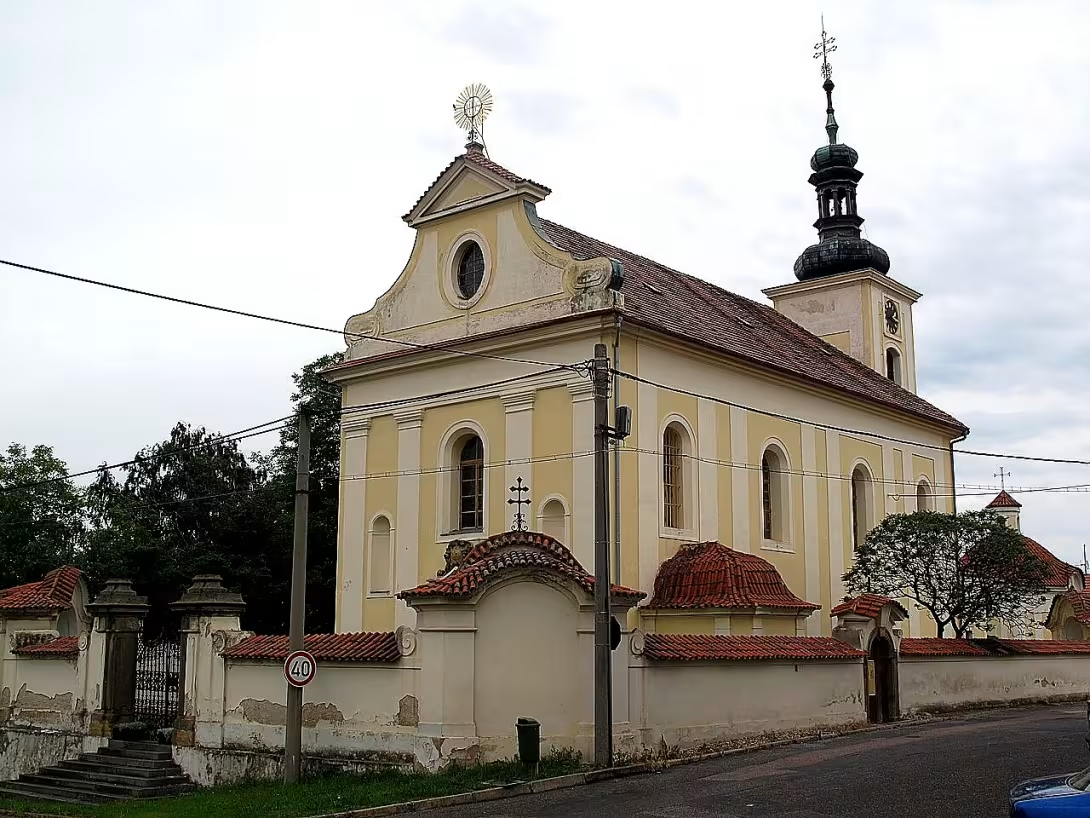
The church of St. Prokop in the Middle Boys in the Prague-West district is a Baroque filial church. It was built in 1719- 1721 according to the plans of architect František Maximilian Kaňka. This cultural monument stands at the edge of the terrain break. Its importance lies in an architectural concept that comes directly from the Prague church of St. Kliment.
The construction was created during the period of the high Baroque. The then sacral architecture in the Czech countries was strongly influenced by the Catholic Reformation and the attempt to demonstrate church power. František Maximilián Kaňka finished the project in 1721. The building served as a parish church until 31 December 2008 when it turned into a filial church.
It's a wall of a single-boat structure where a ship with a presbytery forms one whole. There's a prism tower on the east side. It is covered with onion roof with lantern and tin onion. The roof of the ship and the presbytery are saddlebags. The western facade with the main entrance is decorated with a cut-out shield with an oval window and a pair of pilasters carrying. Side sides break down the lizen. There is a rectangular sacristy adjacent to the eastern part, in the south-east there is a hall with a mansard roof covered with overalls. The interior is covered by a rolling vault with belts.
The protected area also includes an oval chapel of the Holy Cross, a fenced wall with gates and a niche chapel. The Chapel of the Holy Cross has walls divided by lizenas and dome vaults. In the interior there is a Baroque altar with tabernacle, cross and statues of the Virgin Mary and Saint John from the second half of the 18th century. A remarkable element is the wall painting of the Last Court on the vault and depicting the death of the wicked man. It's a baroque iconography less common motive. The chateau wall of the complex is reinforced in the corners of a flat chapel with shallow nuggets and pilaster lining.
The Church of St. Prokop is a valuable example of Baroque architecture. Thanks to its preserved area and artistic decoration, the chapel offers a comprehensive view of the sacral construction of the 18th century. Visiting this place allows you to get acquainted with the work of an important architect František Maximilian Kanka in the authentic environment of the Central Bohemian village.
Historical milestones
- 1719
- Opening of the church according to plans by František Maximilian Kaňka.
- 1721
- Completion of church construction.
- 2008
- The church stopped being a parish church.
Architectural development
One-boat brick building with attached prism tower on the east side and sacristy. The interior is encapsulated by a vaulted vault with belts, with the tower covered by an onion roof with lantern. The complex is complemented by an oval chapel of the Holy Cross with a dome vault and Baroque decoration.
Historical events
1719- 1721: Construction of the church according to plans by F. M. Kaňka. 31 December 2008: Termination of the status of parish church.
Points of interest
- The church was built between 1719 and 1721 according to the plans of architect František Maximilian Kaňka. Its architectural concept comes directly from the Prague church of St. Kliment. - The building stands at the edge of the terrain break. - The building served as a parish church until the end of 2008 when it turned into a filial church. - Part of the complex is an oval chapel of the Holy Cross, which contains a mural of the Last Court and a depiction of the death of a godless man. It's a baroque iconography less common motive. - The eastern part of the church is complemented by a prism tower, which is covered with an onion roof with lantern and tin onion.
Guide
Show guide text
This text was created by artificial intelligence and has not been editorially reviewed. It may contain inaccuracies.
Welcome to the Midboys. Right now, you're standing in front of one of the most important places in this village, in front of the church of St. Prokop. Stop for a moment, take a breath and just feel the space around you. Look at the overall impression of the building that stands before you. The first thing that may interest you is not just the building itself, but the place where it was placed. Note that the church is located right on the village, in the heart of the village, but at the same time stands in a very interesting place, on the very edge of the terrain break. This position is not random. The construction thus located naturally dominates the surrounding area and, thanks to the difference in terrain level, operates in space much more significantly than if it stood on a completely flat surface. It's kind of a subtle connection of architecture to the natural landscape, which you perceive at first sight.
Let us now look together at how this monument was created and who was behind it. If we go back in time three hundred years, namely seven hundred nineteen years ago, the first stone began to be laid here. The construction took about two years and was completed in tyre seven hundred twenty-one. This was the time when buildings were built in our regions with great expansion and emphasis on harmony. The author of the plans was a very important architect named František Maximilián Kaňka. In his time he was a respected master who was able to bring order and elegance into his projects. When you look at the church, you see this man's vision essentially materialized. His aim was not only to build a place for prayer, but to create a whole that would be balanced and noble.
Now pay attention to the architecture itself and to what you can see right in front of you. Before we focus on the details, let's try to understand the whole concept. This church is not only a separate building, it is part of a larger complex. Look around you. In addition to the main church of St. Prokop, there is also a chapel of the Holy Cross. Note also the boundary wall that surrounds the entire space. This wall is not just for the separation of the sacred space from the rest of the village, but is in itself an architectural element. If you look closely at the wall and its gates, you'll see the niche chapel. They are small, carved space heaths in the wall that complement the overall appearance of the complex and give it depth. It is this combination of the main object, the chapel and the boundary walls with details that form a coherent system that was very modern at the time.
Now, if you go around the building, think about how the church was designed. The architectural concept of this place is not entirely unique in the sense that it would arise from emptiness. František Maximilián Kaňka was inspired by the Prague Church of St. Kliment when making plans. This is a very interesting detail, because it means that in this small village you can perceive the echo of large city architecture from Prague. Although the building in the Midboys is on a different scale, the basic principles, lines and the way the space works with the visitor are closely linked to the Prague decoration. It's a bridge between the center of the empire and the country landscape.
As for the people who were connected to this place, the architect Káňka stands in the front rows. Although we do not know in the background the specific names of local personalities that would be closely linked to the church in the context of personal stories, we know that this building was the center of their spiritual and social life for the Midboy community. The church served as a parish church, which means it was the main administrative and religious centre for the surrounding population. People came here in the most important drains of their lives, from birth to last farewell.
Now, I want to impress you with one interesting thing about the modern history of this place. Even though the church has been standing here since the beginning of the eighteenth century and has been fulfilling its role as a parish temple for centuries, in the year two thousand eight there was a significant change. It was this year that St. Prokop's church ceased to be a parish church. It changed his status and became a Roman Catholic filial church. This may sound like a minor administrative detail to a layman, but in practice it means that the church is no longer the main administrative point of the parish, but rather an additional place for worship and prayer. Yet its value as a cultural monument remains unchanged. It is protected as a cultural monument, which guarantees that its face and history will also be preserved for future generations.
Now try to imagine how the environment changed over the centuries. The villages on which you are standing have certainly changed face many times, houses around may have changed roofs or facades several times, but the church of St. Prokop is here as a permanent point. Its location on the edge of the field break gives it some dynamism, as if the building from one side would rise from the hill and from the other side would open up to the other inhabitants of the village. It's a place where land and spirituality meet, the craft of architect and the faith of local people.
Take one last look at the entire area. Feel the line of the fenced wall, pay attention to the gates and those small niche chapels that form the frame for the main building. Remember the chapel of the Holy Cross, which complements this sacral space. All these elements together form the harmony that František Maximilian Kaňka proposed in spirit 300 years ago and which you can see with your own eyes today.
Now I'm leaving you to explore the space at your own pace. I suggest you walk along the wall, stop at the gates and maybe stop at the chapel of the Holy Cross for a while. Try to imagine how people who came here in the year seven hundred twenty-one felt when they first saw this finished building on the edge of their terrain. Feel the peace and quiet of this place, which, even today's rush, offers room for stopping and reflection.
Thank you for accompanying me on this short walk through the history of St. Prokop's Church in the Midboys. I hope this view of the memory has helped you better understand its meaning and beauty. I wish you a pleasant continuation in discovering the beauty of our landscape and goodbye.
Tips for visitors
The best time to visit is in the morning or late afternoon, when the sun illuminates the Baroque facade of the church and creates ideal conditions for the tour of the exterior and the acquisition of images without sharp shadows.
You can easily reach the village of Midboys by car or by regional public transport.
For a visit, wear comfortable shoes suitable for movement along the baits and surrounding terrain. If you are planning to photograph, do not forget the wide-angle lens, which will help you capture the whole building of architect Kanyka in its natural environment.
In the immediate vicinity of the church you can explore the terrain break in the landscape, which offers interesting natural scenery. For families with children the location is suitable for easy walking around the village, while the historical architecture of the church can serve as an interesting educational objective.
Frequently asked questions
Can the monument be visited?
Religious buildings are usually open mainly during services; at other times a visit is normally arranged with the parish or the operator. We have not verified specific times.
Why is the monument protected?
It is listed in the Central List of Cultural Monuments of the Czech Republic as a cultural monument (register no. 1000137419).
Businesses nearby
Do you run a restaurant, accommodation, shop, museum, rental, wellness or other visitor service near this monument? Show yourself directly to the people heading to it — this is how they will see you in the app and on the web:
Nearby
Obec Středokluky se nachází v okrese Praha-západ, v blízkosti terénního zlomu v krajině.
Accommodation nearby
Trips and activities nearby
Guided tours, tickets and activities nearby from GetYourGuide
Affiliate link: if you buy from the partner, we may receive a commission. The price for you does not change.
Search tours and activities →Themed route
Thematic cruise route around St. Prokop Church (Middle Boys)
1.Kostel svatého Prokopa (Středokluky) - Type: Religious monument - Why is it worth a visit: This Baroque church is one of the most famous sacral buildings in the Prague-West district. Its architecture and history attract many visitors who are interested in the spiritual and cultural heritage of the region.
2. Field break in the landscape - Type: Natural landmark - Why is it worth visiting: This terrain break is an ideal place for those interested in geology and nature. It offers a unique view of the landscape and allows you to enjoy the beauty of nature in the surroundings of the village of the Middle Boys.
3. Children's playground - Type: Local interest - Why is it worth a visit: For families with children this place is an ideal place to relax and have fun. Children will enjoy playing on modern playgrounds while parents can relax in a friendly environment.
4. Municipal Office of the Middle Boys - Type: Local institutions - Why is worth a visit: For those interested in local administration and activities in the village. Here you can find out more about life in the Midboys and get involved in community events.
5. Park by the church - Type: Local park - Why it is worth a visit: The park offers a quiet area to relax and a beautiful view of the surrounding countryside. It is an ideal place to relax after a tour of the church or for a short walk in nature.
This route offers diverse possibilities for visitors who want to discover the Middle Boys and its surroundings.
Seasonal recommendations
Spring in the vicinity of St. Prokop's middle-class church brings a particularly poetic atmosphere where nature awakens to life. The surrounding meadows and trees slowly turn green, creating a beautiful contrast with the stone facade of the monument. The light is soft and scattered at this time, ideal for photographic images without sharp shadows. For visitors, this period is quiet because the main tourism has not yet begun. It is recommended to dress layered because spring weather is variable and temperatures may vary significantly between morning and afternoon sun. The best time to visit is the late spring afternoon, when the air is warmer and the way to the monument is pleasant.
Leto offers the longest days and brightest light that reveals all architectural details of the church. Nature is in full bloom, the surrounding green is dense and rich, which gives the place a living and sunny character. The atmosphere is a little more busy here in the high season, so it is advisable to plan a visit for the morning hours when it is colder and the crowds are less. Clothes should be light and breathable, suitable for higher temperatures, but do not forget enough drinking and sun protection. The afternoon heat can be challenging, so a short walk around the monument is enough to avoid fatigue.
Autumn brings a unique colour palette to the region around the middle-class church when leaves turn into golden and red shades. The light is warmer and lower this season, creating dramatic shadows and underlining the texture of stone. The atmosphere is calm and thoughtful, ideal for long walks and nature observation. The temperatures are falling, so it is necessary to carry a jacket and possibly a hat, especially in the morning and evening. The visit is less demanding in the autumn months, which allows for a more private experience. The best thing is to come in the middle of autumn, where the colour of the trees is on top.
The winter surrounding the church of St. Prokopa offers a quiet and often snow-covered landscape, which gives the monument a mystical and peaceful character. Short days and low sun create a specific, cold light that highlights hard lines of architecture. The atmosphere here is quiet, without the summer noise, which allows for a deeper connection to historical space. Clothes must be very warm, including winter shoes, gloves and hats, as outdoor temperatures can be below zero. Visiting in winter is ideal for those who seek escape from crowds and prefer a quiet, snowy environment.
Visualizations and artistic views

The visualisations are generated by artificial intelligence and serve as inspiration.
Photos from the area
Real photos taken near the monument

Zdroj a licence jsou uvedeny u každého snímku.
Tips from visitors
No tips yet. Be the first!
Log in and add your tip.
Sources and literature
Photos: Dezidor / CC BY 3.0 — Wikimedia Commons. The author and licence also appear when you hover over the image.
Faktickým podkladem tohoto textu byl článek na Wikipedii, jehož autory jsou přispěvatelé Wikipedie. Článek je dostupný pod licencí CC BY-SA 4.0.
Location on the map






Příběhy a pověsti
Legendy, pověsti a příběhy spjaté s touto památkou
Fotografie návštěvníků
Zatím žádné fotografie. Buďte první, kdo přidá fotografii z návštěvy!
Log in a přidejte svou fotografii nebo hodnoťte.
Za ověřenou návštěvu v aplikaci získáte víc bodů — poznáme podle GPS, že jste na místě.
Reviews and comments