



Kostel svatého Vavřince (Strašice) Church
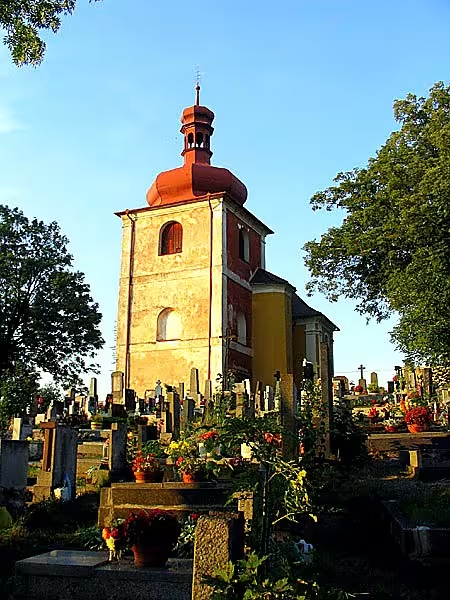
The Church of St. Vavrnice is an important architectural dominant of the village Strašice in the district of Rokycany. It is a Roman Catholic church, which stands in the middle of the cemetery on the hill above the district of the Court, formerly Scarecrow or Little Strašice. The parish church was since 1350, when the estate was won by Peter I. from Rožmberk. The church is protected as a cultural monument and represents one of the most important medieval sacral buildings in southern Rokycanska.
The history of the church is closely linked to the development of medieval Haunted. Archaeological findings show the settlement of the site before the first written mention of the village. Strašice is first mentioned in 1349 as a small town held by the family of Rožmberk, while the church is first documented in writing in 1352. According to historical surveys, however, its foundation is likely to fall into the 13th century.
The oldest part of the building was built in the 1940s. From this period comes presbytery, sacristy and lower part of tower. In the presbytery and sacristy, a Gothic rib arch with a clamp decorated with the coat of arms of the family Rožmberk, which resembles the former patronage over the church. The church was reconstructed in 1637 and again in the second half of the 18th century it underwent a large late Baroque reconstruction, but its Gothic core was preserved.
The church is oriented by a single-boat construction with a polygonally closed presbytery. The north side of the presbytery is adjacent to the sacristy, the west front is closed by the prism tower. The layout of the church reflects several building stages. The Gothic core is made up of presbytery, sacristy and tower, while the ship comes mainly from late Baroque reconstruction. In addition to Gothic structures, the tower has preserved elements of older building development, which are called Romanesque or Romantic.
The presbytery and sacristy on the north side have a Gothic cross rib arch on the consoles, whose clamps belong to the most valuable stoneware articles in the building. The ship is encapsulated with a vaulted vault with sections, typical of Baroque architecture. The exterior is quite moderate. It is read by lizens and profiled moldings from baroque reconstruction. However, the mass solution of the church was preserved by a medieval composition with a significantly removed presbytery.
The most valuable artistic monument of the church are fragments of Gothic wall paintings in presbytery dated about 1380 with Pashian themes of Christ's life. They represent an important piece of medieval wall decoration in Rokycansk and are among the oldest preserved paintings in the region. They were exposed during restoration surveys in the 20th century. In 2011, other Gothic paintings were discovered in the church ship. One of them was exposed and restored and depicts the Virgin Mary with Saint Vincent, Saint Peter and other figures.
The Church of St. Vavrnice is a valuable example of the development of rural sacral architecture, in which the Gothic core was preserved with extensive late Baroque adaptations. The current mobility is mainly from the late Baroque period and from 19th century modifications. The dominance of the presbytery is the main altar dedicated to Saint Vincent, patron saint of the church. The interior is complemented by side altars, pulpit, tin christening tower from 1676 and organ ring.
Today the church is accessible to visitors and is worth visiting for its Gothic core, late Baroque reconstruction and preserved wall paintings. It is a valuable example of the historical development of the Strašice and one of the oldest preserved buildings in the village.
Historical milestones
- 1349
- Stratíky is first changed as a city in the possession of the family Rožmberkó
- 1350
- Peter I. from Rožmberk won the estate and became the parish bane of the church
- 1352
- The church is for the first time a song documented by
- 1380
- The Gothic wall paintings were painted in presbytery
- 1637
- The church was built
- 1750
- The church underwent a late Baroque reconstruction
- 2011
- Other Gothic paintings have been discovered in the church ship
Architectural development
The oldest part of the building was built in the 1940s. From this period comes presbytery, sacristy and lower part of tower. In the presbytery and sacristy, a Gothic rib arch with a clamp decorated by the coat of arms of the family Rožmberk was preserved.
Historical events
Year 1349: First written mention of village Strašice
Year 1352: First written mention of the church
Year 1637: Construction work of the church
Year 2008: Reconstruction of the facade
Owners
Rožmberková, Petr I. z Rožmberk
Points of interest
The church is protected as a cultural monument. - The church is oriented by a single-boat construction with a polygonally completed presbytery. - In addition to Gothic structures, the tower has preserved elements of older building development, which are called Romanesque or Romantic. - Presbytery and sacristy on the north side have a gothic rib arch on the console. - The most valuable art monument of the church are fragments of Gothic wall paintings in presbytery.
Guide
Show guide text
This text was created by artificial intelligence and has not been editorially reviewed. It may contain inaccuracies.
Welcome to a historic place full of secrets and beauty! You are standing in front of the church of St. Vavríce in Strasice, one of the oldest landmarks of Rokycany County. This church is really the center of attention, standing in the middle of the cemetery on the hill above the district of Dvory, former Scarecrow or Little Strašice. It is an architectural dominant and attracts local residents and visitors from far away.
Let's dive into the history of this place. In 1349, Stratíice was first mentioned as a town in the possession of the Rožmberk family, which is a key moment for understanding its historical context. The following year, 1350, Peter I of Rožmberk became the parish pit of the church and the owner of the estate. This relationship between the family of the Rožmberks and the church of St. Lawrence is inherent and shaped other fates of this place. Already in 1352 the church was documented for the first time, confirming its long history.
Now, look up at this single-boat structure with a polygonally-terminated presbytery. It's an oriented design that attracts you with its symmetry and harmony. Note on the tower a combination of Gothic elements in addition to the older building details that some experts call romantic or romantical. These elements are a testament to the complex architectural development and artistic traditions that intertwined here.
In 1380, Gothic wall paintings were painted on the walls of the presbytery, adding another layer of history and artistic value to the church. The church underwent a significant transformation later in 1637 when it was built and then again in 1750 when its Baroque reconstruction took place. These changes reflect the region's dynamic history as well as changing cultural trends.
Of course, its status as a protected cultural monument is a key element of this site. This title not only confirms its historical and architectural importance, but also ensures its preservation for future generations.
The interesting thing about this place is the fact that although many creators and historical figures are associated with the church of St. Lawrence unknown, its significance is not diminished. It's like the church itself tells stories of the past through its walls and structures.
Let us now examine the surrounding area, let us address you with its silent history and beauty. Whether you're here just for a while or preparing a longer stay, every second you spend near this church is valuable.
Thank you for your visit and we hope that they have met here a part of the past that you have kept for us. Let this church of St. Lawrence bring you inspiration and a deeper understanding of the history of the Haunted.
Tips for visitors
The best time to visit is in the morning or shortly before sunset, when the light beautifully highlights the top on which the church stands. For photography are ideal places with a view of the building from the surrounding terraces, which creates a calm and spiritual atmosphere.
It is possible to reach the monument by car and use public transport; Please check the current connection in the search engine.
Until the visit it is advisable to wear comfortable shoes suitable for terrain on the top. It is good for families with children to have their own refreshments and drinks ready, because there is no background in the immediate neighbourhood of the sights.
In addition to the church itself, you can use the time to explore the whole area of the Strašice, which offers a quiet environment for walks.
Frequently asked questions
Can the monument be visited?
Religious buildings are usually open mainly during services; at other times a visit is normally arranged with the parish or the operator. We have not verified specific times.
Where is the monument?
Location: Strašice, Plzeňský kraj. The map on this page shows the exact spot.
Why is the monument protected?
It is listed in the Central List of Cultural Monuments of the Czech Republic as a cultural monument (register no. 1000125037).
Businesses nearby
Do you run a restaurant, accommodation, shop, museum, rental, wellness or other visitor service near this monument? Show yourself directly to the people heading to it — this is how they will see you in the app and on the web:
Nearby
Spooky surroundings
Accommodation nearby
Trips and activities nearby
Guided tours, tickets and activities nearby from GetYourGuide
Affiliate link: if you buy from the partner, we may receive a commission. The price for you does not change.
Search tours and activities →Themed route
1. Exterior of the Church of St. Vavrine (architecture) - See the exterior facade and architectural details of the building. 2. Interior of the Church of Saint Vincent (Church) - Visit the inner space of the temple and focus on its spiritual atmosphere and amenities. 3. Tower of St. Vincent's Church (tower) - Admire the dominant tower, which is a visible symbol of the place. 4. Area of the Church of Saint Vincent (courtyard) - Take a look at the immediate surroundings of the monument and its quiet exterior areas.
Seasonal recommendations
In spring nature awakens around the church and the surrounding greenery begin to offer fresh colours. The light is soft and pleasant in this period to observe the details of architecture. We recommend that we take our layered clothes with us because spring weather is usually variable. The best time to visit is in the morning when the air is purest and the temperatures are mild.
Summer moons bring the longest days and intense sunlight to the Strasice, which beautifully highlights the structure of stone walls. However, more visitors may appear in the main summer season. For the best experience we recommend arriving early in the morning to avoid the greatest heat and people. Don't forget light summer clothes and plenty of fluids.
The autumn season offers a melancholy and calm atmosphere accompanied by golden leaves and occasional morning fog. Lighting is at this time deep and very suitable for photography. It is the perfect time for those who seek silence and want to avoid crowds. Prepare for cooler air and dress in warmer jacket, especially if you plan to walk in the afternoon.
In winter, the church is very raw and monumental, especially if the surrounding area is covered with snow or frost. The day is short, so it is necessary to plan a visit around noon to make enough daylight. Due to low temperatures it is necessary to wear very warm clothes and solid shoes. The atmosphere is most quiet and remote in this period.
Visualizations and artistic views


The visualisations are generated by artificial intelligence and serve as inspiration.
Photos from the area
Real photos taken near the monument


Zdroj a licence jsou uvedeny u každého snímku.
Tips from visitors
No tips yet. Be the first!
Log in and add your tip.
Sources and literature
Photos: Original uploader was Adam Hauner at cs.wikipedia / CC BY-SA 3.0 — Wikimedia Commons. The author and licence also appear when you hover over the image.
Faktickým podkladem tohoto textu byl článek na Wikipedii, jehož autory jsou přispěvatelé Wikipedie. Článek je dostupný pod licencí CC BY-SA 4.0.
Location on the map
More monuments – Strašice
Show all in the municipality


Příběhy a pověsti
Legendy, pověsti a příběhy spjaté s touto památkou
Fotografie návštěvníků
Zatím žádné fotografie. Buďte první, kdo přidá fotografii z návštěvy!
Log in a přidejte svou fotografii nebo hodnoťte.
Za ověřenou návštěvu v aplikaci získáte víc bodů — poznáme podle GPS, že jste na místě.
Reviews and comments