

zámek Nalžovy Chateau
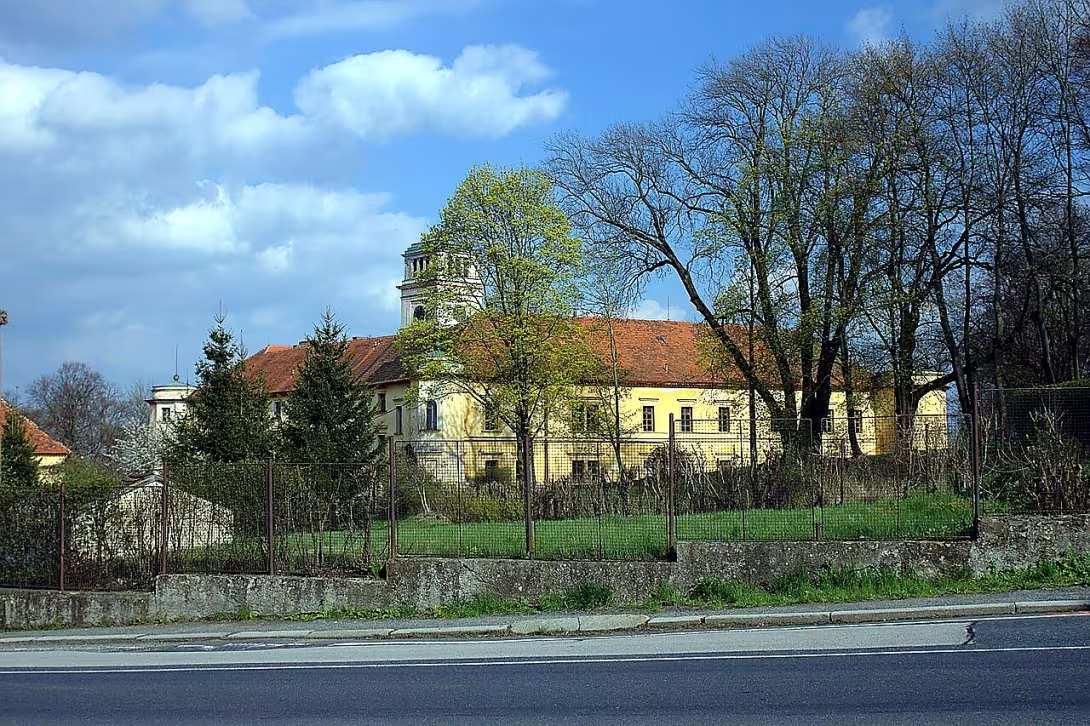
The chateau is located in the central part of Nalžovský Hor in the Klatovy district. It is a Renaissance four-wing building with an enclosed inner courtyard, a prism tower and an adjacent landscape park. Together with economic buildings, the protected area is a cultural monument.
The beginnings of the mansion are probably dating back to the mid-15th century, when the original fortress was supposed to be built here. At the beginning of the Thirty Years' War, in 1618 or 1619, the anti-Habsburg Hungarian troops Nalžovy plundered and apparently severely damaged the fortress. The owner of the Bedřich Švihovský z Rýzmberka Manor had a new Renaissance chateau built south of the damaged fortress. The new building had four wings with a closed courtyard, a main tower above the eastern facade, a tower called rundeles in three corners and its own chapel. In writing, the chateau is first documented in 1630. The original fort was converted into a residence of the civil servants and an economic courtyard with a brewery was created in the vicinity.
In 1718, the Manor of Najov crossed over into the hands of the Peking. They had the chateau modified in the first half of the 18th century in Baroque style, the basic layout of the building did not change much. The reconstruction was probably completed in July 1744 when the chateau chapel of St. Wenceslas was reconsecrated. The original fort probably died then and the granary building took its place. Baroque modifications also affected the surrounding park and gardens.
In 1769, the chateau was moved to the possession of Count Taaffe, an Irish nobleman active in imperial services. The fundamental transformation was brought by Ludwig Taaffe (1791-1855), for which a reconstruction of the Empire and the Neo-Renaissance style started in 1840. The author was Heinrich Koch, the court architect of the Ditrichstein. The fourth tower was added to the southeast corner of the chateau, the roof of the main tower above the eastern facade was modified, the facades were unified and interiors were rebuilt - these works practically wiped out the form of the previous Baroque stage. At the same time, there was a building of horsemen, barn, carriage and a set of brewery cellars using the older Renaissance foundations. The original Baroque garden was transformed into a landscape park with exotic trees. Ludwig Taaffe also had an artificial ruin, inspired by the Irish family home of Ballymotte, built on the top of the Dushivec northeast of the town.
In 1873 he inherited the Nalžovský estate Eduard hrabě Taaffe, the leading politician of his time and later prime minister of Prelitavska. After leaving politics he moved to Nalžov and died here at the end of November 1895. At that time, the estate had about 2 000 hectares of arable land and the breeding centre at Silver Mountain was considered to be the highest and most unfavourable of its kind throughout Czechoslovakia - specializing in the processing of rye, oats, potatoes and peas.
Land reform after the creation of Czechoslovakia has weakened the large estate economically. In 1929 the chateau was hit by a fire and in 1934 a forced administration was imposed on the debtor farm. In 1937, Edward Charles Richard Taaffe sold the estate to the brothers František and Karl Muller; They held him until 1945 when their property was confiscated by the state. A primary school was later located in the chateau and repairs were carried out in 1975.
In 1993 the chateau was returned to the heirs of Karl Müller and in 2008 it went from them to other hands. Renaissance disposition with later empirical modifications, landscape park with exotic trees and undisputed historical interdependence with the fate of nobility and modern state make Nalžov an interesting destination for anyone interested in Czech architecture and history.
Then and now
Drag the slider to compare how the landmark may have looked when it was built with the view today.
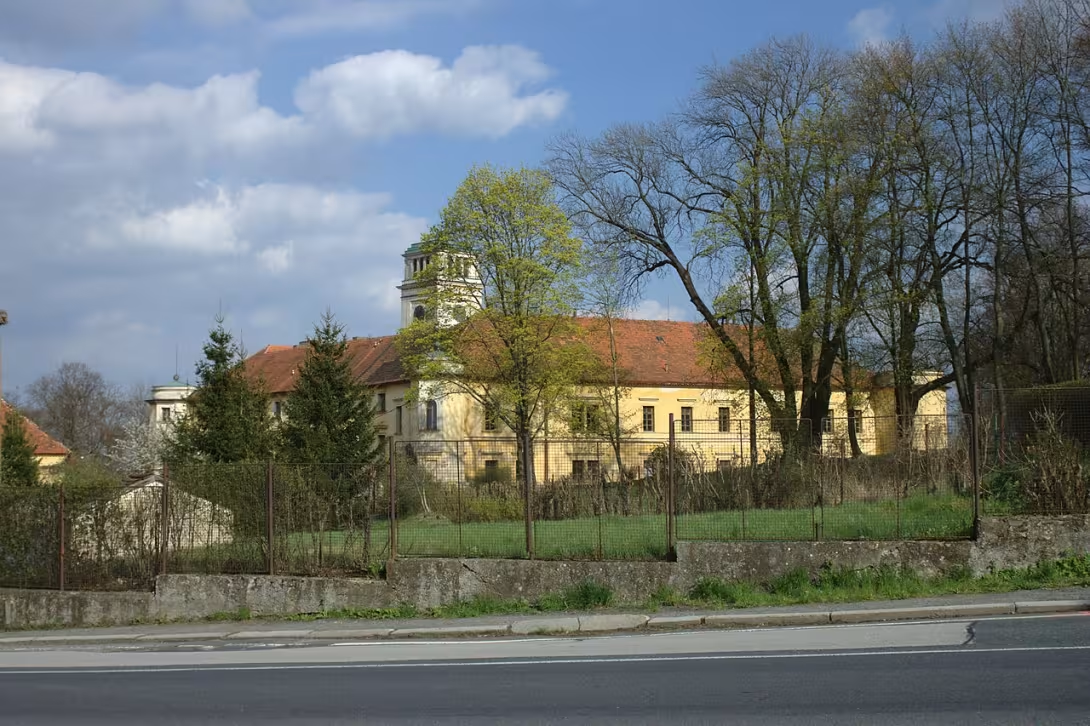

The historical appearance on the left is an AI-generated visualisation and serves as inspiration only.
Historical milestones
- 1630
- First mention of the Renaissance chateau.
- 1744
- Reconsecration of the chateau chapel of St. Wenceslas after Baroque reconstruction.
- 1840
- The launch of an empirical reconstruction under the leadership of Heinrich Koch.
- 1895
- The death of Edward Count Taaffe in the chateau.
Architectural development
The original Renaissance building from the 17th century was modified in the Baroque style in the 18th century. Around 1840, a major reconstruction took place in the Empire and Neo-Renaissance style, which deleted the Baroque features and supplemented the fourth tower. The remains of the original fortress are preserved in the granary building.
Historical events
1618 / 1619: the pillaging of the original fortress by the anti-habsburg hungarian troops; 1929: lock fire; 1934: forced management of the debtor farm.
Owners
Bedřich Švihovský z Rýzmberka, Count of Pötting (from 1718), Count of Taaffe (from 1769), Brothers of Müller (1937-1945), State (after 1945), Heirs (from 1993)
Points of interest
- The chateau is a Renaissance four-wing building with closed courtyard, tower and landscape park. - The original fort was probably damaged by Hungarian troops in 1618 or 1619. - In the first half of the 18th century the chateau was modified in Baroque style. - Ludwig Taaffe started a reconstruction in 1840 in Empire and Neo-Renaissance style. - An artificial ruin inspired by the Irish family residence was built on the top of Drasivec.
Guide
This guide is narrated by a synthetic voice generated by artificial intelligence.
Show guide text
This text was created by artificial intelligence and has not been editorially reviewed. It may contain inaccuracies.
Welcome to the Nalžov Mountains. You are standing in front of an impressive chateau in Nalžovech, which dominates the surrounding countryside with its mighty silhouette. The first impression from this place is unmistakable. There is a four-wing structure in front of you that creates a sense of security and privacy with its closure. Note how the dominant element of the whole complex is the prism tower that stands out above the roof and reminds us of the period functions of these settlements, where they were used not only for housing but also for the supervision of the surroundings.
Now let's look together at how this place was created. The history of this mansion goes deep into the past. Before the current chateau stood here, there was a fortress here. However, this was likely to have suffered major damage in the early seventeenth century, namely around the year of the six miniscule one or two, when Hungarian troops followed. It was from these ruins and ancient foundations that the building you see today began to emerge in the second two decades of the seventeenth century. In the year six hundred and thirty, this place was first mentioned as a Renaissance chateau. It was a time of great change and ambition when the nobles replaced fortified strongholds with more comfortable and more representative settlements.
Now pay attention to the architecture itself. If you look at the overall shape of the building, you will see the quadruple disposition with the inner courtyard. This space was the heart of the chateau, where the economic and social life met. It's fascinating to realize that what you see now is not the work of one time. The chateau is like an open book of history where each layer tells a different story. The original Renaissance core has been gradually transformed over the centuries. In the first half of the eighteenth century, elements of the Baroque style were incorporated into the appearance, which was a direction focused on grandeur and dynamics.
Take a closer look at the facade details and the overall harmony of the building. In the year eight hundred and forty, there was another big change. Ludwig Taaffe started a large reconstruction in the spirit of the Empire, which was a style characteristic of its purity, rigor and return to ancient patterns. The builder Heinrich Koch stood over the whole process of this great change. It is thanks to his leadership that the chateau has acquired a form that makes him the elegant memory you see today. Notice how these different epochs intersect and create the unique character of this house.
When we think about this place, we can't forget the people who lived here and created its history. The figures associated with Nalžovami include Bedřich Švihovský z Rýzmberka, for example. The chateau was a home for generations of noble families who ruled and managed their manor. The Taaffe family left a significant trail. It is with them that one of the last major chapters of this mansion is connected. In a thousand and eight hundred and ninety-five, the life of Edward Count Taaffe ended here, a very sad event for the local population and the chateau itself.
In addition to the main house, see the surroundings. The chateau is not just the building itself, but the whole complex. The area includes a large economic background which was necessary for the operation of such a large estate. Without these buildings, the chateau could not exist because food was stored here, animals were kept and craftsmen worked. And if you look around you, you'll see a landscape park. These green spaces were designed to provide rest and at the same time to decorate the overall view of the construction. Walk through the park allows you to feel the lock from different angles and understand how much it was connected to nature.
Let us now stop at one interesting detail that you may not see at first sight, but it is very important for the spiritual life of this place. There is a chapel of St. Wenceslas. In the eighteenth century, this shrine underwent baroque modifications, and in the year seven hundred forty-four it was ceremonially reconsecrated. Imagine those festivities at the time, the sound of the bells and the people gathered who came to pray in a newly decorated space. It is a reminder that the chateau was not just an administrative center or a luxury apartment, but a place where faith played a vital role.
The mystery remains the exact form of the original fortress and the detailed course of its destruction by Hungarian troops more than four styles ago. History tells us that this occurred around six hundred and eighteen or nineteen years ago, but the exact images of that time remain hidden in the depths of time and under the foundations of contemporary walls. It's fascinating to think how many secrets these walls still hide and how many generations of people have served as a refuge or a symbol of power.
Today zámek Nalžovy is protected as a cultural monument, which means that future generations will be able to admire this gem as much as you are now. It is a place where the Renaissance, the Baroque and the Empire meet in one harmonious place.
We now invite you to further explore. Walk slowly through the courtyard, feel the peace and quiet of this place and let yourself be carried away by the images of people who once walked here. Look again at the prism tower and try to imagine the view from its top to the surrounding landscape of Nalžovské Hor. Go through the landscape park where you can think about everything you've just heard.
Thank you for spending a moment with us at this beautiful monument of Czech construction. We hope that you are interested in this journey over time and that you will get a pleasant feeling from your visit to Nalžovech. We wish you a pleasant continuation in your discovery and I bid you farewell.
Tips for visitors
The best time to visit is spring and summer months, where the landscape park is full of exotic trees and the surrounding nature is the greenest. The village can be reached by car or public transport; We recommend to verify the specific connection in the current search engine.
On your way, wear comfortable shoes that will allow you to explore the surrounding park and climb to the top of the Dwarf. It will be useful for history lovers to have a map of the surroundings with them so they don't miss the path to an artificial ruin.
For the best photos we recommend to come to the morning or late afternoon lights, which highlight the details of the prism tower and facade of the four-wing chateau. Ideal place for pictures is the inner courtyard and views from the park towards the buildings.
In addition to the chateau itself, you can definitely visit the nearby Prašivec mountains with its artificial ruin and a large landscape park. Families with children will appreciate a walk in the park and a trip to the top where children can discover nature and historical remains of buildings.
Frequently asked questions
Can the monument be visited?
Some buildings of this kind are open for guided tours, others serve another purpose or are privately owned. We have not verified whether and when this monument is open – please ask the operator.
What are the opening hours and admission?
We have not verified the opening hours or admission. Current information is published by the operator. Official website: http://www.zameknalzovy.com/
Where is the monument?
Location: Nalžovy 1, 34101 Nalžovské Hory, Plzeňský kraj. The map on this page shows the exact spot.
Why is the monument protected?
It is listed in the Central List of Cultural Monuments of the Czech Republic as a cultural monument (register no. 32804/4-3153).
Businesses nearby
Do you run a restaurant, accommodation, shop, museum, rental, wellness or other visitor service near this monument? Show yourself directly to the people heading to it — this is how they will see you in the app and on the web:
Events nearby
Zdroj akcí: otevřená data měst a obcí ČR (Národní katalog otevřených dat) a kalendář akcí Národního památkového ústavu.
Nearby
Okolí zámku tvoří lesy a pole. Nedaleko zámku se nachází další kulturní památka, kostel sv. Jana Křtitele.
Accommodation nearby
Themed route
Here is the design of the thematic route:
1. Chateau Nalžovy (lock) - The main point of the journey where you can admire the architecture and history of this noble residence. 2. Landscape park (park) - A space near the chateau that captures rare and exotic trees. 3. Top of the Dwarf (top with building) - Finish the trip by climbing to the top where there is an artificial ruin with a beautiful view of the surroundings.
Seasonal recommendations
Spring
Specific is the beautiful lighting of nature and the chateau, when the trees green and the first flowers bloom. The atmosphere is full of optimism and hope for a new year. Spring markets with fresh fruit and vegetables are held in the surroundings.
Local traditions consist of holding spring festivals and holidays such as Earth Day or Spring Spring Day.
Practical advice: The best time to visit the chateau is from April to May, when crowds of tourists are smaller. We recommend wearing comfortable shoes to walk around the garden and not forget the sunglasses.
Summer
The specific weather is warm, which allows a tour of the chateau and its garden. The atmosphere is full of joy and entertainment, where summer festivals and concerts are held.
Local traditions consist in organizing summer markets with fresh fruit and vegetables, but also in organizing summer theatre and concerts.
Practical advice: the best time to visit the chateau is from June to August, when crowds of tourism are the largest. We recommend wearing comfortable shoes to walk around the garden and not forget the sunglasses.
Autumn
Specific is the beautiful lighting of nature and the chateau, when the trees turn into different colors and the last flowers bloom. The atmosphere is full of melancholy and memories of the past year.
Local traditions consist of holding autumn festivals and holidays such as Children's Day or Autumn Fair.
Practical advice: The best time to visit the chateau is from September to October when crowds of tourism are smaller. We recommend wearing comfortable shoes to walk around the garden and not forget the umbrella.
Winter
Specific is the beautiful lighting of the chateau and its garden, when the trees are covered with snow and the Christmas lights. The atmosphere is full of peace and wonder.
Local traditions consist of holding winter festivals and holidays such as Christmas or New Year's Eve.
Practical advice: The best time to visit the chateau is from December to January when crowds of tourism are smaller. We recommend wearing comfortable shoes to walk around the garden and not forgetting the hat and gloves.
Visualizations and artistic views


The visualisations are generated by artificial intelligence and serve as inspiration.
Photos from the area
Real photos taken near the monument


Zdroj a licence jsou uvedeny u každého snímku.
View from the area
This animation was generated by artificial intelligence from a real photograph of the surroundings. The motion and details are not real footage of the location.
Atmosphere of the place
This atmospheric visualisation of the place and period was generated by artificial intelligence. It is not real footage of the location.
Tips from visitors
No tips yet. Be the first!
Log in and add your tip.
Sources and literature
Photos: Aktron / CC BY-SA 4.0 — Wikimedia Commons. The author and licence also appear when you hover over the image.
Faktickým podkladem tohoto textu byl článek na Wikipedii, jehož autory jsou přispěvatelé Wikipedie. Článek je dostupný pod licencí CC BY-SA 4.0.
Location on the map
More monuments – Nalžovy
Show all in the municipality


Příběhy a pověsti
Legendy, pověsti a příběhy spjaté s touto památkou

Fotografie návštěvníků
Přidat fotografiiZatím žádné fotografie. Buďte první, kdo přidá fotografii z návštěvy!
Máte k místu vzpomínku nebo zajímavý příběh?
Log in a přidejte svou fotografii nebo hodnoťte.
Za ověřenou návštěvu v aplikaci získáte víc bodů — poznáme podle GPS, že jste na místě.
Reviews and comments