






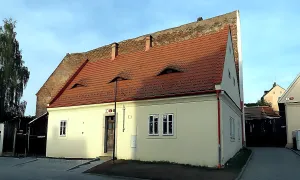
U Ježíška Chapel
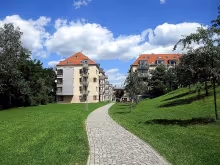
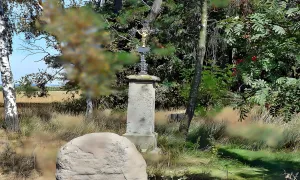
The street U Ježíška is situated in the Pilsen district of Pilsen 2-Slavany and stretches approximately 570 metres along the Eastern Suburb. It bears its name after a protected church, which stands in it and which determines the whole place for a long time. The building is otherwise very modest - next to the church there are only four residential houses in the street, whose construction started in 2003.
Part of the street passes along the Millennium Bridge above which the U Trati Street continues over the ground and the Radbuzou River. The street is connected to the left bank by Kožíšková footbridge. The number 3 and 31 bike paths pass through here, so the streets serve not only pedestrian but also cyclists passing through this part of Pilsen.
In the Middle Ages, the territory of today's street of Forman led the way towards Nepomuk, Koterov and Cernice. According to historical considerations, there could be a Forman station or pub on the place where the church is today - natural background for travellers and their covers on the busy trade route. What is documented with certainty is the presence of the chateau of the wealthy Pilsen family Helffer, who has been standing there since the late 17th century. An even topographical map from 1961 captures the entire area as two separate gardens - an environment far quieter and greener than the neighborhood of the street is now perceived.
The unbuilt area of the park, which is lining the street, has recently undergone a significant renewal. In 2020 there was a new pedestrian road and 82 metres long granite staircase with built-in lighting leading along the wall of the Mikuláš cemetery and connecting the street with the Mikuláš class. A year later, in 2021, the entire area was completely revitalized and supplemented by a playground.
Today the street U Ježíška works as a quiet but lively place. The park belt makes it pleasant for day-to-day walks, granite staircase with lighting invites even at dusk and the area regularly hosts various outdoor cultural and social events. For a visitor who comes here, this offers not only a view of a protected church, which gave the street its name, but also a walk along the Radbuzy River with a stop on a modern-style waterfront.
Then and now
Drag the slider to compare how the landmark may have looked when it was built with the view today.
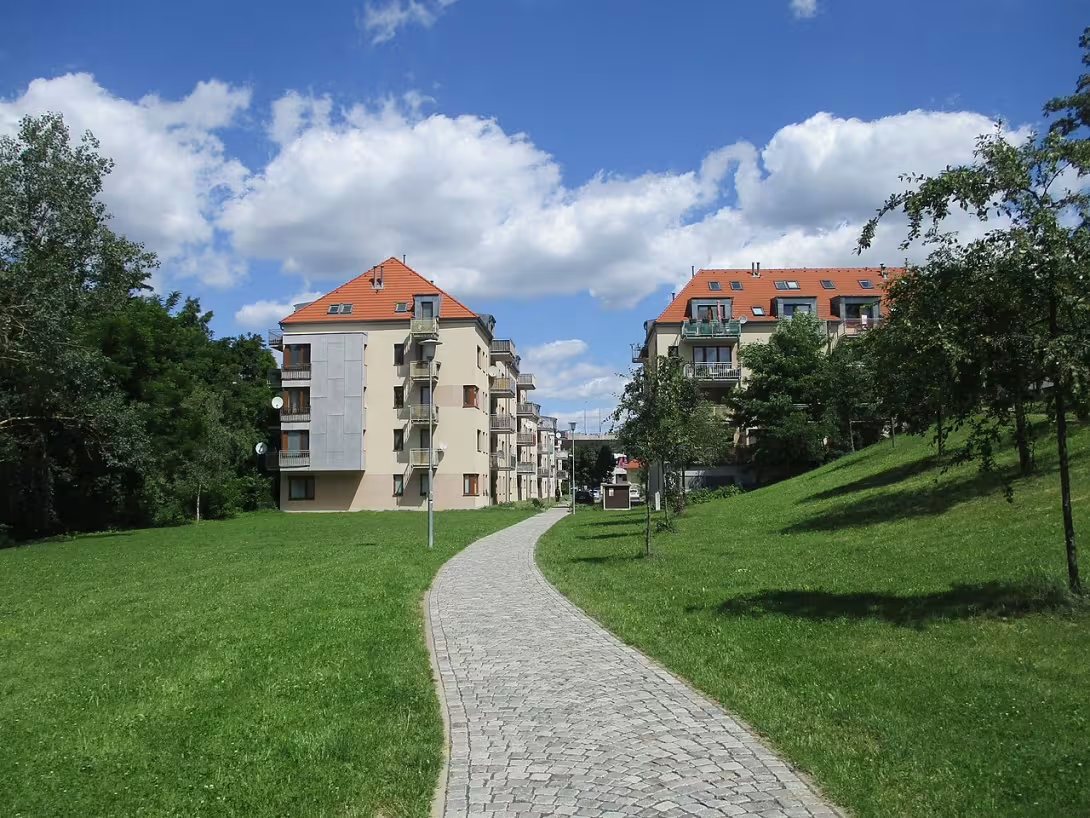

The historical appearance on the left is an AI-generated visualisation and serves as inspiration only.
Historical milestones
- End of the 17th century
- The creation of the Helffer family chateau at the site of today's chapel.
- 20
- Revitalization of the unbuilt area along the street and connection with the Mikuláš class using stairs and walking paths.
- 2021
- Completion of the revitalisation with the creation of a playground and the use of the area for cultural events.
Architectural development
The chapel was built in a Baroque style, probably in the 18th century, and served as a local sacral object. It is currently preserved in good condition and is part of the revitalized U Ježíška street space. The chapel is one of the few preserved historical objects in this location, which was originally part of the Forman route.
Historical events
- End of the 17th century
- The foundation of the Helffer family chateau at the site of today's chapel.
- 1961
- The municipal area in the map marked as two separate gardens.
Owners
The sequence of owners with years if available, otherwise zero.
Points of interest
- The street U Ježíška is named after the monument protected church, which stands in its center.
- In the past, there was a Forman road to Nepomuk, Koterov and Cernice.
- In place of today's church, the Helffer family's chateau has been standing at the end of the 17th century.
- In 2020 a new pedestrian road and 82 metres long granite staircase with lighting were built.
- In 2021 the unbuilt area of the street underwent a comprehensive revitalisation and a children's playground was created.
Guide
This guide is narrated by a synthetic voice generated by artificial intelligence.
Show guide text
This text was created by artificial intelligence and has not been editorially reviewed. It may contain inaccuracies.
Welcome to the East Suburb of Pilsen. You are now standing in front of the chapel U Ježíška, which is located in a street named after this historic monument. In front of you you can see the Baroque sacral structure, which acts as a quiet and peaceful island in the middle of modern urban activity. Look around you and try to perceive the atmosphere of this place. Before we take a closer look at what you actually see in front of you, let's go back in time and talk about how this monument came into being and what its journey was like in history.
Originally, there was no sanctuary in this place. Long before today's chapel appeared here, there was a Forman station or an old pub. The space performed a completely different function than today, serving as a living point for travelers, businessmen and formans. Later, at the end of the seventeenth century, the place had undergone a major transformation. The former station was built here by a chateau that belonged to the influential Helffer family. This chateau has laid the foundation building stone for what you can admire nowadays. With the time and transformation of the whole site, the purpose of the place changed and the former nobleman's summer chateau turned into a Baroque sacral building known today as the chapel U Ježíška.
Let us now focus directly on the architecture and details that you can see with your own eyes. You are standing in front of a protected object, which is one of the few preserved sacral objects in this particular location. Pay attention to the overall shape of the building, its proportions and historical character. Look at the facade and see the work of builders whose names have not been preserved, because the architects of this building are unknown, but their work has lasted centuries. The chapel stands right in the middle of the street, bearing her name, and thus forms a natural dominant element of the whole area. Although you will not find any fancy sculptures or complex descriptions of decoration, because these are not listed in the historical documents, the strength of this building lies in its purity, authenticity and that it represents a rare testament to the past of Eastern Suburbia.
When we look at the stories and personalities associated with this place, we have to say that the names of particular historical figures have unfortunately been largely lost in the fall in time. We don't know exactly who designed the chapel or what particular priests or nobles were walking here. Personalities are unknown, but the more powerful is the story of space itself. The place lived by people of flesh and bone, the formans who passed through here, the members of the Helffer family who spent their moments resting in the late seventeenth century, and the generations of the local people for whom the chapel was an important point on the map.
Let us now say a few interesting facts and intriguing facts that make this place so special. Remember what we said about the street. The street U Ježíška owes its name to this monument-protected church, which stands in its center. If you look around, you might be surprised what this landscape looked like in the past. There were once large gardens in these places. But what is even more interesting is that in the past, there was an important Forman road that went on to Nepomuk, Koterov and Cernice. Imagine the excitement of those days, the rumbling of the cars and the footsteps of the horses on the road that passed just around where you are now standing with headphones on your ears.
But the history of this place was not only written in the distant past, but it is also written today. Remember the recent years when space has undergone a great transformation. In 2020, the revitalisation of the unbuilt area along the street began. The aim was to revive this place and better connect with the nearby Mikuláš class using a new staircase and comfortable walking path. A year later, in 2021, this successful revitalisation was completed. Thanks to this, today you will find not only a fixed historical space around the chapel, but also a children's playground and area which is regularly used for various cultural events. The former forgotten corner became a living meeting place for the whole neighborhood.
And that brings us to the conclusion of our walk today. The U Ježíška Chapel is an excellent example of how deep history can be linked to modern city life. I hope you enjoyed stopping today and that you will be happy to return to this place. Take advantage of the newly built walking path, explore the surrounding renovated space, look at the playground or head towards the Nicholas class. Thank you for your attention, I bid you farewell and wish you a beautiful rest of the day to discover the other beauties of Pilsen.
Tips for visitors
{'paragraph': 'The best time to visit the chapel U Ježíška is in the morning when there is a quiet and pleasant light for photography. If you want to experience the atmosphere of a place without crowds, avoid weekends and summer holidays. The chapel is ideal for visiting during spring or autumn, when nature is beautifully coloured around and the light is softer. The Baroque architecture of the chapel is better reflected in photographs.'}
{'paragraph': 'The chapel is available by car and public transport. If you arrive by car, you can use the parking lot near the Mikuláš cemetery. It is recommended to park in free places on U Ježíška or on neighbouring streets where there is enough space. To travel by public transport check the current connection in the search engine, the nearest stop should be near the street of Nicholas.'}
{'paragraph': 'When visiting the chapel, wear comfortable clothes and shoes because it is a historic monument with a possible uneven surface. It is also appropriate to take a small towel or cloth if you want to wash your hands on public fountains nearby after your visit. If you are planning to take pictures, remember to take batteries or external power sources, because older cameras may be sensitive to cold weather.'}
{'paragraph': The most suitable place for photography is in front of the main facade of the chapel, where the Baroque composition of the facade is well captured. The best light is morning or afternoon, when the sun shines from an angle and creates interesting shadows. If you want to photograph the inside of the chapel, please check the rules in advance because some historical buildings have restrictions. In the vicinity of the chapel is also a beautiful view of Denis' waterfront, which can be an interesting addition to your photos. '}
{'paragraph': 'There are several interesting places around the chapel U Ježíška that are worth visiting within 30 minutes. You can walk around the cemetery of Nicholas, which offers a quiet atmosphere and historic tombstones. Denis' waterfront is ideal for walking along the river and observing Pilsen architecture. For cyclists it is advisable to use cycle paths 3 and 31, which lead right around the chapel. Families with children can enjoy a walk along the Kožíška footbridge, which is safe and offers beautiful views of the surroundings. '}
{'paragraph': 'The chapel U Ježíška is also suitable for visiting with children. Children can see historical architecture and hear stories about the origin of the chapel. It is possible to play in the surroundings at the Mikuláš cemetery, where there is enough space for safe games. For children it is also interesting to observe cyclists on trails 3 and 31 or walk along the Kožíšková footbridge, which is safe and fun for them. Parents can take the opportunity to relax on benches around the chapel.'}
Frequently asked questions
What does the name "U Ježíška" mean?
The name refers to the tradition of naming houses by religious symbols. "Baby Jesus" can refer to the Baby Jesus or Prague Jesus Jesus - a famous wax statue brought from Spain at the age of 16, whose cult was extremely widespread in Bohemia. Houses with such names used to be marked with a relief or image of the relevant motive above the entrance.
When was the historical center of Pilsen built?
The new Pilsen was found by King Václav II around 1295 as a royal city with a regular chessboard plan. The building of the centre was then carried out for centuries - Gothic houses were given Renaissance, Baroque or historical reconstructions, so today's centre is a layering of many historical epoch.
Why is Pilsen famous?
Pilsen is famous mainly for Pilsner beer (Pilsen source), created in 1842 in the town brewery. The type of light beer "Pills" has spread all over the world, and today it is the most widespread beer type on Earth. Pilsen is also famous for Škoda's races (engineering, arms production) and as one of the main medieval royal cities in Bohemia.
What is Prague Jesus?
The Prague Jezulátko is a famous wax statue of Baby Jesus (height 47 cm) stored in the Church of Our Lady of Victory on the Lesser Side in Prague. It was brought from Spain at the age of 16 and became one of the most revered religious subjects in Bohemia. Her cult has spread all over the world and is still attracting pilgrims from many countries.
How do I get to the historical center of Pilsen?
The historical centre of Pilsen is easily accessible from the main station by foot (about 10 minutes). Pilsen lies on the highway D5 from Prague (distance about 90 km). The train from Prague takes approximately 1.5 hours. The centre is clear and compact - walking tour takes 2-3 hours.
What else is interesting in the historical centre of Pilsen?
Next to the building U Ježíška is worth visiting the Gothic Cathedral of St. Bartholomew with the highest tower in Bohemia, the Great Synagogue (second largest in Europe), underground corridors under the centre, brewery museum and West Bohemian museum. Pilsen is rich in cultural and historical attractions.
Is Pilsen the European Capital of Culture?
Yes, Pilsen carried the title of European Capital of Culture in 2015. This award resulted in extensive revitalisation of cultural infrastructure, restoration of the historical centre and increased tourist interest in the city. The title helped Pilsen assert itself as a modern cultural metropolis.
For kids
Businesses nearby
Do you run a restaurant, accommodation, shop, museum, rental, wellness or other visitor service near this monument? Show yourself directly to the people heading to it — this is how they will see you in the app and on the web:
Events nearby
Zdroj akcí: otevřená data měst a obcí ČR (Národní katalog otevřených dat) a kalendář akcí Národního památkového ústavu.
Nearby
In the vicinity of the chapel there is a Mikuláš cemetery, Denis' waterfront and the bridge of Millennium. The street U Ježíška is connected to the street of Mikuláš and the footbridge. There are also bike paths 3 and 31 nearby.
Accommodation nearby
Trips and activities nearby
Guided tours, tickets and activities nearby from GetYourGuide
Affiliate link: if you buy from the partner, we may receive a commission. The price for you does not change.
Search tours and activities →Themed route
Thematic cruise route: Travel around the chapel U Ježíška
1. Chapel U Ježíška * Type: * Historical sacral construction. * Why visit? * A picturesque Baroque chapel from the 18th century, connected with local legends and a calm atmosphere. Ideal place for a short prayer or photography.
2. Nicholas cemetery * Type: * Ancient cemetery with historical tombstones. * Why visit? * Quiet location with preserved monuments, which offers a view to the past of the village. Suitable for walking and relaxing.
3. Denis' waterfront * Type: * Promenade along the river. * Why visit? * A picturesque path overlooking the water, ideal for walking or relaxing on benches. Suitable for cyclists and pedestrians.
4. Millennium Bridge * Type: * Modern bridge across the river. * Why visit? * A symbolic bridge connecting parts of the village, with an interesting view of the surrounding landscape. There's a bike trail through it.
5. Leather bridge * Type: * Walking bridge across the river. Why visit? Simple but practical road connecting the street U Ježíška with other parts of the village. Suitable for a short walk or route connection.
Seasonal recommendations
Spring The U Ježíška Chapel offers a unique atmosphere in the spring months when its Baroque facade and its surroundings awaken to life. After rainy days, the green wall of the chapel shines with moisture, while the sunny morning disperses the shadows on its plaster and reveals the fine details of the statues. The surrounding gardens and trees are starting to shrivel, and if you visit the memory in April, you can see the first spring flowers along the way. It is convenient to come early in the morning when the chapel is calm and the light falls directly on its entrance portal. The recommended clothing suitable for variable weather - light jackets and umbrellas, because spring rain can come unexpectedly. The ideal time is between 9: 00 and 11: 00, when the air is fresh and the monument is not filled with tourists.
Summer In the summer months the chapel U Ježíška will be transformed into a living space where the historical atmosphere with the summer bustle is mixed. The sun draws sharp shadows on the chapel at noon, while the evening clock offers golden lighting that emphasizes its sculpture details. The surrounding area is full of green, but also of visitors, especially in the high summer season, when tourists come from all over the region. It is recommended to arrive before 9: 00 a.m. or after 16: 00 a.m. to avoid the biggest crowds. Light clothes, sunglasses and water are essential, but don't forget the hat - some parts of the area around the chapel have no shadow. It is also appropriate to visit a memorial on Sunday afternoon when it is calmer than on working days.
Autumn Autumn brings unique colour around the chapel U Ježíška, when tree leaves turn into shades of yellow, orange and red. The chapel itself appears to be surrounded by a natural picture, especially in September and October, when the sunny morning creates a contrast between warm leaf colours and cold plaster. In Advent Time, the chapel gains a more serious tone when evening darkness connects with Christmas preparations. It is recommended to visit it in the morning when the air is still fresh and light softer. Warm, but not too heavy clothing is ideal because autumn weather can be unpredictable. Watch out for the wind that can blow even in lower positions. The quietest times are on Tuesday and Wednesday when the monument is less visited.
Winter Winter visit to the chapel U Ježíška is like an entrance to another world when the snow cover turns its surroundings into a fairy tale landscape. The chapel itself, illuminated by the sun or artificial light, looks like from the past, especially with frozen windows and ice circles on the roof. In Advent time, the Christmas atmosphere is added, when the chapel becomes part of the pre-Christmas peace. It is recommended to come in the morning when light is brighter and opening times longer. Warm, layered clothes are essential because temperatures can fall below freezing. In winter it is also advisable to visit the chapel on Tuesday or Thursday when there are fewer visitors. Watch out for slippery ice on the road - comfortable footwear with adhesion soles is a necessity.
Visualizations and artistic views


The visualisations are generated by artificial intelligence and serve as inspiration.
Photos from the area
Real photos taken near the monument


Zdroj a licence jsou uvedeny u každého snímku.
View from the area
This animation was generated by artificial intelligence from a real photograph of the surroundings. The motion and details are not real footage of the location.
Atmosphere of the place
This atmospheric visualisation of the place and period was generated by artificial intelligence. It is not real footage of the location.
Tips from visitors
No tips yet. Be the first!
Log in and add your tip.
Sources and literature
Fotografie: Lenka64 / Public domain — Wikimedia Commons. The author and licence also appear when you hover over the image.
Faktickým podkladem tohoto textu byl článek na Wikipedii, jehož autory jsou přispěvatelé Wikipedie. Článek je dostupný pod licencí CC BY-SA 4.0.
Location on the map
More monuments – Východní Předměstí
Show all in the municipality
Příběhy a pověsti
Legendy, pověsti a příběhy spjaté s touto památkou

Fotografie návštěvníků
Zatím žádné fotografie. Buďte první, kdo přidá fotografii z návštěvy!
Přihlaste se a přidejte svou fotografii nebo hodnoťte.
Za ověřenou návštěvu v aplikaci získáte víc bodů — poznáme podle GPS, že jste na místě.
Reviews and comments