






Kozel (hradiště, okres Beroun) Hillfort
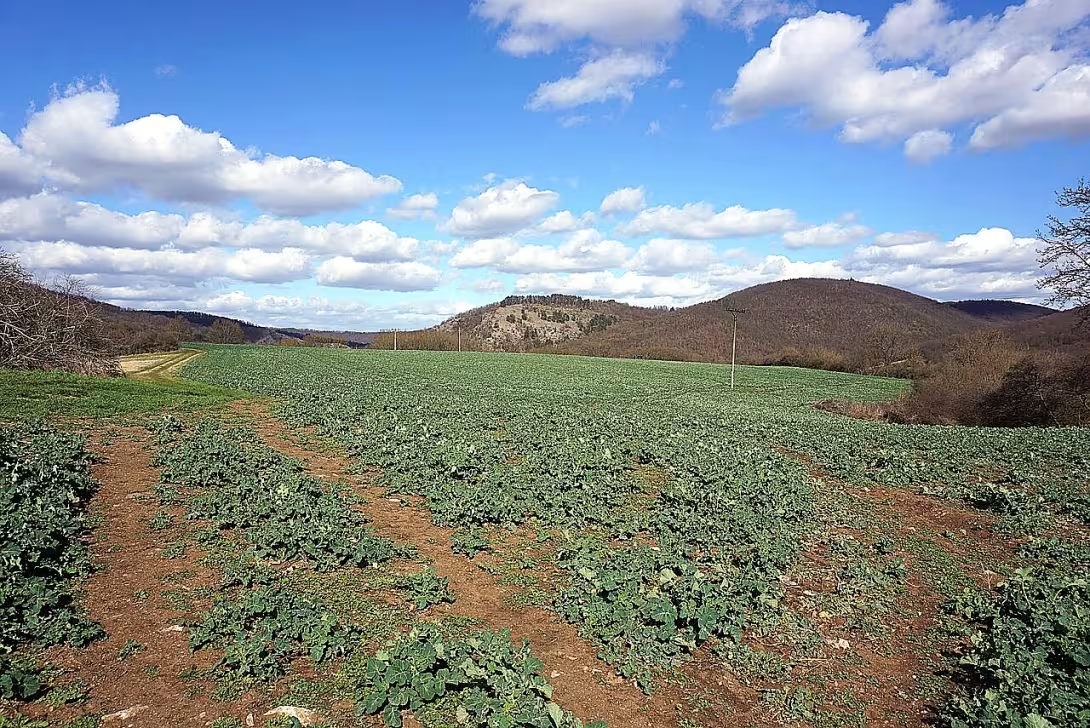
Goat, also known as In Kozlu or Hostim, there is an extensive archaeological site in the early medieval and primordial castle in the district of Beroun, Central Bohemian region. The location lies on the island above the Berounka and Lodnice confluence and is protected as a cultural monument for its exceptional historical value and complex fortification.
The time of creation is not specified; the findings cover the period from the eneolite to the middle and younger periods of the bronze, Halštat and Roman to the castle. It is assumed that part of the fortification was already formed in the eneolithic or mid-bronze (moth culture). The only reliably dated part is the middle wall from the 9th century; the early medieval fort was destroyed not later than the beginning of the 10th century. The first written mention appears in Hájkova Chronicle.
The fortified area is 14,9 ha and uses natural protection of steep rock walls (height up to 65 m). The access north side was secured by three lines of walls. The outer wall (about 825 m) reaches 5 m in northeast corner The medium wall (400 m) has a width of 5-6 m and a height of 1,5 m; its construction consisted of a dry stone wall and an inner wood-clay part. The shortest inner wall (134 m) shows traces of fire on the stones, indicating the dramatic end of this part of the fortification.
The professional interest began in 1875 with a description of Morice Lüssner. In 1877 he carried out a surface survey of Štěpán Berger, in the late 19th century he dealt with the site Břetislav Jelínek. In the 20th century (1944) he examined the central wall Miloš Šolle, whose work was followed by František Prošek. During the century, the site was damaged by the construction of Czechoslovak fortification (Prague line), whose bunkers were later demolished. The southern edge of the island was irreparably damaged by the industrial extraction of limestone in the Alkhar quarry.
Today, the Kozel Castle is inaccessible to the public, located in the Karlstejn National Nature Reserve and no marked route leads to it.
This building is an important evidence of the development of settlement and fortification techniques in Czech countries from prehistoric times to early medieval state. Although the entrance for nature protection is prohibited, the site remains a key archaeological site, documenting the strategic importance of the Berounky Confluence and the Shipyard.
Historical milestones
- around 3000 BC l.
- Predicted early settlements in the eneolite
- 9th Century
- Construction of the middle wall of the early medieval castle
- 10th Century
- The demise of the early medieval castle
- 1875
- First technical description of the site by Moricem Lüssner
- 1944
- Archaeological research of the Miloš Šollem Central Wall
Architectural development
The fortifications consisted of three lines of valves, the oldest parts of which may come from the eneolite or bronze age. The middle wall of the 9th century used a wooden clay structure with a front wall made of dry laid stones. The southern part of the island was disturbed in the New Testament by the extraction of limestone in the Alkhar quarry.
Historical events
In 1944, an expert archaeological research of the middle wall was conducted under the direction of Miloš Šolle. During the 20th century, the fortifications were damaged by the construction of the Czechoslovak fortifications known as the Prague line.
Points of interest
- The fort is situated on an area of 14.9 hectares and uses the natural protection of steep rock walls with a height of up to 65 metres. - The only reliably dated part is a middle wall dating back to the 9th century. There were fire marks on the stones of the shortest inner wall, suggesting a dramatic end to this part of the fortification. - The location was damaged in the 20th century by the construction of Czechoslovak fortifications and industrial limestone mining in the Alkár quarry. - The fort is currently inaccessible to the public because it is located in the national nature reserve and there is no marked route to it.
Guide
Show guide text
This text was created by artificial intelligence and has not been editorially reviewed. It may contain inaccuracies.
Welcome to the place where nature has decided to become the best ally of man. You are standing in front of the Kozel castle, an archaeological site that stands above the confluence of two rivers, Berouns and Shipyards. If you look around right now, you'll see why this place was chosen for defense and life thousands of years ago. Look down to the river. See those steep, rocky walls that bend to the water? These natural barriers, reaching up to 65 metres in some places, have in the past created an impenetrable protection. The whole castle is situated on a vast area of nearly 15 hectares, and its strategic location on the edge must now remind you how important it was to control this rocky edge over the waters. Feel the atmosphere of peace that prevails here, but realize that beneath your feet is a fascinating story that has lasted since the beginning of civilization.
Now let's go deeper into time. This site is not just a one-time record in history, it is a pedestal story of settlement, which began in the eneolithic era, about 3,000 years ago. Imagine the first people here to see the safety of these rocks. Although their tracks are very old, the most distinctive chapter in the history of the Kozl writes the early Middle Ages. It was in the ninth century that a fortifications arose that gave the castle its true character and strength. This was the time when the foundations of future states were formed and this place served as a key point in the region. However, this golden age of the castle was not eternal. As early as the tenth century, the settlement began to disappear and the castle ceased to exist, but it left traces of what experts study today.
Now pay attention to what you can see right around you. Although there are no ruins of high castles or decorative towers that you would find in later medieval castles, the architecture of this place lies in the genius of the use of the terrain and in the building of the waves. Notice the lines in the landscape that indicate where the defense used to be. The only part we can date with certainty through scientific methods is the central wall. It comes from the ninth century and represents the most important building element of the entire castle. When you look at the surrounding terrain, you realize how vast the scope of this fortification was. Almost 15 hectares of space had to be organised to provide safety not only for the soldiers, but also for the population that lived here. The architecture of the Kozle was not about the beauty of stone statues, but about the functionality, the accumulation of earth and stone into massive dams, which cooperated with impenetrable rock walls.
But this castle island would not be so well known if there were no people who chose to uncover its secrets. The history of the Kozl is closely linked to the names of scientists who have worked here during the last centuries. The first technical description of this fascinating location left us Moric Lüssner in 1875. Thanks to his work, the world of science began to know that there was something far more important than just a simple rock slide. Later, other experts, such as Štěpán Berger or Břetislav Jelínek, entered history to help understand the broader context of this place. The research carried out by Miloš Šolle in 1944 was also very important. It was his work at the middle wall that allowed us to get accurate information about what the castle looked like at the time of its greatest glory. Even names like František Prošek are important in relation to this place, because all of these people have tried to put together the mosaic of the past from the markets that the country left us.
If you stop now and observe the stone remains of the shortest inner wall, you may feel a strange tension. Here is one of the greatest mysteries of this place. Archaeologists found evidence of a strong fire when they examined the stones of this wall. This find is very freezing. It suggests that the end of this early medieval castle was not the peaceful departure of the people, but it was probably a very dramatic and violent moment. It may have been an attack, it may have been an accident, but the burned stones are a silent witness to an event that finally ended life on this island in the tenth century. It is the moment when history has stopped and the fort has again become a silent part of the rocky landscape.
But now we will not keep you in suspense, but we invite you to further explore. A goat isn't just a place to see, it's a place to live. We advise you to continue along the roads that will guide you around these historic waves and allow you to see with your own eyes the incredible combination of natural rocks and human efforts in defense. Feel the wind leaning on the rocks, and listen to the roar of the rivers beneath you. Every step of this castle brings you closer to understanding the ancient life of people who once sought safety here. Brief what you've seen and enjoy the beauty of this historic monument. Thank you for joining us on this journey through time. We wish you a pleasant walk.
Tips for visitors
Best time to visit the castle The goat is spring or autumn when vegetation is thinner and the terrain inequalities of the archaeological site are better seen. In summer the site may be covered with lush vegetation, which makes it difficult to move and observe field relics. The place is freely accessible in nature, therefore we recommend fixed shoes for the field and suitable clothes for movement in the national nature reserve. The early morning is ideal for photography, when the sun lights up the bay above the river confluence and creates interesting shadows in the field waves. In the vicinity you can visit the Karlstejn National Nature Reserve, the Berounky River Confluence and the Shipyard or nearby Alkár quarry. For families with children, the location is suitable as a destination for an educational trip to nature, but due to the nature of the terrain the space is not accessible with a pram, therefore we recommend a stretcher.
Businesses nearby
Do you run a restaurant, accommodation, shop, museum, rental, wellness or other visitor service near this monument? Show yourself directly to the people heading to it — this is how they will see you in the app and on the web:
Events nearby




Zdroj akcí: otevřená data měst a obcí ČR (Národní katalog otevřených dat) a kalendář akcí Národního památkového ústavu.
Nearby
The location is located in the national nature reserve of Karlstejn, near the confluence of rivers Berounky and Lodnice and near the quarry of Alkár.
Accommodation nearby
Trips and activities nearby
Guided tours, tickets and activities nearby from GetYourGuide
Affiliate link: if you buy from the partner, we may receive a commission. The price for you does not change.
Search tours and activities →Themed route
Thematic cruise route: Goat (castle)
1. Goat (castle) - * Type: * Archaeological site - * Why is it worth visiting: * This castle is one of the most important prehistoric dwellings in the Czech Republic. Visit a place where people could live in the 3rd millennium B.C., and explore its history through exhibitions.
2. National Nature Reserve Karlstejn - * Type: * Natural reserve - * Why is it worth visiting: * This reservation offers beautiful landscapes and is home to many rare species of plants and animals. It is an ideal place to relax in nature, with the opportunity to enjoy a moment of peace and sight of the valley Berounky.
3. Confluence of rivers Berounky and Shipyard - * Type: * Natural interest - * Why is it worth visiting: * The confluence of these two rivers is a beautiful natural phenomenon. It's a place where you can observe the dynamics of water and enjoy the view of their common flow.
4. Lom Alkhar - * Type: * Historical location - * Why is it worth visiting: * This quarry is an important historical place that reflects the industrial history of the region. It's an interesting place for those interested in geology and mining history.
This route offers a combination of archeology, nature and history in one of the most beautiful places of the Beroun district.
Seasonal recommendations
Spring: In spring the historical monument of Kozel (the castle) in Beroun is fertilized by live flowering and warm sun days, which contributes to a wonderful atmosphere. The morning cloud vanishes at dawn, which illuminates ruins in unforgettable colors. During spring it is advisable to visit the memory of the morning when crowds are usually less numerous and nature offers its most beautiful faces. It is recommended to wear clothes in several layers because weather is usually variable, with warm days and cold evenings.
Summer: The Kozel (castle) is the best for spring due to long sunny days and high temperatures that attract many visitors. The sun illuminates the ruins in its full brightness, giving them a dramatic atmosphere. Summer is the period of the highest attendance, so to minimise waiting time it is advisable to come to memory earlier on the day. The carriers should have worn protective sunglasses and plenty of drinking, because the temperature is considerable, and also remember the short pants and hat.
Autumn: In autumn, Kozel offers unique views with birch forests in grey or golden shades, adding the atmosphere to a romantic and peaceful period. Sundays get shorter, but the temperature is often pleasant, which makes the visit a comfortable experience. In this season, it may be advisable to visit a memorial at noon, when the autumn sun is still sufficiently manifest and the crowds are usually smaller than in the main summer season. We recommend wearing clothes suitable for colder weather, but with the possibility to postpone the layer on a sunny day.
Winter: The winter visit of Kozel (the castle) offers a completely different experience, when ruins are projected into dark and soft colors under the snow cover. The atmosphere is calm and quiet, which allows you to enjoy the sights of the memory without the usual crowd noise. In the winter months the opening hours may be shorter due to lower temperatures, so it is advisable to visit her soon on the day. The important thing is to wear warm clothes, protective shoes and perhaps some kind of protection against rain or snow, because winter can be very cold.
Visualizations and artistic views


The visualisations are generated by artificial intelligence and serve as inspiration.
Photos from the area
Real photos taken near the monument


Zdroj a licence jsou uvedeny u každého snímku.
Tips from visitors
No tips yet. Be the first!
Log in and add your tip.
Sources and literature
Photos: MartinVeselka / CC BY-SA 4.0 — Wikimedia Commons. The author and licence also appear when you hover over the image.
Faktickým podkladem tohoto textu byl článek na Wikipedii, jehož autory jsou přispěvatelé Wikipedie. Článek je dostupný pod licencí CC BY-SA 4.0.
Location on the map
Příběhy a pověsti
Legendy, pověsti a příběhy spjaté s touto památkou
Fotografie návštěvníků
Zatím žádné fotografie. Buďte první, kdo přidá fotografii z návštěvy!
Log in a přidejte svou fotografii nebo hodnoťte.
Za ověřenou návštěvu v aplikaci získáte víc bodů — poznáme podle GPS, že jste na místě.
Reviews and comments