



Králova pila a mlýn Water mill
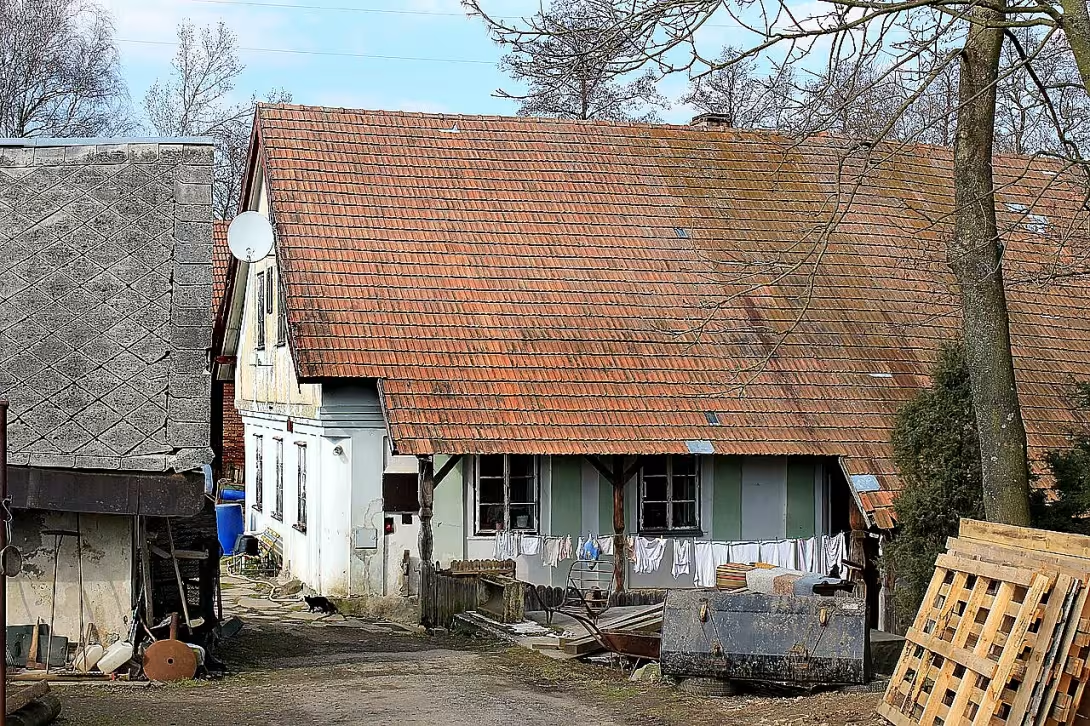
Králova pila a mlýn in Milesimov near Výrad in the Chrudim district is a ground-floor grafted water mill with an added saw. It stands on the river Chrudimka and is protected as a real cultural monument of the Czech Republic.
The first historical mention of the mill dates back to 1651, when it was owned by the miller Jan Kumpán. In 1745 the mill was rebuilt, which confirms the dating on the cabin above the shield with initials WK referring to Vít Kumpan. In 1924, a system of artistic composition was introduced and a new grinding stool was built, while the original equipment began to serve as a scrapper.
The building combines the grafted construction of the mill with the walled residential part. The mill has a spindle on the front side with painted wings and a saddle roof, covered with burnt bags since 1945. The brick facade of the residential part is divided by pilasters and the facade is decorated with a niche for plastic. The windows in the facade are arranged in three axes and at the threshold into two, have a six-table breakdown. The whole complex is complemented by economic buildings: barn, barn and ground cellar.
The water to the water wheels led from the lake through the reservoir tank of the drive, and after passing through the wheels it went back into the river bed. According to data from 1930, the mill had two wheels for the bottom water with a diameter of 408 centimeters, with a flow rate of 0,4 m ³ / s and a drop of 1,65 meters. A simple saw, so-called one, is attached to the mill. It had an archaic structure with a wooden shift, a cart and a flywheel. The wooden pinion and shaft were replaced by metal elements at the beginning of the 20th century.
The typical feature of the building is the location of the saw, which was built directly against the wall of the mill. Similar buildings usually distance or are built on the other side so that vibrations do not damage the main building. It was this location between 1796 and 1944 that caused the flood wall to drop by 50 centimetres even with grafting.
In the vicinity of the monument leads the educational trail of the County of Chrudimka, which guides visitors towards the nearby Happy Hill.
Králova pila a mlýn is a valuable technical and architectural unit that documents the history of water management in the region. Visiting this place offers insight into the operation of old mills and saws.
Historical milestones
- 1651
- The first historical mention of the mill for the miller Jan Kumpán
- 1745
- Rebuilding the mill
- 1924
- Introduction of artistic composition and new grinding stool
- 1945
- Covering the roof with burnt bags
Architectural development
The mill combines the grafted mill with the walled residential part divided by pilasters. After the reconstruction in 1945, the saddle roof was covered with burnt bags. The saw originally had an archaic wooden structure, which was later replaced by metal parts.
Historical events
The first mention of the mill in 1651, the reconstruction of the mill in 1745, the introduction of the artistic composition in 1924 and the end of the operation of the saw in 1944.
Owners
Jan Kumpán (1651), Vít Kumpan (1745)
Points of interest
- The first mention of the mill dates back to 1651, when it was owned by the miller Jan Kumpán. - In 1745 the mill was rebuilt and a shield appeared on the stall with initials WK referring to Vít Kumpan. - From 1796 to 1944 the saw was placed directly against the wall of the mill, which caused the flood wall to drop by 50 centimetres. - According to data from 1930, the mill had two wheels for the bottom water of 408 cm diameter, flow 0,4 m ³ / s and drop 1.65 m. - A simple saw is attached to the mill, so called one-piece, whose wooden parts were replaced by metal at the beginning of the 20th century.
Guide
Show guide text
This text was created by artificial intelligence and has not been editorially reviewed. It may contain inaccuracies.
Welcome to the King's saw and mill. You are standing in a quiet landscape by the river Chrudimka, near the Výrad, where time has stopped. In front of you is a fascinating whole that is not just a set of old buildings, but a living witness to the centuries that have been going on here. Feel this atmosphere. Listen to the murmur of water that has been driving the wheels of this place for centuries, and feel the smell of wood and history that is there at every turn. This complex, which you are now seeing, is protected as a real-estate cultural monument of the Czech Republic, which gives it special seriousness and importance. It's a place that deserves your full attention and a moment of silence while you're looking.
Now let's go back to the past together to understand how this whole thing came about. To understand the meaning of this place, we have to look to the mid-seventeenth century. The first historical references to this mill appear in our documents in the year one thousand six hundred fifty-one. At that time, the miller Jan Kumpán worked here. Imagine life then, the rhythm of work determined by the relentless flow of water and the constant movement in this complex. The mill has been standing here for over three centuries and its existence has been absolutely crucial to the surrounding village. It wasn't just a grain milling machine, it was the heart of the local economy and the place where people from all around met. This bottom water mill was built to use the energy of the river Chrudimka to perform the heavy work that was necessary for the survival of the people.
Now pay attention to the architecture itself, which is right before your eyes. Look at how different construction techniques and materials mix here. The main characteristic element here is the grafted construction that gives the buildings their traditional, rural appearance. However, these wooden walls are in interesting contrast supplemented by a more decorative wall section. This combination of wood and stone or bricks creates a unique visual rhythm. There is a mill in front of you, with a simple saw attached to it. This whole set of buildings is very comprehensive. In addition to the mill and saw, you will also see related economic buildings such as a barn or a barn. These structures form one harmonious unit, which has been gradually expanded and modified according to time requirements. Notice the roof as well. Although it may seem that it always looks like this, in the year one thousand nine hundred forty-five there was an important change when the roof was covered with burnt bags, which gave the building its present, stable appearance. If you look at the details, you can also see traces of modernization from the year one thousand nine hundred twenty-four, when a new grinding stool was put into service and some artistic modifications were made to the entire composition of the building.
When you look around, you realize that every wooden beam and every stone in these walls has a name. The history of this place is closely linked to the Kumpan family. In addition to the above-mentioned founder, Jan Kumpán, another important figure appears in the history of the mill, Vít Kumpan. It is thanks to him that we can find a very specific and beautiful detail in architecture. Now if you look carefully at the wood elements, you might encounter one of the rarest elements in this place. There is a shield with the initials W. K on one of the beams from the stall. These two letters are a reference to Vít Kumpan and are a silent but very tangible signature of a man who, in the middle of the eighteenth century, in precisely the year seven hundred and forty-five, oversaw the significant reconstruction of the mill. It's like a miller from the past looks right in your eyes and reminds you of his presence.
Now, I want to invite you to think about one less well-known but very interesting issue concerning the stability of the building itself. This thing is connected to the operation of the saw. Between a thousand seven hundred ninety-six and a thousand nine hundred forty four saw was placed directly against the wall of the mill. However, this practical choice, which was likely to facilitate work for miners and pillars, had its unexpected and long-term consequences. The pressure and the way the saw acted on the surrounding area caused the water wall to gradually decrease. This process lasted almost 150 years. It is a fascinating example of how any technical change, even the seemingly small or practical one, can have a profound impact on the very nature and stability of the historical building. It is a reminder that man, in constant struggle with natural forces and with the need for work, constantly changes the face of his surroundings.
Thank you for spending this moment with us and listening to the story of the King's saw and mill. We hope that this information has helped you better understand what you see and perceive right now. Now you have enough information to observe every detail, every crack in the wood and every rock in the wall with a new, deeper look. Continue to discover this beautiful landscape, feel the calm offered here by the river Chrudimka, and enjoy every moment you spend near this monument. Goodbye.
Tips for visitors
The best time to visit is spring and autumn months. Nature around the river Chrudimka is at this time the most attractive and milder temperatures are ideal for walking around the monument.
You can reach the mill near Výrad by car and public transport.
For the journey, wear comfortable shoes suitable for the terrain, because the monument is located in a natural environment that encourages you to walk outside the paved roads.
For the best photos look for soft light shortly after sunrise or before sunset. The most significant motive is the grafted walls of the mill and saw in combination with the flowing water of the river Chrudimka.
In the area there is the Educational trail of the County of Chrudimky and the Merry Kopec, which makes the visit a great day trip for families with children who can explore old technology and local nature.
Frequently asked questions
Can the monument be visited?
This is a technical monument. Some are open as exhibitions, others are out of use or on private land. We have not verified whether this one is accessible.
What are the opening hours and admission?
We have not verified the opening hours or admission. Current information is published by the operator.
Where is the monument?
Location: Pardubický kraj. The map on this page shows the exact spot.
Why is the monument protected?
It is listed in the Central List of Cultural Monuments of the Czech Republic as a cultural monument (register no. 1000135306).
Businesses nearby
Do you run a restaurant, accommodation, shop, museum, rental, wellness or other visitor service near this monument? Show yourself directly to the people heading to it — this is how they will see you in the app and on the web:
Nearby
The educational trail through the Chrudimky Region and the nearby Merry Hill.
Accommodation nearby
Themed route
1. Educational trail by the Land of Chrudimky (natural path) - Explore the beauty of the local landscape and discover natural attractions. 2. Králova pila a mlýn (historical area) - Admire unique architecture and feel the atmosphere of this historic place. 3. Happy Hill (experience area) - Finish your trip in this favorite place full of fun and activities.
Seasonal recommendations
In the spring, fresh energy of awakening nature permeates through the mill and mill. The trees are beginning to bloom around the historic walls, and the surrounding meadows get a fresh green color. The light is fine and does not shine during this period, which is ideal for shooting details of wooden structures. For visitors we recommend choosing layered clothes because the morning cold can quickly turn into warmer air during the day. It's a great time for a quiet walk, because the crowds aren't as strong as they were in the next few months.
Summer months bring intense sunlight and full vegetation to the place, which provides a pleasant shade at the mill raid. The atmosphere is alive and full of life, making the monument a popular destination for trips. Due to the increased number of visitors in the main summer season, it is best to arrive as early as possible in the morning to enjoy the peace. Don't forget light summer clothes, headgear and enough fluids to keep the heat from bothering you too much.
The autumn visit offers a melancholy and poetic atmosphere, where morning fog floats around the mill and surrounding forests are colored in golden and brown shades. The lighting is low in this period and creates long, interesting shadows on historical facades. It is advisable to carry waterproof shoes because the humidity in the area may be higher. Walking in the afternoon, when the sun is falling slowly, is the most beautiful, with visitors already significantly less.
In winter, the king's saw and mill operate in silence and quiet, especially when the landscape is covered with snow. The freezing air and the crunchy sound below your feet create a unique, up to fairy tale atmosphere, which is accompanied by shorter days. It is necessary to take very warm clothes and quality shoes so that the cold does not affect you. Due to the faster shear, we recommend planning a visit around noon hours, so that you have enough light left to search the entire area.
Visualizations and artistic views


The visualisations are generated by artificial intelligence and serve as inspiration.
Photos from the area
Real photos taken near the monument


Zdroj a licence jsou uvedeny u každého snímku.
Tips from visitors
No tips yet. Be the first!
Log in and add your tip.
Sources and literature
Photos: This file is available under Creative Commons BY-SA license. Basically: You can use this picture for any purpose, provid / CC BY-SA 3.0 — Wikimedia Commons. The author and licence also appear when you hover over the image.
Faktickým podkladem tohoto textu byl článek na Wikipedii, jehož autory jsou přispěvatelé Wikipedie. Článek je dostupný pod licencí CC BY-SA 4.0.
Location on the map
More monuments – Pardubický kraj
Show all in the region

Příběhy a pověsti
Legendy, pověsti a příběhy spjaté s touto památkou
Fotografie návštěvníků
Zatím žádné fotografie. Buďte první, kdo přidá fotografii z návštěvy!
Log in a přidejte svou fotografii nebo hodnoťte.
Za ověřenou návštěvu v aplikaci získáte víc bodů — poznáme podle GPS, že jste na místě.
Reviews and comments