






Krucifix v Dašicích Wayside cross
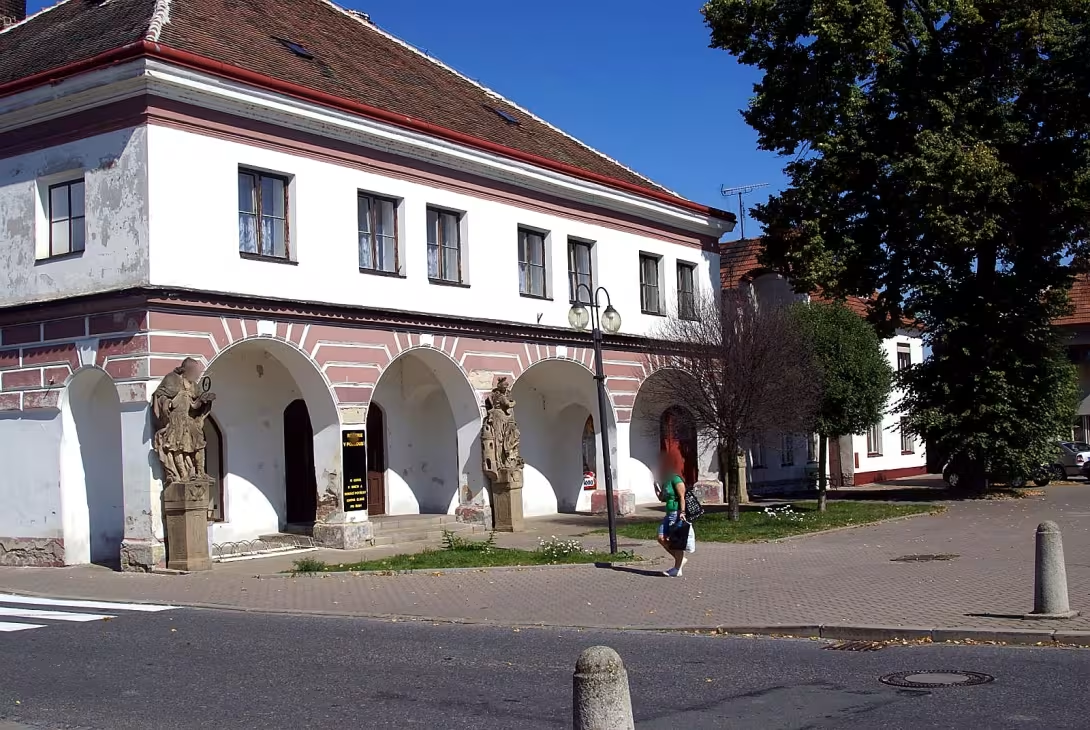
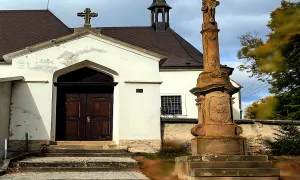
The Baroque-style crucifix in Dašice, Pardubice district, is an anonymous folk sculpture located in the town square. This monument stands out due to its unique blend of artistic and historical significance, making it a must-visit destination for anyone interested in Czech culture.
Origin and Historical Context The crucifix was created in 1782, during Dašice's time as part of the Habsburg Empire. The Enlightenment was gaining momentum in Europe, but little is recorded about its earliest history.
Architecture and Artistic Form The crucifix features a two-step base with a relief of St. Florian on the front and dates of creation (1782) and restoration (1882) on the back. It has a Baroque-style design with a crucified Christ standing on a low pedestal adorned with plant motifs.
Key Events and Curiosities The crucifix was restored in 1882, and its dates of creation and restoration are inscribed on the base. This well-preserved example of Baroque folk sculpture features a relief of St. Florian on the front.
Today The crucifix remains an important cultural landmark in Dašice, standing tall in the town square. Visitors can still admire its intricate design and historical significance, making it a worthwhile stop for anyone interested in Czech history and culture.
In conclusion, the Baroque-style crucifix in Dašice is a unique and fascinating monument that offers a glimpse into the country's rich cultural heritage. Its well-preserved design and historical significance make it a must-visit destination for anyone interested in exploring the region's history and culture.
Historical milestones
- 1782
- Crucifix created in Dašice
- 1882
- Crucifix restored
Architectural development
The crucifix has a two-step base with a relief of St. Florian and dates of creation (1782) and restoration (1882).
Historical events
Creation in 1782
Restoration in 1882
Points of interest
– This anonymous Baroque-style folk sculpture is located in the town square of Dašice, Pardubice district. – It was created in 1782 during the time when Dašice was part of the Habsburg Empire. – The crucifix features a two-step base with a relief of St. Florian on the front. – The dates of its creation in 1782 and restoration in 1882 are inscribed on the back of the base. – The design includes a crucified Christ standing on a low pedestal adorned with plant motifs.
Guide
Show guide text
This text was created by artificial intelligence and has not been editorially reviewed. It may contain inaccuracies.
Welcome to the historic heart of Dašice. You are standing in the town square, and directly before you rises a modest yet striking Baroque‑style crucifix. Its presence is quiet but confident, set upon a two‑step stone base that invites the eye upward. On the front of that base you can see a shallow relief of Saint Florian, the patron saint of firefighters, rendered in a simple folk style. Turn your head slightly to the rear and you will notice two dates carved into the stone—1782 and 1882—marking the year of its creation and the year it was lovingly restored. This is the crucifix in Dašice, a piece of local heritage that has watched the town’s life unfold for more than two centuries.
Let us step back in time to the year 1782, when this crucifix first took shape. At that moment Dašice was part of the vast Habsburg Empire, a realm that stretched across much of Central Europe. The town, like many others in the region, sought to express its faith and communal identity through public religious art. While the hands that carved the wood remain unknown, the work reflects the skill of anonymous folk artists who blended the dramatic flair of the Baroque with the practical sensibilities of local craftsmen. The decision to place a crucifix in the square was both devotional and civic: it provided a focal point for processions, a place for personal prayer, and a visual reminder of the Christian narrative that underpinned daily life. A century later, in 1882, the community once again gathered to restore the monument, ensuring that its weathered surfaces would continue to convey their message to future generations.
Now, turn your attention to the architecture of the crucifix itself. Though modest in scale, the piece embodies key characteristics of Baroque folk sculpture. The two‑step base creates a subtle elevation, giving the cross a sense of prominence without overwhelming the surrounding square. The relief of Saint Florian on the front is carved in low relief, allowing the figure to emerge gently from the stone. Notice the simplicity of the lines and the unadorned surface—features typical of folk artisans who worked with limited resources but great devotion. The cross that crowns the base is proportioned to harmonize with the base’s steps, creating a balanced silhouette that can be appreciated from all angles. On the back, the dates 1782 and 1882 are inscribed in a straightforward script, a factual record rather than an ornamental flourish. As you observe these details, consider how the craftsmanship speaks to a community that valued both reverence and durability.
Although the names of the sculptor and any patrons have been lost to history, the crucifix is linked to a figure whose presence is felt throughout the monument: Saint Florian. In Central European tradition, Saint Florian is invoked for protection against fire and floods, and his image on the crucifix’s base suggests that the townspeople of Dašice placed particular trust in his intercession. While we do not have specific stories of miracles or events tied directly to this particular statue, the inclusion of his relief indicates a collective hope for safety and divine guardianship. The crucifix, therefore, serves not only as a representation of Christ’s sacrifice but also as a local emblem of protection, embodying the intertwined spiritual and practical concerns of the town’s ancestors.
Here is a small mystery that adds a layer of intrigue to the monument. The dates on the back—1782 and 1882—are exactly one hundred years apart, a symmetry that invites speculation. Was the restoration deliberately timed to commemorate a centennial, or did the community simply happen upon the same year for practical reasons? The records do not clarify, leaving us with a subtle puzzle that encourages imagination. Moreover, the anonymity of the artist means that the crucifix stands as a collective creation, a work of many hands and many hearts rather than a single celebrated master. This anonymity itself is a story: it reflects a tradition where the act of making sacred art was a communal duty, and the focus remained on the spiritual purpose rather than personal fame.
As you finish your moment with this humble yet resonant piece, take a breath and let the atmosphere of the square settle around you. The crucifix has witnessed markets, festivals, and the quiet passage of everyday life in Dašice. It remains a silent witness to the town’s evolution, from its days within the Habsburg Empire to the modern Czech Republic. Feel free to walk around the base, to trace the relief of Saint Florian with your eyes, and to imagine the hands that chiseled each line a century and a half ago. If your curiosity is sparked, the surrounding streets of Dašice offer further glimpses into the region’s Baroque heritage, with other modest monuments and historic façades waiting to be explored.
Thank you for joining this auditory journey through a piece of Dašice’s living history. May the quiet strength of the crucifix inspire you to seek out the stories hidden in the corners of other towns, and may your steps continue to uncover the layers of culture and faith that shape our shared past. Enjoy the rest of your visit, and let the spirit of this place accompany you as you wander onward.
Tips for visitors
To fully appreciate the craftsmanship of the Baroque-style crucifix, visiting during daylight hours is highly recommended. The natural light helps highlight the intricate details of the two-step base and the relief of St. Florian. Early morning or late afternoon light often provides the best conditions for observing the texture and historical character of the folk sculpture.
The monument is situated in the town square of Dašice, making it easily accessible. You can reach the area by car or via public transport; for specific schedules and routes, it is best to consult a local transit search engine or municipal information services.
When visiting, there is no need for special equipment, though a camera is useful for capturing the historical relief. For photography, try to position yourself to avoid harsh shadows or direct glare on the stone, allowing the relief work and the dates of creation to stand out clearly.
Since the crucifix is located in a public square, it is a convenient and quick stop for families with children who are exploring the town. As there are no specific nearby attractions listed in the immediate vicinity, it is best enjoyed as a brief, meaningful cultural pause during a walk through Dašice.
Businesses nearby
Do you run a restaurant, accommodation, shop, museum, rental, wellness or other visitor service near this monument? Show yourself directly to the people heading to it — this is how they will see you in the app and on the web:
Events nearby
Zdroj akcí: otevřená data měst a obcí ČR (Národní katalog otevřených dat) a kalendář akcí Národního památkového ústavu.
Accommodation nearby
Themed route
Since the "Okolí" (Surroundings) section in your prompt is empty, I must strictly adhere to the rule prohibiting the invention of external locations. Therefore, this itinerary focuses exclusively on the immediate area of the main destination: the Krucifix in Dašice.
1. The Krucifix in Dašice *Type:* Landscape Monument / Religious Sculpture *Why visit:* This cross standing in the open landscape serves as a profound focal point for the local community, offering a moment of quiet reflection amidst the rural scenery. Its presence highlights the deep spiritual heritage embedded in the everyday life of the village.
2. The Immediate Surroundings of the Cross *Type:* Open Landscape / Walking Path *Why visit:* The area directly surrounding the monument provides an unobstructed view of the local terrain, allowing visitors to appreciate the natural beauty and tranquility of the Dašice countryside. This open space is ideal for a peaceful pause, letting the silence of the landscape complement the solemnity of the sculpture.
3. The Base and Foundation of the Monument *Type:* Architectural Detail / Historical Site *Why visit:* Examining the base of the cross offers insight into its construction and the materials used, reflecting the craftsmanship of the era in which it was erected. This close-up perspective reveals the durability and artistic intent behind the structure that has stood as a landmark for generations.
4. The Viewpoint from the Cross *Type:* Scenic Observation Point *Why visit:* Standing at the location of the monument allows for a panoramic appreciation of the immediate horizon, connecting the spiritual symbol with the physical environment of the village. This vantage point emphasizes the integration of human faith with the natural world, a core theme of such landscape crosses.
5. The Quiet Atmosphere of the Site *Type:* Experiential / Meditative Space *Why visit:* The lack of commercial distractions in this immediate vicinity creates a unique atmosphere conducive to personal contemplation. Visitors can experience a sense of timelessness, where the simple act of standing before the cross becomes a meaningful connection to the local history and identity of Dašice.
This route ensures a focused and respectful exploration of the Krucifix in Dašice and its direct environment, strictly avoiding any fabricated or external points of interest as per the provided constraints.
Seasonal recommendations
In spring, the Krucifix v Dašicích is surrounded by awakening nature and fresh greenery, creating a hopeful and serene atmosphere. The soft, morning light is ideal for appreciating the monument's excellent condition against a backdrop of blooming wildflowers. Visitors should wear waterproof footwear, as the surrounding landscape can be damp, and early morning visits are recommended to enjoy the peace before the day warms up.
During the summer, the landscape around the Krucifix v Dašicích is lush and vibrant, with the bright sun highlighting the details of the cross. The atmosphere is lively and warm, making it a pleasant spot for a reflective walk. To avoid the midday heat and the peak of the summer tourist season, it is best to arrive early in the morning. Light, breathable clothing and sun protection are essential for a comfortable visit.
Autumn transforms the area around the Krucifix v Dašicích into a palette of gold and ochre, often accompanied by a mystical morning mist. The cooling air and falling leaves add a contemplative mood to the site. It is advisable to dress in layers to adapt to the fluctuating temperatures. The late afternoon provides the most dramatic lighting for photography, capturing the monument in the warm glow of the setting sun.
In winter, the Krucifix v Dašicích stands in stark, silent contrast against the white snow, offering a peaceful and solemn experience. The crisp air and clear skies often make the monument stand out sharply in the landscape. Because daylight hours are limited, plan your visit for the middle of the day. Heavy, warm clothing and sturdy, non-slip boots are necessary to navigate the winter terrain safely.
Visualizations and artistic views

The visualisations are generated by artificial intelligence and serve as inspiration.
Photos from the area
Real photos taken near the monument


Zdroj a licence jsou uvedeny u každého snímku.
Tips from visitors
No tips yet. Be the first!
Log in and add your tip.
Sources and literature
Fotografie: JanHubik / CC BY-SA 3.0 — Wikimedia Commons. The author and licence also appear when you hover over the image.
Faktickým podkladem tohoto textu byl článek na Wikipedii, jehož autory jsou přispěvatelé Wikipedie. Článek je dostupný pod licencí CC BY-SA 4.0.
Location on the map


Příběhy a pověsti
Legendy, pověsti a příběhy spjaté s touto památkou

Fotografie návštěvníků
Zatím žádné fotografie. Buďte první, kdo přidá fotografii z návštěvy!
Přihlaste se a přidejte svou fotografii nebo hodnoťte.
Za ověřenou návštěvu v aplikaci získáte víc bodů — poznáme podle GPS, že jste na místě.
Reviews and comments