



Obecní úřad Municipal house
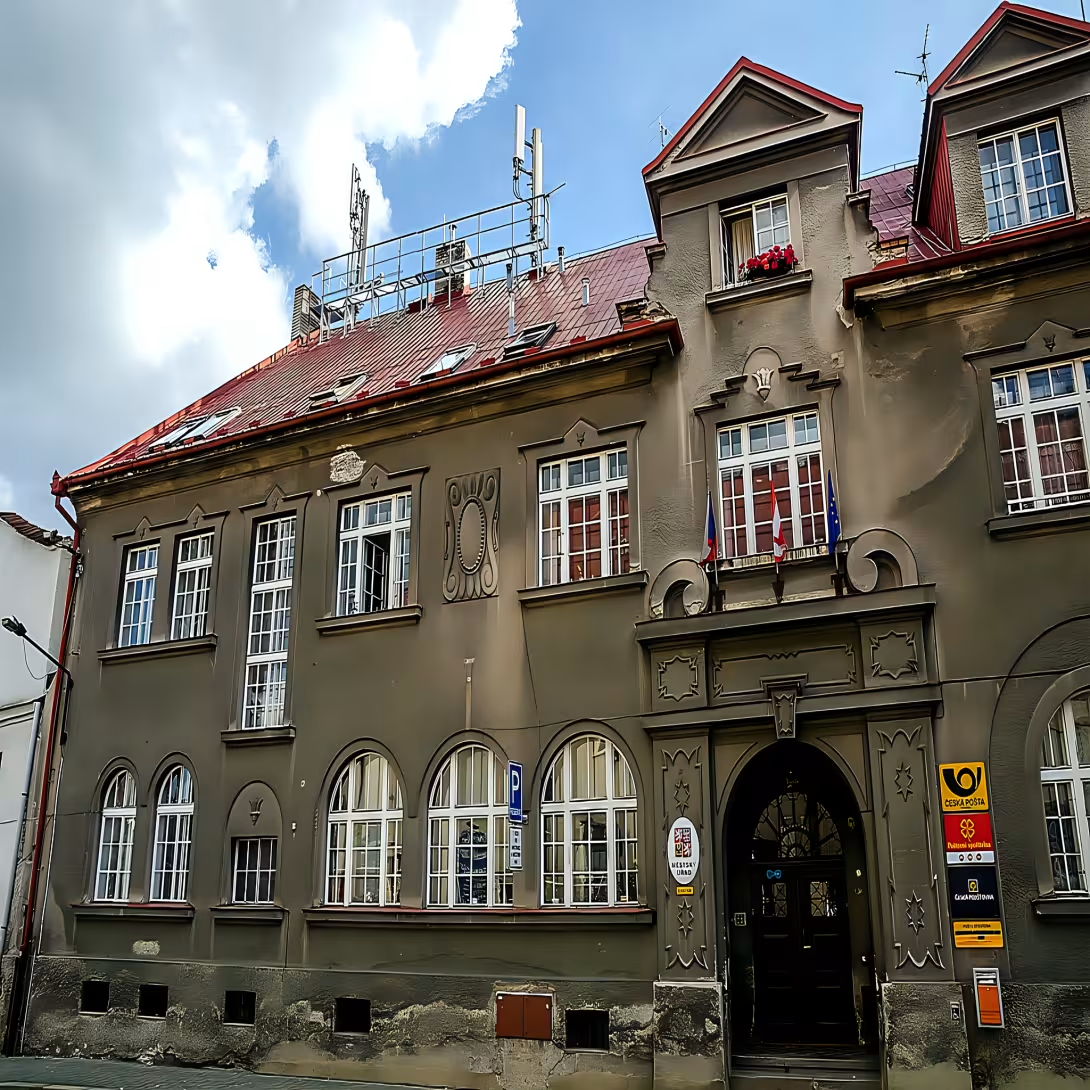
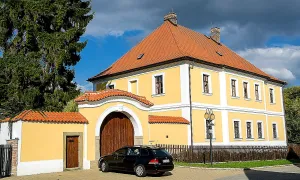
Town Hall in Dashic in Pardubice district is a monumental brick building from 1925. Dominates the east side of the square T. G. Masaryka. The object is protected as a cultural monument under the register number SAR 36615 / 6-5203. It represents a high-quality representative of architectural modernity and decorativism.
The present town hall was founded in 1925 as a work of Prague architect Milan Babušek. It is built from bricks in an elongated storey available. They are interested in the urban position on the corner of the square. The side shield facade facing the square contains a rectangular bay. It is fastily erected in the top above the roof, reminiscent of traditional clock towers.
The history of administration buildings in Dashic is marked by repeated fires. The oldest famous town hall was wooden with an arch and stood in the place of today's house No. 41. In 1571, her half was sold on the condition of maintaining the clock tower. Subsequently, a new town hall was established at the site of today's house No. 40. However, it burned down during the Thirty Years' War on February 4, 1679, with a book from 1562.
Another town hall was built in 1682 in the middle of the square against the statue of St. Florian. This one-storey building had a stone base, wooden hall and upper part. The building burned down on December 4, 1830, along with four neighboring houses. The clock from this town hall was moved to the church tower after repair.
In 1852 the house No. 17 was purchased for 4,500 gold pieces. In 1855 he was rebuilt into an old town hall and again equipped with clock from the church. In 1891 a hall with theatre stage and adjacent rooms was added to this building.
The bronze memorial plaque is an important detail of the present town hall. It reminds President T. G. Masaryk's visits to Dashic, which took place in 1922 and 1926.
The City Hall building is an important element of the city's picture thanks to its architecture and historical continuity. Its visit offers insight into the development of modern civil architecture of the first republic.
Historical milestones
- 1571
- Sale of half the oldest wooden town hall with the condition of maintaining the turret
- 1679
- Second Town Hall fire during the Thirty Years' War
- 1682
- Building a new town hall in the middle of the square
- 1830
- City Hall and Neighborhood House Fire
- 1855
- Rebuilding house number 17 at City Hall
- 1925
- Building a contemporary monumental brick town hall
Architectural development
The building is built from bricks in an elongated storey available. The facade towards the square contains a rectangular bay ending at the top. The overall style corresponds to decorative and architectural modern.
Historical events
In 1922 and 1926, President T. G. Masaryk visited the city.
Points of interest
- The current brick building from 1925 resembles traditional clock towers thanks to the bay above the roof. - The history of administrative buildings in the village is marked by repeated fires. - One of the former city councils burned down in 1679, with a book from 1562. - In 1891 an hall with theatre stage was added to the town hall. - Bronze memorial record reminds of President T. G. Masaryk's visits in 1922 and 1926.
Guide
Show guide text
This text was created by artificial intelligence and has not been editorially reviewed. It may contain inaccuracies.
Welcome to Dashice. Right now, you're standing in front of a building that, both its size and its size, dominates the whole neighborhood. In front of you is the municipal office, a local town hall that immediately attracts the attention of anyone who enters the square named after Thomas Garriguel Masaryk. Notice how this storey structure of red bricks filled the space on the east corner of the square and how strictly, yet elegantly, defines the space around it. It is a building that emits stability and dignity, while telling a story about the ambition and development of this village during the first half of the last century.
Let us now stop at how this building was built and in what context it was built. The current town hall dates to a thousand and nine hundred twenty-five. By that time, modern architecture was already in full swing and was looking for new ways to express the importance of public buildings. The author of this project was architect Milan Babuška. His aim was to create a space that was not just an administrative centre, but a real symbol of the village. The building thus represents a high-quality representative of modern and so-called decorative, a style that combined clean lines with fine decorative elements. Thanks to its value, the town hall is today protected as a cultural monument, which means that the state recognises its uniqueness and importance for the whole area.
Now please pay attention to the architecture itself and the details that you can see right in front of you. Take a look at the facade made of bricks that gives the building its characteristic colour tone and feeling of strength. Notice how the building is located in the square space. Her position on the corner is not random, she should have been visible from several directions at the same time. Now, please, look up towards the top of the building. Notice there a very interesting element, which is the bay placed above the roof. This exiting element dominates the whole building and gives it a vertical dimension. This detail is so distinctive that the building resembles traditional clock towers, although the tower itself is not a separate building. It is a clever architectural element that combines modern style with the tradition of administrative buildings.
When you look at the present town hall like this, you might wonder if this is what the city centre always looked like. However, the history of administration buildings in Dashic is much more dramatic and constantly linked to the fight against fire. If we look deeper into the past, we'll find that the path to this brick building was thorny. The first mention introduced us until the year one thousand five hundred seventy one, when half the oldest wooden town hall was sold. At that time, a very interesting condition was attached to the sale, namely the obligation to maintain the turret, which was probably a symbol of the power and autonomy of the municipality.
Unfortunately, wooden structures were prone to fires, which happened repeatedly in Dashic. In the year six hundred seventy-nine, when the region was flooded with a 30-year war, the second town hall burned down. But not only the walls and the roof, but also the rare documents, namely the book of a thousand five hundred sixty-two, which was a huge loss of historical records for the municipality. But the community did not take the determination to build on. Three years later, in the year six hundred and eighty two, a new town hall was built, this time located right in the middle of the square to be in the very heart of the happening.
But history repeated itself. In the year one thousand eight hundred thirty came another devastating fire that consumed not only the town hall but also the neighboring houses. Imagine the chaos and sadness the people had to experience when they saw their administrative center disappear into the ashes again. There was a period of provisions and adjustments. In a thousand and eight hundred and fifty-five, a remodeled house with the number seventeen was used behind the town hall. However, these solutions were temporary, and with the advent of the new century and the new state that helped to build Tomas Garrigue Masaryk, something was needed to match the new era. That's how we got to the year one thousand nine hundred twenty-five, when the building you're standing in front of was built.
It's fascinating to realize that this monumental brick structure is actually a victory over the unfortunate events of the past. While the previous town hall was consumed by fire, this building from the year one thousand nine hundred twenty-five stands firm and reminds us of how the needs and aesthetic preferences of the population changed. It's where history meets modern.
The interesting thing that may interest you is the contrast between the fragility of wooden structures from the sixteenth and seventeenth centuries and the mass of this brick structure. If you look at her walls, think of them as a symbol of stability. While previously the town hall was in the centre of the square or in the rebuilt house, the present building has its position on the corner symbolically embracing the entire area of Masaryka Square. It's an architecture that doesn't have to be a hiding place for the books, but it becomes a business card for the whole village.
Now I just recommend that you take a quiet look at the entire facade of the building and try to imagine how the fate of the village has been decided in these areas over the last ten decades. Feel the atmosphere of this place, which combines the administrative order and deep history.
Thank you for spending a moment with us at this beautiful monument. We now invite you to explore Dashic again. Go through the rest of the square, see the surrounding architecture and look for clues of the past in every detail. We wish you a pleasant continuation of your journey and a pleasant day.
Tips for visitors
The best time to visit is late afternoon when the sun hits the brick surface of the building and highlights its monumental appearance from 1925. The building stands in a dominant position on the corner, allowing it to capture its total size from several angles.
You can reach the place by car or public transport; Check the specific connection and stop options in the current search engines. We recommend shoes suitable for walking around the square.
For the best photos, focus your lens on details of brick wall and architectural elements of the facade. The ideal light for building images is during the golden hour before sunset.
In the immediate vicinity is a statue of St. Florian, which is suitable to visit right after the tour from outside the town hall. Both dominoes form together a characteristic picture of the square T. G. Masaryka.
Families with children can use the square space to safely move and search together for details on the facade of the building, which can be a fun game of observation.
Frequently asked questions
Can the monument be visited?
This is a residential or farm building, not a museum with opening hours. Please view it from public space and respect the owners' privacy. We have no information about access to the interior.
Where is the monument?
Location: Dašice. The map on this page shows the exact spot.
Why is the monument protected?
It is listed in the Central List of Cultural Monuments of the Czech Republic as a cultural monument (register no. 1000001342).
Businesses nearby
Do you run a restaurant, accommodation, shop, museum, rental, wellness or other visitor service near this monument? Show yourself directly to the people heading to it — this is how they will see you in the app and on the web:
Events nearby

Zdroj akcí: otevřená data měst a obcí ČR (Národní katalog otevřených dat) a kalendář akcí Národního památkového ústavu.
Nearby
Budova se nachází na náměstí T. G. Masaryka, kde se nachází rovněž socha svatého Floriána.
Accommodation nearby
Themed route
Here is a proposal for a short thematic walk:
1. Statue of Saint Florian (statue) - This character protects the village from fire and decorate the square. 2. Obecní úřad (administration building) - The main destination of the road where the local government resides.
Both stops are located close to T. G. Masaryka Square.
Seasonal recommendations
In spring nature wakes up around the building and the young green accompanies fresh air. The city hall building is best observed in the morning when the sun gently illuminates the facade. We recommend a light spring jacket and shoes suitable for walking around the village.
In the summer months the area is dominated by rich green color and bright, bright light. For the best experience from looking at the exterior, choose the time early in the morning or late in the evening to avoid heat. Don't forget the cap and comfortable sandals.
Autumn brings gold shades and a specific fog to the landscape that gives the building a mysterious look. An ideal visit in the afternoon is when the light is softer. Layer clothes and waterproof shoes are suitable for wet surfaces.
Zimą operates a building in quiet and quiet, often accompanied by a freezing white layer on roofs. The most atmosphere is in advent time, when evening lighting highlights the outlines of the house. Hot gloves, hats and a fat sweater are essential.
Visualizations and artistic views

The visualisations are generated by artificial intelligence and serve as inspiration.
Photos from the area
Real photos taken near the monument


Zdroj a licence jsou uvedeny u každého snímku.
Tips from visitors
No tips yet. Be the first!
Log in and add your tip.
Sources and literature
Photos: JanHubik / CC BY-SA 3.0, rozlišení zvýšeno umělou inteligencí — Wikimedia Commons. The author and licence also appear when you hover over the image.
Faktickým podkladem tohoto textu byl článek na Wikipedii, jehož autory jsou přispěvatelé Wikipedie. Článek je dostupný pod licencí CC BY-SA 4.0.
Location on the map
More monuments – Dašice
Show all in the municipality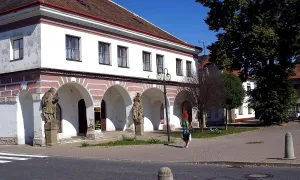
Příběhy a pověsti
Legendy, pověsti a příběhy spjaté s touto památkou
Fotografie návštěvníků
Zatím žádné fotografie. Buďte první, kdo přidá fotografii z návštěvy!
Log in a přidejte svou fotografii nebo hodnoťte.
Za ověřenou návštěvu v aplikaci získáte víc bodů — poznáme podle GPS, že jste na místě.
Reviews and comments